
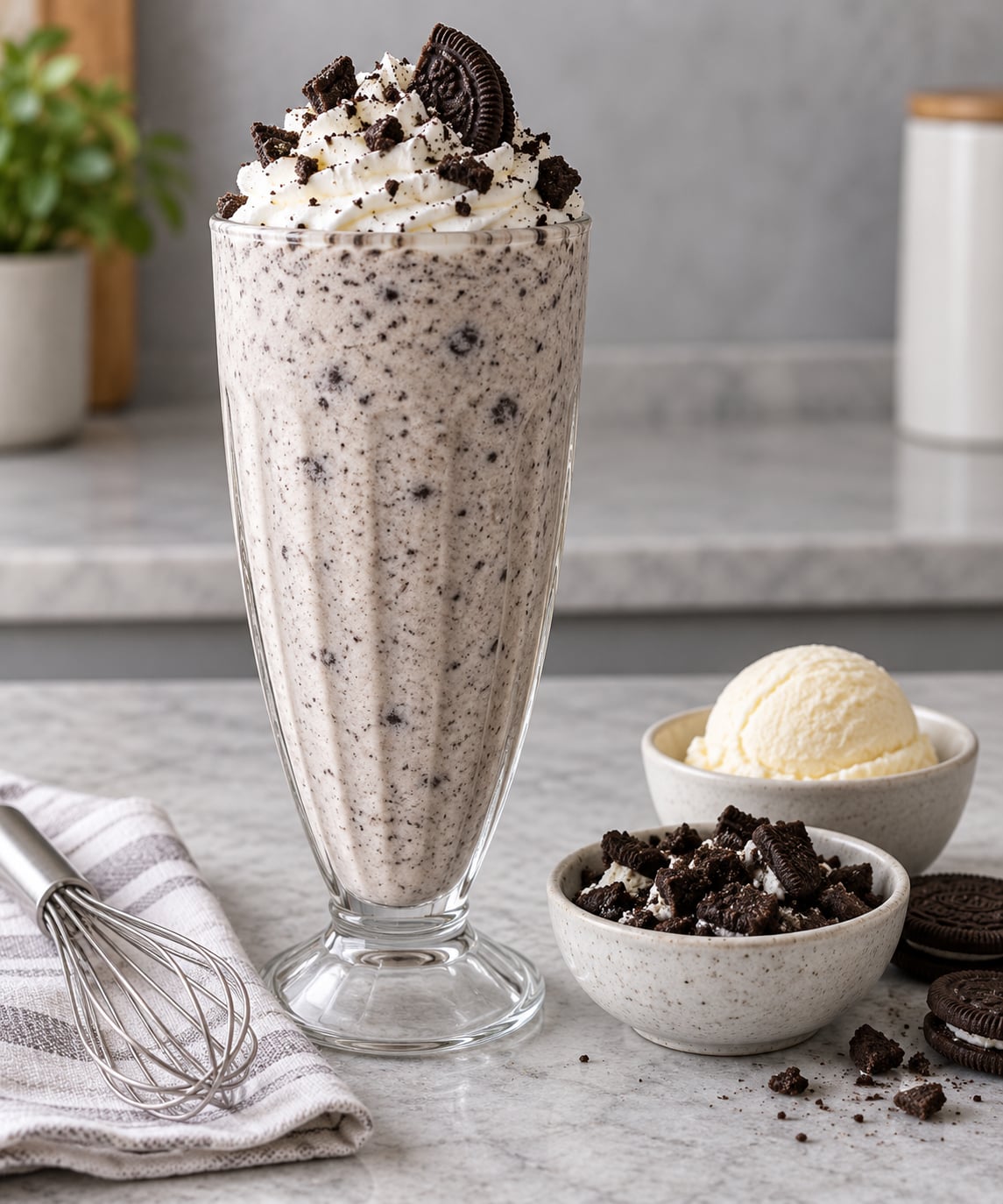
A cookies and cream milkshake is vanilla ice cream loosened with a splash of cold milk and mixed with crushed chocolate sandwich cookies until it is thick enough to drink from a spoon-straw. Three ingredients, one bowl, and about five minutes from freezer to glass. No blender, no cooking, nothing that needs washing up beyond a whisk and a spoon.
I make this the way a diner would: ice cream first, milk second, cookies last. Add the milk in stages rather than all at once, because that single habit is the difference between a shake that holds a ribbon on the spoon and one that turns into a flat sweet drink. Most people who get it wrong are too generous with the milk, not too stingy with the ice cream.
If you have never made one at home because you think you need equipment, that is the part people get wrong most often. A whisk, a rubber spatula and a tall glass will do the whole job. The recipe also scales up easily for a birthday party, and it works as a half-frozen dessert if you want something closer to a milkshake made without an ice cream maker, though that method needs planning ahead.
What You Need
This makes one generous 16-ounce serving. Everything else is optional.
- 2 cups vanilla ice cream, slightly softened. About 480 ml, or four rounded scoops. French vanilla or vanilla bean both work well and pull the flavour forward.
- 1/4 cup cold whole milk (60 ml) to start. Whole milk is creamier than 2% because of the extra fat, and cold milk keeps the ice cream from melting while you stir. Have up to half a cup more nearby in case you need it.
- 6 chocolate sandwich cookies such as Oreos or Double Stufs, plus 2 extra for the garnish. Any store-brand chocolate sandwich cookie behaves the same way.
- 1 tablespoon unsweetened cocoa powder. Optional but recommended. It supplies the cocoa depth that cookies lose when they are crushed fine, and it stops the shake tasting flat and one-note.
- 1/2 teaspoon vanilla extract, optional. It sharpens the vanilla in the ice cream.
- Whipped cream, chocolate syrup and extra cookie pieces, for the top.
The ice cream does the heavy lifting. Its fat and sugar give the shake body, the milk loosens it to a drinkable consistency, and the cookies add chocolate flavour, colour and chew. Removing the cream centres from half the cookies before crushing sharpens the cookie flavour, because you lose a little of the extra sugar that comes along with the filling.
Pull the ice cream out about five minutes before you start. Straight from a hard freezer it will fight whatever you are using to stir it and leave hard lumps that never break down, and that is the most common reason a homemade shake turns out disappointing.
Step-by-Step
Four steps, and the order matters. Crush first, mix the base second, dial the thickness third, serve straight away. This is where most recipes start to look complicated, and it is almost always because the cookies got into the drink before the base was ready.
1. Crush the Cookies
Put the 6 cookies in a sealed zip bag or between two sheets of parchment and roll over them with a rolling pin. Crush until there is no whole cookie left and nothing larger than a coarse gravel, roughly a quarter of the pieces smaller than a lentil.
You know it is fine enough when you can barely see the distinct half-moons of the sandwich. Coarser crumbs survive stirring as texture and some fall out of suspension, which is exactly what you want.
If you are using Double Stufs, split them and scrape off the cream, then crush the two halves separately. You end up with roughly one-third less cookie and a noticeably cleaner cocoa flavour. Set the two garnish cookies aside in a small bowl, break them into four or five pieces each, and do not crush those.
2. Mix the Chocolate-Cookie Base
Put the softened ice cream in a large bowl or a tall container with room for stirring. Pour in the 1/4 cup of cold milk, the cocoa powder and the vanilla extract. Stir with a whisk or spatula until the milk and cocoa are fully worked into the ice cream and the colour is even all the way to the bottom.
Spend a minute on this. The most common flaw in a homemade shake is dry pockets of cocoa sitting at the bottom of the glass, and they come from stirring the cocoa in too late. If you see white streaks of ice cream and darker streaks of chocolate, keep going.
Add about three quarters of the crushed cookies now, saving the rest for texture. Fold them in with the spatula, turning the mixture from the bottom up rather than stirring hard in circles. You want the crumbs distributed through the whole shake, not dumped in one spot.
3. How to Make a Cookies and Cream Milkshake Thick but Drinkable
This is the step where most recipes go wrong, because they give one fixed milk volume and ask you to live with it. Treat the milk as a dial instead. The shake is finished when a spoon dragged through the surface leaves a clean channel that closes slowly, and the mixture is not sliding off the spoon faster than gravity pulls.
Start at 1/4 cup of milk, which is what the recipe calls for. If the mixture is scoopable rather than drinkable, stir in cold milk one tablespoon at a time and check again. Adding ice cream is the faster move when you have overshot into thin territory.
If you want it thicker without diluting the flavour, use an ice cube or two. A cube melts slowly enough that you get another two or three minutes of body, and it does not wash out the cocoa the way extra milk eventually does. This is what I do when the shake needs to survive a short walk to the couch.
To loosen a shake that has gone stiff and clumpy, splash in cold milk a tablespoon at a time while whisking hard until the clumps disappear. Whisking air in at this stage gives you a lighter, fluffier body, and the same whisk fixes a shake that has seized into one solid scoop.
Stir in the remaining cookie crumbs last, right before serving, so they stay distinct. Anything mixed in early gets pulverised and turns the whole shake into uniform grey dust.
4. Serve the Milkshake
Chill the glass in the freezer for 10 minutes if you have time. A cold glass buys you several minutes before the shake loses its body, and it is the cheapest trick in this recipe.
Pour the shake in and watch the rim: if it holds a slow, thick wave rather than settling flat, the consistency is right. Drizzle a little chocolate syrup inside the glass and roll it to coat the sides if you want the diner look. Top with whipped cream and the reserved cookie pieces.
Drink it within about ten minutes of mixing. A milkshake is a frozen suspension, so it softens the whole time it sits, and after an hour in the fridge it will have separated into a watery layer over a denser one. Stir it back together and expect it to be thinner than the first pour.
Common Mistakes
Five things go wrong, and every one of them is fixable in under a minute.
Dry pockets of cocoa or powder. You added the dry ingredients after the liquid. Whisk the cocoa into the milk first in a separate cup, or sift it over the ice cream and work it in before anything else goes near the bowl.
A thin, drinkable shake. Too much milk, or blended too long. Add three or four more spoonfuls of ice cream and let it sit for a minute to soften into the mixture. If you are using a blender, pulse three to five times and stop to look rather than running it for a full minute, because friction alone turns the ice cream into a thin drink.
Ice chunks that survive the stirring. The ice cream was too hard. Softer, or take the shortcut of cutting the block into small cubes with a knife so they mix in faster.
An overly sweet shake. Sandwich cookie and cream filling plus ice cream plus sweetened milk is a lot of sugar. Cut it back with a tablespoon of milk, drop the added sugar, or use double-stuf cookies and skip the garnish, since a smaller amount of cookie goes a long way.
Gritty or powdery cookie bits with no chew left. Either you crushed too fine, which is a hand job rather than a blender one, or you used a low-wattage personal blender. Small motorised blenders such as the Magic Bullet are known for pulverising cookies into grey dust with no chunks surviving, so crush by hand and save the blender for the base. If you do use a blender, blend the ice cream and milk first, then add cookies and pulse twice.
A couple of other things worth knowing. Vanilla ice cream beats chocolate ice cream here, because chocolate on chocolate reads as flat unless the cocoa is upped with instant espresso powder. Coffee does the same job without adding sweetness. For a different drink entirely, turn the same base into a chocolate malt by blending in a tablespoon of malt powder, or pair it with soda rather than milk for something closer to a root beer float.
Dairy-free works. Use a vanilla coconut or almond ice cream and the matching unsweetened plant milk, and add nothing extra for body, since these freeze softer and thin faster than dairy ice cream. Keep the same ice cream to milk ratio and expect to add a little less liquid.
Frequently Asked Questions
Can I make a cookies and cream milkshake without a blender?
Yes, and it comes out better than most blender versions. Soften 2 cups of vanilla ice cream, whisk in 1/4 cup cold milk, 1 tablespoon cocoa and 1/2 teaspoon vanilla, then fold in 6 crushed chocolate sandwich cookies. Whisking air into the mix gives a lighter body than blending, and you keep control over the texture because nothing is racing a motor. Reserve a few cookie pieces for the top.
What cookies work best for a cookies and cream milkshake?
Plain chocolate sandwich cookies such as Oreos or Double Stufs are the reliable choice. Scrape the cream filling from half of them and crush both halves for a cleaner, less sugary cookie flavour. Golden sandwich cookies work well too, paired with vanilla ice cream, and any store-brand chocolate sandwich cookie behaves identically. Avoid anything with nuts, since the shake is served cold and sits out.
How do I make this milkshake less sweet?
Reduce the milk to 2 tablespoons, use plain cookies with the cream scraped off, and leave off the whipped cream and any chocolate syrup drizzle. You can also swap the ice cream for a low-sugar vanilla or use unsweetened plant milk. Do not reduce the ice cream itself, because that is what gives the shake its body and thickness. Test before serving, not after.
Can I use dairy-free ice cream and milk?
Yes. Use a vanilla coconut, almond or soy ice cream with the matching unsweetened plant milk and keep the same ratio, starting with less liquid since non-dairy ice cream tends to melt and thin faster. Skip the whipped cream or use coconut whipped topping. Add nothing extra for thickness, and if the shake loosens, freeze it for 20 minutes before serving.
How much cookie and ice cream should I add to my milkshake?
For one 16-ounce serving, use 2 cups of vanilla ice cream and 6 cookies, plus 2 more for garnish. Start with 1/4 cup of cold milk and add it one tablespoon at a time until the mixture runs slowly off a spoon. Add a second or third cookie for more chocolate depth, or an ice cube when you want it thicker without diluting the flavour. Doubling every number covers four servings.
Conclusion
Knowing how to make a cookies and cream milkshake comes down to two habits: start with the 2 cups of ice cream and the 1/4 cup of milk written in the recipe, then treat the milk as something you add rather than something you measure out. Crush the cookies by hand so a few pieces survive into the glass, mix the cocoa into the base before the crumbs go in, and serve it within ten minutes while the texture is at its thickest.