
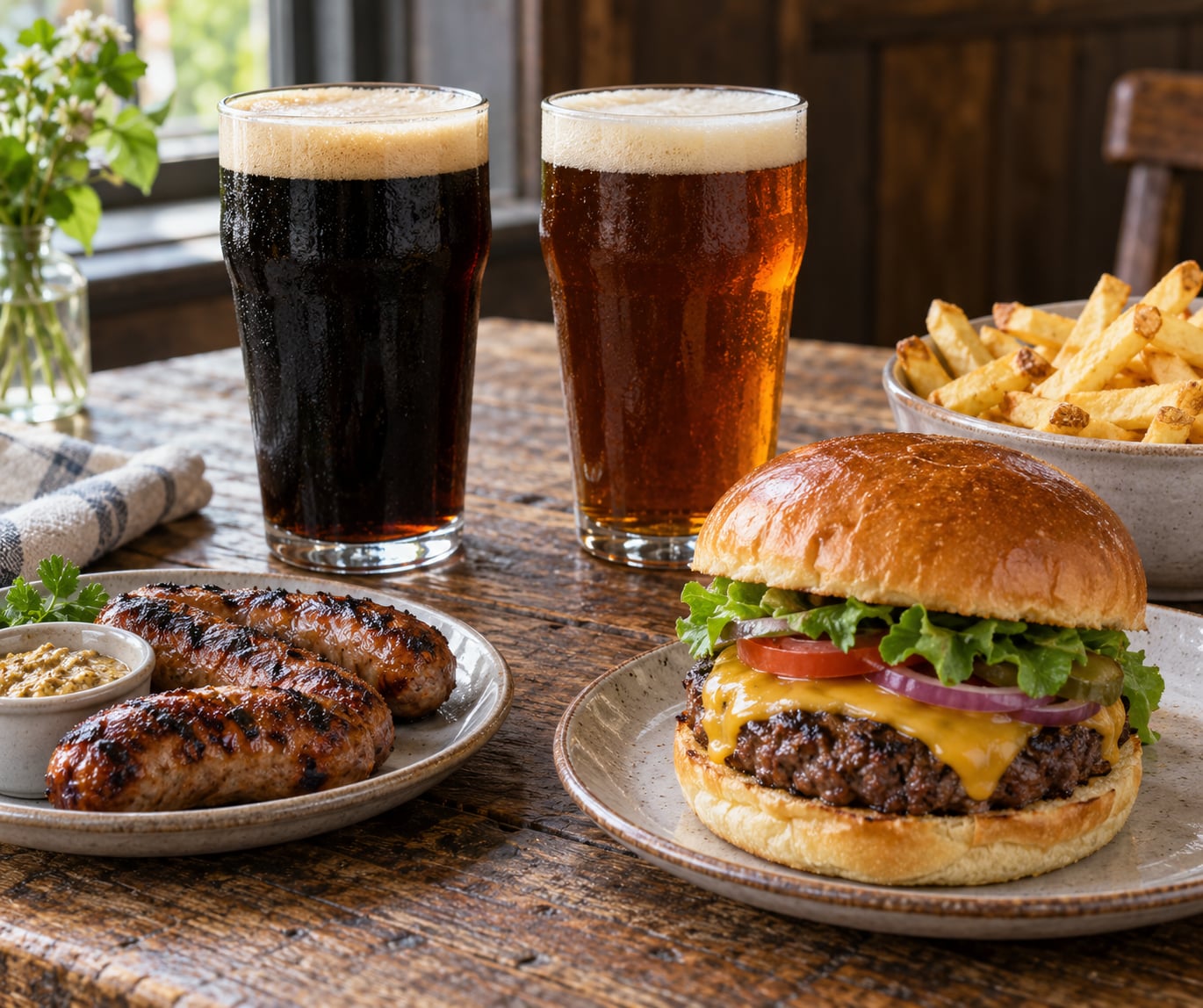
The stout vs porter differences come down to one ingredient in the grain bill. Porters are built on malted barley, often roasted, while stouts get their signature character from unmalted roasted barley, which adds color, body, and coffee-like roast flavor without adding alcohol. Pick a porter for caramel, toffee, and an easy-drinking middle weight. Pick a stout for espresso, smoke, and a drier, fuller finish.
That is the short version, and it is enough to order with confidence. It is also the last word, because everything else people argue about — color, body, bitterness, strength — overlaps heavily between the two families. What follows is the longer version, plus the part that actually matters at your table: which one belongs next to a burger.
Last updated October 2026. Style definitions here follow the BJCP Style Guidelines, and the tasting descriptions come from a lot of comparing beers that were not supposed to taste the same.
Table of Contents
- stout vs porter differences at a Glance
- What Is the Difference Between Stout and Porter?
- How Do Flavor and Roast Differ?
- stout vs porter differences: Body, Color, and Mouthfeel
- Which Beer Pairs Better With Burgers and Grilled Food?
- How Brewing Traditions Shape the Styles
- How to Taste and Choose the Right One
- Which Should You Choose?
- Frequently Asked Questions
- Start With the Beer’s Tasting Notes
stout vs porter differences at a Glance
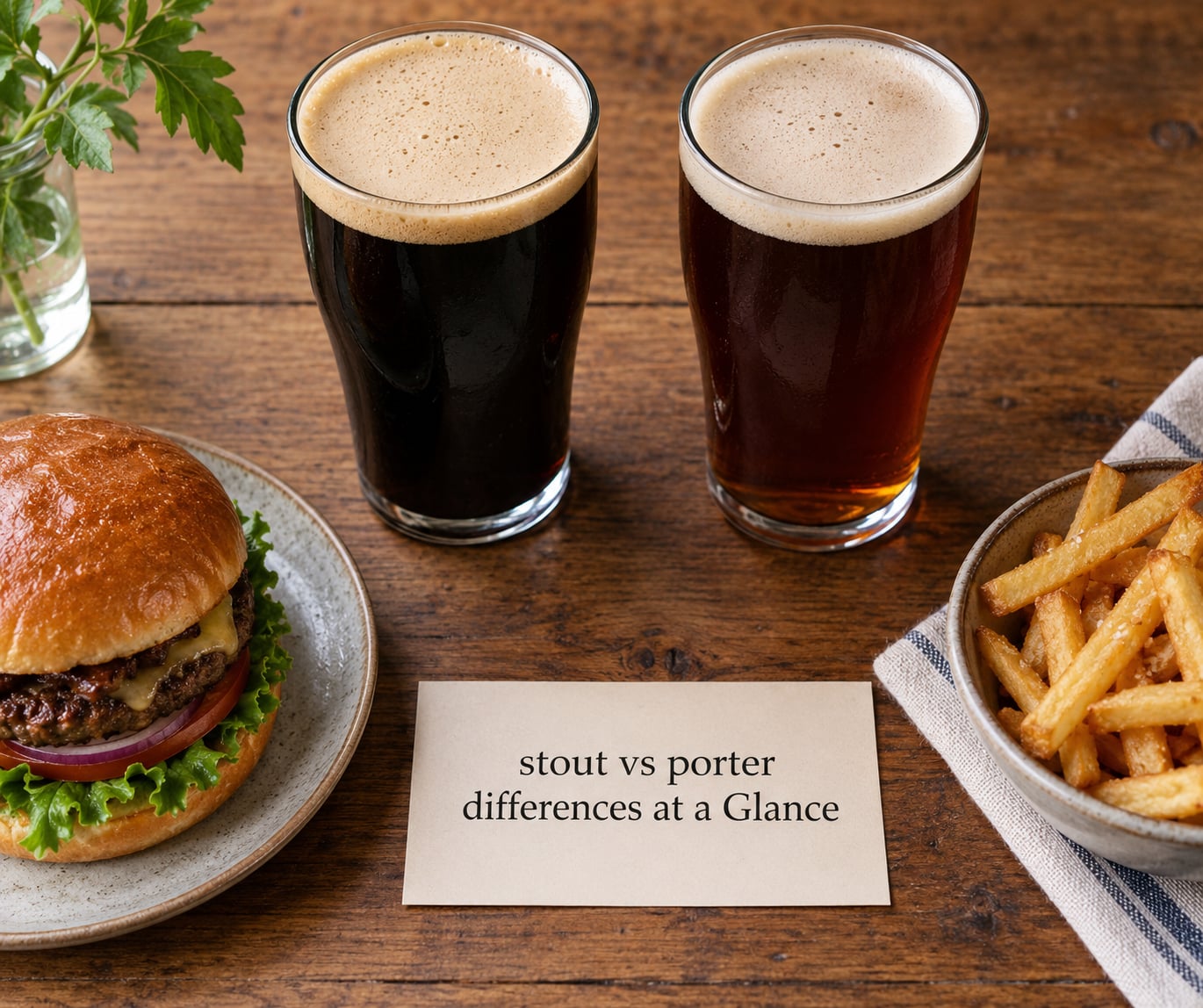
| Characteristic | Porter | Stout |
|---|---|---|
| Grain bill | Malted barley, often with brown malt and chocolate malt | Malted barley plus unmalted roasted barley |
| Color | Dark amber-brown through to near-black, sometimes a purplish hue | Black to jet black, often opaque in the glass |
| Roast character | Toasty, biscuity, restrained | Coffee, espresso, ash, sometimes smoke |
| Sweetness | Noticeable caramel or toffee sweetness up front | Drier finish, though sweet sub-styles exist |
| Body | Medium to medium-full, round | Medium to full, sometimes slick or creamy |
| Bitterness | Moderate, mostly from hops and roast | Moderate to assertive, with more visible hop bite |
| Typical ABV | About 4 to 6.5 percent | About 4.2 percent for Irish extra stout, 7 to 12 percent for imperial stout |
| Recognizable examples | Fuller’s London Porter, Deschutes Black Butte Porter, Jack’s Abby FramingHammer Baltic Porter | Guinness Extra Stout, Murphy’s Irish Stout, Bell’s Kalamazoo Stout, North Coast Old Rasputin |
Read that table as tendencies, not rules. A strong modern porter can be darker and roastier than a gentle dry stout, and a sweet milk stout is about as far from an imperial stout as a porter is from a pale ale. Style labels in this corner of beer are guidelines a brewer works within, not a promise to your palate.
What Is the Difference Between Stout and Porter?
A porter is a dark ale built on malted roasted barley. Historically it grew out of 18th-century London brown ale, and its sweetness comes from malts that convert to sugar in the mash and, in part, stay in the finished beer.
A stout takes the same malted base and adds unmalted roasted barley. Because that barley never went through malting, its starches were never converted into fermentable sugar. It contributes color, body, and roast flavor, and very little alcohol.
That is the whole technical difference, and it explains everything else you taste. One sentence you will see repeated in almost every explainer online — “stouts are stronger” — is not a rule. Guinness Extra Stout, the beer most people picture when they hear “stout,” sits at 4.2 percent ABV.
The categories also overlap in a way that frustrates beer writers. BJCP splits porter into English, American, and Baltic variants and stout into dry, sweet, oatmeal, American, and imperial ones. The BeerAdvocate community threads dwell on this constantly, and the recurring conclusion is that it mostly comes down to what the brewer wants to call it.
How Do Flavor and Roast Differ?
Porters lean toward the sweet end of toasted grain. Expect toffee, caramel, dark biscuit, cocoa, and dried dark fruit, with the roast sitting in the background as a warm, bready note rather than a hit of smoke.
Stouts lean toward the dry end of the same spectrum. Expect coffee, espresso, dark chocolate, cold ash, and in the bigger examples a smoky, charred edge. A dry Irish stout is bone-dry on the finish, while an American stout can be genuinely acrid in the roast.
Reading stout vs porter differences in the aroma
Smell before you sip. A porter’s aroma reads sweet and grain-forward even at a distance — think burnt sugar, raisin, fresh bread. A stout’s reads dry and roasted — think cold coffee, charcoal, dark cocoa powder.
That distinction is where drinkers actually agree. Across BeerAdvocate and r/beer threads, the note people repeat most is that stouts carry more roast character and more visible hop bite, while porters are sweeter with less of it. One homebrewer put it more precisely: porters use brown malt and chocolate malt for a smoother flavor, while the unmalted roasted barley in a stout pushes a harsher, ashier roast.
The honest caveat, which every good brewery page on this topic repeats, is that tasting the specific beer matters more than the style name on the tap handle. A modern roasty American porter has plenty of people reaching for a stout glass by mistake.
stout vs porter differences: Body, Color, and Mouthfeel
Color follows the roast, roughly. Porters land anywhere from dark amber-brown to black, and when you hold one up to a window you can often see light through the edge, sometimes with a purplish cast. Stouts run from black to jet black and are usually opaque in the glass.
Body is a function of how much fermentable sugar the brewer left in the wort and how much protein and dextrin the grain carried over. A sweet porter is round and full in the middle with a lingering caramel finish. A dry stout is often just as thick but reads as silkier, because the sugar is gone and the roast carries the weight.
Carbonation is not a difference worth arguing about, though it changes how the beer reads on the palate. A well-attenuated dry stout sits heavier on the tongue; a higher-residual-sugar porter carries more of that creamy, almost slick texture that pairs with a fatty burger.
Sweetness perception trips people up more than anything else here. A dry stout tastes almost as sweet as a porter in the first sip and then vanishes; a porter’s sweetness follows you through the whole glass. Sweet sub-styles — milk stouts, pastry stouts, oatmeal stouts — sit under the stout name deliberately, adding lactose or oats for creaminess and body.
Is porter stronger than stout?
Generally stouts are brewed stronger, but it is a tendency of sub-style rather than a rule of the category. A typical English porter sits around 4 to 5.5 percent ABV. An imperial stout runs 8 to 12 percent. Guinness Extra Stout is 4.2 percent.
So a 4.2 percent stout and a 5 percent porter will make you feel almost identical, while an imperial stout in the same glass will make you reconsider your evening. Check the label, not the style name.
Calories follow the alcohol and the residual sugar, which means Guinness lands at roughly 40 calories per 12 ounce serving — about the same as a standard lager. Stout is not the healthier option; it is beer with a darker color scheme.
Which Beer Pairs Better With Burgers and Grilled Food?
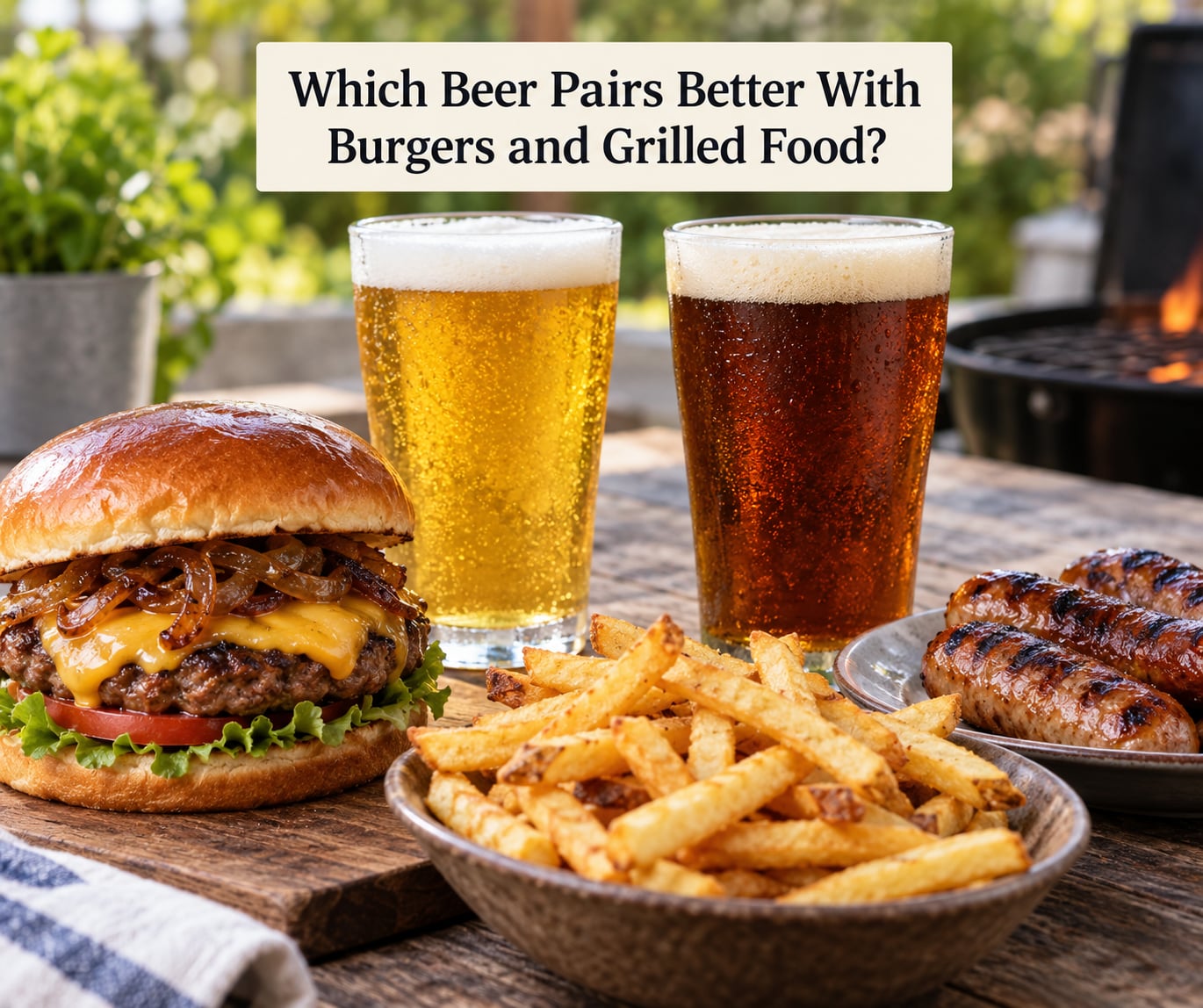
This is where the stout vs porter differences earn their keep at a burger cookout, and it is the shortest path to picking the right bottle for the meal in front of you.
A porter’s caramel sweetness and medium body cut through a seared beef patty better than almost anything else in the beer aisle. It is the better match for a classic cheeseburger with caramelized onions, for grilled sausages, and for a sharp aged cheddar melt. The toast and toffee notes echo the Maillard crust on the meat without competing with it.
A stout’s roast and dryness handle heavier, smokier, more aggressive food. Barbecue brisket, ribs with a dry rub, smoked brisket burnt ends, and anything charred over real wood all pair with a stout because the smoke in the beer matches the smoke on the food. Stouts also take the salt and fat of fried chicken better than a sweeter porter does.
Porters get overlooked on the seafood side, which is a shame. A Baltic porter — the lager-fermented cousin from the Baltic region — is a genuinely excellent match for raw oysters on the half shell, and its clean malt profile does not fight delicate shellfish the way a heavy imperial stout will.
For the sweet end of the menu, a sweet or pastry stout behaves like a dessert course. Milk stouts with lactose and coffee stouts both work with a dark chocolate dessert, a smoked chocolate cake, or a blue cheese plate. Sharp blue cheese and roasted coffee share the same aromatic family, so the pairing lands for the same reason it works for stout and dark chocolate.
Two practical notes from the grill side. If you are cooking burgers, keep the ground meat to 160°F internal and whole cuts to 145°F, and pour at 45 to 55°F — a beer served warm from the sun tastes flatter than the label deserves. Either style works fine cold; temperature only changes how much the roast shows up.
How Brewing Traditions Shape the Styles
Porter is the older of the two. It developed in 18th-century London from brown ale, and the name came from the porters who drank it — the men carrying goods between the city and the docks along the Thames. Those porters wanted a beer that could stand up to physical work, so the style went heavy on brown malt and became the emblem of industrial London pub culture.
Arthur Guinness opened his Dublin brewery in 1776, and the early product was called Guinness’s Extra Stout Porter. The words “stout” and “porter” both sat in the name because, at the time, stout meant a strong, well-hopped porter. Over the next century the two words pulled apart: stout kept the strength and the roast, porter kept the malt and the everyday drinking occasion.
Why did Guinness stop making porter?
It largely renamed it. Through the 1960s and 70s the company phased the porter name out in favor of stout-led branding, and the beers descended from that lineage — Harp Lager and Guinness Foreign Extra Stout — carry the stout label rather than the porter one, even though Foreign Extra still traces straight back to the porter recipe family.
This is the part that trips people up most often, and it is a genuine curiosity rather than trivia. The beer the porter name was invented for is still on shelves under a different word.
Modern naming went the other way too. BJCP retired one of its porter sub-categories entirely, and the replacements have not caught on, so what used to be a precise label is now a loose one. Porters also carry a reputation problem in Britain, where they are treated as a dusty relic while stouts get the craft attention. In the US the reverse is true — American porter is a healthy and active category, and American stout is where the experimentation happens.
How to Taste and Choose the Right One
You do not need a tasting mat to work this out. Four steps, about ninety seconds, and you will know more than the beer name on the tap tells you.
First, smell both. Sweet grain and raisin in the nose means porter. Cold coffee, charcoal, and cocoa powder means stout. This single test resolves most cases.
Second, look at the rim. Translucent dark brown with a purplish edge points porter. Opaque black points stout.
Third, taste the first sip and then wait ten seconds. A porter keeps its sweetness through the whole mouthful and finishes gently. A stout drops away into dryness, ash, and often a roast bitterness that lingers.
Fourth, check the strength before you commit to the glass. If a stout is at 8 percent or above, treat it as a sipping beer rather than a burger beer, and pour a smaller measure. This is the step that stops the whole exercise from going badly.
If you are buying rather than ordering, do the same test on the brewery’s tasting notes instead of the label. Look for the words roast, coffee, char, and dry on one side, and caramel, toffee, chocolate, and biscuit on the other. Breweries describe their beer accurately, and they will happily tell you the ABV on the can.
Which Should You Choose?
Choose a porter when the meal is a clean, beefy, medium-rare burger with a slice of cheddar, or a plate of grilled sausages. You want caramel and toffee, a medium body, and enough sweetness to cut through rendered fat. Porters are also the safer first pick for someone who has only ever drunk Guinness and found it too strong or too bitter.
Choose a stout when the food is smoky, charred, or rich in a different direction — barbecue, brisket, ribs, fried chicken, oysters, or a blue cheese plate. You want coffee and roast to meet the smoke, and you want a drier finish to reset your palate between bites.
Choose by the sub-style, not the family, when strength is on the table. A dry Irish stout at 4.2 percent and a Baltic porter at 5 percent may be more alike than their names suggest. As the brewery pages keep repeating, the brewer decides what to call it, which means the tasting notes decide what you will actually drink.
Frequently Asked Questions
Is Guinness a stout or a porter?
A stout, specifically an Irish extra stout at 4.2% ABV. Arthur Guinness brewed it in Dublin in 1776 as Guinness’s Extra Stout Porter, so the porter name was historically correct and the stout name is the one that survived. Both labels describe the same modern beer, which is why the confusion has lasted centuries.
Is Murphy’s a stout or a porter?
A stout, specifically a dry Irish stout brewed in Cork. Its crisp, bone-dry character comes from a high mash temperature and a long, unrushed boil, which suppresses the harshness an American-style roasty stout can carry. If you like Guinness but want less roast bite, Murphy’s is the usual recommendation.
Which is better, porter or stout?
Neither is better, because they are siblings rather than rivals. Pick a porter for caramel, toffee, chocolate, and an easy-drinking medium body that suits burgers and sausages. Pick a stout for coffee, roast, smoke, and a fuller, drier finish that suits barbecue and oysters. The food in front of you usually decides it faster than the style does.
Why did Guinness stop making porter?
It was mostly a naming decision. Through the 1960s and 70s the brewery dropped the porter name in favor of stout-led branding, and the modern stout range inherited the label. Foreign Extra Stout still traces its recipe straight back to the porter family, which is why the two names sit so close together for most drinkers.
Is porter stronger than stout?
Stouts are usually brewed stronger, but it is a tendency of sub-style rather than a rule of the category. Typical English porters sit around 4 to 5.5% ABV and Russian Imperial Stouts run 8 to 12%. Guinness Extra Stout is only 4.2% ABV, which is the counter-example that kills the myth. Check the label instead of assuming.
Which is smoother, stout or porter?
Porter is usually the smoother of the two. Its all-malted grain bill leans on brown and chocolate malt for a rounder, sweeter profile, while the unmalted roasted barley in a stout adds a drier, more abrasive roast. The exception is a sweet stout such as a milk or pastry stout, which can be silkier than most porters.
Start With the Beer’s Tasting Notes
Next time you are standing in front of a tap handle, read the tasting notes before the style name. Words like roast, coffee, char, and dry point you toward a stout. Caramel, toffee, chocolate, and biscuit point you toward a porter.
Then match it to the plate. A seared burger wants the caramel of a porter. Charred barbecue wants the roast of a stout. That single habit tells you more than any style guide, including this one.