
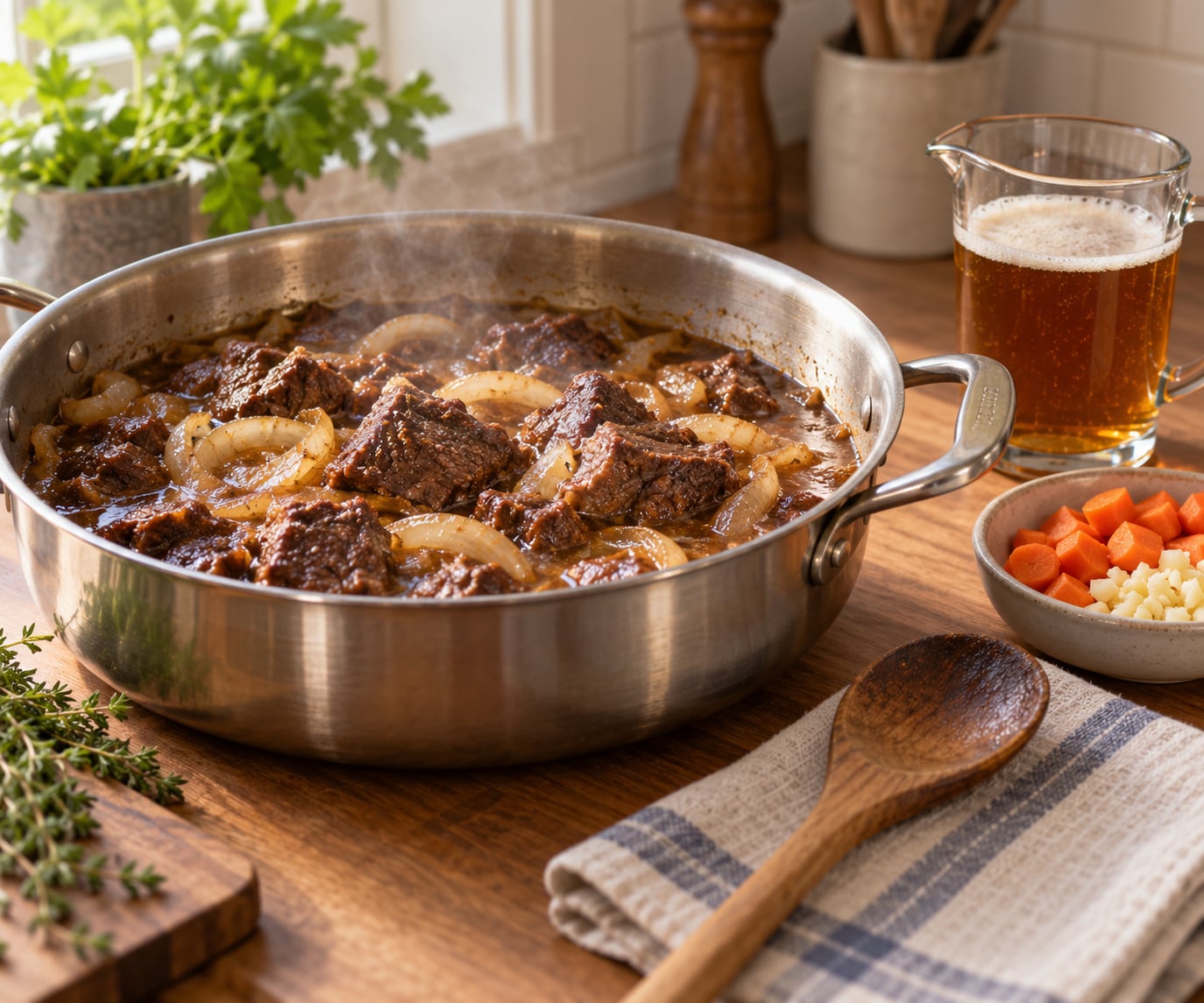
Learning how to cook with beer is mostly about control. Beer is about 90% water, and the rest of it brings malty sweetness, roasted depth, hop bitterness and enough carbonation to lift a batter. Pick a style that matches the dish, measure it instead of pouring by feel, and give it time to reduce. That is the whole method, and it takes about 40 minutes of active work for most dishes.
Nobody needs special equipment. A heavy pan or Dutch oven, a measuring cup, a strainer and whatever you already season with will carry you through a weeknight stew, a better burger sauce or a batch of beer-battered onion rings.
What You Need
Before you turn on the heat, gather the liquid and the things that keep it in balance. The beer is the flavoring; everything else is what stops that flavor from overwhelming the dish.
- A wide, heavy pan or Dutch oven. Wide matters more than heavy, because a wide surface lets beer evaporate. That evaporation is how you thicken a sauce and lose the raw alcohol edge.
- A measuring cup or a kitchen scale. The single biggest jump in consistency comes from measuring beer instead of pouring until the pan looks right.
- A fine-mesh strainer. You will strain reduced beer before adding it back if you want a clear pan sauce instead of a grainy one.
- Two or three styles of beer on hand. A light lager for delicate things, an amber or brown ale for stews, and a stout or porter for desserts and rich sauces.
- Balancing ingredients. Salt, a little sugar or brown sugar, an acid such as vinegar, lemon juice or tomato, and fat such as butter or olive oil.
Most of the time one bottle is enough. If you plan to cook down a whole bottle at the start of a braise, keep a second cold bottle in the fridge, because the pan will want more than you expect.
Step-by-Step: How to Cook With Beer
1. Choose the Right Beer for the Dish
Match the strength of the beer to the strength of the food. A heavy, roasted beer in a light dish overwhelms it, and a mild beer in a rich braise disappears entirely.
- Light lager or pilsner: clean, faintly sweet, almost no bitterness. Best for batters, brines, chicken, shrimp, steamed mussels and light pan sauces.
- Wheat beer: soft, slightly tart, cloudy. Good with vegetables, fish, and anywhere a little acidity helps.
- Amber or brown ale: caramel and toasted bread, gentle hop bite. This is the workhorse for beef stew, chili, braised pork and pot roast.
- Porter: dark, chocolatey, roast-forward but not as heavy as a stout. Excellent in barbecue glaze, mushroom dishes and chocolate cake.
- Stout: the heaviest option, with strong coffee and cocoa notes. Good for desserts and slow braises, risky in a batter where it can darken fried food.
- Pale ale or IPA: high hop aroma and real bitterness. Use sparingly, late, and never in a long reduction unless you want the bitterness front and center.
One more note on quality. Cooking concentrates everything about a beer, including its flaws, so use something you would happily drink on its own. A bad lager in a braise becomes a bad lager with the volume turned up.
If you are also picking bottles to drink alongside, how to pair beer with burgers follows the same logic from the other direction.
2. Measure the Beer and Build the Flavor Base
Measure the beer and treat it as an ingredient, not a beverage. Roughly 1 cup of beer per pound of meat is the working ratio for a braise or chili, 1/2 cup per pound for a marinade, and about 1/2 cup for a batter that serves four.
Add the beer in stages rather than all at once. Deglaze first to lift the browned bits off the pan, taste, then add the rest. That way you can see how much the dish actually wants.
This is also where wine swaps out. For most savory dishes, replace wine one for one with a lager, pilsner or amber ale, then add 1 to 2 tablespoons of something acidic such as vinegar or lemon juice to make up for the fruit that beer does not have. Beers that are heavily roasted or very hoppy push a dish away from wine more than lager does, so save those for recipes that already lean smoky or bitter.
Build the rest of the flavor base before the beer goes in. Onions browning in fat, garlic, spices toasted dry in the pan, and a spoon of tomato paste all give the beer something to attach to.
3. Cook the Dish and Control the Heat
After the beer goes in, the heat you use depends on the technique.
- Sauces and pan deglazes: medium heat, brought to a bare simmer. A hard boil scatters the fat and makes the sauce grainy.
- Braises and stews: bring to a boil, cover, drop to the lowest simmer. You want bubbles every second or two, not a rolling boil, for two to three hours.
- Marinades: no cooking at all. Time does the work, usually 2 to 8 hours in the refrigerator.
- Batters: never cooked. You mix cold beer with flour and it goes straight into hot oil.
When the beer is a marinade rather than a cooking liquid, it works partly through the alcohol loosening muscle fibers, and partly through salt and sugar in the beer drawing moisture into the surface. Pat the meat dry before it goes into the pan. A wet surface steams instead of sears, and you lose the browning that makes the finished dish taste worth eating.
For poultry, keep to a safe internal temperature of 165°F. Ground meat wants 160°F, and whole cuts of beef, pork and fish want 145°F. The beer does not change these numbers.
4. Finish, Reduce, and Taste
This is the step that decides whether a dish tastes like beer or just vaguely alcoholic. If the beer flavor is missing at the end, the fix is almost always to concentrate it.
Spoon the liquid into a small pan, bring it to a simmer, and reduce it by about half before stirring it back in. This single step rescues more disappointing beer cooking than anything else. Thin chili, watery pan sauce and flat-tasting fried food all improve the moment the beer gets boiled down first.
Taste as you go. Too bitter means the beer was too hoppy or reduced too long, and you correct it with fat, sweetness or acid rather than more liquid. Too sweet means the beer was too malty for the dish, corrected with vinegar, mustard or lemon. Too salty means you over-salted early, and a spoonful of unsalted stock or water is the only fix.
Strain a reduced reduction through a fine mesh before it goes back in. It costs you a minute and turns a grainy pan sauce into a glossy one.
5. Try Beer in Burgers and Casual-Dining Foods
Beer shows up in casual cooking in small, sharp doses. It is a flavoring there, not the liquid the dish cooks in.
- Beer-battered onion rings: a pale lager, ice-cold, mixed into a self-rising flour and seasoning batter just before frying. Rings stay crisp longer than they do in a plain flour batter.
- Beer-marinated burger patties: 1/2 cup lager per pound, plus 1 tablespoon Worcestershire, 1 teaspoon mustard and a pinch of salt, for 2 to 4 hours in the fridge.
- Beer cheese sauce: 1/2 cup amber ale simmered with butter, flour and shredded cheddar until the sauce coats a spoon, with mustard powder at the end.
- Beer-braised onions: a splash of amber ale and a pinch of brown sugar in the pan with the onions until they collapse and darken.
- A burger condiment: reduce 1/3 cup amber ale with 2 tablespoons ketchup, 1 teaspoon Worcestershire and a dash of hot sauce to a glaze that coats the back of a spoon.
For the drink that goes with the plate, our picks for what beer goes with a bacon cheeseburger follow the same style-to-strength logic.
How to Cook With Beer in Common Dishes
Everything below uses the same core method. What changes is the style, the quantity and how long the beer gets to reduce.
Beer for Burgers and Bratwurst
Burgers need very little beer and it goes in late. Put 1/2 cup lager in the pan with the onions for a burger condiment, or marinate patties for a few hours at most, since long marination breaks down the protein that holds a patty together.
Brats are the opposite. Simmer them in a lager with onion, mustard and a bay leaf at the lowest heat for about 30 to 45 minutes. The beer keeps them juicy and gives you a ready-made drinking broth in the pot. If the sausage is already fully cooked, add the beer for the last 10 minutes only.
If you are staying inside rather than grilling, how to cook burgers in the oven pairs well with a beer-based topping sauce.
How to Cook With Beer in Sauces and Pan Dishes
Deglazing is the fastest way to use beer and the biggest upgrade to a seared steak or a pan of mushrooms. Sear at high heat, add 1/2 cup lager or amber ale, scrape every browned bit loose, then simmer 2 to 3 minutes until the liquid coats the bottom of the pan.
Finish with cold butter whisked in one piece at a time for a glossier sauce, and season after the reduction, not before. Beer is a weak seasoning on its own, and a sauce that tastes under-salted when the liquid is thin usually needs nothing but a little more reduction.
Beer for Meat, Poultry and Roasts
Beef, lamb and pork braises take amber or brown ale at about 1 cup per pound of meat, plus enough to cover halfway up the meat. The pot should hold heat evenly, so a Dutch oven beats a thin skillet here.
Poultry wants a lighter beer and a shorter time. Pouring 1/2 cup of lager over chicken thighs before roasting gives the pan juices a rounded, malty base you can reduce to a glaze afterward.
For a smoke-roasted bird, put the bird over an open can of beer with a quarter inch of the top removed, stand the can in a tray, and roast at 375°F. The drippings steam up into the cavity and the can keeps the breast from drying out. Watch the temperature rather than the clock, since cans vary in size and the timing does not transfer between them.
Pulled pork, brisket and chili all take the same shape: brown the meat first, drain the fat, then braise in beer before adding tomatoes or beans. That ordering matters more than the beer you pour in, because the browning is what gives you the deep flavor the beer then carries across the whole pot.
Beer for Vegetables, Beans and Greens
Vegetables need a light beer and a short cook. Braised kale, chard or cabbage improve with 1/2 cup amber ale and a splash of vinegar, since the acid keeps the greens from going muddy.
Beans and lentils are the easiest place to start. One cup of beans with 1 cup of lager or amber ale, an onion and a bay leaf, simmered until the liquid is gone, makes a pot of chili that tastes like it cooked all afternoon. Mushrooms behave the same way, browning in butter and finishing in porter.
Beer for Seafood and Fried Food
Fish, shrimp and mussels take a pale lager and almost no cooking time. Steam mussels in half a cup of lager with garlic and thyme for the few minutes it takes them to open, and discard any that stay shut.
For batters, use a light lager, keep it ice cold, and mix it in at the last second. The carbonation is what makes the crust airy, and it starts escaping the moment it hits the flour.
Two warnings. Do not use a dark stout in a batter, since its color and roast carry through frying and fried food turns grey. And do not use a heavily carbonated craft beer in a batter without expecting foaming in the oil, which is both messy and dangerous at high heat.
Beer in Desserts and Beer Bread
Stout and porter bring coffee and cocoa notes that make chocolate taste darker. Swap about half the liquid in a chocolate cake for a stout, add a tablespoon of coffee, and reduce the baking time slightly because the batter runs wetter.
Beer bread is the easiest win on this whole list. Replace the water in a standard quick bread with an amber ale, keep the baking powder, and add 2 tablespoons of sugar since beer supplies malt but not enough of it to sweeten the loaf. The yeast in the beer gives a fine crumb and a slightly shorter bake.
Common Mistakes When Cooking With Beer
- Using a hoppy IPA in a long reduction. Hop bitterness does not evaporate the way alcohol does, so it concentrates. Fix a bitter pot with fat, a spoonful of sugar, or a splash of vinegar, and reserve heavily hopped beer for glazes added at the end.
- Pouring instead of measuring. An extra half cup of beer is the usual reason a stew tastes thin. Measure from the start and add the last quarter cup only after you taste.
- Boiling hard. A rolling boil for an hour drives off alcohol but leaves a harsh, cooked edge and can make emulsions break. Hold everything at a bare simmer.
- Skipping the reduction. Beer flavor is subtle at the point you add it and only arrives once liquid has cooked away. If the finished dish tastes flat, boil about 1 cup of the same beer down to half and stir it in at the end.
- Reducing a dark beer too far. Roast flavors become ash. Porters and stouts need a gentler hand, and lagers and pale ales tolerate reduction better.
- Not adjusting the salt and sugar. Beer contributes salt, sugar and acid in a balance you cannot predict. Season at the end, and treat a flat dish as a seasoning problem before you add more liquid.
- Marinating too long. Alcohol and acid break down proteins. A few hours is enough for steaks and burger patties, overnight is plenty for a roast, and beyond that the surface turns grainy.
Tips for Better Beer Flavor
- Taste the beer before you cook with it. If you would not drink it warm, do not reduce it for twenty minutes.
- Reduce a portion of the beer separately and add it at the end. It is the fastest way to make a dish taste meaningfully more like beer.
- Use a light-bodied lager for delicate foods like fish, eggs and fresh greens. Heavier ales belong with beef, pork and chocolate.
- Toast your spices in oil before the beer goes in, and brown your aromatics properly. The beer carries flavor forward but it does not create any.
- Balance bitterness with fat. Butter, olive oil, cream, cheese and avocado all soften the hop bite that reads as harsh on a tongue when the sauce is thin.
- Use old or flat beer without hesitation. A flat, uncarbonated bottle is a poor batter liquid, because the carbonation is what lifts a batter, but a fine braising liquid where the malt and hops are doing all the work. Brats, chili and pan sauces are the places it earns its keep.
- Store opened beer cold and sealed, and use it within a few days. Once it goes flat, it is still usable for cooking, just not for batter lift.
Frequently Asked Questions
What type of beer is best for cooking?
Amber or brown ales are the safest all-purpose choice because they add caramel and toasted malt without much bitterness. Use a light lager or pilsner for batters, brines, poultry and seafood, and a porter or stout for chocolate desserts and rich braises. Save heavily hopped IPAs for glazes and marinades added at the end, since their bitterness concentrates as the liquid reduces.
Can I use any beer in a recipe?
You can use any beer, but the style changes the result more than you would expect. Beers that taste pleasant on their own are the safe choice, because cooking concentrates flavors rather than hiding them. Very hoppy beers turn bitter in a long braise, and very dark stouts make fried food and batters look grey. If a recipe is open to any lager or ale, an amber ale is the least risky pick.
How much beer should I add to a dish?
Roughly 1 cup per pound of meat for a braise or chili, 1/2 cup per pound for a marinade, and about 1/2 cup for a batter serving four people. Add it in stages: deglaze with half, taste, then add the rest until the pan looks right. If the dish tastes thin at the end, reduce 1 cup of beer to half a cup and stir that in rather than adding more raw beer.
Does beer make food taste bitter?
It can, and hop bitterness is the reason. Bitterness does not cook away the way alcohol does, so it becomes stronger as the liquid reduces. Hoppy beers are safe in a quick pan sauce or a late glaze and risky in a two-hour braise. If a dish already tastes bitter, fix it with fat, a spoonful of sugar or a splash of vinegar or lemon juice rather than diluting it.
Can beer replace broth or stock?
Partly. Beer has a similar liquid volume to stock, but almost none of the savory depth, so replacing all of it leaves a thin dish. Use beer for up to half the liquid in a braise and keep stock or water for the rest, or add a spoonful of tomato paste and a hard-boiled egg for body. Beer is at its best replacing wine one for one in a recipe that already has aromatics and fat built into it.
Should beer be boiled when used in cooking?
It depends on the technique. Boiling is what cooks off raw alcohol and concentrates malt flavor, which is what you want in a braise or a finished pan sauce, so bring it to a boil and then drop it to a bare simmer. Boiling hard for a long time makes food and emulsions harsh, so cover and hold it low. Batters and brines are the exceptions, where the beer is never heated at all.
Start With the Reduction
Pick a lager or an amber ale, brown your aromatics properly, and add the beer in a measured amount rather than a pour. If the dish tastes flat at the end, boil half a cup of beer down and stir it back in before serving. That single habit is the difference between food that tastes beered and food that tastes like beer.