
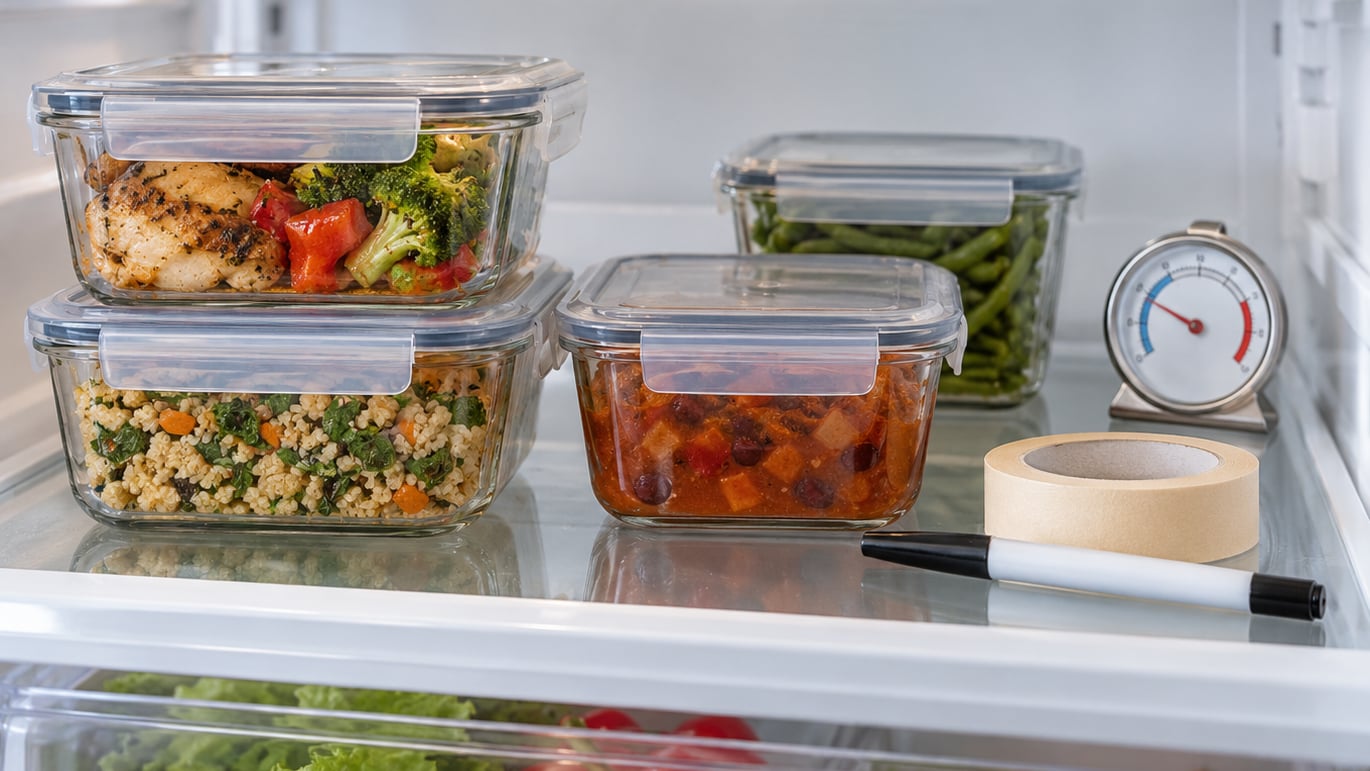
Most cooked leftovers last 3 to 4 days in a refrigerator kept at 40°F (4°C) or below. The clock only starts when the food goes into the fridge, and it only runs if that happens within two hours of cooking. USDA FSIS and CDC publish the same window, which is why it is worth using instead of the rules floating around social media.
That answer covers most of what ends up in a leftover container. Seafood, cooked rice, mayonnaise salads and thin gravies run shorter, and a few dry or low-moisture foods run longer. Storage method matters as much as the food does, which is why the same pot of chili can be perfectly good on day four or a bad bet on day six.
How Long Do Leftovers Last in the Fridge?
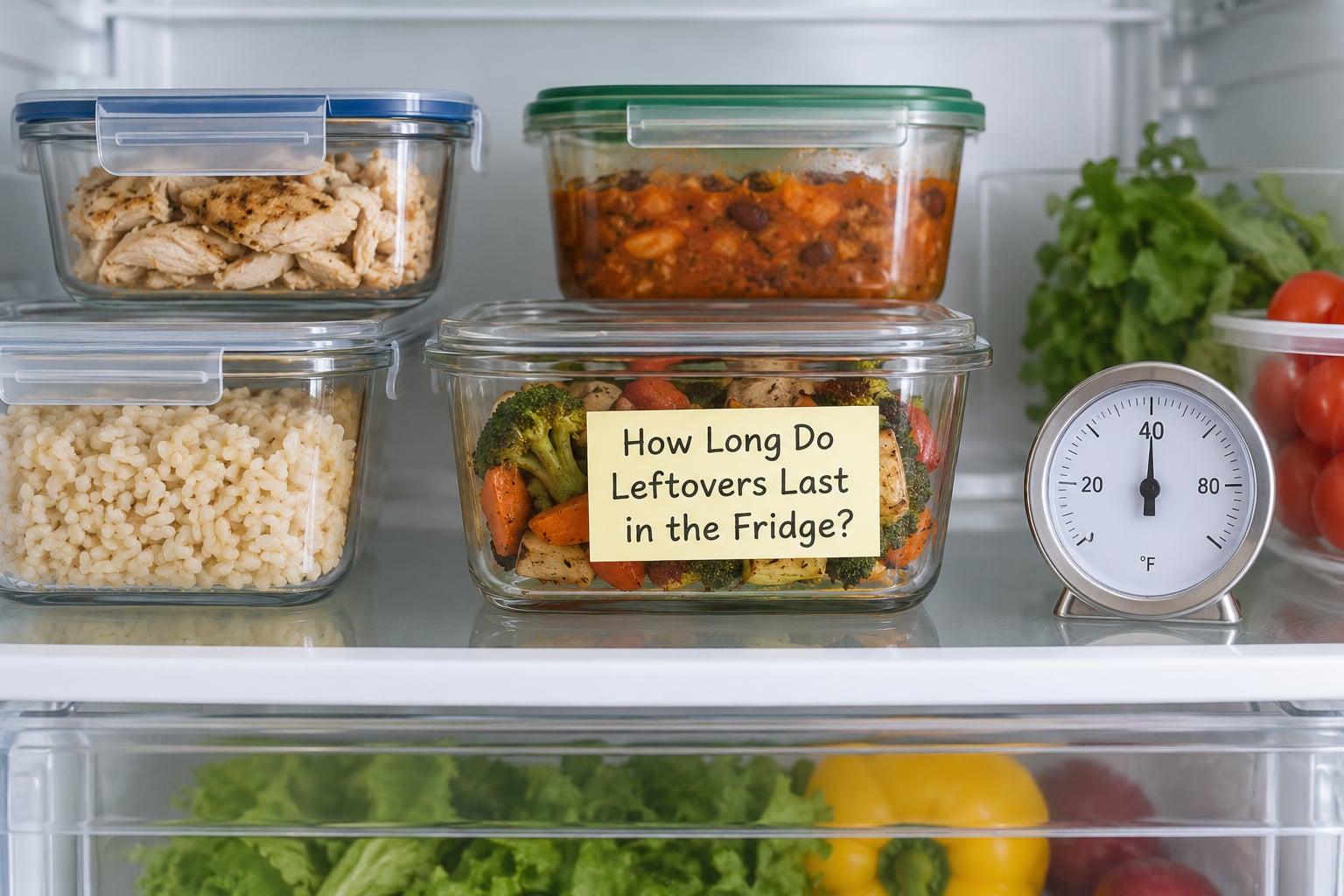
Three to four days is the number, and it comes with two conditions attached. The refrigerator has to be at 40°F (4°C) or below, and the food has to be refrigerated within two hours of cooking — one hour when the air is above 90°F.
Both conditions are doing real work. A fridge reading 48°F is not a refrigerator for food-safety purposes, and a casserole that sat on the counter through a four-hour dinner party already picked up bacteria before it ever got cold. USDA FSIS puts the danger zone at 40°F to 140°F (4°C to 60°C), and bacteria in that band can multiply fast enough that the four-day window is no longer a margin.
Food type, preparation and storage conditions all shorten that window. A tightly packed, deep container cools from the outside in, so the middle of the food can sit in the danger zone long after the edges feel cold. That is the single most common reason a well-kept leftover spoils early.
Where the 2-2-2, 2-2-4, and 7-Day Rules Come From
None of those rules are published by USDA, CDC or FoodSafety.gov. The 2-2-2 and 2-2-4 rules borrow one real number, the two-hour refrigerate limit, and pad it with two or three invented ones. The 7-day rule is a rerun of the same trick, and it tends to show up in posts that also advise trusting the smell test.
Be careful with dates printed on packaging too. A best-by date is a quality estimate from the manufacturer, and a use-by date on infant formula is a genuine safety limit. Neither one governs a homemade container of leftovers, which is exactly why hand-labeled dates work better here.
There are two clocks running on a leftover, and they are not the same clock. The safety clock is three to four days and it does not negotiate. The quality clock is food-specific: pasta with tomato sauce dries out and dulls by day two, while chili, curry and most soups genuinely taste better on day two or three. On a r/Frugal thread about leftover storage, the most common household answer was to eat within two or three days and freeze after that, which is a reasonable quality strategy sitting well inside the safety window.
Leftover Storage Times at a Glance
These are refrigerated times at 40°F or below for cooked and prepared food. Frozen times assume portioning, labeling and airtight sealing.
| Food | Fridge | Freezer |
|---|---|---|
| Cooked chicken or turkey | 3 to 4 days | 4 months |
| Cooked ground beef or pork | 3 to 4 days | 3 to 4 months |
| Steaks, chops, roasts | 3 to 4 days | 4 to 6 months |
| Cooked fish and shellfish | 1 to 2 days | 2 to 3 months |
| Opened deli meat | 3 to 5 days | 1 to 2 months |
| Cooked rice | 3 to 4 days | 6 to 8 months |
| Cooked pasta | 3 to 4 days | 2 to 3 months |
| Soups, stews, chili | 3 to 4 days | 2 to 3 months |
| Thin gravies and sauces | 1 to 2 days | 2 to 3 months |
| Casseroles and gratins | 3 to 4 days | 2 to 3 months |
| Cooked vegetables | 3 to 4 days | 10 to 12 months |
| Cooked potatoes or sweet potatoes | 3 to 4 days | 2 to 3 months |
| Cooked stuffing | 3 to 4 days | 2 to 3 months |
| Leftover pizza | 3 to 4 days | 1 to 2 months |
| Cooked eggs and egg dishes | 3 to 4 days | 2 to 3 months |
| Cooked oatmeal or hot cereal | 3 to 4 days | 2 to 3 months |
| Pancakes and waffles | 3 to 4 days | 1 to 2 months |
| Mayonnaise or dairy-based salads | 1 to 2 days | not recommended |
| Caesar or tuna salad | 1 to 2 days | not recommended |
| Curry, biryani, dal | 3 to 4 days | 2 to 3 months |
| Cooked tacos or quesadillas | 3 to 4 days | 2 to 3 months |
| Cooked pho or ramen broth | 3 to 4 days | 2 to 3 months |
| Sushi with raw fish | 1 day | not recommended |
| Cooked beans | 3 to 4 days | 2 to 3 months |
| Opened hard cheese | 3 to 4 weeks | 3 months |
| Milk or opened cream | 5 to 7 days | 3 months |
Three distinctions matter when reading that table. Freezer time is storage life for quality as much as safety, and it assumes food was frozen promptly after cooking. Foods you eat straight from the package, like unopened deli meat, are governed by their own use windows rather than by leftover rules. And anything refrigerated in a bag or box from a restaurant falls under the general three-to-four-day guidance too, not a special longer one.
Which Leftovers Last Longest in the Fridge?
Moisture drives almost all of it. Wet, protein-rich, nutrient-dense foods give bacteria both the water and the raw material they need, which is why meat, poultry, seafood and cooked rice sit at the short end. Dry, low-moisture cooked foods are a different story.
Cooked stuffing, dry-roasted nuts, plain crackers and crisp roasted potatoes can sit comfortably past four days if they are stored airtight. Salt-cured and cured items last longer as well, and smoked or cured fish keeps longer than fresh-caught fish for the same reason. Those are quality windows, not invitations to ignore a date.
The short end is where people get caught. Cooked fish and shellfish, thin gravies, and anything built on mayonnaise or cut vegetables — potato salad, tuna salad, Caesar, a chopped cucumber-and-tomato salad — are all one-to-two-day foods. Cooked rice sits at three to four days but deserves extra care for a reason worth knowing.
Why Do Leftovers Go Bad in the Fridge?
Bacteria survive cooking. Spores of Bacillus cereus, for example, can survive a boiling pot of rice and cook up into toxins in a container that sits at room temperature, which is why cooked rice gets a short window and a fast chill. Cooking kills a great deal, not everything.
Contamination also happens after the stove is off: during the transfer to a container, while you portion, from a cutting board, a cracked lid or an uncovered spoon standing in the pot. Then the cooling stage adds its own risk. Bacteria multiply in the 40°F to 140°F band, so a deep, tightly packed container of hot stew can hold its warm center in that band for hours.
That is the whole reason for the two-hour rule, the shallow containers and the refrigerator thermometer. It is also why food can be unsafe with nothing to see or smell. Salmonella, Listeria monocytogenes and pathogenic Escherichia coli can reach harmful levels without producing the off odor or the visible fuzz that people use as their decision rule.
How to Store Leftovers Safely in the Fridge
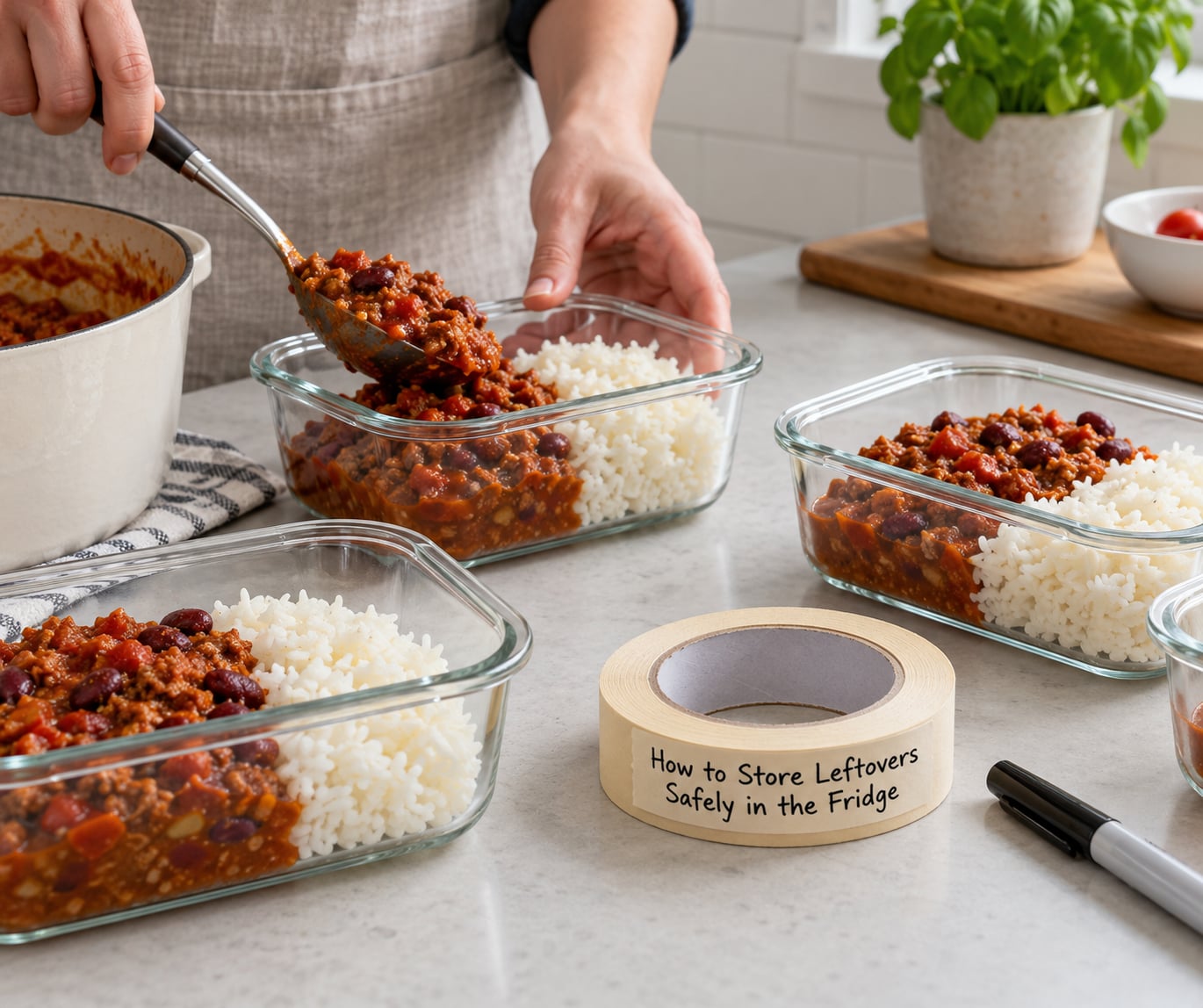
Six habits cover almost every storage mistake I see in home kitchens.
- Refrigerate within two hours of cooking, or within one hour when it is above 90°F outside.
- Divide large batches into shallow containers no more than about two inches deep.
- Use leakproof, airtight containers or wrap food tightly, so nothing dries out or sits exposed.
- Keep the refrigerator at 40°F (4°C) or below, and check it with an appliance thermometer rather than trusting the dial.
- Label each container with the food and the date it went in, using tape and a marker or a lid sticker.
- Eat in the order it was stored, moving older containers to the front shelf so they get used first.
Do not put a large, hot pot straight into the fridge hoping the whole thing chills fast. Heat radiating from a deep pot can also warm the food stored beside it, which shortens the window for a container you never touched.
On a site full of burgers, this is where I would add a freezing step. Cooked ground beef has the same three-to-four-day refrigerator window as any other cooked meat, and if you know you will not eat it in that time, freeze it the day you cook it. Our guides on how long ground beef lasts in the fridge and how long burgers stay in the freezer go into the details, including how freezing changes the texture of a patty once it is reheated.
Should Leftovers Go in the Biggest Container or Small Ones?
Small and shallow, every time. A deep container cools from the outside in, so the center can remain in the danger zone long after the food near the wall feels cold to the touch. Bulk does not save time, and a crowded fridge also circulates air poorly, which makes the problem worse.
Take a big pot of chili. Instead of leaving it in the pot, I portion it into four or five containers roughly two inches deep, leave the lids cracked while they cool for twenty minutes, then seal and label them. If I know I will only eat two of them, the rest go into the freezer right away, which is a better use of a Tuesday than discovering a forgotten container a week later.
Stirring large batches during cooling also matters, since it moves cooler food from the edges into the warm center. A pot of soup or a big pan of rice and beans benefits more from one stir partway through cooling than it does from a full extra container in the fridge.
How to Tell When Leftovers Are No Longer Safe
Visible and sensory warning signs are worth trusting as a trigger, never as a clearance. Mold, a slimy film, discoloration, an unexpected texture or an off odor all mean the food gets discarded, no matter how recent the date on the lid.
What those signs cannot do is confirm that food is safe. Harmful bacteria can reach dangerous levels with no change in smell, taste or appearance at all. The smell test tells you food has spoiled; it does not tell you food is fine, and the gap between those two statements is where foodborne illness comes from.
Time and temperature do the deciding. When a cooked leftover passes its window, or sat in the danger zone for over two hours, it goes in the bin. If the refrigerator stayed above 40°F for more than four hours because of a power cut or a door left open, treat perishable leftovers the same way. That is a common and expensive night, and it is exactly the scenario people ask about on r/foodsafety.
Pregnant people, adults over 65, young children and anyone immunocompromised or with a chronic illness should treat three days as the ceiling instead of four, and skip reheating deli meat and hot dogs. When in doubt, throw it out. Food waste stings for a minute; food poisoning takes days out of you.
How to Reheat Leftovers Safely
Reheat cooked food to 165°F (74°C) measured in the center, and use a food thermometer where you can. This is a real number with a real basis, not a formality, and it is the step most home reheating skips.
In the microwave, cover loosely, heat in short bursts, stir between each one, and let the food stand a minute at the end so the heat distributes. Microwave heating is uneven, and a cold pocket in the middle of a bowl of rice is the reason a second stir matters.
In the oven, cover with foil or a lid and heat at 350°F until the center reads 165°F. On the stovetop, bring soups, sauces and gravies to a rolling boil and stir often, since the surface is the hottest part and the pot wall hides the coldest. In a slow cooker, keep the food at 165°F or hotter for the duration of the cycle.
Two things to keep straight. Reheating food once is fine, reheating the same portion repeatedly is not, because each cycle gives bacteria another chance to grow between reheats. And reheating cannot rescue spoiled food — a container that smells off should be discarded before it reaches the stove, not after.
Can You Refrigerate Leftovers Overnight or for Longer?
Overnight is well inside the window. Three to four days is the practical maximum for most cooked leftovers, and eating on day four is a good day-four choice. Holding cooked food to the very end of the window is legal guidance, not good practice, especially if the container was warm for a while on the way in.
Freezing is the practical answer for anything longer. Soups, stews, chili, curry, cooked meats, rice and casseroles freeze well. Salads, mayonnaise-based dishes, fried food and cooked eggs do not, because the texture changes in ways that make reheating pointless. Sushi with raw fish is the one food where both the fridge and the freezer windows are short enough that same-day eating is the sane plan.
Cooked food that was refrigerated safely can be frozen once. Freeze it in single-meal portions so thawing only touches what you plan to eat, and label the container with the food and the freezing date. If you want the flavor of the day it was cooked, thaw overnight in the refrigerator rather than on the counter.
And if a freezer trip is not in the plan and you would rather start from raw, our guide to how long to cook burgers on a gas grill covers the timings that get the center to 160°F the first time, so nothing you grill sits in the danger zone waiting to be eaten later.
Frequently Asked Questions
How long do leftovers last in the fridge after cooking?
Most cooked leftovers keep 3 to 4 days in a refrigerator at 40 degrees F or below, according to USDA FSIS and CDC guidance. The count starts when the food is refrigerated, and it only counts if that happens within two hours of cooking, or one hour above 90 degrees F. Freeze anything you will not eat inside that window.
Is it safe to eat leftovers that smell or taste normal?
Not reliably. Salmonella, Listeria monocytogenes and pathogenic E. coli can reach harmful levels without changing how food smells, tastes or looks. A clean smell means no obvious spoilage, not a safety clearance. Use time and temperature instead, and discard perishable cooked food that has passed its window or sat in the danger zone for more than two hours.
How long can cooked rice and pasta stay in the fridge?
Both keep 3 to 4 days refrigerated at 40 degrees F or below, and both turn risky faster than most people expect. Bacillus cereus spores survive cooking and can produce toxins in rice held at room temperature, which reheating may not destroy. Cool rice quickly in shallow containers, refrigerate within two hours, and do not leave a pot of it on the counter overnight.
Can I refrigerate leftovers on a plate instead of in a container?
You can, but you lose the protection a container provides. A plate leaves the food exposed to handling, spills and cross-contamination, and it lets moisture and odors move freely. A plate also cools more unevenly than a shallow airtight container. If a plate is all you have, cover it tightly with plastic wrap or foil and keep it on a lower shelf.
How long do leftovers last in the fridge before freezing?
You can safely refrigerate cooked leftovers for up to 3 to 4 days before freezing them, provided they were refrigerated within two hours. Freezing at day two or three often improves quality. Foods that do not freeze well include salads, mayonnaise-based dishes, fried food and cooked eggs, where texture changes badly on thawing.
Bottom Line
Get leftovers into the refrigerator within two hours, in shallow airtight containers, with a refrigerator that holds 40°F or below. Eat most cooked leftovers inside three to four days, or freeze them on day two or three and stop guessing.
Time and temperature decide whether food is safe. Smell, appearance and the viral rules like 2-2-2 or the 7-day rule do not.
Sources: USDA Food Safety and Inspection Service, USDA FoodSafety.gov, and CDC guidance on foodborne illness. Last reviewed October 2026.