
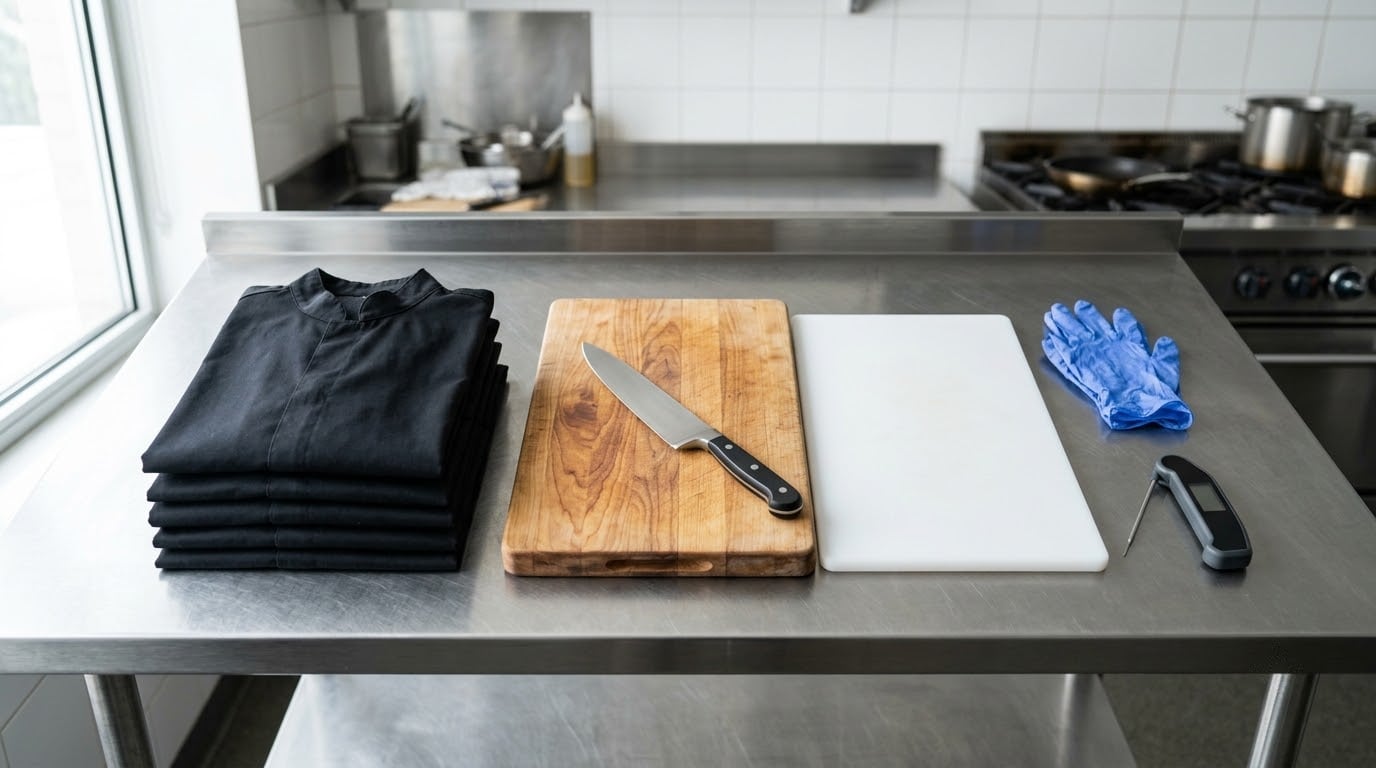
Yes, you can get hired as a line cook with no experience. Most kitchens will not hand you a hot line on day one, but plenty of them will hire you as a prep cook or dishwasher and move you onto the line within a few weeks of showing up early, working hard, and not complaining. The path to becoming a line cook with no experience comes down to three things: skills you can practice at home this week, a resume that sells what you already know how to do, and a restaurant willing to teach you.
Expect the first few weeks to be physically tiring. You will be on your feet for hours, working near open flame and hot oil, learning to read tickets while three people shout at once. Most beginners who quit in week one quit because nobody warned them what the job actually feels like, not because the cooking was too hard.
If you have never worked in a restaurant, start with what a line cook actually does during a shift so the picture in your head matches the real job.
Table of Contents
- What You Need
- Step-by-Step: How to Become a Line Cook with No Experience
- 1. Choose a Line Cook Entry Point
- 2. Build the Basic Skills Employers Look For
- 3. Learn Food Safety and Kitchen Standards
- 4. Create a Resume and Application That Shows Transferable Skills
- 5. Practice a Restaurant-Style Line at Home
- 6. Apply to Restaurants That Hire Beginners
- 7. Prepare for the Interview and Trial Shift
- 8. Start Strong and Improve Your Career
- Common Mistakes
- Frequently Asked Questions
- Can you get hired as a line cook with no experience?
- What qualifications do you need to be a line cook?
- What is the easiest kitchen job to get with no experience?
- How long does it take to become a line cook with no experience?
- Do I need culinary school to work as a line cook?
- How old do you have to be to be a line cook?
- Conclusion
What You Need
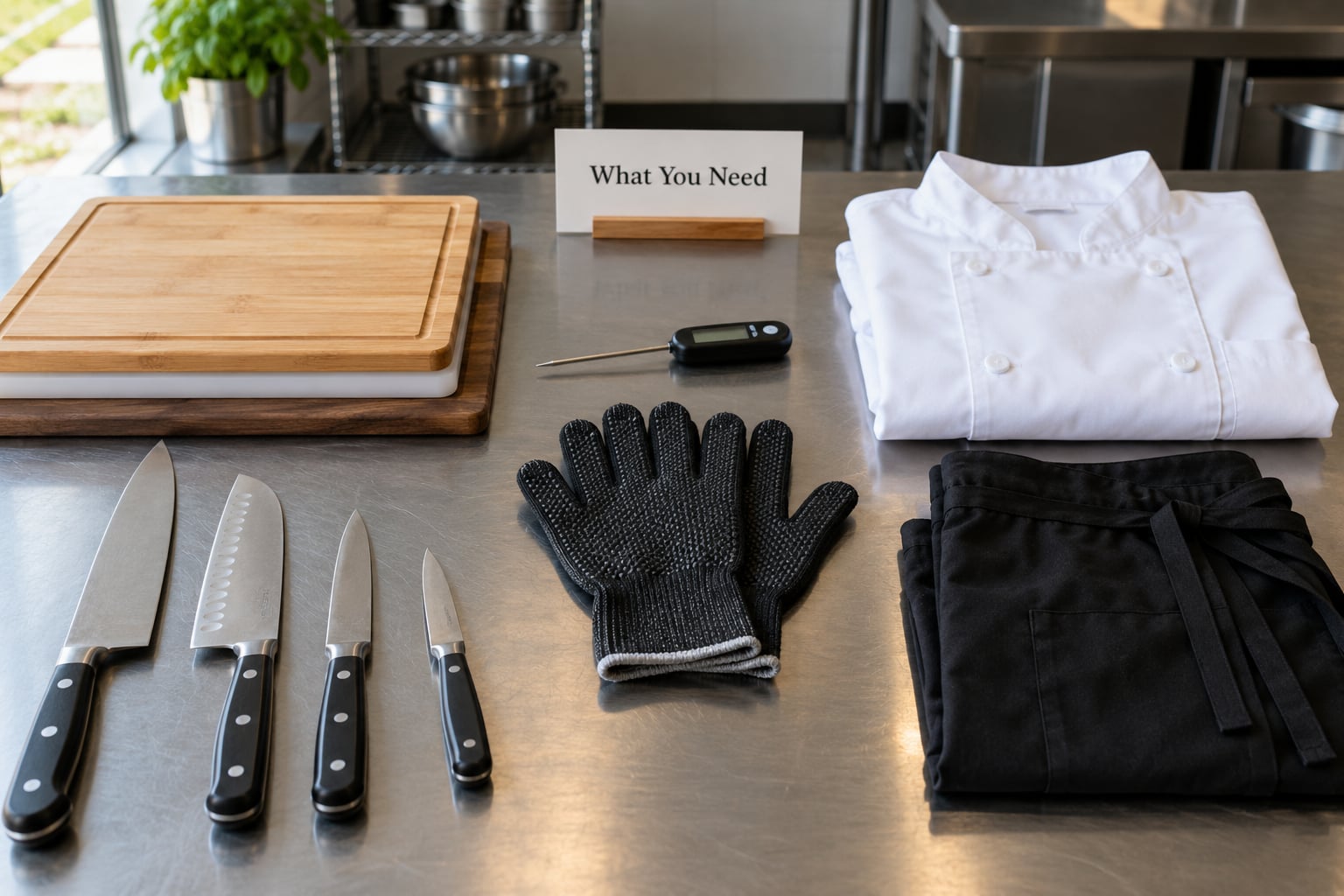
You do not need a culinary degree, a knife set, or a professional kitchen to get started. You need a few practical things in place before you start applying.
- Open availability. Line cooks work evenings, weekends, and holidays. A chef who can only offer Tuesday through Thursday afternoons will rarely get picked.
- Physical readiness. Plan on standing for six to ten hours a shift. Stretching your calves and lower back before and after service matters more than any single workout.
- Reliable transportation. Closing shifts end around 10 or 11 p.m. when many buses have stopped running.
- A food handler card. Most states require one, and it takes an afternoon to finish an approved course. Having it before you apply puts you ahead of most applicants.
- A short, honest resume. One page is plenty. See step 4.
For a starter toolkit, keep it small and buy it used where you can: one 8-inch chef knife you can actually sharpen, one cutting board, a kitchen thermometer, a set of non-slip shoes, and two pairs of cheap non-slip kitchen gloves. That is enough to practice at home for months. Bring a knife to an interview only if the restaurant asked whether you have one, because many kitchens supply their own equipment and take no responsibility for what you carry in.
The skills worth learning before you apply are chopping vegetables, portioning, reading a recipe, mise en place, handwashing and safe temperature control. You can practice every one of those in your own kitchen this week, which is exactly why beginning cooks who show up having already cooked do noticeably better in their first month.
Step-by-Step: How to Become a Line Cook with No Experience
1. Choose a Line Cook Entry Point
The easiest job in a kitchen to get with no experience is usually dishwashing or food prep, not the line itself. That is a normal path, not a setback. Dishwashing teaches you speed, hygiene, and how a kitchen runs; prep teaches you knife work, mise en place, and portioning. Plenty of cooks have climbed that ladder in two to three years.
If you want to apply directly for a line cook posting, target kitchens where the menu is narrow and repeatable: fast-casual, a burger-focused spot, a diner, a pizza kitchen, or a small seafood counter. Fine dining usually wants a stage or an externship first, and institutional kitchens often want a certificate you do not have yet.
Pick the environment that matches your strengths. If you are calm under pressure, a busy casual kitchen may suit you. If you hate loud rooms, a quieter prep-heavy operation will not break you the same way.
2. Build the Basic Skills Employers Look For
Chefs are not looking for expert technique on day one. They are looking for someone who can chop an onion evenly, follow a recipe without improvising, and keep moving when five orders land at once.
Practice these at home:
- Onion, garlic, pepper, and tomato dice, aiming for even pieces.
- Portioning sauces and proteins with a scale and measuring spoons.
- Mise en place, which simply means setting out and prepping every ingredient before you start cooking.
- Basic sautéing, grilling, and frying, including preheating and timing.
- Reading a recipe out loud once before you cook it.
- Plating to a simple standard so hot food leaves the pass looking the same every time.
- Saying “behind” and “hot” loudly enough to be heard over a blender.
A good test is cooking one complete meal start to finish without stopping to search for anything. If you can do that twice in a row, you are more ready than most people who apply on day one.
3. Learn Food Safety and Kitchen Standards
This is the one area where beginners lose offers fastest. Food safety is not optional knowledge and it is the first thing a kitchen manager will quiz you on. Learn the basics from your state’s food handler course, then keep these numbers in your head:
- Ground meat: 160°F internal temperature, with a three-day refrigerator rule for raw ground product in most kitchens.
- Poultry: 165°F.
- Whole cuts of beef, pork, lamb, and fish: 145°F with a three-minute rest.
- Cool cooked food from 135°F down to 70°F within two hours, then to 41°F or below within four more hours.
- Wash hands with hot soapy water for at least 20 seconds before handling food and after every break, restroom trip, or phone call.
- Keep raw meat below ready-to-eat food, use separate boards, and change gloves between tasks.
Every restaurant has its own written food-safety program, often HACCP-based. Read it if they hand it to you. Following the kitchen’s written system, rather than your own method, is the whole point.
4. Create a Resume and Application That Shows Transferable Skills
Career changers often apply with a resume full of jobs that look nothing like cooking and then wonder why nobody calls back. Translate your history into kitchen language without lying.
A retail job becomes “handled high-volume customer service during eight-hour shifts.” A warehouse role becomes “maintained strict time pressure and worked safely around heavy equipment.” A military, medical, or first-responder background becomes “worked under time pressure in a team where safety errors were not tolerated,” which is genuinely how a kitchen runs.
Do not put cooking hobbies under a job history heading. Put them in a short skills line: prepared meals for family, cooked on a home griddle and skillet, follows recipes, handles knives safely, comfortable with early mornings and closing shifts. Add any food-adjacent work, including dishwashing, food prep, catering help, or a family food business, and name it plainly.
One page, saved as a PDF, sent the same day you walk in. If the restaurant hires through an online portal, use it anyway, then follow up in person.
5. Practice a Restaurant-Style Line at Home
Practice at home so service feels familiar instead of foreign. Build a small menu with five or six items, a burger-and-sides format works well, then run it like a real service: prep everything first, fire one ticket at a time, and time yourself.
Run a 30-minute session twice a week. Prep for the first ten minutes, cook from a written list in the next fifteen, then clean and reset in the last five. Write down what went wrong. The first few sessions usually end with toast burning while the onions sit finished, because you tried to watch two pans at once. That is exactly the lesson a real line teaches you in one service.
Learning how a kitchen divides stations, who calls out orders, and how food travels from the line to the pass will make your first shift calmer. How restaurant kitchens organize a burger line is a useful walkthrough of that flow.
6. Apply to Restaurants That Hire Beginners
Independent and small casual restaurants hire walk-in applicants more often than large chains, which mostly filter through online applications and staffing agencies. Walk in between 10 a.m. and 2 p.m., never at 6:30 p.m. during a dinner rush, unless you are applying specifically for a closing shift and you call first.
Ask for the manager by name, not just anyone. Say you have no professional kitchen experience yet, you have a food handler card, you are available evenings and weekends, and you are available to work a trial shift this week. Keep it under thirty seconds and let them say no.
Online listings still work, especially for fast-casual and chain kitchens. Follow up two days later in person or by phone. Cooks on Chef Talk describe calling or returning a couple of days later as the difference between being remembered and being filed away.
7. Prepare for the Interview and Trial Shift
Expect a short interview and then a working interview, usually two to four hours on the line. Some kitchens pay it, some do not, and in most places a trial shift that goes unpaid for several hours is a legal problem rather than normal practice. Ask whether the shift is paid before you agree to one.
Common questions: what made you want to cook, how do you handle a busy service, why are you leaving your current job, can you work weekends and closes, and what do you know about food safety. The honest answer, “I have never worked a line yet, and I want to learn stations properly,” beats a rehearsed one every time. Chefs hire for attitude and reliability because cooking is teachable and showing up is not.
For the shift, arrive fifteen minutes early, tie your hair back, wear clean black trousers and closed-toe non-slip shoes, and expect to be handed a knife sharpener or a crate of vegetables within five minutes. Work clean, ask before you touch a station someone else owns, and wipe your bench every time you set something down. Red/green flags matter here too: kitchens with a written training plan and cooks who have stayed for years are the ones worth staying at.
8. Start Strong and Improve Your Career
Your first week is about names, not speed. Learn what gets called on your station, which item comes off the fryer basket first, and who calls the tickets. Ask the same question twice if you need to, and ask before the rush rather than after it.
Cooks who move up fastest do three things: they show up early, they stay late when asked, and they do the dirty jobs nobody wants, like breaking down the line at close. Skill comes second. Once you are comfortable, chase cross-training, then a station promotion. How to survive your first week as a line cook covers the daily detail if you want it before day one.
Common Mistakes
Most people who fail to become a line cook with no experience make one of these six mistakes, and every one of them has an easy fix.
Skipping the food-safety basics. A manager who asks you the safe temperature for ground meat and gets a shrug will offer the job to the next applicant. Study the numbers in step 3 and get your card before you apply.
Applying with a resume full of irrelevant jobs. Do not hide your history, translate it. Time pressure, service, teamwork, and safety are all kitchen skills wearing different uniforms.
Pretending you know the kitchen vocabulary. If you do not know what “mise en place” or “in the weeds” means, ask. Guessing wrong during a rush is worse than asking a question in a quiet moment.
Arriving unprepared. No shoes, no hair tie, no food handler card, ten minutes late. Ten minutes decides it more often than talent does.
Working slowly without organizing your station. Set out your tools and ingredients before the rush, not during it. A station that is already built is faster than a talented cook who has to search for a spoon at ticket nine.
Never asking for feedback. Ask your kitchen lead once a shift what you could do faster. Cooks who ask get moved onto new stations; cooks who wait stay where they are.
A few shorter career notes: treat closing shifts as a way to prove reliability, stay long enough to close, and learn one station deeply before asking for another. Burnout is real in kitchens, so protect your days off and watch for kitchens where the yelling never stops. A chef who works the line beside the staff instead of shouting from a distance is a much better place to learn.
Frequently Asked Questions
Can you get hired as a line cook with no experience?
Yes. Most restaurants hire beginners for dishwashing or food prep first, then move them onto the line within a few weeks. What gets you hired with no experience is a food handler card, open availability for evenings and weekends, a resume that translates past jobs into kitchen skills, and a willingness to learn a station properly instead of trying to cook well on day one.
What qualifications do you need to be a line cook?
Most states require a food handler card, and that is the only qualification you cannot skip. The rest is what you can show rather than what you hold. Employers want safe knife handling, mise en place habits, knowledge of safe internal temperatures, the ability to follow a recipe, and enough stamina to stand through a full service. A culinary degree helps in fine dining and is rarely required in casual dining.
What is the easiest kitchen job to get with no experience?
Dishwashing is usually the easiest to land because almost every kitchen needs one and the job is not glamorous enough to attract many applicants. Food prep is the better starting point for learning, since prep teaches knife work, portioning, and mise en place. Both paths lead to the line, and cooks who start in dish or prep often move up faster than those who wait for a line posting.
How long does it take to become a line cook with no experience?
Expect one to four weeks before you are cooking on a line unsupervised, depending on the kitchen and how fast you learn. From a dishwashing or prep start, reaching a full line cook role typically takes several months, and moving to sous chef takes considerably longer. Plenty of cooks never go to culinary school and work the whole way up on the job.
Do I need culinary school to work as a line cook?
No. Casual dining, fast-casual, and most independent kitchens train on the job, and that is where the vast majority of working cooks got their start. Culinary school is worth it when you want fine dining, pastry, or a hotel kitchen, because those employers ask for a degree or a stage. It also costs real money, so try the on-the-job route first if you are unsure.
How old do you have to be to be a line cook?
There is no universal age rule for the job itself, but labor law varies by state. Younger workers usually face limits on hours, when they can work, and which tasks they may perform, such as operating slicers or fryers. States and cities also set their own rules. If you are under 18, check your state labor department rules before you sign up for evening and closing shifts.
Conclusion
Start this week, not when you feel ready. Practice knife work and mise en place at home, learn the safe internal temperatures, get your food handler card, and write a one-page resume that translates whatever you did before into service, speed, and safety.
Then walk into two or three independent restaurants between 10 a.m. and 2 p.m. with an honest line about your experience and a willingness to work a trial shift. That is how most people learn how to become a line cook with no experience, one station at a time.