
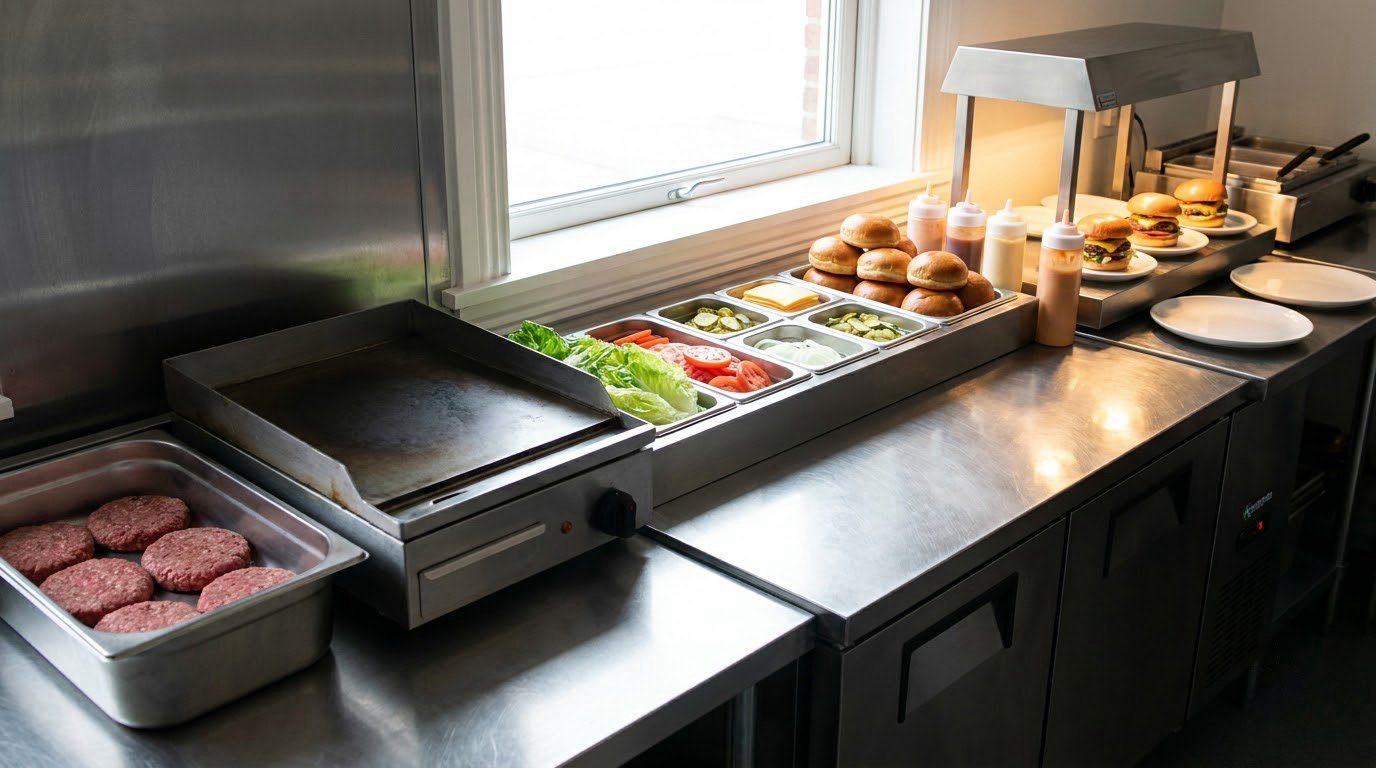
An organized burger line is a one-directional assembly line inside the kitchen. A ticket enters at the screen, product moves forward through fixed stations in the order prep, grill, dress, wrap, and nothing travels backward against that flow.
Understanding how restaurant kitchens organize a burger line comes down to ownership: which person owns each handoff, what information rides along with the ticket, and how many patties are allowed on the griddle at once. Get those three things right and the dinner rush stops being a scramble. Get them wrong and no amount of extra staffing rescues the service.
Table of Contents
- What Does an Organized Burger Line Mean?
- How Restaurant Kitchens Organize a Burger Line From Order to Service
- Who Owns Each Part of the Burger Line?
- How Kitchens Prep the Line Before Service
- How Restaurants Batch Burgers Without Making Them Inconsistent
- How the Line Controls Quality and Waste
- How Communication Keeps Orders Moving
- What Food-Safety Checks Belong in a Burger Line?
- How Burger Lines Differ by Restaurant Format
- Frequently Asked Questions
- Conclusion
What Does an Organized Burger Line Mean?
An organized burger line is a fixed sequence of stations where product, people and paperwork each move forward only. Raw protein is portioned at one bench, patties cook on a griddle, the build happens on a separate board, and a person at the expo checks every order before it leaves the pass.
Five goals define a well-run line:
- Consistent builds. Ticket 10 and ticket 200 should come out looking the same, in the same order, with the same portion.
- Short waits. A typical counter aims for roughly six minutes from ticket to handoff, and diners judge the whole restaurant by that number.
- Clear ownership. Every station receives something specific, makes decisions inside its own scope, and passes it on.
- Controlled waste. Patties get cooked to demand, not to panic, and remakes are logged rather than waved through.
- Safe handling. Raw and ready-to-eat work never shares a surface, hand, or towel.
The payoff is bigger than speed. Kitchens with a written station map tend to hold onto staff longer, because a new cook can read the line instead of guessing where the tongs live.
How Restaurant Kitchens Organize a Burger Line From Order to Service
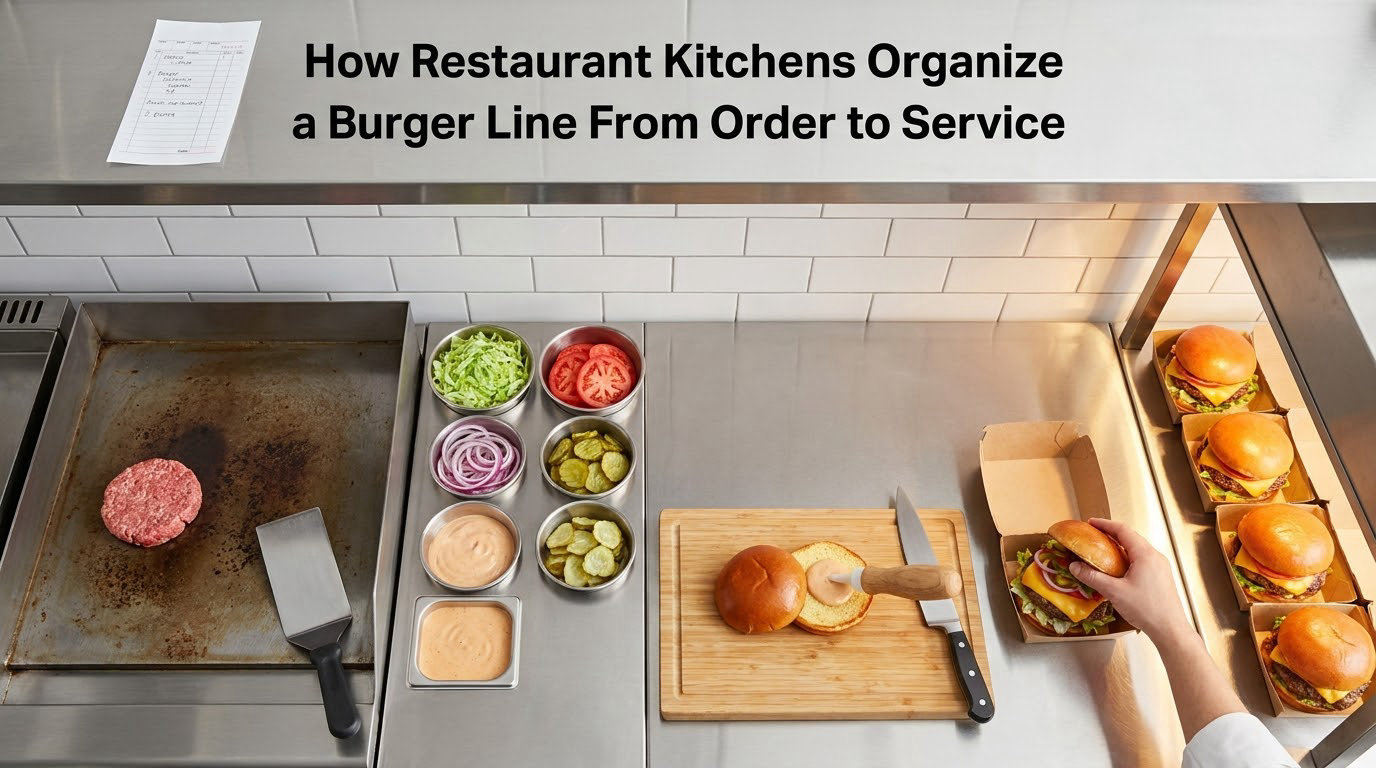
Here is the whole path in one view. Each row is a handoff, not just a place: the person listed owns the output of that step until someone downstream takes it.
| Stage | What happens | Who owns it | What travels with the ticket |
|---|---|---|---|
| Register to screen | The order is keyed in and printed or displayed, sorted by type | Expo or expeditor | Modifications, allergy flags, dine-in or takeout marking |
| Prep | Buns opened and staged, toppings pulled to the cold rail, patties portioned to spec | Prep or garnish cook | Build order: top to bottom, in ticket sequence |
| Grill | Patties seared in timed batches, cheese added, buns toasted | Burger cook | Number of patties fired, and how many of each doneness |
| Dress and build | Sauce, lettuce, tomato, cheese, toppings added in the same order every time | Dress or assembly cook | Nothing added. This station only assembles what it received |
| Expo and pass | Ticket read against the finished burger, plate or box, call the table, hand off | Expo person | The ticket itself, until the order leaves the kitchen |
Wash-up runs on a separate path entirely. Dirty equipment and waste travel back along a route that never crosses the food path, because a collision point in a busy kitchen is where injuries and cross-contamination both start.
How Restaurant Kitchens Organize a Burger Line During a Rush
During a rush, how restaurant kitchens organize a burger line changes rhythm, not layout. Stations that ran alone at 6 p.m. now run in parallel, and the expo starts sorting tickets by fire time rather than print order.
What changes in practice:
- Ticket prioritization. Simple single-patty burgers fire first because they cook fastest and unblock the pass. Custom builds wait for the next available griddle zone.
- A hard cap on the active batch. The cook only starts a new group when the previous one is plated. Stacking six finished patties waiting for assembly is the single most common way burgers go cold.
- Parallel stations. Someone who would normally only dress burgers starts toasting buns or building, so the grill is never waiting on a garnish bin.
- Signal words, not shouting. Short calls like “two up” or “table twelve” cut through a loud kitchen far better than full sentences.
- Bottleneck hunting. When tickets start stacking, the expo looks at which station has not moved in the last few minutes. Adding a body to a healthy station does nothing; adding one to the stuck station fixes the queue.
Dinner service is the hardest shape. Most covers land inside a two-to-three hour window, so the line has to hold peak throughput for longer than a lunch rush ever asks it to.
Who Owns Each Part of the Burger Line?
Every burger kitchen I’ve studied runs the same six roles, though one person often covers two of them on a slow Tuesday. Roles are defined by what comes in, what gets decided, and what goes out.
The expo person
Receives the order stream, decides fire order and ticket priority, confirms each finished burger against the ticket, and owns the handoff. This is the only station that sees the whole order at once, which makes it the only place a mistake can be caught before the plate leaves.
The burger cook
Receives a fired count, decides batch size and sequencing, and passes finished patties downstream. Temperature verification and doneness calls belong here, along with the decision to redrop a patty that failed the check.
The dress or assembly cook
Receives cooked patties and staged garnishes, decides nothing about the ticket’s content, and passes a finished burger to expo. Keeping this person out of decision-making is what keeps builds identical across a shift.
The prep or garnish cook
Receives the incoming ticket list, decides how much of each topping is staged and how far ahead, and passes a loaded rail plus portioned patties. This station predicts demand, so it is the first place shortages show up.
The fry cook
Owns fryer temperature, oil quality and basket timing, and passes finished fries to the pass. Fry is a separate station on purpose: hot oil and open flame next to a build board is how a line gets cross-contaminated.
The prep cook working the line during peaks
Relieves whichever station just stacked. Floating support cooks are what let a small kitchen run a lunch rush without hiring a full second line.
How Kitchens Prep the Line Before Service
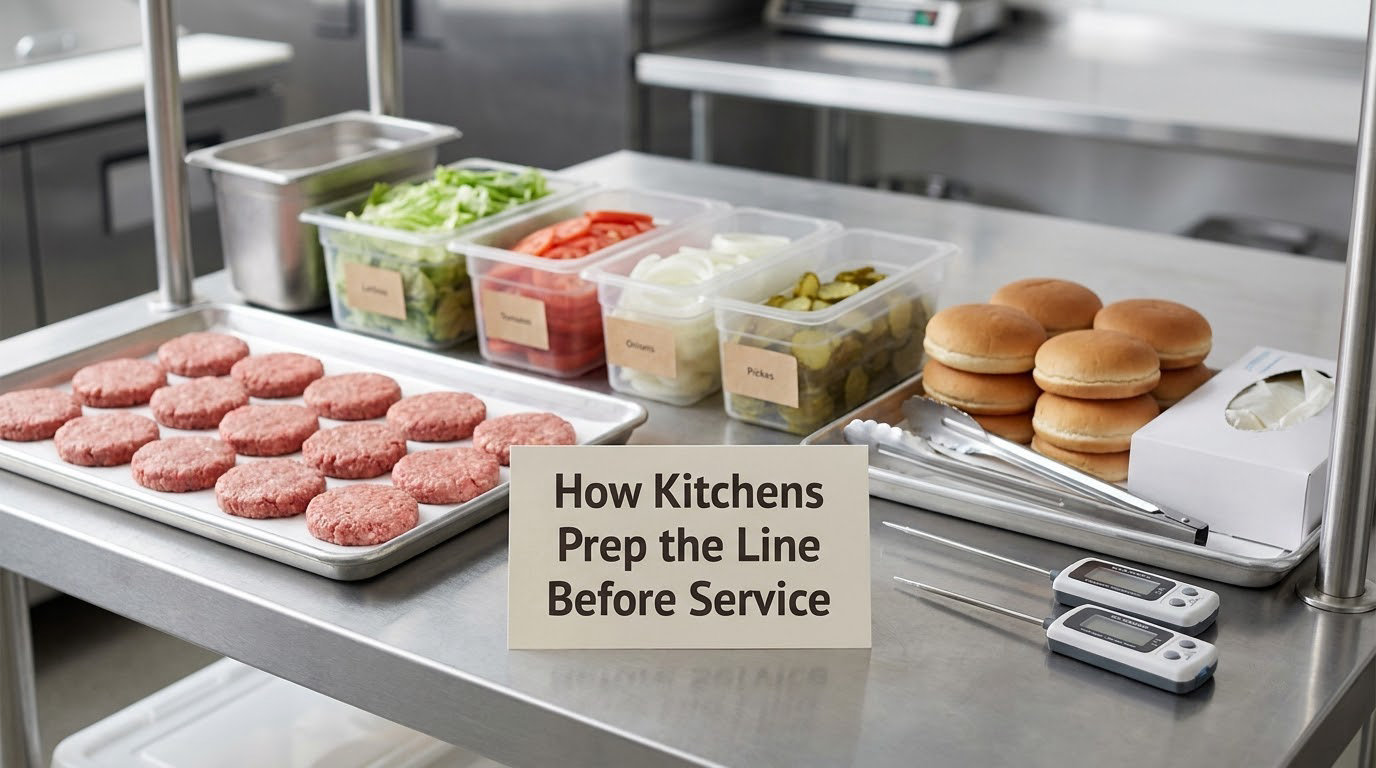
Mise en place is the work that makes service boring. A line that is fully staged before the first ticket rarely stalls, and a line that is not will spend the first ten minutes of service building the same station four times.
The standard pre-service routine:
- Portion patties to spec. Patties get weighed on a scale, not eyeballed. A common target sits around four ounces raw, and consistent weight means consistent cook times on the griddle.
- Label and date every bin. Lids get a tape label with the item and a use-by time, so nobody has to lift the lid to find out.
- Stage buns in small runs. Ten to fifteen buns at a time rather than a full tray, which keeps them from going stale or drying out under the heat lamps.
- Walk the cold rail left to right. Lids on the left, toppings stacked in build order to the right, so assembly is a left-to-right sweep instead of a search.
- Check equipment, not just turn it on. Probe the griddle, the salamander and the holding cabinet with a calibrated thermometer, and confirm the probe sanitizer is in date.
- Manage ice and holding. Ice bins get fresh ice, not topped off, and hot-hold cabinets come to temperature before the first order exists.
- Set condiments and packaging. Squeeze bottles filled, labels on bags, lids and gloves staged at the pass, because reaching for supplies mid-rush is wasted motion.
Save the heavy prep for ahead of service: blanched onions, sauce batches, and patties formed and chilled. Nothing on that list should be made to order during a rush.
How Restaurants Batch Burgers Without Making Them Inconsistent
Restaurants batch burgers by controlling one variable at a time: how many patties are in the heat, how thick they are, and how long they sit before assembly. A batch rule of thumb is to keep the cooking zone to what fits comfortably without crowding, commonly six to eight patties on a standard flat top.
The supporting rules that keep every patty in the batch identical:
- Same thickness, every time. A quarter-inch difference between patties is the difference between a juicy burger and a dry one, and it is the most common miss at a fast-casual line.
- A real temperature target. Ground-meat patties must hit 160°F (71°C) internally, verified with a calibrated probe, not judged by time alone. Time is a planning tool; temperature is the check.
- Buns toast last. Toast in the same window the patty comes off, not in a standing batch under the salamander. Buns left under heat too long go hard and dry, and a wet bun next to a hot patty goes soggy in seconds.
- Short holds only. A cooked patty waiting on a pass should be seconds, not minutes. If a batch is holding past that, the problem is upstream pacing, not the patty.
- One active batch per cook. A single cook works a single batch. Adding a person to a griddle that already has eight patties on it creates heat loss and uneven cooking, not speed.
The test of a good batch system is boring consistency: the 40th burger of the night should measure, cook and look like the fourth.
How the Line Controls Quality and Waste
Waste control and quality control pull in opposite directions, and a line resolves that with written thresholds rather than judgment calls in the moment. Both sides need a number attached.
The controls that work:
- Build order written down. Every burger follows one sequence, top to bottom. New hires learn the sequence instead of learning it from whoever is loudest that shift.
- Portion control at the bench. Scale-checked patties, measured sauce, counted toppings. An unmeasured ladle is where food cost quietly disappears.
- A defined remake rule. A dropped patty gets remade once and the remake gets noted on the ticket. Unlimited remakes hide a real problem; zero remakes hide a real problem too.
- A discard log for the pass. Anything held past its window gets written down with the reason. The same reason three nights running is an equipment or layout problem, not a staffing problem.
- Ticket time tracking. Most counters track from ticket print to handoff. Sustained drift upward points at the station that slowed, not at the whole team.
- Shortage triggers. When a bin hits its par level, the prep cook stages more before it empties. Restocking after a bin runs dry costs a ticket time and a remake.
The balance point is simple: waste is real money, but a stockout costs more because it costs a ticket time and a customer who never comes back.
How Communication Keeps Orders Moving
Communication on a burger line is short, specific and spoken in the same words by everyone. Consistency of language matters more than volume, because the grill cook has about two seconds of attention to spend on it.
What a line actually uses:
- Callouts. “Two up, one no cheese” says everything about what is leaving the griddle and what is expected downstream.
- Ticket marks. Color codes, circles, or written flags for modifications, allergy orders and takeout. Whatever the local convention is, it gets written on the board and taught, not assumed.
- Confirmation at expo. The expo reads the ticket against the plate: item count, build order, modifications. This is the last checkpoint before the order leaves the kitchen.
- Escalation rules. A wrong item discovered after handoff gets called back immediately and remade, not quietly fixed at the next table. Anything unresolved after a set number of minutes goes to the manager, not into a longer queue.
- A kitchen display system when volume justifies it. Screens sort tickets by type, flag modifications and track time automatically. On a high-volume counter this is the difference between the expo sorting by hand and the expo just reading.
Silence is the failure mode. When something unusual happens to an order, the station that noticed it says it out loud immediately, even if the fix takes ten minutes.
What Food-Safety Checks Belong in a Burger Line?
Burger service concentrates raw ground meat, cooked meat, and ready-to-eat toppings within arm’s reach of each other, which makes it one of the highest-risk lines to run sloppy. The USDA minimum internal temperature for ground-meat patties is 160°F (71°C), measured with a calibrated probe at the thickest point.
The checks that belong in every burger line:
- Handwashing on entry and after every task. Raw protein handling, then phone, then bun work, is a glove change. Gloves are not a handwash substitute.
- A dedicated raw-protein bench. Raw patties are portioned at their own station with their own knife, board and under-bench fridge. That prep never continues on the build board.
- Sanitized surfaces between tasks. Wipe, sanitize, air dry. The air-dry step gets skipped constantly and it is the one that makes sanitizing work.
- Temperature verification, not temperature guessing. Probe patties before they go to the pass, probe hot-hold units on a schedule, and log both. Calibrate the probe and sanitize its cords between uses.
- Correct storage. Raw patties stored below and separated from ready-to-eat items, covered and labeled with a use-by time. Never stack raw product above garnishes.
- Reheating rules that stay consistent. Cooked items reheated for service hit the same temperature targets as fresh cooks, and leftovers get reheated once rather than repeatedly.
- Discard by time, not by look. Anything past its window goes in the bin, including food that still looks fine. Appearance is not a temperature reading.
Local health codes add their own requirements, so the manager’s version of this list is the one that governs on any given service.
How Burger Lines Differ by Restaurant Format
The core sequence stays the same at every format, but station count, staffing and speed targets change with the menu and the service model. A burger-only truck and a full-service dining room are the same flow at very different speeds.
| Format | How the line is organized | Typical shape of service |
|---|---|---|
| Fast-casual counter | Prep, grill, dress, expo, plus a separate fry and beverage station; usually a screen at the pass | Highest volume, tightest ticket targets, heavy takeout and delivery mix |
| Full-service dining room | Grill and pantry stations handle burgers alongside a broader menu; expo runs the whole kitchen | Lower burger volume, slower tickets, more customization from the floor |
| Food truck | Two to three stations compressed onto a vehicle; prep doubles as storage | Very short service windows, one or two people cooking, extreme space limits |
| High-volume counter or commissary | Line split across parallel grill positions with dedicated prep, build and packing runs | Dozens of burgers per hour, batching and screen discipline replace hand signals |
Space drives a lot of it. Kitchens generally plan bench-run clearance in the 900 to 1200mm range; a cook line with less than 900mm behind it photographs well and fails the first time two staff need the same spot.
Frequently Asked Questions
Does every restaurant organize its burger line the same way?
No. The sequence stays roughly the same everywhere – prep, grill, dress, wrap, then expo – but station count, staffing and batch sizes change with the menu and the service model. A full-service dining room folds burger work into a larger pantry and grill setup, while a high-volume counter splits the line across parallel grill positions. The order of operations is the constant; everything else flexes.
How many burgers should a restaurant cook in one batch?
Enough to fill one comfortable zone of the griddle without crowding, which on a standard flat top is commonly six to eight patties. One cook works one batch, and a new batch starts when the previous one is plated rather than stacked on the pass. Holding cooked patties for later is the fastest way to lose both quality and ticket time.
What is the most common bottleneck in a restaurant burger line?
The dress and build station is the usual culprit, because it has the most hand-offs per burger and depends on everything upstream arriving together. Grill capacity is second: when patties back up waiting for a build bin, the grill slows down and cold patties pile up behind it. Watch for a station that has not moved for a few minutes rather than adding people everywhere.
How do restaurants keep buns and toppings from running out?
Par levels. Each topping and the buns have a minimum staged amount, and when a bin drops to that level the prep cook restocks it before it empties, not after. Buns are usually staged ten to fifteen at a time so they stay fresh, and the expo watches pars during service because a stockout costs a ticket time, a remake and a customer who does not come back.
Can a home cook use the same system for a large gathering?
Yes, and it scales down cleanly. Set up stations in one direction – a table for portioning and toppings, a hot surface for cooking, a separate board for assembly, and a spot where finished burgers wait – and stage everything before anyone arrives. Cook in small batches so nothing sits, and assign one person to handing out so you know how many are left.
Conclusion
The principle behind an organized burger line is simple: product moves forward, people own their handoff, and nothing waits. If you take four things from this guide, make them the first four changes you make.
Write down exactly what each station receives, decides and passes. Cap the active batch so nothing sits waiting. Check every build against the ticket at expo. And keep the same short callouts and the same written marks for modifications.
Once those four hold under load, scale the line up: add a grill position, split prep across two runs, put a screen on the pass. Scaling a system that does not hold yet just makes the failures arrive faster.