
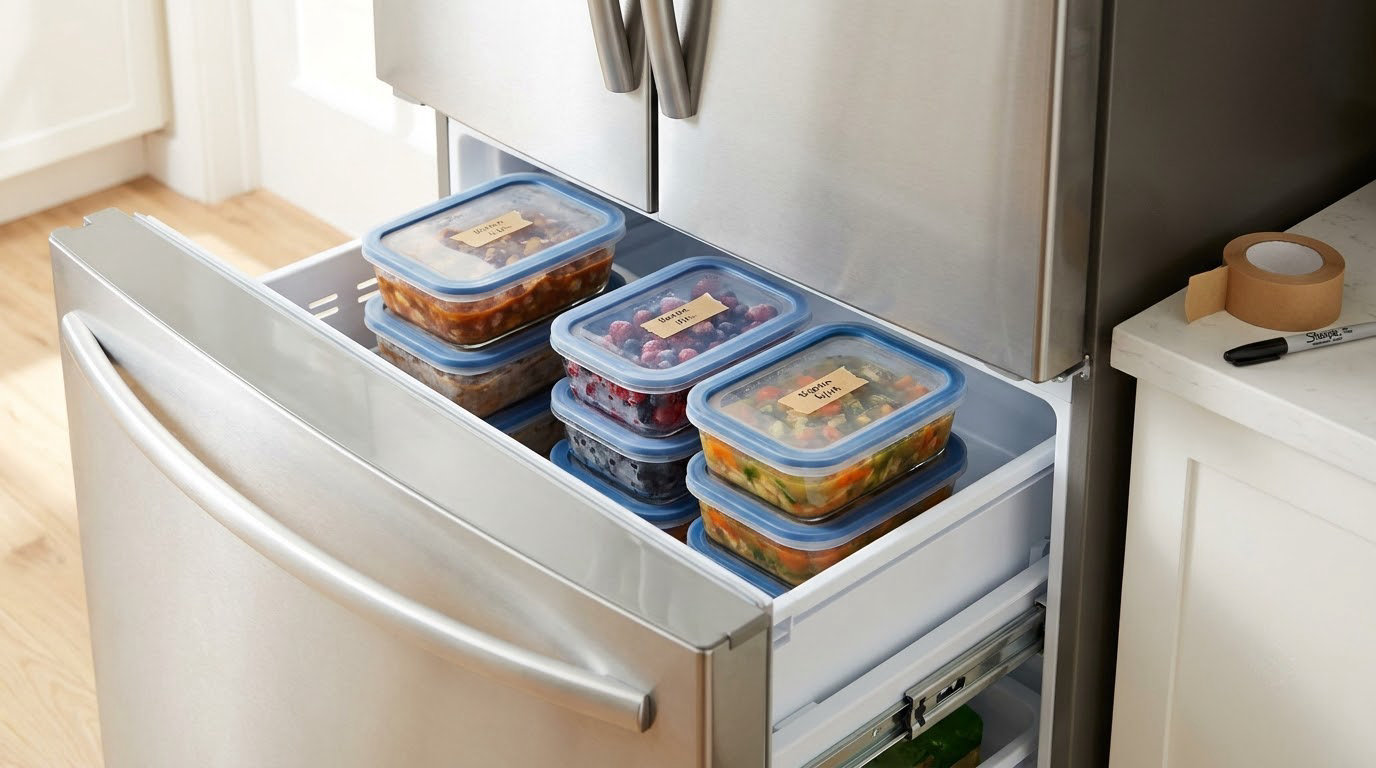
To label frozen food properly, write two things on every container: what the food is, and the date it went into the freezer. Add a use-by date for anything raw or perishable, the number of servings, and a short reheating note. Clear labels turn an anonymous frozen block into dinner you actually plan to cook.
The whole job takes about a minute per container, and the awkward part is doing it at the moment the food goes in, while you are still looking at it.
- Contents first, date second. A date on an unlabeled container tells you nothing.
- Always include the month and year, and spell the month out: FROZEN 3/14/26.
- Use a waterproof label and a marker that survives cold and moisture.
There is no federal rule requiring home cooks to date their freezer food, but the food safety guidance people actually rely on, from USDA and FDA, is built around knowing what a package is and how long it has been sitting there. That guidance also treats date labels as mostly about quality, not a hard safety cutoff, which changes what you should write.
Table of Contents
- What You Need
- Step-by-Step
- How to Label Frozen Food Properly Step 1: Identify the Product
- How to Label Frozen Food Properly Step 2: Write the Product Name and Quantity
- How to Label Frozen Food Properly Step 3: Add Safe Storage and Thawing Details
- How to Label Frozen Food Properly Step 4: Note Cooking or Serving Instructions
- How to Label Frozen Food Properly Step 5: Seal, Position, and Check the Label
- Common Mistakes
- Frequently Asked Questions
What You Need
You do not need a label printer or a commercial kitchen setup. You need something that survives a freezer, which is wetter and colder than most shelves.
A waterproof removable label is the most useful item. Removable matters more than waterproof: a label you can peel off means you can reuse a container instead of scraping off a date that is now wrong.
For writing, a freezer-safe permanent marker handles most containers and bags. On a wet or greasy surface, or on the printed label panel most freezer bags have, a paint marker or chinagraph pencil grips where a normal marker slides off and smears.
Keep a dry-erase pen in the kitchen too. When a label needs updating, because you moved a package or split a container in half, you correct one field instead of writing a whole new label over an old date.
Masking tape works for a few weeks and then gives up, curling or sliding off frosted plastic. It is fine as a temporary marker on something you plan to eat next, not as the system itself.
And you need a reference for freezing and thawing times, which is the table further down this page. Freezer temperature matters here: a freezer held at 0F / -18C keeps food safely frozen far longer than one that drifts up and down. If you are storing bread or buns for a cookout, portion and label them the same way you would a container of chili, the same rules in How to Toast Burger Buns Properly: Restaurant-Style Tips apply to what happens after they come out.
Step-by-Step
How to Label Frozen Food Properly Step 1: Identify the Product
Before you freeze anything, decide what it is. Most unlabeled freezer disasters are portioned containers with no lid note: a flat white block that could be rice, soup, or mashed cauliflower.
Leave commercial packaging labels intact. Do not cover or alter anything the manufacturer printed, including an ingredient list or allergen statement. Add your own label to a clear area on the front, or to the bag’s printed label panel, without hiding what is already there.
Success looks simple: hold the container at arm’s length, glance at the label, and you can say what is inside before you open it.
How to Label Frozen Food Properly Step 2: Write the Product Name and Quantity
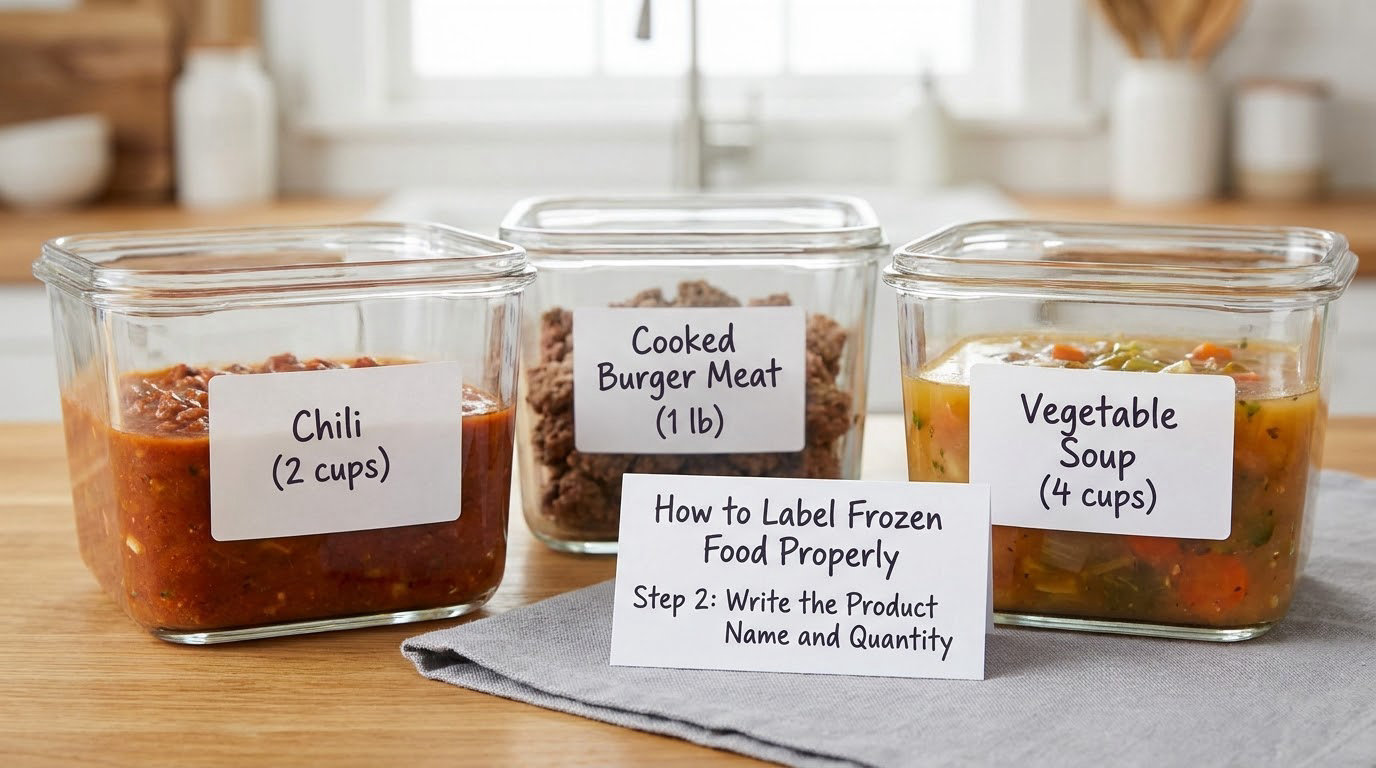
Write the name the way you would describe it to someone who has to cook it without you. “Chicken” is weak. “Chicken thighs, garlic and lemon, 4 servings” tells you the recipe, the cut, and the portion in one line.
Include the details that change how it is used: added toppings or vegetables, whether it is a full batch or a single portion, and whether the food is raw or cooked. Cooked and uncooked in the same pale color block are a real hazard, so mark cooked batches plainly.
For allergens or dietary restrictions that matter to someone in the house, write them out. This is the one case where a short code on the label is worse than a full word.
How to Label Frozen Food Properly Step 3: Add Safe Storage and Thawing Details
Write the date the food went into the freezer. Add a use-by date when the food is raw, perishable, or already cooked and meant to be eaten soon after thawing.
On wording, USDA guidance pushes Best If Used By, because that phrasing signals a quality date rather than a safety deadline. That works for most things. For raw meat, poultry, and seafood, write a specific cook-by date instead, because those carry a real limit and you should treat it like one.
Note the difference, since it is the part people get wrong. Freezing pauses bacterial growth; it does not kill bacteria. Food that was already past its use-by date when you froze it does not become safe again, which is why the original date matters as much as the freeze date.
Keep the freezer at 0F / -18C and use these windows as your starting point for the use-by date on the label:
| Food | Stays frozen at 0F / -18C | After thawing, cook or eat within |
|---|---|---|
| Raw beef, pork, lamb chops and roasts | 4 to 12 months | 3 to 5 days refrigerated |
| Ground beef and ground pork | 3 to 4 months | 3 to 5 days refrigerated |
| Chicken and turkey, raw | 9 to 12 months | 1 to 2 days refrigerated |
| Fish and shellfish | 3 to 8 months | 1 to 2 days refrigerated |
| Cooked leftovers, casseroles, soups | 2 to 3 months | 3 to 4 days refrigerated |
| Cooked grains and pasta | 2 to 3 months | 3 to 4 days refrigerated |
| Vegetables, blanched | 6 to 12 months | Cook or eat once thawed |
| Bread, buns, and baked goods | 2 to 3 months | Refresh or use from frozen |
These are the USDA frozen-food storage windows, and they describe quality first. Older cooks on home freezing forums regularly report food lasting well past these numbers in a cold, steady freezer, with texture as the thing that gives out first. Write the realistic use-by date for your food and keep your judgment about the rest.
For a container you already froze and forgot about, do not guess at the date and move on. Look at the food, check whether the texture and smell look normal, date it today, and give it the shortest realistic window. If you cannot identify it at all, that is a discard, not a label job.
How to Label Frozen Food Properly Step 4: Note Cooking or Serving Instructions
Add a line for how to cook or reheat it: “reheat 350F, covered, 25 min, stir at 15,” or “from frozen, 400F, 12 min per side.” Short is fine.
Do not treat that line as a safety guarantee. Cook to temperature, not to time, using the USDA minimums: 165F for poultry, 160F for ground meat, 145F for whole cuts of beef, pork, and lamb, and for fish. A label tells you what the food is; a thermometer tells you whether it is done.
If you freeze raw burger patties, it helps to write the cook direction right on the label so nobody has to find a recipe. How to Cook Frozen Burger Patties Without Thawing covers that in detail.
How to Label Frozen Food Properly Step 5: Seal, Position, and Check the Label
Attach the label flat, on the front or lid, with no corners lifting. On a round container, a flat rectangular label on the lid beats one wrapped around the curve.
Push out excess air and leave headspace in liquids so nothing presses against the label, then seal the bag or container. Label after sealing, once you know the final portion count. Squeeze the bag flat so the writing stays readable through frosted plastic.
Store in a consistent spot by category, and put newer packages behind older ones so the oldest one is the first you touch. That single habit, oldest first, is what turns labels into meals eaten instead of food thrown out. Labeling only works if you can find it.
Common Mistakes
Writing only a date. A date tells you how long something has been there, not what it is. Contents come first, then date, then quantity. This is the mistake home freezes and forum threads about unidentified freezer blocks have in common.
Writing 3/14 or leaving off the year. You will not remember what you meant a year later, and a month-old batch can look identical to a twelve-month-old one. Write the full date: FROZEN 3/14/26.
Using the wrong ink. Water-based ink on a damp container freezes into a smear, and some markers bleed through thin plastic. Use a waterproof marker, or a paint marker on the printed panel of a freezer bag.
Piling everything in with no order. Labels that face the wall do nothing. Face labels outward, group by type, and keep the oldest at eye level and in front. Food wrapped and buried at the bottom is how people find a bag of frozen meat on moving day.
Freezing leftovers without labeling them. Portion before freezing, not after. One container of chili becomes four single servings with labels on them, and single servings get eaten because they fit a Tuesday night.
Throwing food away on the date alone. For most frozen food, the date marks peak quality, not a safety cliff. If a Best If Used By date passed and the food looks and smells normal, it is usually fine. Raw meat, poultry, and seafood are the exception, which is exactly why those get a cook-by date.
Leaving headspace out of liquids. A frozen block presses against the label and the writing disappears behind ice. Leave room, or freeze liquids flat in a bag with the label on the flat face.
One last freezer labeling tip: date the day you freeze, not the day you plan to cook. Freezing on Sunday and cooking Thursday means Thursday is when you decide, and you will usually reach for the older package instead of the one you just made.
Frequently Asked Questions
Do I need to label frozen food that already has a package label?
Add your own label, but never cover or alter the manufacturer’s label. Retail packages already carry an ingredient and allergen statement you may need later, so write your details on a clear area or the bag’s printed label panel. What the factory rarely gives you is the date it went into your freezer or a portion count, and that is what your label adds.
How long can food safely stay in the freezer?
In a freezer held at 0F / -18C, USDA guidance gives frozen storage windows of 4 to 12 months for raw beef, pork and lamb, 9 to 12 months for raw poultry, 3 to 8 months for fish and shellfish, and 2 to 3 months for cooked leftovers and soups. Food frozen well past those windows is often still safe, but texture and flavor degrade. Freezing halts bacterial growth, it does not kill bacteria.
Should I write a use-by date or a best-by date on frozen food?
Write Best If Used By for most things, since USDA treats that phrasing as a quality date rather than a safety deadline. Write a specific cook-by date instead for raw meat, poultry and seafood, since those carry a real limit. Freezing pauses bacterial growth without killing bacteria, so food that was already past its use-by date when frozen stays past it.
What is the best way to organize a freezer with many packages?
Group by category, face every label outward toward the door, and put the oldest package at eye level and in front so you grab it first. A small basket or bin per category keeps flat packages from slumping into the back. Label everything, including bags cut from a larger box, because an unidentifiable block is the one thing labeling cannot fix.
Can I use masking tape to label food in the freezer?
It works in the short term and fails over time. Cold and moisture make the tape edges curl and the adhesive let go, usually within weeks, and the writing underneath smears if the surface is damp. Use it to note something you expect to eat in the next few days. For everything else, a waterproof removable label plus a freezer-safe marker holds up far longer.
Start with the oldest unlabeled container in your freezer, not the newest. If you cannot say what is in it, pull it out. If you can, label it today with the contents, the date, and a realistic use-by window, and put it back at the front.