
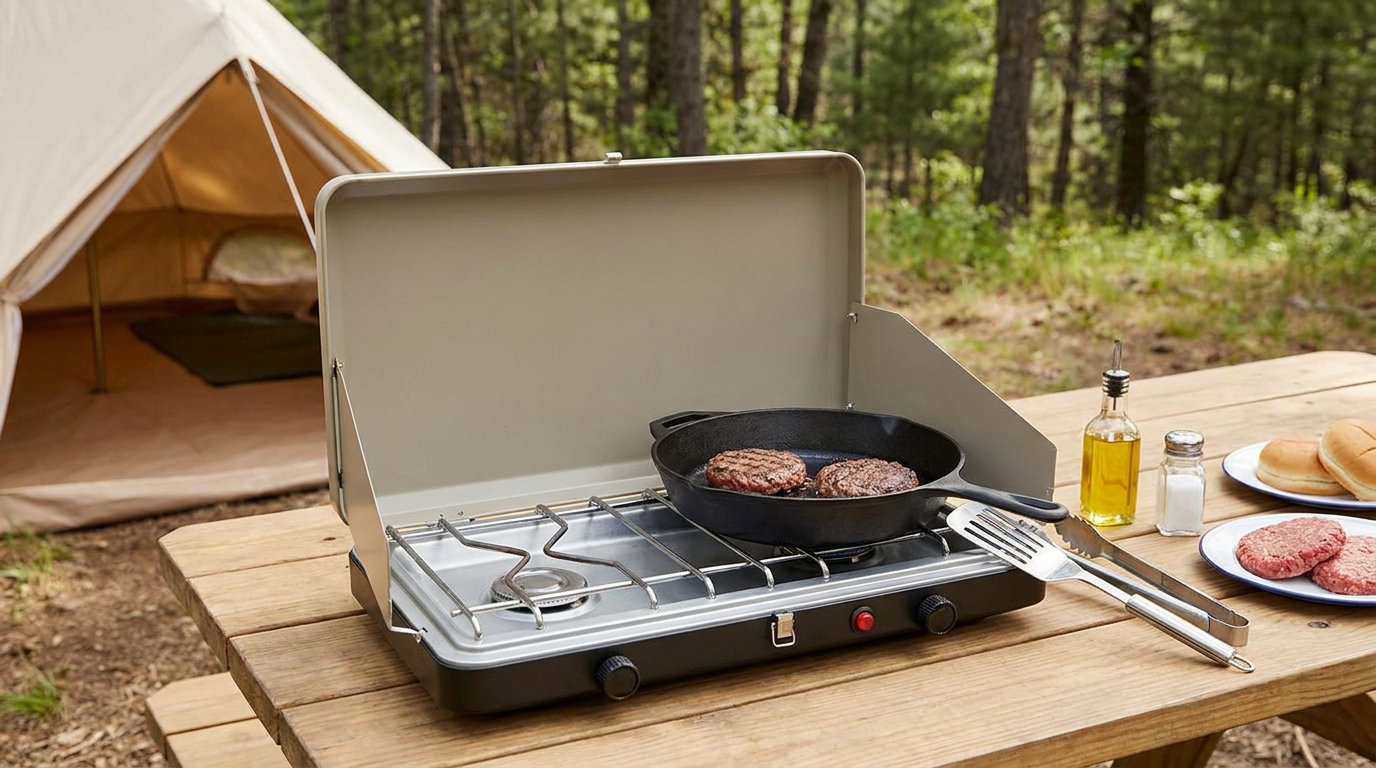
Yes, you can cook burgers on a camping stove, and you do not need a grill to get a proper crust. Sear ground beef in a hot cast iron or carbon steel pan over a portable burner: preheat the pan, lay the patties down without pressing them, flip once, and pull them at 160°F in the thickest part. A 1/4 inch patty takes about 3 to 4 minutes per side, a thicker 1/2 inch patty about 5 to 7.
Two things ruin camp burgers, and neither one is the recipe. The first is a pan that never got properly hot, which steams the beef instead of browning it. The second is a patty that gets moved too early, which tears the crust off and leaves it stuck to the iron.
What makes this different from a home skillet is heat loss. A camp burner sits in open air with wind across it and cold metal around the flame, so it climbs to temperature more slowly and drops it faster. Give the preheat extra time, keep the flame steady once you are cooking, and the method is otherwise the same one you would use in your kitchen.
What You Need
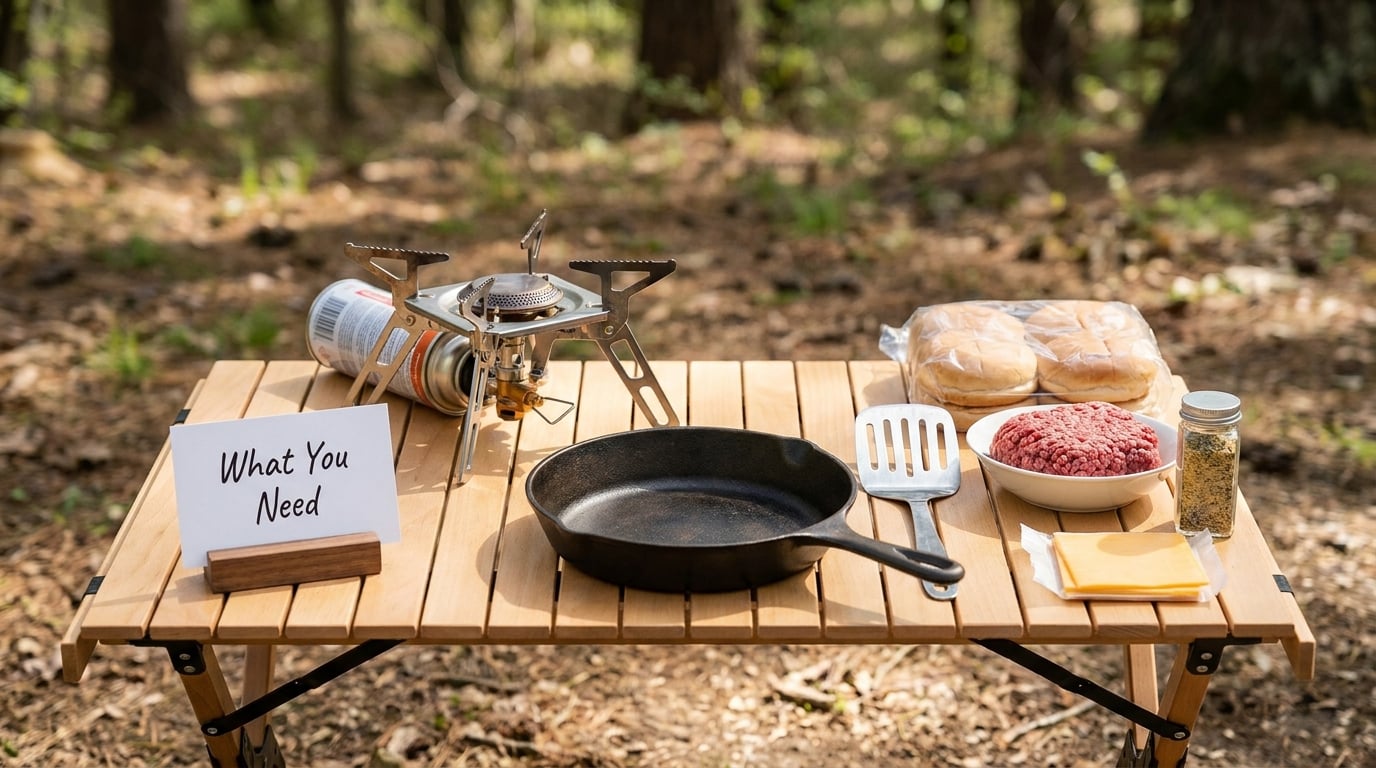
The gear list is short. Most campers already own most of it, and anything missing can be improvised without hurting the result.
Choose a burner that can hold steady heat
Any stove with a flame you can turn down and up again will work, but the size of the burner decides how many patties you cook at once. A single-burner backpacking stove handles one or two patties fine. A two-burner car camping stove gives you room for four and a spare burner for toasting buns while the meat cooks.
Community stove threads on r/CampingGear and fiberglassrv.com keep naming the same three-burner propane suitcase stove as the go-to for car-camping meals, mostly for simmer control and burner strength. That reputation tracks with what searing needs: a burner that holds its output rather than surging and dropping.
Pick a pan with some heft
Cast iron skillet is the best choice. It heats fast, holds temperature through a gust, and gives you the crust that people actually want from a camp burger. Threads in r/camping repeat the same point about durability: a cast iron pan will handle this heat for years.
Carbon steel is the lighter alternative and seasons the same way cast iron does. It heats almost as quickly and weighs noticeably less, which matters if you are walking to the site. Both need oil rather than soap for the longest life, and both need a thin film of high smoke point oil before the beef goes in.
Skip the flimsy nonstick camp pan if you want a sear. It cannot get hot enough to brown without the coating, and it takes more fuss to clean at a site.
Pack the supporting tools
- A wide spatula with a thin edge, so you can slide under a patty without tearing it
- A meat thermometer that reads instantly. This is the one tool that turns guesswork into a result
- A plate or board for cooked patties, kept separate from the raw beef
- A foil tray or the lid of your pot to catch drippings and give you an instant second burner surface
- A bottle of high smoke point oil such as canola, grapeseed or avocado
- Paper towels, a fork, and tongs
For raw meat, bring a separate cutting board or a sheet of parchment you can fold around everything afterwards and toss in a bag. Rinsing raw beef splashes water around the table and the cooler, and that water carries bacteria to everything it touches.
Also pack salt, pepper, and whatever else you actually like on a burger. A small jar of coarse salt and a bottle of sauce go a long way at a site with no kitchen.
Step-by-Step
Budget about 30 minutes from unpacking to eating for four patties, and most of that is preheat plus the ten minutes the meat needs. Here is the order that works.
- Set your cooking surface. Park the stove on a flat, stable table away from dry grass, and put a folded towel or a piece of cardboard under it so it does not rock. A stove that tips halfway through dinner is the real camping disaster.
- Light the burner and turn it to medium-high. Not maximum. You want a steady flame licking the underside of the pan, roughly a quarter inch, with no yellow tips. High heat gets you a black crust before the middle cooks.
- Preheat the empty pan for 3 to 4 minutes. Cast iron needs a real preheat. If the stove is a small backpacking burner, give it 4 to 5 minutes, because the flame is narrower and the recovery is slower.
- Check the heat with a drop of water. Flick a few drops onto the pan surface. If they skate across and evaporate in a couple of seconds, it is ready. If they sit and boil, wait. You are looking for a shimmer on the surface of the oil, not smoke.
- Add a thin film of oil, then the patties. Oil the pan, not the meat. Lay the patties down and leave them alone. Pressing them squeezes out the juice you want inside.
- Cook 3 to 4 minutes per side for a 1/4 inch patty, 5 to 7 for a thicker one. Flip once with the spatula, using a quick wrist motion rather than a slow slide. Season with salt on the second side as it hits the pan.
- Check the temperature and rest. Probe the thickest part of the patty with the thermometer. Pull at 160°F for beef. Rest the cooked patties on a clean plate for 3 to 5 minutes while you toast the buns, so the juices redistribute instead of running out onto the plate.
Cooking times by patty thickness
These times assume a cast iron skillet over a medium-high camp burner in calm air. Wind, altitude and a small burner can each push the numbers up.
| Patty thickness | Minutes per side | Total time | Pull at |
|---|---|---|---|
| 1/8 inch thin | 2 to 3 | 4 to 6 minutes | 160°F / 71°C |
| 1/4 inch standard | 3 to 4 | 6 to 8 minutes | 160°F / 71°C |
| 3/8 inch thick | 4 to 5 | 8 to 10 minutes | 160°F / 71°C |
| 1/2 inch thick | 5 to 7 | 10 to 14 minutes | 160°F / 71°C |
| Turkey or chicken patty | 5 to 7 | 10 to 14 minutes | 165°F / 74°C |
These are estimates, not a substitute for the thermometer. Altitude lowers the boiling point, cold nights pull heat out of the pan, and wind does both at once.
How to Cook Burgers on a Camping Stove Without Burning Them
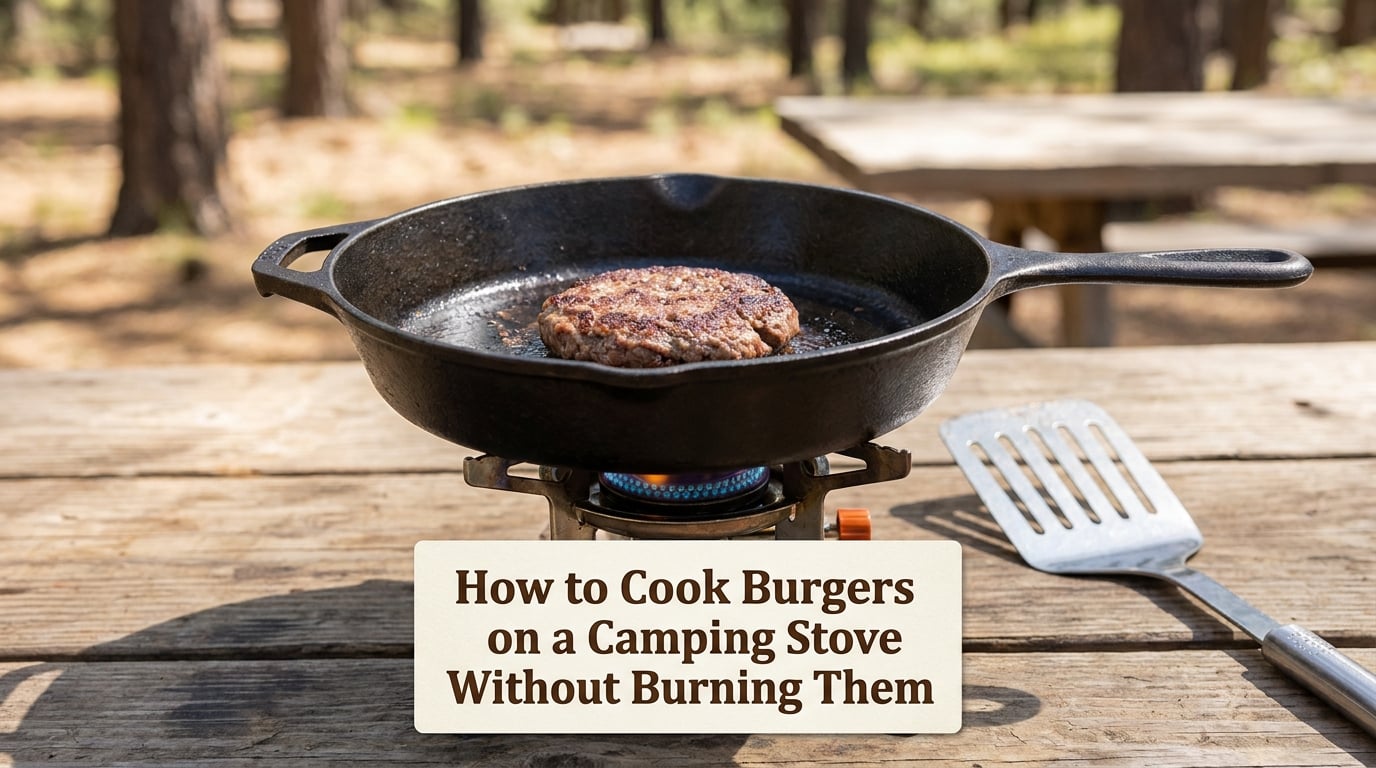
Burning happens when the outside of the patty is far ahead of the inside, and on a camp stove that gap opens for a specific reason: the flame is too strong for the pan you are using.
Turn the burner down once the pan is hot. A roaring blue flame under a thin cast iron skillet will scorch the crust in under two minutes while the centre is still cold. Aim for the smallest flame that still keeps the pan at temperature, and if your stove has a simmer control, use it.
When the burner runs hot on one side, offset the pan so the flame sits under half of it. A sandwich of uncooked and cooked patties on the same skillet also helps: the second patty sits over a cooler section of iron and stops the direct heat.
Watch the drippings rather than the clock. When the fat coming off the patty stops sputtering and starts to run like water, the surface has dried enough for the Maillard reaction to start properly. If smoke pours off the pan, pull the burner down immediately and add a spoonful of water or move the pan to the cool side.
Do not move the pan around. Every time you lift and settle it, the temperature drops and the sear resets. Set it down once and let it work.
How to Cook Burgers on a Camping Stove to the Right Doneness
Use a thermometer, probe the thickest part of the patty, and take it off the heat at 160°F for ground beef. USDA guidance for ground meat is 160°F, and ground turkey and chicken patties need 165°F. Those numbers are not preferences. Ground meat is mixed from many animals, so bacteria are distributed through it rather than sitting on the outside where searing can kill them.
Insert the probe from the side, at a shallow angle, aiming for the centre without pushing all the way through and out the top. If you only have a single reading, take it from the side rather than the top. The top surface cooks against the hot pan and reads high; the centre is the number that matters.
Carryover cooking will add a few degrees while the patty rests. Pulling at 158°F gives you a burger that lands at 160°F by the time it reaches a plate, and the rest keeps the juice in. Pulling at 165°F to be safe gives you a dry burger, because that extra heat pushes moisture out.
If you have no thermometer, press the patty gently with a finger. If it springs back it is raw, if it is springy with no give it is done, and if it feels firm and dense you have gone too far. This is the old way and it is noticeably less reliable than 10 seconds with a probe.
Common Mistakes
Almost every disappointing camp burger traces back to one of these. Each has a specific fix.
- Crowding the pan. Four patties in a skillet with room for two drops the pan temperature fast and steams the meat. Cook in batches. Two patties at a time beats four grey ones.
- Starting with cold cookware. Cold iron on a cold burner means the first two minutes go into warming metal instead of browning beef. Preheat empty, always.
- Flipping too often. Four flips in four minutes and you never get a crust to set. Flip once, let the second side finish, and only nudge a patty if it is genuinely stuck.
- Pressing the patties with a spatula. That squeezes juice out of the meat and gives you a dry burger with a broken crust. A press is only for a deliberate smash burger, and even then the press goes on once, for 10 seconds.
- Cooking on maximum heat from the start. Maximum is for preheating. It is not the setting for cooking the patty.
- Oiling the meat instead of the pan. Oil the pan. Oil on the beef just runs off and drips into the flame, which causes the flare-ups that char the outside while the middle stays cold.
- Using butter in the pan. Butter burns at searing temperature. Use a high smoke point oil for the sear. If you want butter flavour, toast the buns in butter on the cooler burner after the meat is off.
- Ignoring flare-ups. Grease falls, catches, and shoots flame up the side of the pan. Keep the burner down and a lid nearby to slide over the skillet for a few seconds.
- Reusing the board that held the raw beef. Use a clean plate for cooked patties and a separate board for raw meat, or use the parchment trick.
- Skipping the thermometer. Colour is not a temperature. A patty can look done and still be undercooked in the middle.
One more myth worth clearing up: the 5-6-7 rule of five minutes on the back, six on the front, seven to rest is a home grill convention tuned for a charcoal grill’s indirect heat. A camp stove gives you direct, intense heat under the patty. Use the thickness table above instead.
Tips
Match the method to your stove class
| Stove type | Can it make a good burger? | Notes |
|---|---|---|
| Two-burner car camping stove | Yes, easily | Four patties at once, and a spare burner for buns. Best option for families. |
| Three-burner propane suitcase stove | Yes, most control | Wide grates hold a heavy cast iron skillet without tipping. Popular in r/CampingGear threads. |
| Single-burner backpacking stove | Yes, one or two patties | Works if you preheat longer. Watch the wind. |
| Rocket or rock stove | Possible, one patty | Feasible, and the r/castiron threads on rocket stove burgers confirm it. Debate is about grate size and wind shielding, not whether it can be done. |
| Single-burner butane canister stove | Marginal | Lower output per unit volume. Fine for a quick cook, slower to recover. |
Propane or butane for searing
Propane is the better choice for burgers. It holds a higher output, works in cold weather where canisters get sluggish, and comes in larger refills, which matters when you are cooking for a group. Butane and isobutane mixes are lighter and pack smaller, which is why they win on backpacking stoves, but they have lower heat output per unit of volume and are the first fuel to struggle in a cold morning.
Neither fuel cares about altitude much, but thin air does reduce the heat your pan receives at altitude, so expect the top of the thickness table to run a minute or two long above about 8,000 feet.
Handle wind and cold
Wind is the biggest variable. Build a windscreen on the lee side of the stove, out of a spare shirt on a stake or the side of your vehicle, and give the burner a minute to recover after you light it. In cold weather, preheat longer than feels necessary and keep the lids on your other pots so they do not steal warmth from the pan.
Small upgrades that change the burger
- Rest the patties. Three to five minutes on a warm plate keeps the juice in the meat instead of on the board.
- Toast buns on the second burner or in the same pan. Buns that sat in a cooler all day are stale. Cut side down in the rendered fat for 30 to 60 seconds and they come back.
- Make patties thinner for small burners. A 1/8 inch patty on a rocket stove finishes in a few minutes and forgives a hot flame much better than a thick one.
- Freeze patties flat at home. Between parchment in a freezer bag they thaw in a cooler overnight and cook more evenly than beef packed loose.
- Do a smash burger with a spatula. Put the ball down, wait 10 seconds, then press once with the flat of the spatula and hold. A piece of parchment between the spatula and the patty stops the meat sticking to your tool. Lace a paper lid or a second cast iron pan on top and you get the double sear.
- Caramelize onions in the same pan. After the burgers come off, drop the heat, add a sliced onion and a spoon of water, and scrape the fond off the bottom. It takes five minutes and turns a plain patty into a dinner.
Clean up without a sink
Let the burner heat the pan until the excess fat smokes off, then turn it off and wipe with a paper towel. Wash with hot water and a small amount of soap when you get home, dry on the burner for a minute, and rub a very thin coat of oil over the surface before you pack it. Overland Bound’s cast iron thread makes the same point about camp cooking being gentler on a pan than people expect, as long as you do not leave standing water in it.
Frequently Asked Questions
What type of camping stove is best for burgers?
A single-burner stove with adjustable heat handles one or two patties, while a wider two-burner model gives you room for four plus a spare burner for buns. Three-burner propane suitcase stoves are the most popular car-camping choice in camper communities. What matters most is flame control: a burner you can turn down to a steady simmer gives you a crust without burning the outside.
Should I use a cast iron skillet or foil on a camping stove?
Cast iron heats quickly and holds temperature through a gust, so it gives you the best sear and the most even cook. It is heavy, though, and needs careful flame control because it stores a lot of heat. A disposable foil tray is lighter and washes in seconds but produces less browning and a thinner crust. Foil works fine for drippings and a second burner surface.
How long does it take to cook a burger on a camping stove?
A thin 1/4 inch patty takes about 3 to 4 minutes per side, so 6 to 8 minutes total. A 3/8 inch patty runs 8 to 10 minutes and a 1/2 inch patty 10 to 14 minutes. Wind, cold, altitude and burner size all shift these numbers, so check the thickest part with a thermometer and pull beef at 160°F.
How do I stop camp stove burgers from burning?
Turn the burner down once the pan is hot rather than running it at maximum, and offset the pan so the flame sits under only half of it. Cook two patties at a time instead of crowding the skillet, and watch the drippings: when fat runs freely instead of sputtering, the surface is ready to brown. If smoke starts, drop the flame and move the pan to the cool side.
Can you make a smash burger without a grill press at camp?
Yes. Press the ball of beef onto the hot pan, wait 10 seconds, then press once with the flat of a spatula and hold for about 10 seconds more. A sheet of parchment between the spatula and the meat keeps it from sticking to your tool. Put a paper lid or a second pan on top for the double sear, and skip the press for a thin patty over a small burner where the flame is hard to control.
Conclusion
Four things decide whether your camp burgers turn out well. Set the stove on stable ground with a windscreen and keep raw meat away from your clean plate. Preheat the cast iron empty for 3 to 4 minutes, then drop the flame to medium-high. Cook two patties at a time, flip once, and leave them alone. Probe the thickest part and pull at 160°F for beef or 165°F for poultry.
Everything else, the buns, the onions, the sauce, is negotiable. Those four are not, and nailing them is what turns a weeknight pan burger into the best one of the trip.