
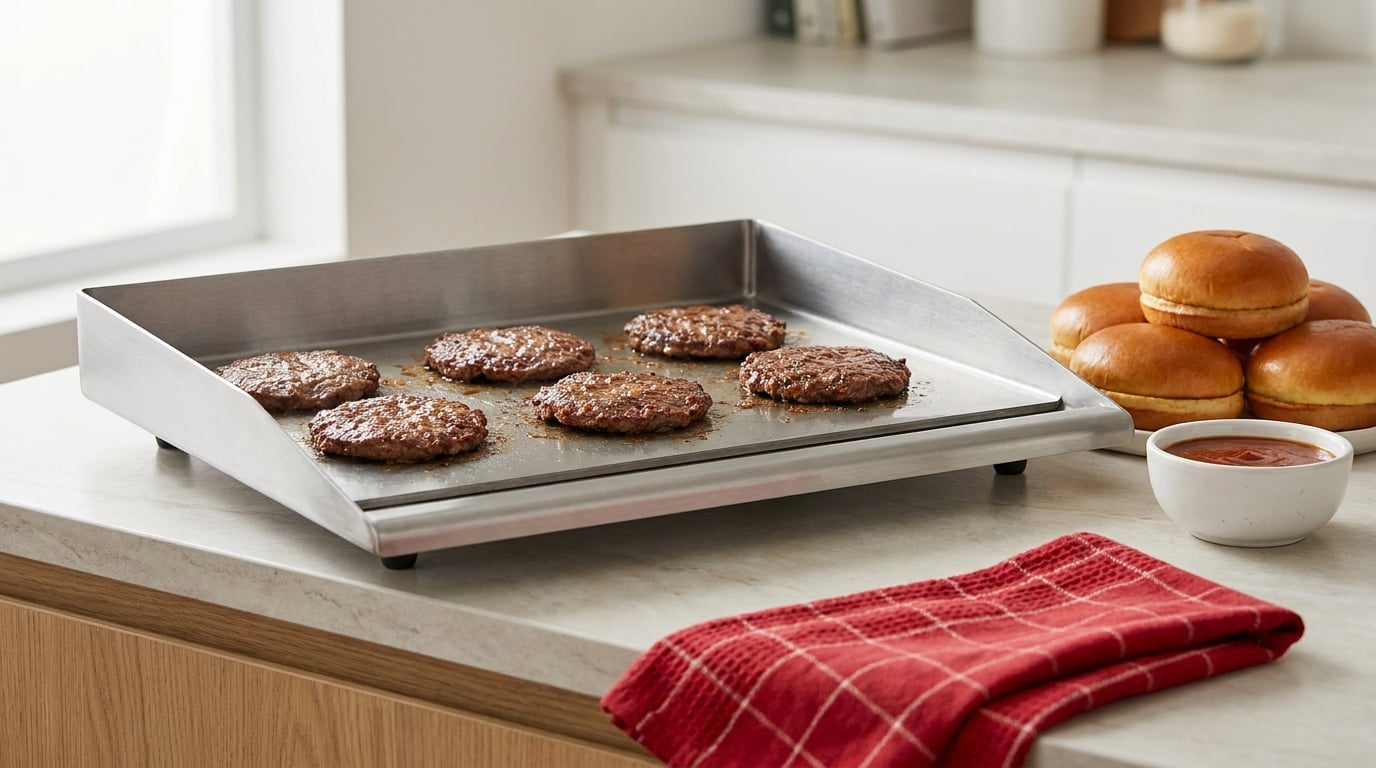
How fast food burgers are made comes down to three stages: a supplier grinds, blends, forms and blast-freezes USDA-inspected beef into uniform patties, a restaurant cooks each patty on a hot flat-top in roughly 40 seconds, and a crew member toasts the bun, adds condiments and hands it over. Nothing in that chain turns beef into something other than beef.
Most of the confusion comes from one word: frozen. Patties are frozen because a national supply chain has to work, not because the meat is fake or broken down. Once you understand the factory side, the kitchen side and the counter side, the whole process makes sense, and you can copy most of it on a home griddle.
Table of Contents
- What Is a Fast Food Burger?
- How Fast Food Burgers Are Made from Beef to Box
- How Are Fast Food Burger Patties Formed?
- What Happens Before the Patty Reaches the Kitchen?
- How Are Fast Food Burgers Cooked?
- Why Are Fast Food Burger Edges Crispy?
- Are Fast Food Burgers Grilled, Fried, or Cooked on a Griddle?
- What Is the Safe Temperature for a Fast Food Burger?
- How Are Fast Food Buns Prepared?
- How Are Cheese, Sauces, and Toppings Added?
- How Long Can a Fast Food Burger Be Held?
- Fast Food Burger-Making Methods at a Glance
- Can You Make Fast Food Burgers at Home?
- What Common Myths Are About Fast Food Burgers?
- Frequently Asked Questions
- Are fast food burger patties made from 100% beef?
- Do fast food restaurants freeze their burger patties before cooking?
- Why do fast food burgers taste different from homemade burgers?
- Are fast food burgers actually fried?
- How do fast food restaurants cook so many burgers at once?
- What is the best way to copy a fast food burger at home?
- Conclusion
What Is a Fast Food Burger?
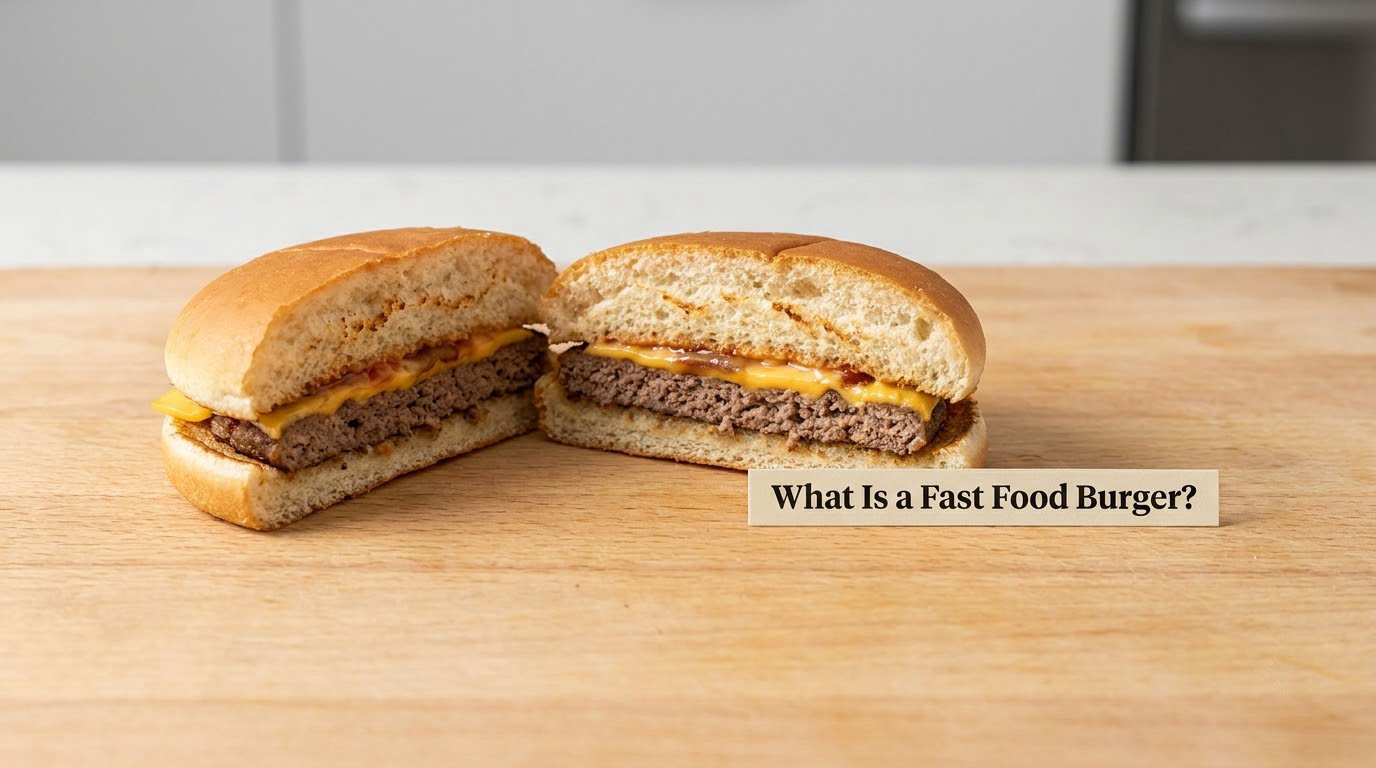
A fast food burger is an assembled menu item built through a high-volume restaurant process: beef formed into a portion of a fixed weight and thickness, cooked in batches on a flat cooking surface, and stacked in a bun with condiments and a small set of toppings.
That makes it different from three things people often lump it in with. A frozen supermarket patty is a retail product sold in a box, not a restaurant portion. A gourmet or pub burger is typically a thicker, irregular, hand-shaped patty cooked to order on a grill. And a home burger has no fixed weight, no fixed cook time and no assembly line behind it.
What a fast food burger has is consistency. Two locations 400 miles apart should hand you a patty that weighs the same and cooks in the same window, and that engineering goal drives every decision in the process.
How Fast Food Burgers Are Made from Beef to Box
Here is the full chain, in order, from the animal to the counter.
- Beef is cut and trimmed at a processing facility, and the usable trim is separated from the carcass.
- Trim is ground through a plate and grinder to a chosen consistency and particle size.
- Grinds from different cuts are blended together to hit a target fat ratio and a consistent texture.
- The blend is portioned, pressed, and shaped into patties of a fixed weight, usually on a forming line or by hand where a chain advertises hand-formed patties.
- Patties move onto lined trays or into sealed packaging, then through a blast freezer.
- Frozen patties move to a central distribution center and then to restaurants, usually arriving in about two to three weeks from formation.
- At the restaurant, patties go onto a preheated flat-top or clamshell grill, where thin patties are pressed and cooked on both sides at once for roughly 40 seconds.
- The bun is buttered and toasted for about 22 seconds while the patty cooks.
- The burger is assembled: sauce first, then the patty, cheese, and the rest of the toppings, then a wrap for the window.
Two to three weeks is the part that surprises people most. Transport is why freezing exists: a fresh patty would not survive that trip in a safe state, and a national chain needs thousands of identical patties in thousands of kitchens at once.
How Are Fast Food Burger Patties Formed?
Patties are formed for consistency, not for character. A production line portions the blend by weight so every patty cooks the same way, and presses it to a set thickness so the edges hit the griddle at the same moment.
Where a line runs, the sequence is straightforward. Blend arrives chilled, a portioner drops a set weight, a flat plate presses it, and a forming die sets the diameter and the surface texture. Some lines leave the patties with the fine parallel grain that comes from a grinder plate, which is a normal by-product of forming, not a defect.
Chains that advertise fresh or hand-formed patties skip the freezing and often the machine forming too. Five Guys is the clearest example: fresh ground chuck, pattied in the kitchen, and stored in coolers rather than freezers.
Patty shape changes the eating experience more than anything else on the line:
- Thin smash patties are pressed hard at the moment they hit the griddle. They cook in seconds and develop a crisp, browned surface.
- Thick patties are formed looser and taller, need a longer cook, and stay juicier in the middle.
- Double patties are two thin portions stacked, which is why some burgers are described by patty count rather than weight.
- Irregular hand-formed patties vary in thickness and edge, and cook less evenly by design.
Uniform weight matters for more than looks. A heavier patty needs more cook time, and a restaurant serving a fixed window cannot adjust per burger. Fixing the weight in the factory is how the cook time in the kitchen stays short.
What Happens Before the Patty Reaches the Kitchen?
Beef arrives at the supplier as trim and inspected carcasses rather than as finished portions. Every animal is inspected under USDA rules, and the meat a chain uses is a cut list of inspected product, not an assembled patty.
Grinding is where the blend takes shape. Chuck brings fat and collagen, which is what keeps a thin patty from drying out in forty seconds. Leaner trim from round and similar cuts supplies substance and keeps the fat ratio in the right place. Sirloin-style trim sits in between. The blend ratio is set by the chain, and getting a consistent ratio across millions of patties is the entire reason a blend exists.
For readers who want to understand fat in a patty, our guide to the best beef to fat ratio for juicy burgers goes deeper on why a lean fast-food-style blend behaves differently at home.
Blast freezing comes next. Patties move on lined trays through a freezing tunnel where temperatures drop fast enough that ice crystals stay small. Freezing quickly limits cell damage, which is why a blast-frozen patty loses less moisture when it thaws than a slowly frozen one. It also builds in shelf life and makes the cold chain enforceable.
From there it is logistics. Frozen patties go to a central distribution center, are held frozen, and travel to restaurants on scheduled routes. Chains that deliver patties chilled instead shorten the trip and accept a much shorter shelf life in exchange.
Not every chain uses the same supplier, the same blend or the same process. What is common across the category is inspection, a stated beef source, and temperature control from plant to grill.
How Are Fast Food Burgers Cooked?
Cooking happens on a preheated flat surface, in batches, with a fixed time target. The three setups you will see are a flat-top griddle, a clamshell or double-sided grill that presses both sides at once, and a conveyor line used at some high-volume sites.
Thin patties usually go down unseasoned, get pressed with a weighted spatula for a few seconds to force out moisture and seal the surface, then cook on the flat-top until the edges brown. Salt and pepper go on during or just after cooking rather than before, because salt on the raw surface pulls moisture out and slows the browning that gives a fast-food patty its flavor. Cooking both sides at once on a clamshell is the shortcut that makes the forty-second window possible.
Different chains run different versions of this, and the differences are public:
| Chain | Beef source and blend | Fresh or frozen | Cook method |
|---|---|---|---|
| McDonald’s | USDA-inspected beef trim, described as 100 percent beef with no fillers or additives | Most patties frozen; Quarter Pounder cooked to order from fresh beef in most contiguous US locations since 2018 | Flat-top grill, short cook, both sides pressed |
| Wendy’s | USDA-inspected beef, published as fresh, never frozen | Fresh, chilled | Griddled to order, single-sided with a turn |
| Burger King | USDA-inspected beef trim | Frozen patties, thawed in the kitchen | Flame broiling on a split-top grill |
| In-N-Out | Fresh ground beef, no freezers | Fresh, chilled | Griddle, spread thin with a spatula, cheese and fixings while hot |
| Five Guys | Fresh ground chuck, high fat ratio, no salt added | Fresh, chilled coolers only | Flat-top griddle, thin patties seared and flipped |
| Whataburger | Fresh ground beef, larger hand-formed patty | Fresh, chilled | Griddle, cooked on both sides |
| Shake Shack | Fresh ground chuck blend, no preservatives | Fresh, chilled | Flat-top griddle, thin smashed-style patty |
Read that table as a menu of approaches rather than a ranking. A frozen thin patty and a fresh thick patty are two different products built for two different jobs, and both can be good at what they are.
Why Are Fast Food Burger Edges Crispy?
The browning comes from the Maillard reaction, a chemical reaction between amino acids and sugars that kicks in at high heat, plus the caramelizing of surface sugars. Both need dry surface heat, which is exactly what a hot griddle and a thin patty deliver.
Pressing a thin patty at the start of cooking is what makes the difference. The press squeezes out surface moisture, flattens the protein on the surface, and increases contact with the metal, so more of the patty reaches browning temperature. A thicker, loosely shaped patty cannot do that, which is why fast food edges taste fried even though nothing was fried.
The flip side of that is a drier center. A pressed thin patty loses water to the griddle, which is one reason fast food burgers have the reputation for being thin and firm rather than thick and juicy. More fat in the blend is how that is balanced.
Are Fast Food Burgers Grilled, Fried, or Cooked on a Griddle?
Most fast food patties are cooked on a flat griddle or grill plate. Nothing is dropped into hot oil, so calling them fried is wrong, even though the crisp edges feel fried.
“Grilled” is used loosely. On a flat-top there are no grates and no smoke, just a hot steel plate. Burger King uses flame broiling, where burners heat the underside of a split-top grill and the drippings run off, which is closer to grilling and adds a smoky note. Everything else in the category is a flat surface.
One consequence of the flat surface is that there is no place for fat to drain away during cooking, so rendered fat stays in the patty and in the pan. That is part of the flavor people either love or avoid.
What Is the Safe Temperature for a Fast Food Burger?
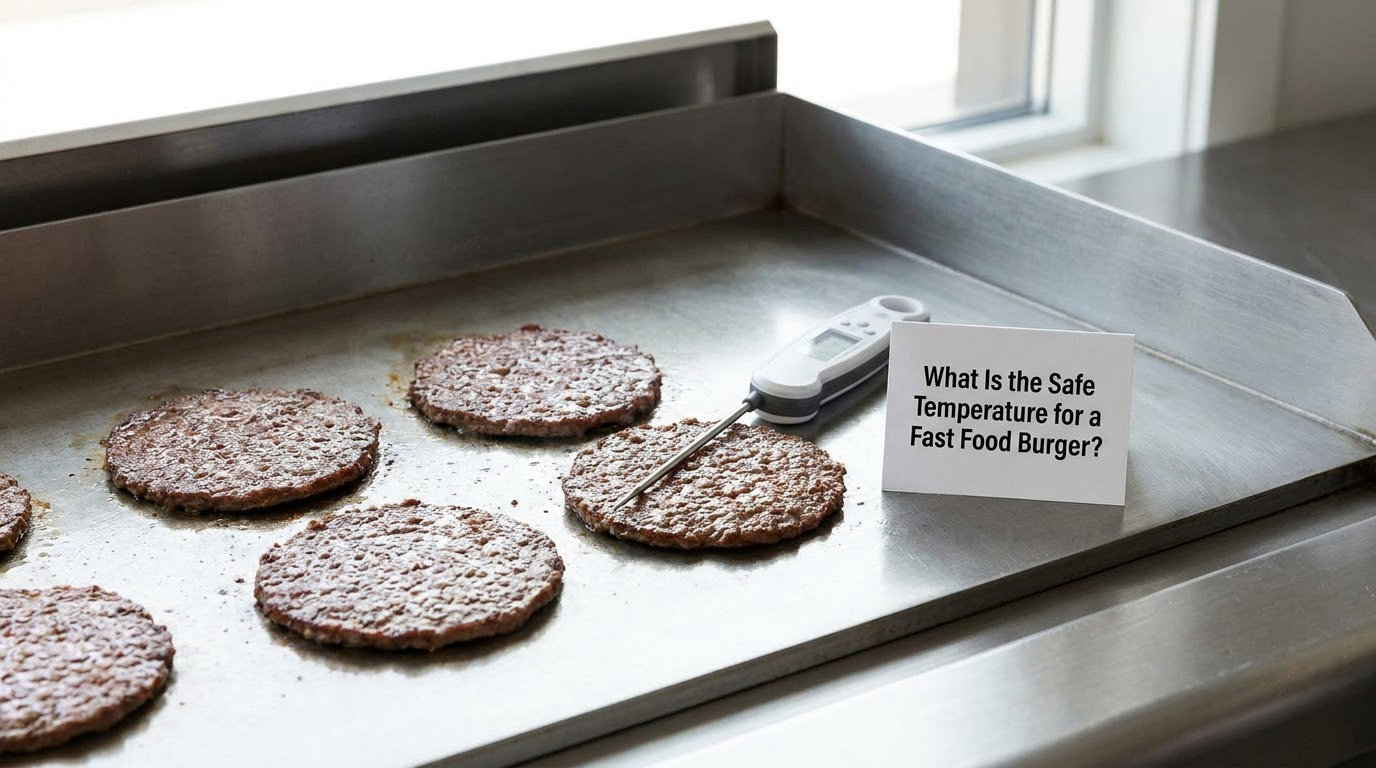
The USDA safe minimum internal temperature for ground beef is 160°F (71°C). Restaurants meet it with calibrated equipment, fixed cook times, and HACCP-based programs that document how each batch is verified, not by eye.
At home the hard part is measurement. A thin fast-food-style patty is hard to probe accurately, and pressing a thermometer into it while it is on the griddle can tear it. The practical approach is to cook to the target time on a verified hot surface, then check one patty out of the batch, or cut into the thickest part of a sacrificial patty and confirm there is no pink.
Appearance alone is not a safety check. Color depends on myoglobin and pH, and a patty can look right before it reaches temperature. If you are cooking for anyone at higher risk, take the extra step and verify with a thermometer.
Also worth knowing: cooked ground beef that is kept hot should stay at 140°F (60°C) or above, and any cooked patty you save should be refrigerated within two hours.
How Are Fast Food Buns Prepared?
Buns are manufactured, delivered, and held on site, and their condition depends almost entirely on moisture management. Most are delivered in plastic bags, which keeps the bun from drying out but can also trap condensation and make the bun gummy on the bottom.
At the restaurant the bun usually gets buttered and run through a conveyor toaster for roughly 22 seconds. That short pass warms the interior, crisps the cut face, and gives the sauce something to grab onto instead of soaking straight through.
Where a kitchen has a steamer instead of a toaster, the bun is warmed with steam and the result is softer and less buttery. Untoasted buns are the third option, common at places that build to order and want the bun to stay mild.
Crowns, the domed top slices, are treated separately from heels because they have different moisture. A line that toasts the crown longer gets a crunchier lid; a line that treats them the same gets a bun that dries out first at the top.
How Are Cheese, Sauces, and Toppings Added?
Assembly order is fixed so a burger built by three different people at 5 p.m. still looks the same. The usual sequence is: bun, sauce, patty, cheese, then the remaining toppings, then a wrap for the window.
Cheese goes on while the patty is still hot so it melts from residual heat rather than from the oven. Onions and pickles arrive dehydrated, which is a logistics decision as much as a flavor one: dried toppings weigh less, travel without a cold chain, and hold their texture on a line. Fresh lettuce and tomato are added cold at the window to keep them crisp.
Sauces are mixed in batches at a central kitchen and delivered in jugs, which is why a chain’s sauce is identical across states. Restaurant-made sauces and warmed gravy-style sauces exist too, mainly at chains cooking fresh patties to order.
The rush is the real test. A good line builds several burgers in parallel: bun in, sauce, patty down, cheese, toppings, wrap. That parallel work, not any secret step, is why a kitchen can put out a finished burger in a couple of minutes.
How Long Can a Fast Food Burger Be Held?
There is no single universal safe hold time, and you will not find a published one, because quality loss starts well before safety risk. The food-safety rules that do exist are about temperature: keep hot food at 140°F (60°C) or above, and refrigerate within two hours.
Two different holds get confused. Cooked patties are often held briefly in a covered pan during a rush, which costs a little moisture. A finished burger is a different story: steam softens the bun, the sauce migrates, the lettuce wilts, and a patty that was excellent at 90 seconds is a disappointment at ten minutes.
That is why many kitchens build to order rather than batch ahead. The patty is the fast part, and only the assembly is done in advance when volume allows it.
Fast Food Burger-Making Methods at a Glance
| Method | Cooking surface | Shape | Texture | Equipment | Home difficulty |
|---|---|---|---|---|---|
| Smashed thin patty | Flat-top griddle | Very thin, wide, pressed | Crisp edges, firm and dry in the center | Flat-top, weighted spatula | Easy, timing sensitive |
| Thick flame-grilled patty | Split-top grill over flame | Medium, tall | Smoky, juicy, heavier | Split-top grill | Hard, needs flame and a heavy grill |
| Conveyor-cooked patty | Belt over a heated plate | Fixed by tooling | Even, consistent, mild | Conveyor system | Not practical at home |
| Retail frozen patty | Home pan or griddle | Pre-set, uniform | Consistent, can be dry | Any skillet | Easiest, least control |
The pattern is clear: thinner and flatter means faster cooking and more browning, thicker means more time on the surface and more moisture retained. Pick the row that matches the burger you actually want.
Can You Make Fast Food Burgers at Home?
Yes, and the gap between the two is smaller than most people expect. You need ground beef, a heavy flat surface, a sturdy spatula, and a thermometer. You do not need a clamshell grill.
- Use ground beef with enough fat to stay juicy. Fat is what keeps a thin patty from turning to leather in a short cook; our beef to fat ratio guide explains why.
- Heat a cast iron griddle or flat-top pan until it is properly hot, then wipe it with a paper towel. A cold pan is the most common mistake; it gives you a gray patty with no crust.
- Ball a 2 to 3 ounce portion and flatten it between your palms to roughly an eighth of an inch. The thinner it is, the closer you get to the restaurant result.
- Salt the outside lightly right before it hits the metal. More than that pulls moisture out and slows browning.
- Lay the patty down and press hard with a spatula for about 10 seconds to force out moisture and seal the surface. Full walkthrough in our guide to making smash burgers on a griddle.
- Add a thin layer of oil around the edges if you want a lacy, crisp fringe. A square of parchment paper under the press gives a cleaner, more even smash on a home pan.
- Do not move it. Let it cook undisturbed until the edges brown and the top loses its raw sheen, then flip and cook the second side briefly.
- Check doneness with a thermometer in the thickest part and aim for 160°F (71°C), and salt again only after cooking if you want more seasoning.
- Butter the bun and toast it cut-side down on the same griddle for about 20 seconds while the patty rests, then assemble with a thin layer of sauce, American cheese, and pickles.
Total active time is about ten minutes. Once you have the pan hot and the portions even, the actual cook is still a matter of seconds per side.
What Common Myths Are About Fast Food Burgers?
The 100-cow claim. A burger patty can contain beef that passed through a shared grinder alongside product from many animals, sometimes cited as up to 100. That fact describes how a national supply chain handles a large animal carcass economically, not a quality judgment. Blended trim is standard practice in ground beef generally.
Fast food patties are fake meat. The patties sold in the US are USDA-inspected ground beef, and chains publish that they contain beef with no fillers, no preservatives and no additives. The rumor spreads faster than the rebuttal, which is why it keeps coming back.
Every patty is frozen. Most are, and some are not. Chains that advertise fresh, never-frozen beef and chains that cook fresh beef to order both exist, and a good number of outlets run both products side by side.
Fast food burgers are fried. They are not. They are cooked on a flat hot surface, and the crisp edge comes from pressed contact and browning, not from oil.
Leftover patties get recycled into chili. This one has circulated for years without a source. A used cooking line produces a small, unsanitary amount of material that nobody wants to handle or ship, which is a good reason to treat the rumor as folklore.
A brown exterior means the center is safe. Color is a surface reaction, not a thermometer. It is the most common food-safety mistake made with burgers at home, and the fix is a probe.
Frequently Asked Questions
Are fast food burger patties made from 100% beef?
In the US, the patties sold at major chains are made from USDA-inspected ground beef, and brands publish that they contain beef with no fillers, no preservatives and no additives. What varies is the blend: fast food patties usually combine leaner trim with fattier cuts such as chuck to hit a set fat ratio, so they are not always as fatty as a grocery store ground chuck. Read the chain’s own sourcing page for the specific product, since recipes and suppliers differ by item and by market.
Do fast food restaurants freeze their burger patties before cooking?
Most do, and the reason is supply chain, not quality. A frozen patty survives two to three weeks of transport through a central distribution network, and a fresh patty cannot. Fast freezing limits ice crystal formation, so a blast-frozen patty loses less moisture when it thaws. Chains that market fresh beef use chilled distribution and a much shorter shelf life instead, and some outlets run both products.
Why do fast food burgers taste different from homemade burgers?
Three things. The blend is formulated for a forty-second cook, with fat and collagen added so a thin patty does not dry out. The patty is pressed hard onto a hot flat surface, which forces out moisture and creates a browned crust that supplies most of the flavor. The bun is buttered and toasted, and the sauce is a recipe mixed in a central kitchen. A home patty cooked gently in a thick, loosely shaped form simply cannot match the crust.
Are fast food burgers actually fried?
No. Fast food patties are cooked on a flat-top griddle or a grill plate, with no hot oil involved. Some kitchens add a thin film of oil around the edges, and some grills run a flame under the meat from below, but neither is frying. The crisp edge comes from pressing a thin patty against very hot metal, which browns the surface quickly and drives off moisture.
How do fast food restaurants cook so many burgers at once?
They cook in batches on a large heated surface, not one burger at a time. Thin patties go down in rows, get pressed with a weighted spatula, and cook on both sides at once on a clamshell grill or turn in seconds on a flat-top. While that batch runs, the crew toasts buns, applies sauce, and stages toppings, so cooking and assembly happen in parallel. A well-run line puts out a finished burger in a couple of minutes.
What is the best way to copy a fast food burger at home?
Use a fatty ground beef blend, portion it to about 2 to 3 ounces, and flatten it to roughly an eighth of an inch. Get a cast iron griddle properly hot, salt the patty lightly just before it goes down, then press hard for ten seconds and leave it alone until the edges brown. Toast a buttered bun on the same griddle and assemble with a thin sauce layer, American cheese and pickles, in that order.
Conclusion
Fast food burgers are usually ground-beef portions formed for consistency and cooked rapidly on a flat cooking surface. A supplier blends inspected beef trim, forms fixed-weight patties, blast-freezes them, and ships them through a distribution network; a restaurant presses thin patties onto a hot griddle for roughly 40 seconds, toasts a bun, and stacks the burger in a couple of minutes.
Start at home with the one variable you control: a properly seasoned, evenly portioned patty, cooked on a genuinely hot flat surface and verified with a thermometer at 160°F (71°C). Everything else in the process is either logistics or repetition, and both of those are easier to copy than people expect.
Information here reflects general U.S. restaurant practice and public sourcing statements from the chains named, updated for 2026.