
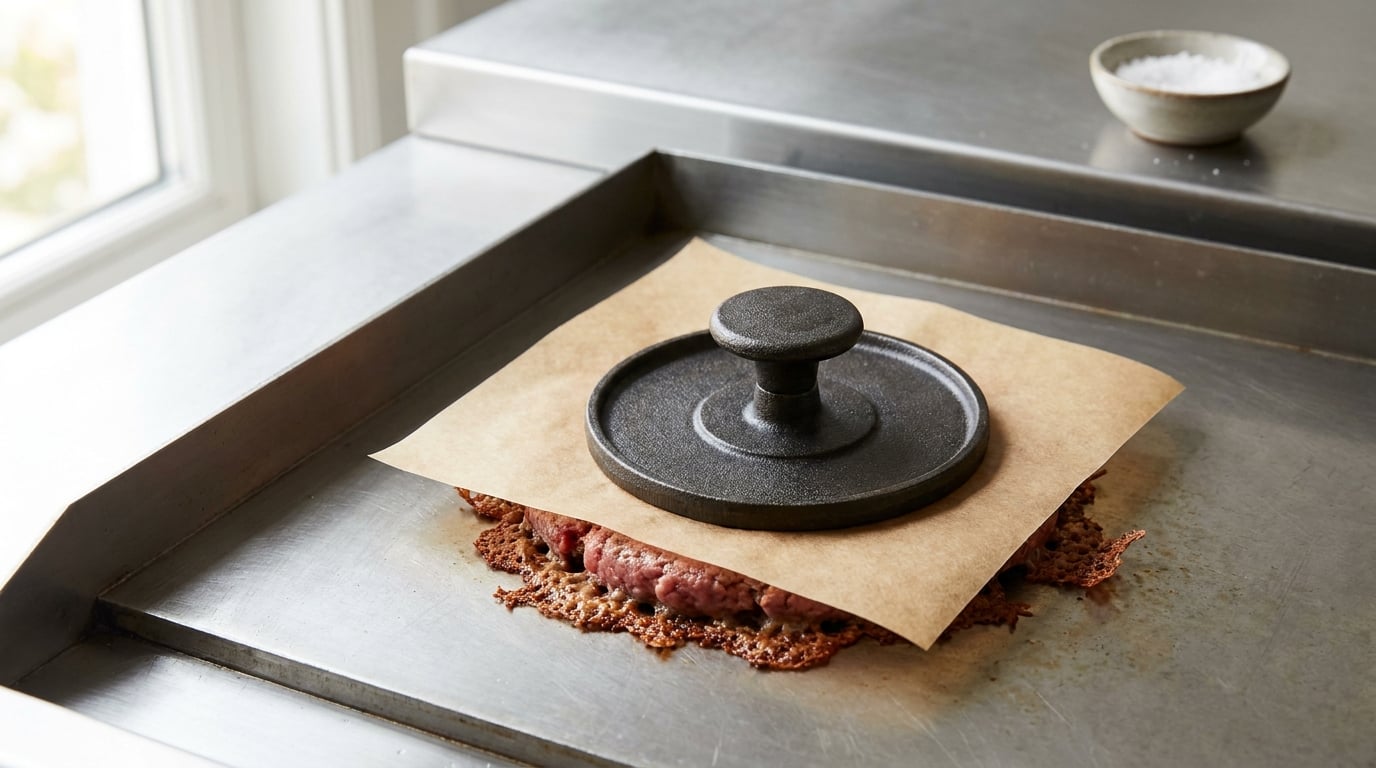
Parchment paper helps when smashing burgers because it puts a non-stick barrier between the raw beef and your press or spatula, so the patty spreads wide instead of tearing apart. The sheet goes on top of the meat, never on the griddle, which means the hot-metal contact that builds a smash burger crust still happens. You get an easy release without giving up the sear.
That last part surprises a lot of people. The sticking everyone complains about happens between beef and tool, not between beef and cooking surface, and those are two very different problems. Once you know where the paper sits, the whole technique makes sense.
Table of Contents
- What Does Parchment Paper Do for a Smash Burger?
- Why Parchment Paper Helps When Smashing Burgers
- How Does Parchment Affect Browning and the Sear?
- How to Use Parchment Paper for Smashing Burgers
- Parchment Paper vs. No Paper: Which Is Better?
- Common Problems and How to Avoid Them
- Frequently Asked Questions
- Does parchment paper really prevent smash burgers from sticking?
- Does using parchment paper make a smash burger taste different?
- What temperature should I use for smash burgers on parchment paper?
- Can I use wax paper instead of parchment paper for burgers?
- Is parchment paper or a silicone mat better for smash burgers?
What Does Parchment Paper Do for a Smash Burger?
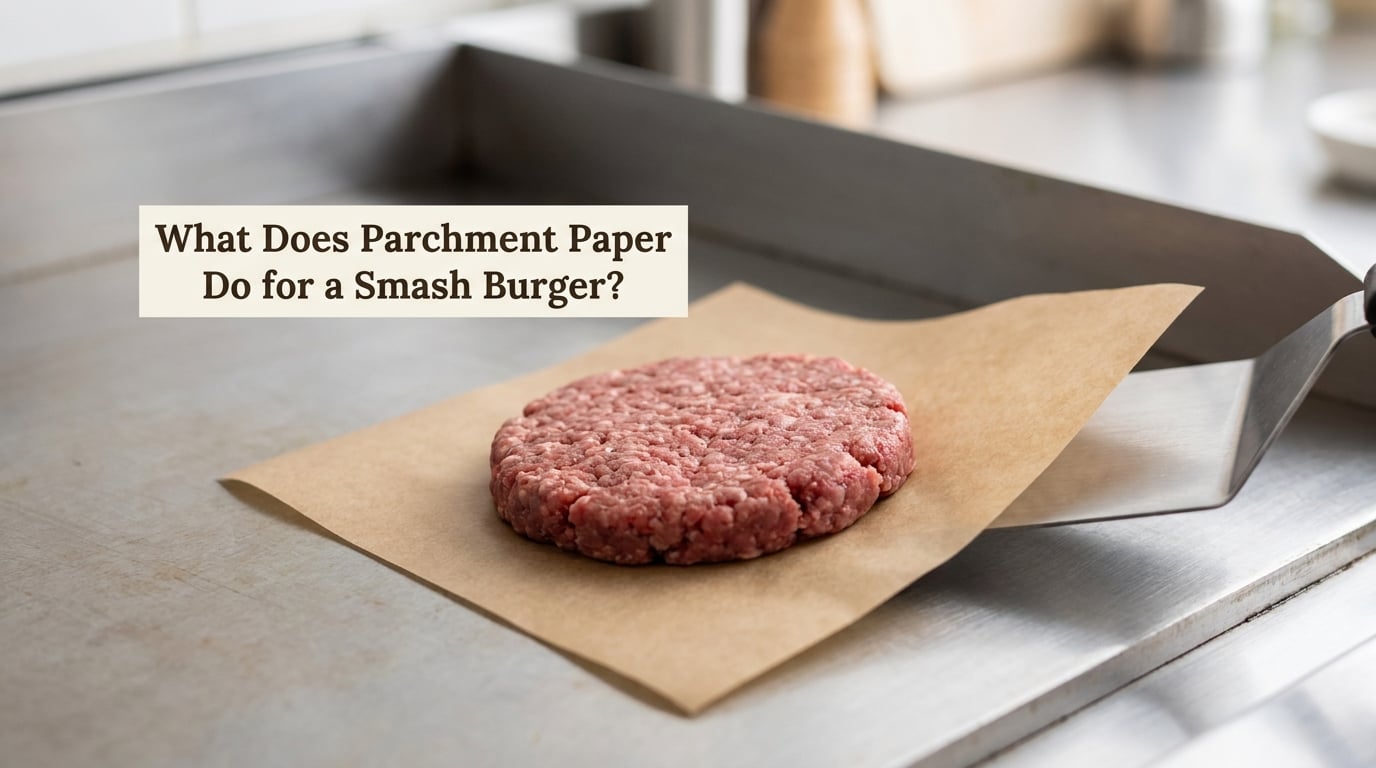
Parchment paper is a silicone-coated, non-stick baking sheet, and its job on a griddle is simple: it becomes a sacrificial layer you can peel off. A 3 to 4 ounce ball of beef goes down, a square of paper goes over the top, and your press flattens the meat through that sheet.
Because the beef never touches the tool, the press lifts off clean. The patty keeps its round shape, stays an even thickness, and spreads to the full diameter you wanted. Without the paper, raw beef grabs onto metal the second you press it, and a third of the patty often stays welded to the press when you try to pull it away.
A secondary benefit is grease containment. Rendered fat soaks into the paper instead of burning onto your griddle, and once the patty is transferred to your bun the sheet goes in the trash. Your griddle still needs scraping, but far less of it.
Here is what parchment does not do. It does not make the burger taste different, it does not speed up cooking, and it does not insulate the beef from the heat unless you lay it on the griddle as a liner, which is a different method with a different tradeoff.
Why Parchment Paper Helps When Smashing Burgers
Raw ground beef is sticky in a way that cooked beef is not. When the meat hits a tool, its proteins and its moisture form a tacky bond in under a second, and pressing multiplies the contact area. Parchment paper interrupts that bond completely, which is why the reason parchment paper helps when smashing burgers is mechanical rather than culinary.
Beyond release, the barrier does three more useful things:
- It preserves the patty. Torn edges turn into ragged scraps of beef stuck to the press, and a smash burger needs a full-width disc to cook evenly.
- It keeps thickness uniform. A patty pressed through paper comes off the press at one consistent height, so every bite cooks the same way.
- It makes transfer trivial. Lift the paper, hook a spatula under the patty, and you are already moving toward the bun with no scraping and no scraping marks.
- It works for batch prep. Parchment squares on the counter let you flatten meat balls away from the heat, which is how greasy spoon diners get a stack of patties out fast.
That last use is where the paper earns its keep for anyone cooking more than a couple of burgers. On the Pitmaster Club forum, cooks describe laying squares on a counter, dropping a ball on each, covering with another square, and stacking them so they can flatten a whole tray before the griddle gets going. They also reuse one top square across roughly twenty patties before swapping it out.
Why parchment paper helps when smashing burgers: it blocks the tool, not the griddle
State it plainly, because the confusion runs deep. In the barrier method, the paper sits between the press and the meat. The meat still sits directly on hot metal. Nothing is between the beef and the griddle, so the sear is untouched.
That also settles the wax paper question. Wax paper is not a weaker version of parchment, it is a different product with a wax coating that softens and can smear at griddle temperatures. Parchment is silicone-coated and made for high heat. Experienced cooks on r/AskCulinary and DiscussCooking reject wax paper for this job on principle, and the mechanism is why: it is not rated for the surface you are cooking on.
How Does Parchment Affect Browning and the Sear?
Under the barrier method, essentially not at all. A smash burger crust comes from the Maillard reaction, where amino acids and sugars brown under intense dry heat, and from full surface contact that lets rendered fat run out while the edge dries out and crisps. The paper does not touch the griddle side of the patty, so both of those processes run exactly as they would without it.
What changes is the top surface. The side that faced the paper steams a little more than bare metal would, since moisture escapes more slowly through a sheet than through open air. In practice that side goes onto the bun, so you never notice it.
Two honest caveats. If you are using a griddle at the very top of its range, an extra layer between the press and the beef can shave a few seconds off the press side, so watch the top rather than blindly copying a timer. And if you lay the paper on the griddle as a liner, you are now insulating the meat, browning will be slower and less even, and you give up the lacy crisp perimeter that makes a smash burger worth eating.
Typical smash burger work happens on a flat-top at roughly 450 to 500°F, with the patty pressed for 30 to 60 seconds per side. Home cooktops and electric griddles often cannot hold that, so give the beef more time and expect less char, whether or not paper is in the picture.
How to Use Parchment Paper for Smashing Burgers
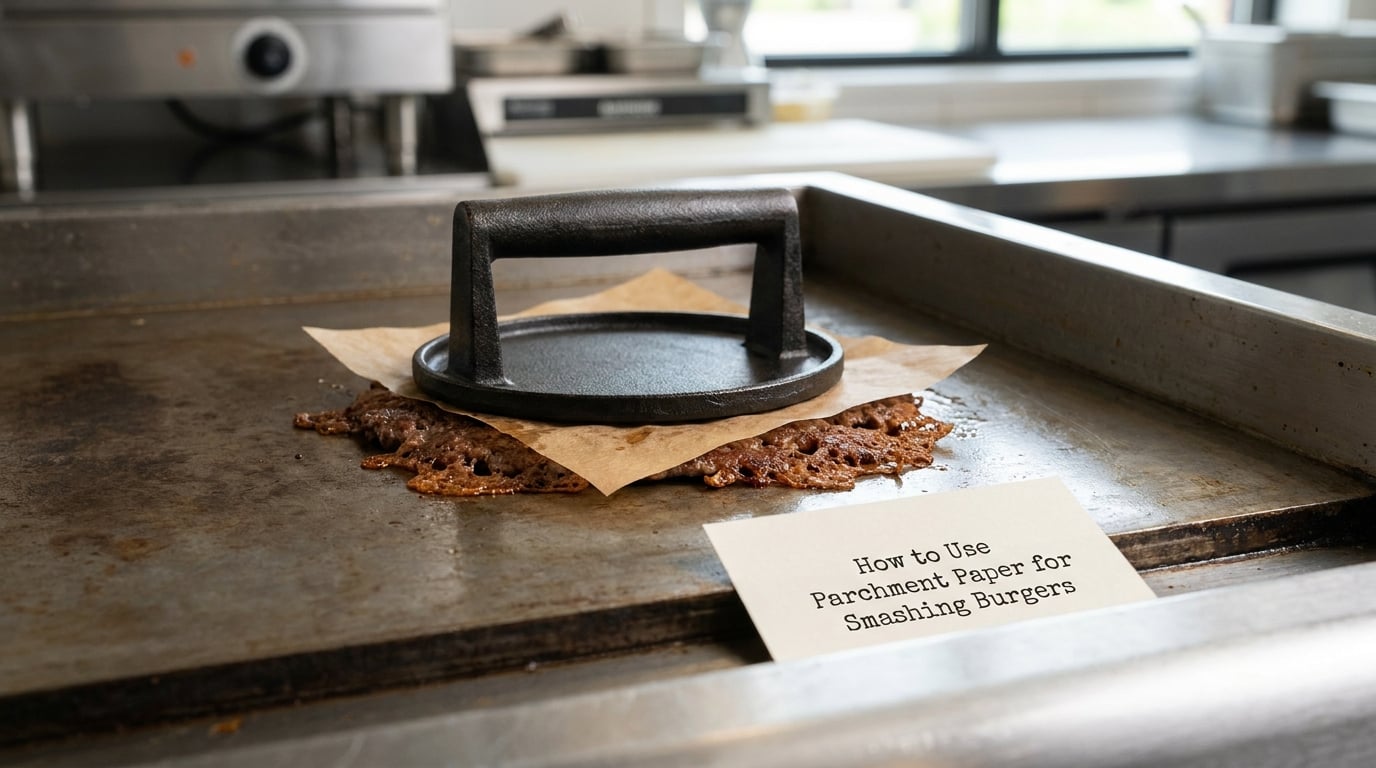
Heat the griddle first, then get the paper ready. Never put a sheet on a cold or heating surface and walk away, because paper scorches fast on bare metal with no food on it.
- Heat the surface. Bring the griddle to a hot, even temperature before any paper goes near it. An unheated griddle plus a press equals a grey patty and a greasy sheet.
- Cut the paper. A 6 inch square handles a 3 to 4 ounce ball with room to spare. Pre-cut squares are the same thing sold in a box. Lay the stack somewhere within arm’s reach.
- Put down the beef. Place the ball on the griddle, roughly where the center of the patty should end up.
- Cover and press immediately. Set one square over the ball and press straight down with a sturdy flat tool, a cast iron pan, or a weighted spatula. Hold it for a few seconds so the heat cooks the layer it is touching.
- Lift the paper, not the meat. Slide or twist the sheet off. Most of the time the patty stays on the griddle and the paper comes away clean.
- Season and cook undisturbed. Salt the exposed top and leave the patty alone until the edges brown and crisp.
- Flip, cheese, move. Use a thin spatula, add cheese if you want it, and transfer to the bun. Take the greasy paper off the griddle right away and start fresh for the next one.
Two details matter more than people expect. Press immediately rather than waiting, because a ball left to sear for a while before pressing will have welded itself to the metal and will not spread evenly. And peel the sheet while the surface is still dry enough; once paper has soaked through with rendered fat it turns translucent, brittle, and prone to tearing.
Ground beef should hit 160°F / 71°C in the center before it goes in the bun, same as any burger.
Parchment Paper vs. No Paper: Which Is Better?
No paper gives you the crisper, more restaurant-style result, and parchment gives you the most forgiving release. Plenty of experienced cooks never use it: on r/burgers, people describe setting balls down, waiting 20 to 30 seconds, flipping, then smashing straight onto the griddle, and finding it barely sticks at all. That trick needs a properly preheated surface and a confident hand with the press.
| What changes | Parchment barrier | No paper | Silicone mat |
|---|---|---|---|
| Release | Forgiving, peels clean | Depends on heat and technique | Good, if rated for the heat |
| Browning | Unaffected, beef still meets metal | Maximum, direct contact throughout | Slightly softened |
| Grease handling | Soaks into the sheet | Burns onto the griddle | Holds grease, needs washing |
| Cleanup | Throw the sheet, scrape less | Full scrape and scrub | Wash in a sink |
| Batch prep | Pre-smash stacks of patties | One at a time on the griddle | Same as paper |
| Best for | Cast iron presses, beginners, parties | Stainless smasher, confident cooks | Repeat cooks who want reusables |
A reusable silicone mat sits in the middle. It releases like paper and can be washed, but check that the mat is rated for your cooktop’s heat, since many are not meant for a full-size flat-top. Some cooks also wrap their press or spatula in aluminum foil, shiny side down, which removes the need for paper entirely and works for a whole cookout.
Rule of thumb: use paper when your tool grabs the beef, when you are new to pressing, or when you are cooking a batch. Skip it when you have a stainless smasher and a hot, well-seasoned griddle.
Common Problems and How to Avoid Them
The paper curls or slides. Full sheets lift at the edges as steam escapes underneath. Cut 6 inch squares, lay them flat, and press immediately rather than letting the sheet sit and wander.
Smoke or a flash of flame. This is what happens when empty paper is left on a hot surface. A Pitmaster Club cook described paper catching fire immediately. Parchment is only safe while beef is on it or within a few seconds of landing, and it is never a liner you leave on the griddle to char.
Pale patties with no lacy edge. Usually the griddle, not the paper, is the problem. If your stovetop cannot hold 450°F, the Maillard reaction has less to work with. Give it more time and use a thicker press so the beef has the mass to reach browning temperatures.
The patty tears on the first lift. You are pressing a bare tool onto bare beef, which is exactly what the paper prevents. Use a square, or oil the tool lightly instead.
Greasy, fragile paper. Pull the sheet off as soon as the patty is on the griddle and use a fresh square for the next one. Saturated paper tears and starts smoking on contact with the hot plate.
Browning is uneven under the paper. Make sure the press covers the whole ball in one pass. Beef pressed in two passes gets cooked unevenly, and the thinner first section browns before the second section is even thin.
Sticking despite paper. Check that the coated side is facing the beef, not the griddle. Parchment has one silicone side and one plain side, and the silicone side is the one that releases.
Frequently Asked Questions
Does parchment paper really prevent smash burgers from sticking?
Yes, in the barrier method, because the raw beef never contacts your press or spatula. The silicone-coated sheet forms a disposable barrier that you peel off after pressing. Patties come away round, evenly thin, and intact instead of tearing, which is the sticking problem most home cooks run into. It does not stop beef from sticking to a griddle liner, since that is a different setup with different results.
Does using parchment paper make a smash burger taste different?
Not meaningfully. The sheet sits on the side of the beef that goes into the bun, and it contributes no flavor of its own when used at normal griddle temperatures. What you do get is a more consistent patty, since nothing tears away during the press. If a sheet blackens or smokes, that is a sign it was left too long, and that scorched taste is a sign to work faster.
What temperature should I use for smash burgers on parchment paper?
Aim for a hot, even surface, which on a flat-top griddle is roughly 450 to 500°F. A home electric griddle or stovetop may not reach that, and a lower temperature means a longer cook and less char, with or without paper. Keep the paper on the beef only, lift it within seconds, and never leave a bare sheet sitting on a hot griddle to save time.
Can I use wax paper instead of parchment paper for burgers?
No. Wax paper has a wax coating that softens and can smear at griddle temperatures, and it is not rated for this kind of dry high heat. Parchment paper is silicone-coated and made for it, which is why experienced cooks reject wax paper for smashing. The same goes for ordinary baking foil, which tears under a press and reflects heat back into the meat.
Is parchment paper or a silicone mat better for smash burgers?
Parchment wins for a single cookout because it handles grease better, needs no washing, and costs less than replacing a mat that scorches. A silicone mat is the better long-term choice if you cook often and it is rated for your cooktop’s heat, though it insulates the beef slightly and slows browning. Many experienced cooks skip both and press straight onto a properly preheated griddle.
Start with two patties and see how your own tool behaves. If the beef tears on the press, cut two 6 inch squares of parchment and use them. If it releases fine on a hot griddle, press directly and save the paper for batch prep. Either way, the sear comes from thin beef and undisturbed contact with hot metal, and that part is always on you.