
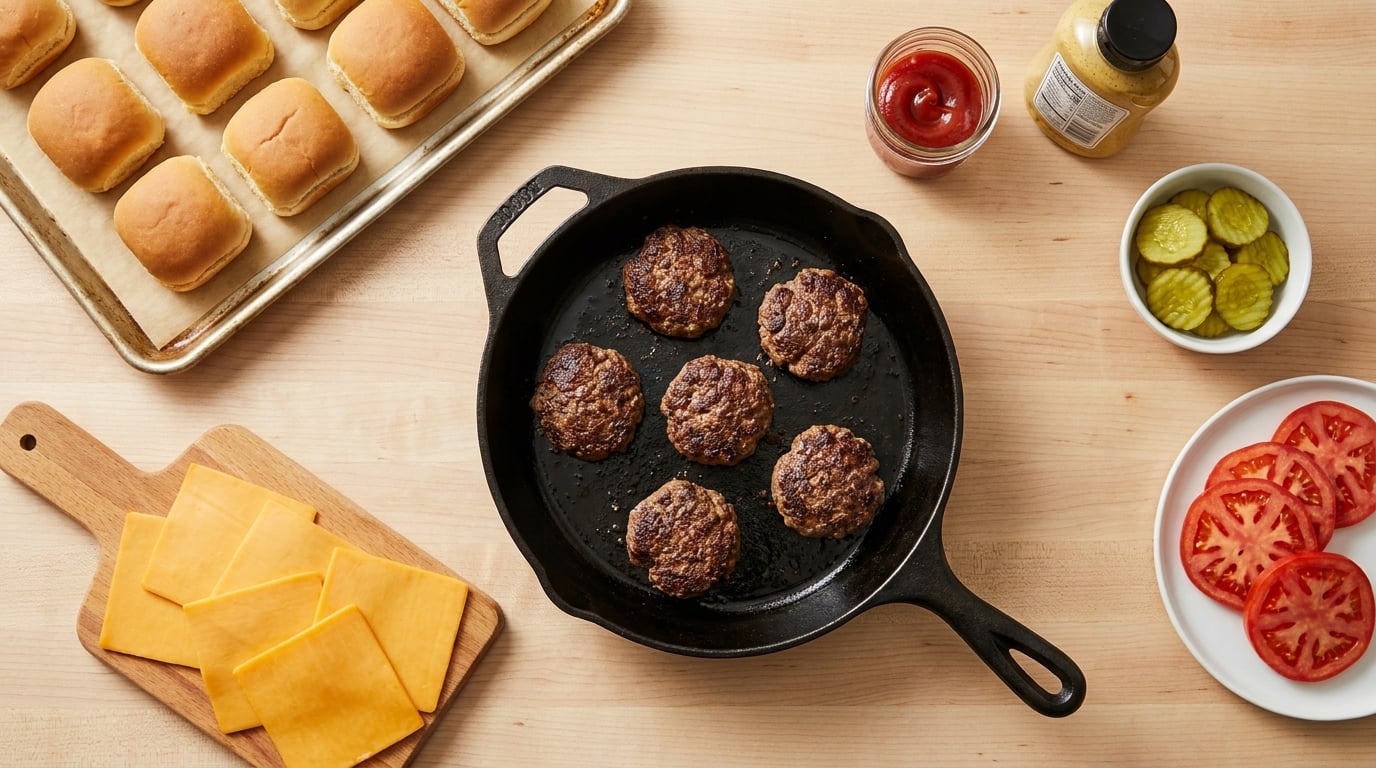
To make sliders at home, brown seasoned ground beef in a hot skillet, then pile it onto small rolls with melted cheese and toppings, or bake the beef and the rolls together on one pan at 350°F until the beef reaches 160°F inside. The whole job takes about 35 minutes and scales from a six-person snack to a two-dozen party tray without adding cook time.
Sliders are miniature burgers built for eating one-handed: two or three bites each, served on soft rolls small enough that nobody has to deal with a full-size burger. Most of them are made from seasoned ground beef, American or cheddar cheese, and something pickled, but the shape is what matters more than the filling.
It is an easy recipe. The only real technique is not overworking the beef, and the only real trap is a soggy bun bottom. I have ruined both at least once, so this method leans on the parts that are hard to get wrong.
What You Need to Make Sliders at Home
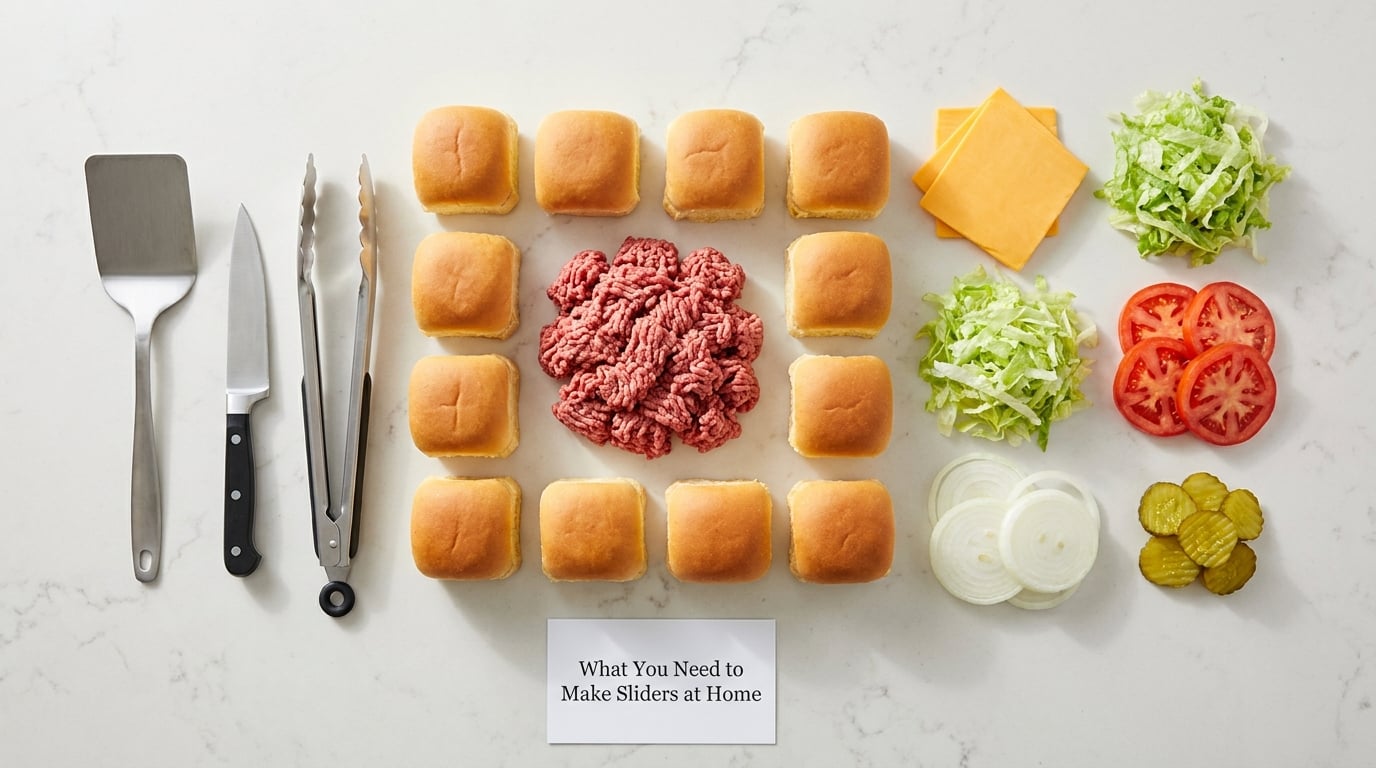
For twelve standard sliders, plan on 1.5 pounds of ground beef, a 12-pack of slider buns or Hawaiian sweet rolls, eight slices of American or cheddar cheese, and about 1 teaspoon of salt. Everything else is a topping you already have in the fridge.
- Bread: one 12-pack of slider buns, or two 6-packs of Hawaiian sweet rolls. Brioche slider buns hold up best; pretzel and potato buns also work, and potato buns are the most forgiving of a sloppy filling.
- Beef: 1.5 pounds of 80/20 ground chuck for twelve sliders, which is about 2 ounces per patty. Lean 93/7 is where dry, rubbery sliders come from, and 85/15 is a good middle ground if you prefer a little less grease.
- Seasoning: 1 teaspoon salt, 1/2 teaspoon black pepper, 1 teaspoon garlic powder, and a small splash of Worcestershire sauce. Everything bagel seasoning works in place of the salt and garlic powder.
- Cheese: eight thin slices of American or cheddar. Thin slices melt faster and form a seal that keeps juice out of the bread.
- Toppings: dill pickle slices, thin-cut onion, shredded lettuce, tomato slices, and a sauce such as special sauce, barbecue, or buffalo.
- Tools: a wide spatula, a shallow tray or 9×11 inch baking dish, a large skillet or griddle, and an instant-read thermometer.
Protein swaps work. Ground turkey with a spoonful of mustard and ketchup tastes close to beef and needs the same 160°F target, pulled pork and shredded chicken come straight off a slow cooker, and firm tofu or black beans are fine vegetarian versions that still need the same careful handling.
Step-by-Step
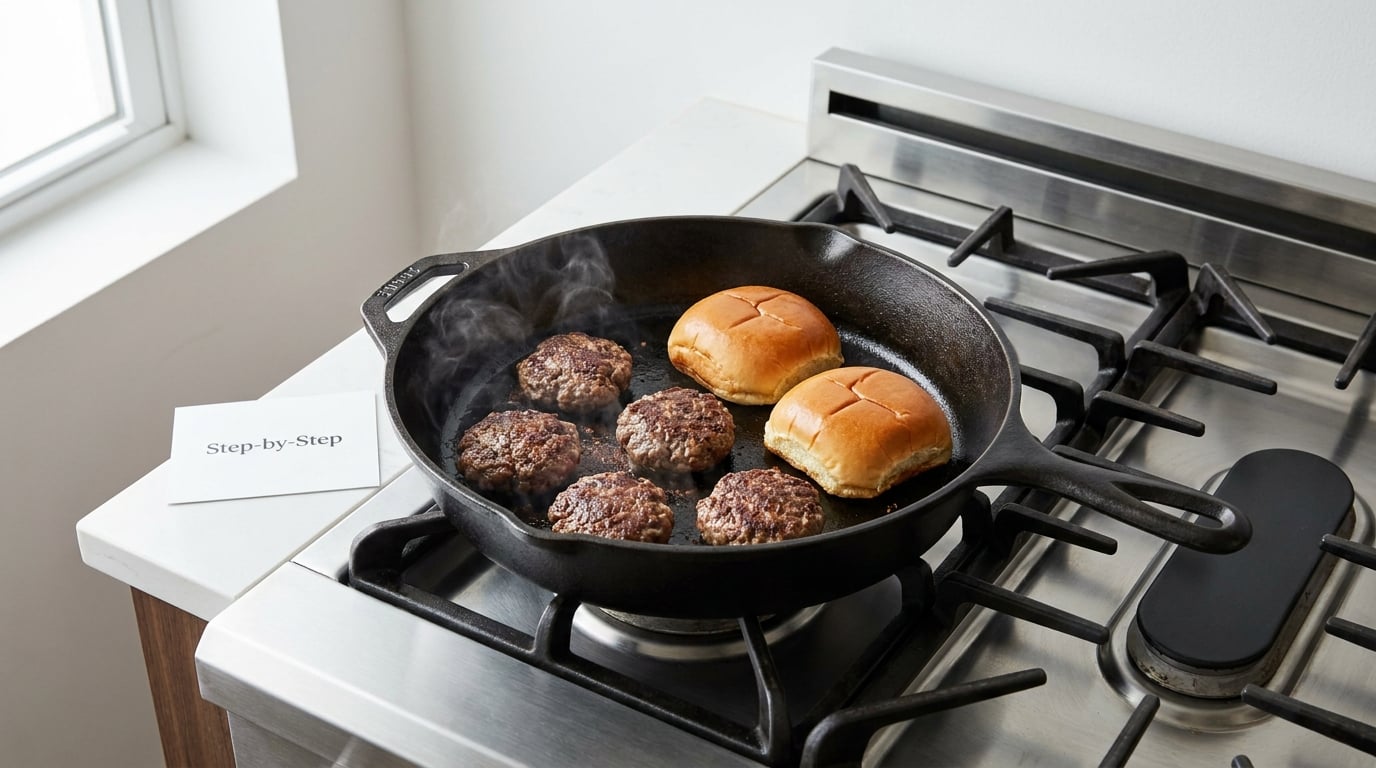
Follow the order below and you can have a tray of finished sliders before the game starts. Work from cold beef to hot pan to warm bun, and each stage sets up the next one.
How to Make Sliders at Home: Mix and Rest
Combine the beef with the salt, pepper, garlic powder, and Worcestershire in a bowl, then use your hands to combine it in about fifteen seconds. Stop the moment the seasoning disappears. Working the meat longer turns the fat into a film that tightens in the pan, and that is where dry, dense patties come from.
Weighing the beef beats dividing it by eye. Twelve equal 2-ounce portions give you sliders that cook at the same rate; the 2-ounce piece is also the fast-food standard that home cooks on cooking forums chase when they want sliders to taste like the small ones.
Press each portion into a patty a little wider than the bun, about 2.5 inches across for a 2-inch roll. Leave a shallow indent in the center with your thumb so the meat domes less and sits flatter under the cheese, and keep the edges gently rounded rather than cracked, because a torn edge is where the juices escape.
Chill the shaped patties for 15 to 30 minutes, or park them in the fridge while you set out the toppings. Cold beef hits a hot pan with more of a sear and holds its shape instead of spreading into a thin ragged disc. This is also the step that makes sliders a make-ahead recipe: shape them a day ahead and cover them in the fridge.
For a White Castle style slider, fold about a quarter cup of finely diced onion into the beef and press the patties thinner, closer to a quarter inch. Thin patties cook fast, which is the whole point of the chain version, and thick copycat patties are the usual reason the middle comes out raw.
How to Cook Sliders for Crispy Edges
Set a large skillet or griddle over medium-high heat and give it a thin wipe of oil. The pan should be hot enough to sizzle the moment a patty lands, not smoking-hot, because sliders have so little surface that they scorch before the center catches up.
Lay the patties down with about an inch of space between them. Crowding drops the pan temperature, steams the meat, and gives you uneven browning across the tray, so a batch of six in a 12-inch skillet beats a crowded dozen.
Leave them alone until the first side has set and browned, usually 2 to 3 minutes. Pressing early squeezes out the fat you came for. Pressing later, with a spatula, flattens the patty just enough to speed the cook without tearing it.
Flip once, cook another 2 to 3 minutes, and check the thickest patty with your thermometer. Ground beef is done at 160°F; some people pull it at 155°F and let the carryover heat finish the job, which is a fine shortcut for small patties, but 160°F is the number I trust with sliders because they cool fast once they hit a bun.
Timing is a guide, not a promise. Patties that weighed 2 ounces and hit a properly hot pan are usually done in 4 to 6 minutes total, while a cold, thick patty in a cooling pan can take twice that. If you are using a muffin tin, the wells hold the mini patties upright and portion them automatically, which is why that trick circulates so much in home cooking communities.
Assemble and Serve the Sliders
Split the buns and toast the cut faces for 30 to 60 seconds in the same skillet or under the broiler while the beef rests. A toasted face sheds water, and that single step is the most effective defense against a soggy slider.
Drain the beef. Tip the finished patties onto a plate and blot the tops with a paper towel, or lift them out with a slotted spoon, because the grease that sits on top of a patty is what soaks straight through a soft roll.
Build in this order: bun, patty, slice of cheese, then wet toppings like pickles or onion, then sauce, then the bun top. The cheese between the meat and the wet toppings is a barrier that keeps dressing off the bread, and putting the sauce above the cheese rather than under the meat keeps the bun from steaming.
Four combinations cover most requests. Classic is beef, American cheese, pickles, onion, and a spoon of special sauce. Bacon and cheddar swaps in crisp bacon and a sharper cheese. Spicy barbecue uses barbecue sauce, jalapeno slices, and pepper jack. Vegetarian-style goes with a firm patty, provolone, roasted peppers, and a vinegar-based sauce, and it deserves the same cold-chain discipline as beef.
Serve them within a few minutes of assembling. If you must hold them, put the tray in a 200°F oven uncovered with the lid cracked, never foil-covered, since trapped steam is exactly what you were trying to avoid.
Common Mistakes
Most disappointing sliders trace back to one of six problems, and each has a fix you can apply in the same session.
- Dry, rubbery patties: you used lean beef or cooked it past 160°F. Use 80/20 chuck, take the patties off the heat the moment the thermometer reads 160°F, and rest them a couple of minutes before building.
- Meat that shrank a lot: the beef was overworked before it hit the pan, or the heat was too high. Mix gently and cook on medium-high rather than high.
- Cracked edges and juices running everywhere: the patties were formed too thin or the edges were ragged. Press firmly to bring the meat together, keep the thickness even, and fill cracks in the middle of the patty before it hits the pan.
- Soggy bun bottoms: grease from undercooked beef soaked through. Toast the cut faces, blot the patties, put the cheese directly on the meat, and keep the tray uncovered.
- Uneven cooking: the pan was crowded or the patties varied in weight. Cook in batches and weigh the portions.
- Sliders that fall apart when lifted: too little filling, a bun sliced too thin, or no cheese to bind things. Cut the buns with a serrated knife, and give each slider a patty that fills the roll without overflowing it.
To cook ahead, shape the raw patties up to a day in advance and refrigerate them, or cook the beef a day ahead and refrigerate it in a sealed container for up to 3 to 4 days. Reheat in a dry skillet over medium heat rather than a microwave, which reheats the bun and dries the beef at the same time.
For a crowd, figure 2 to 3 sliders per person as an appetizer and 4 to 6 if they are the meal. That is two 12-packs for about eight people as a snack, and one 12-pack of rolls needs 1.5 pounds of beef, so scaling is simple arithmetic rather than guesswork.
Never freeze assembled sliders. The buns go flat and the beef loses its texture. If you want to be genuinely prepared, cook the beef ahead, hold the buns at room temperature loosely covered, and do the assembling and toasting in the last ten minutes before guests sit down.
Frequently Asked Questions
What size should I make slider patties?
For slider buns about 2 inches wide, use 2 ounces of beef per patty and press it roughly 2.5 inches across, so the meat sits slightly proud of the roll. That is the fast-food standard and it cooks in 4 to 6 minutes a side. Leave a small indent in the center so the patty stays flat under the cheese.
Should I use ground beef or turkey for sliders?
Ground beef at 80/20 fat is the best starting point for flavor and moisture, and it is what most slider recipes assume. Ground turkey works well when you add mustard and ketchup for a hamburger-like taste, and it cooks faster, so watch it closely. Chicken, pulled pork, and firm tofu all work, but every option still needs to reach 160°F internally.
Can I make sliders ahead of time?
Yes, in two ways. Shape raw patties and refrigerate them for up to a day, or cook the beef entirely a day ahead and store it covered in the fridge for 3 to 4 days. Assemble and toast in the last ten minutes before serving, and keep the finished tray uncovered in a 200°F oven so the buns do not steam themselves soggy.
How do I keep slider patties from drying out?
Use 80/20 ground chuck rather than lean beef, mix the seasoning in quickly and gently, and stop cooking each patty the moment it reads 160°F. Add fat back with a teaspoon of mayonnaise mixed into lean meat if you must use 93/7. Resting the cooked patties two or three minutes before they go into the bun keeps more juice in the meat.
Can I cook sliders in an air fryer?
Yes, and small patties are a good fit for the basket. Set it to 375°F, keep the patties in a single layer with space between them, and cook for 6 to 8 minutes, flipping halfway, checking that the centers reach 160°F. Toast the buns in the same basket for the last two minutes. Watch them closely, since air fryers brown the outside faster than a skillet.
How long do cooked sliders last?
Cooked beef filling keeps 3 to 4 days covered in the refrigerator, and assembled sliders with toppings last about 2 days, though the buns soften and are best toasted again before serving. Hold cooked patties in a 200°F oven for up to an hour. Do not freeze assembled sliders, since the buns go flat and the beef turns rubbery when thawed.
Here is the short version for your first batch: weigh 2 ounces of 80/20 beef per slider, mix it gently, chill the patties while you prep everything else, and give the skillet room so nothing steams. Cook to 160°F, blot the beef, toast the cut faces of the buns, and stack it all in the order bun, patty, cheese, toppings, lid. That sequence alone fixes sogginess, dryness, and uneven browning, which are the three things that go wrong most often.