
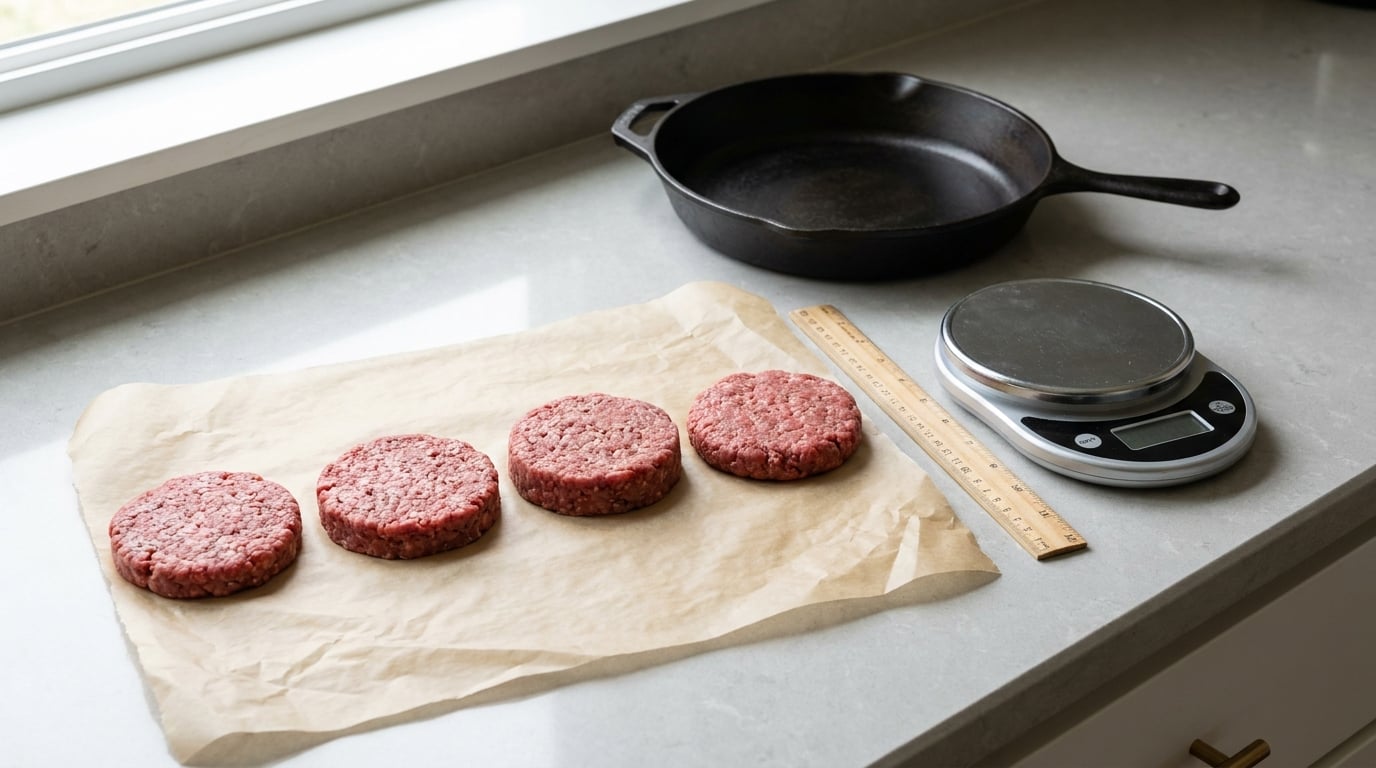
Most home cooks should form their patties about 1/2 inch thick. Smash burgers go thinner, around 1/8 to 1/4 inch, while pub-style burgers run 3/4 to 1 inch. Past an inch, the outside burns before the center is done.
There is no single correct number, and that is the part most guides skip. Thickness has to match three things at once: the heat source you are cooking on, the burger style you are chasing, and the bun you have in the bag. Get any one of those wrong and the same patty turns dry, raw in the middle, or falls apart in your hands.
I have made this mistake more times than I care to admit, usually by forming a thick backyard patty and cooking it like it was thinner than it was. Once you see the numbers side by side, the choice becomes pretty easy.
Table of Contents
- How Thick Should a Burger Patty Be? Quick Guide
- What Thickness Works Best for Different Cooking Methods?
- How Thick Should a Burger Patty Be for a Juicy Center?
- How Thick Should a Burger Patty Be for Different Buns?
- How Do You Measure and Form the Right Patty Thickness?
- What Happens If a Burger Patty Is Too Thick or Too Thin?
- How to Cook Burger Patties Safely and Keep Them Juicy
- Frequently Asked Questions
- Conclusion
How Thick Should a Burger Patty Be? Quick Guide
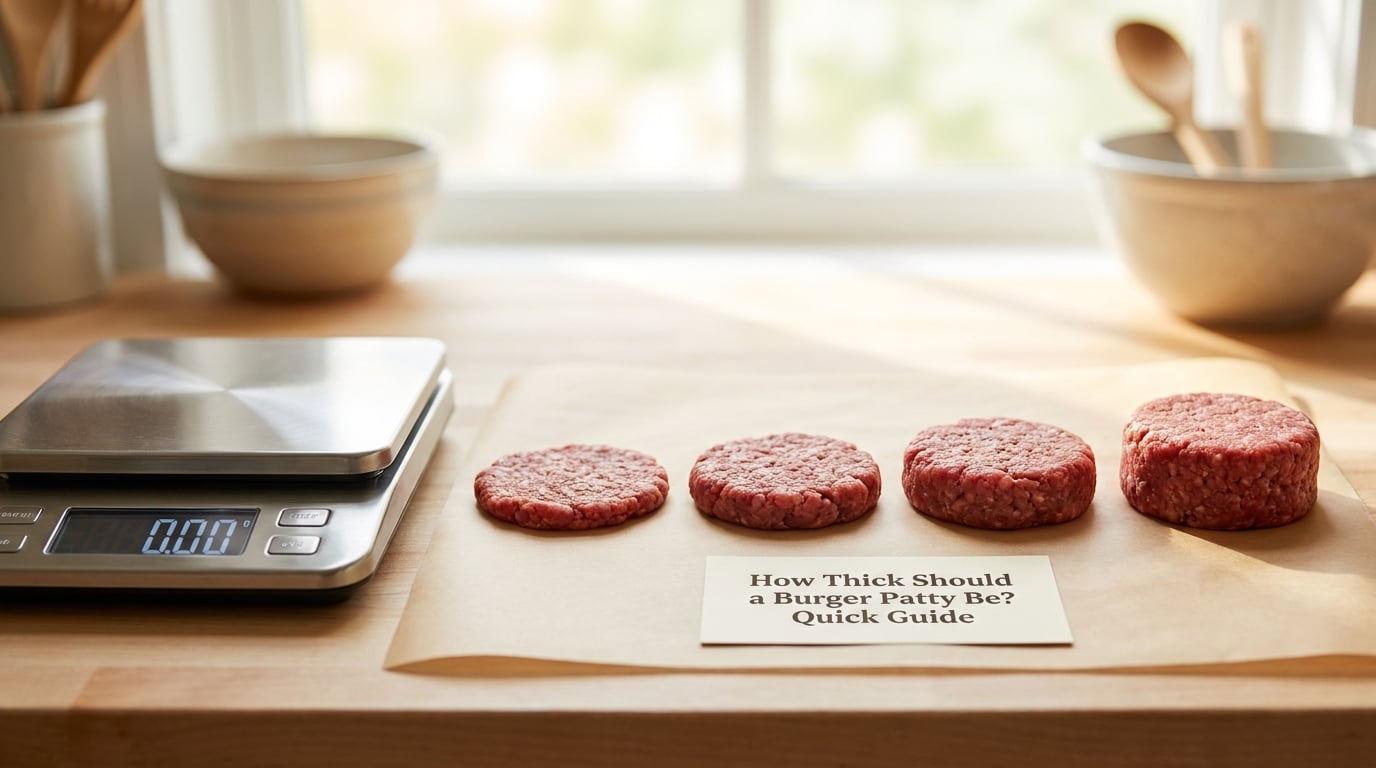
Start at 1/2 inch for an everyday burger, and treat that as a baseline you adjust rather than a rule carved in stone. Here is how thickness changes with the method you are using.
| Cooking method | Patty thickness | Raw weight per patty | Cook time per side | What you get |
|---|---|---|---|---|
| Flat-top griddle, smashed | 1/8 to 1/4 inch | 2 to 3 oz | 60 to 90 seconds | Lacy crisp edges, quick service |
| Small skillet, pan-seared | 1/4 to 1/2 inch | 3 to 4 oz | 2 to 3 minutes | Deep browning on one flat side |
| Gas or charcoal grill | 1/2 to 3/4 inch | 4 to 6 oz | 3 to 5 minutes | Smoke flavor, even doneness |
| Cast iron skillet | 3/4 inch | 6 to 8 oz | 3 to 4 minutes | Juicy, restaurant-style burger |
| Frozen preformed patty | Cook as sold, about 1/3 to 1/2 inch | 3 to 4 oz | 4 to 6 minutes | Even cooking from frozen |
The general rule is simple: the harder and flatter your cooking surface, the thinner the patty needs to be. A griddle at 450°F transfers heat into the patty from one flat plane, so a thin patty cooks in under two minutes. A grill or a thick cast iron skillet heats more slowly and gradually, which means the patty can afford to be taller.
A few quick tips before you start
- Use 80/20 or 85/15 ground beef, and treat leaner blends as needing a thinner patty.
- Handle the meat as few times as possible; warmth and working turn it mealy and dense.
- Press a shallow dimple into the center of any patty thicker than 1/2 inch.
- Chill formed patties in the refrigerator for 20 to 30 minutes so they hold their shape.
- Never press a cooking patty with a spatula; you are squeezing out the juice you paid for.
- Use an instant-read thermometer and stop at 160°F / 71°C for ground meat.
What Thickness Works Best for Different Cooking Methods?
The cooking surface decides more than any other variable, so pick your method first and let it set the thickness.
Flat-top griddle: 1/8 to 1/4 inch
This is the smash burger range, and the window is narrower than it looks. A commercial griddle runs around 450°F, and a home griddle on a medium-high burner gets close to that. Press the puck down within a few seconds of hitting the surface and you get the Maillard crust and lacy edges that make this style worth the effort.
Press too late and the meat has already welded itself to the griddle. Press too hard and you squeeze the fat out before it has a chance to render and season the patty.
Cast iron skillet: 3/4 inch
Cast iron has real thermal mass, so it forgives an uneven patty in a way a thin sheet-metal griddle does not. A 3/4 inch patty at 6 to 8 ounces gives you a browned exterior, a hot center, and enough time to render the fat properly. This is the thickness most steakhouse-style burgers are built around.
Conventional grill: 1/2 to 3/4 inch
A gas or charcoal grill heats from below and loses that heat through the grate, so a patty in the 1/2 to 3/4 inch range is the sweet spot. Anything thicker and you are fighting the fuel and air gaps for a piece of the heat. Set a thick patty over direct heat first, then move it to a cooler side to finish.
Pan-seared burger: 1/4 to 1/2 inch
A home skillet on a normal stovetop burner produces moderate heat, so thinner patties cook through before the underside burns. Press the meat flat, leave it alone, and finish it with a lid or a splash of water if the browning is racing ahead of the center.
Frozen or preformed patties: as sold
You cannot reform a frozen patty without thawing it, so cook it straight from the freezer on a moderate surface. Most read the package time for a grill or skillet and land on four to six minutes a side, which is exactly why frozen patties are usually thin. They are thin because that is the only shape that cooks evenly from frozen.
How Thick Should a Burger Patty Be for a Juicy Center?
Between 1/2 and 3/4 inch is the range where you get the best balance of crust and moisture. Thinner than 1/4 inch and there is not enough interior left to hold juice. Thicker than an inch and the center has to wait so long for heat that the outside gives up first.
Here is the mechanism most people never hear explained. As ground beef heats, the proteins contract and squeeze toward the center. A perfectly flat patty domes up as it cooks, and the domed top is now further from the heat than the flat bottom, so it browns last and lags behind. That dome is why so many thick patties come out with a black base and a pink crown.
The fix is the center dimple. Press a shallow depression into the middle of the patty, leaving the rim at its original height. The meat fills the void as it contracts, stays closer to flat, and cooks at something closer to an even rate. On a 3/4 inch pub-style patty this one small step does more than any amount of flipping.
Fat matters as much as thickness. 80/20 ground beef renders during the cook and flavors the outside while keeping the interior moist; 90/10 does not, and the same 3/4 inch patty that is juicy with fatter beef can come out dry and tight. Leaner proteins, including turkey and most vegetable patties, want a thinner shape for exactly this reason.
One more thing worth saying plainly: the red juice that runs out of a properly cooked burger is myoglobin, the protein that carries oxygen in muscle. It is not blood, and its presence is not a sign of undercooking. Chasing the last of it out is the most common way home cooks turn a juicy burger into a dry one.
How Thick Should a Burger Patty Be for Different Buns?
Match the patty to the bun, not the other way around. A good fit means the patty is slightly wider than the bun’s cut face, so you get a visible edge all the way around, and the finished burger is short enough to eat without the top sliding off.
Brioche buns
Brioche is tall and cut side down often enough that it swallows height well. A 1/2 to 3/4 inch patty disappears into it without drama. Anything past an inch and the bun has to be toasted and the whole thing eaten in halves.
Potato rolls
These are soft, squishy, and shorter than they look. A 1/2 inch patty is the ceiling here; go thicker and the roll compresses into a dense brick under the weight.
Sesame and classic hot dog style buns
Long, narrow, and structurally modest. A 1/4 to 1/2 inch patty is the right call, sized so a couple of patties overlap. Two thin ones eat better here than one that stands up above the rim.
Lettuce wraps
The only place where a thick patty is genuinely fine, because there is no structural limit at all. A 3/4 inch patty wraps easily, and you can go to a full inch if the lean ratio is low.
Oversized and specialty buns
These can carry 3/4 to 1 inch, and they are the reason restaurant burgers get taller than anything you would make at home. Keep the patty a bit wider than the bun so it does not slide, and expect the burger to be a two-hand affair.
There is also a hard ceiling that has nothing to do with cooking. A standard bun becomes genuinely hard to eat once the raw patty passes about 8 ounces, because the bread compresses under the weight and the bottom slice splits. That ceiling is easy to hit without noticing, so watch the raw weight rather than the finished height.
How Do You Measure and Form the Right Patty Thickness?
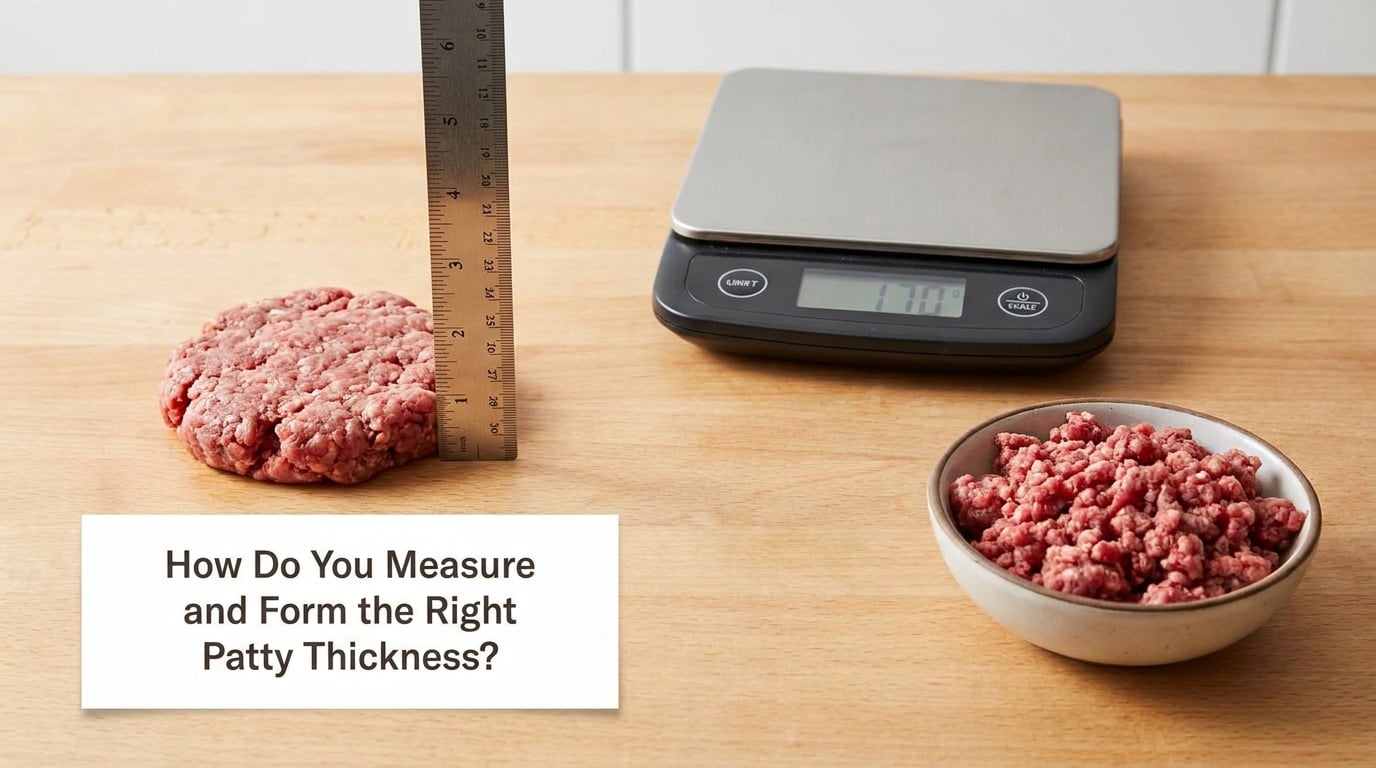
You do not need anything exotic. A scale, a flat surface, and the palm of your hand are enough, and the weight-to-diameter relationship below does the rest of the thinking for you.
- Weigh the portion. Four ounces for a standard burger, six to eight for a pub-style one. A 4 ounce ball is roughly the size of a golf ball.
- Shape it loosely into a ball. Handle the meat as little as possible. Warm, worked meat turns dense and squeezes out fat when it hits the heat.
- Flatten it to the target thickness. Press with the heel of your palm, then check with a ruler or the side of a bench scraper. Fill in any gaps with a few taps rather than one hard press.
- Match the diameter to the weight. Too wide a patty at a given weight is thin and falls apart; too narrow and it turns into a tall disk that domes badly.
- Dimple the center if it is over 1/2 inch thick, then chill formed patties for 20 to 30 minutes before cooking.
How Thick Should a Burger Patty Be for a Given Weight?
Here is the arithmetic that makes thickness achievable by hand. Raw ground beef packs loosely, at roughly four-fifths the density of water, so a patty weighs about 1.5 ounces for every cubic inch of shape. That single ratio gives you the table below.
| Raw patty weight | Diameter at 1/2 inch thick | Diameter at 3/4 inch thick | Diameter at 1 inch thick |
|---|---|---|---|
| 4 oz | about 4.7 inches | about 3.8 inches | about 3.3 inches |
| 6 oz | about 5.7 inches | about 4.7 inches | about 4 inches |
| 8 oz | about 6.6 inches | about 5.4 inches | about 4.7 inches |
That middle column is why the classic 4 inch wide, 3/4 inch thick burger lands near 6 ounces. If you cook for six people, multiply the weight column by six and the rest follows.
What Happens If a Burger Patty Is Too Thick or Too Thin?
Thickness problems show up in predictable ways, and each one has a fix you can apply before or during cooking.
Too thick
Past 1 inch, the outside browns and then burns while the center is still cool, which is the raw-middle problem almost everyone has hit at least once. A thick patty also shrinks more as it cooks, so a 1.25 inch puck becomes something closer to an inch with a domed top and tough, overworked texture in the middle. The fix is to press it thinner before cooking, dimple the center, and move it to indirect heat once the first side is browned.
Too thin
Under about 1/8 inch the patty has almost no interior left. It browns in seconds, dries out, and loses whatever fat it had before you got it off the heat. Thin patties also tear when you try to flip them, which is why smash burgers are pressed and left alone rather than lifted. If yours is too thin, cook it fast, use a well-oiled surface, and support it with a wide spatula.
Uneven
A lopsided patty is almost always one formed on a work surface that is not flat, or one that was shaped from a ball that was not rounded first. Press the ball into a rough disc, then use a second patty or a spatula to knock the height back to even. Uneven height means uneven cooking, and one side of the bun goes soggy while the other stays crisp.
Too wide for the bun
This is a forming problem, not a cooking one. A patty wider than the bun by more than half an inch tends to sag, crack along the fold, and drop its toppings. Reshape it narrower and slightly thicker to keep the same weight.
How to Cook Burger Patties Safely and Keep Them Juicy
Even a perfectly formed patty will disappoint on the wrong heat. Most of what people call a thickness problem is really a heat problem.
- Preheat fully. Give a grill or griddle ten minutes, and wipe cast iron with a paper towel and a little oil. A cold surface is the reason a “thick” burger turns gray and sticky before it browns.
- Use moderate heat for thick patties. High heat is right for thin smash patties and wrong for anything over 1/2 inch. High heat on a thick patty burns the outside before the heat conducts inward.
- Flip once, and only when ready. Wait for the edges to brown and the surface to release from the grate without scraping. If it sticks, give it another 30 seconds rather than tearing it.
- Press or smash only at the moment of contact. For a 1/2 inch or thicker patty, skip the press entirely. Pressing is a griddle technique, and pressing a thick patty just squeezes the juice out of it.
- Check with a thermometer. Insert an instant-read thermometer into the thickest part of the patty without touching bone or the pan. Ground beef is safe at 160°F / 71°C, the USDA minimum internal temperature.
- Rest for 3 to 5 minutes. Resting lets the juices redistribute instead of running out onto the plate, and carryover cooking finishes the center while you wait.
If you want medium-rare in the middle, take it off the heat a few degrees early and let the carryover finish the job. Just know that with ground meat, that window is narrow, and the safe choice is a fully cooked patty.
Frequently Asked Questions
What thickness should a smash burger be?
Press smash burger patties to about 1/8 to 1/4 inch, which is 2 to 3 ounces of meat spread on a flat-top griddle. Press within a few seconds of the patty hitting the surface so the underside welds and browns. The thin shape cooks in 60 to 90 seconds a side and produces the lacy, crisp edges that make the style worth making.
What is the difference between a thick burger and a smash burger?
A thick burger is 3/4 to 1 inch and cooked on a grill or in a cast iron skillet for 3 to 5 minutes a side. It has a tall, juicy interior and eats more like a steak than a sandwich. A smash burger is 1/8 to 1/4 inch, cooked under heavy pressure on a very hot flat top, and is thin, fast, and crisp-edged.
How long should I cook a thick burger patty?
A 3/4 inch patty needs roughly 3 to 4 minutes per side, and a 1 inch patty needs 4 to 5 minutes. Cook over direct heat for the first side, then move to a cooler part of the grill to finish. Verify doneness with an instant-read thermometer in the thickest part, and rest the burger 3 to 5 minutes before serving.
Why is my burger patty dry?
Three things cause dry patties: pressing the meat with a spatula while it cooks, forming it thinner than about 1/4 inch, and using beef leaner than 80/20. Cutting into the patty to check for pink also releases juice, and so does chasing out the red myoglobin juice, which is not blood. Handle the meat gently, keep some fat in the blend, and rest the burger before cutting it.
How thick should a slider patty be?
Slider patties should be about 1/4 inch thick and 2 to 3 inches wide, which works out to roughly 1 to 1.5 ounces of meat. They cook in under two minutes per side on a hot griddle, so watch them closely. Because they are small, form them with a light hand and avoid overworking the meat, or they will taste dense.
Is 400 degrees hot enough for smash burgers?
Yes. A griddle or grill around 400°F / 205°C is enough heat for a smash burger patty pressed to 1/8 to 1/4 inch. The key is a heavy, flat, well-seasoned surface rather than a maximum of heat, plus a little oil in the meat to prevent sticking. Cook a thin patty in 60 to 90 seconds per side at that temperature.
Conclusion
Form your everyday burger patties 1/2 inch thick, and let your cooking surface adjust that number: thinner for a griddle smash, up to 3/4 to 1 inch for a grill or cast iron skillet, and never past an inch. The first thing to do is measure one patty instead of guessing, which takes ten seconds and tells you more than any instinct.
After that, pick the thickness to match your method, dimple anything above 1/2 inch, and check the bun so the finished burger still fits your hand. Weigh the meat and shape it lightly, then let the heat do its work without you pressing on it.