
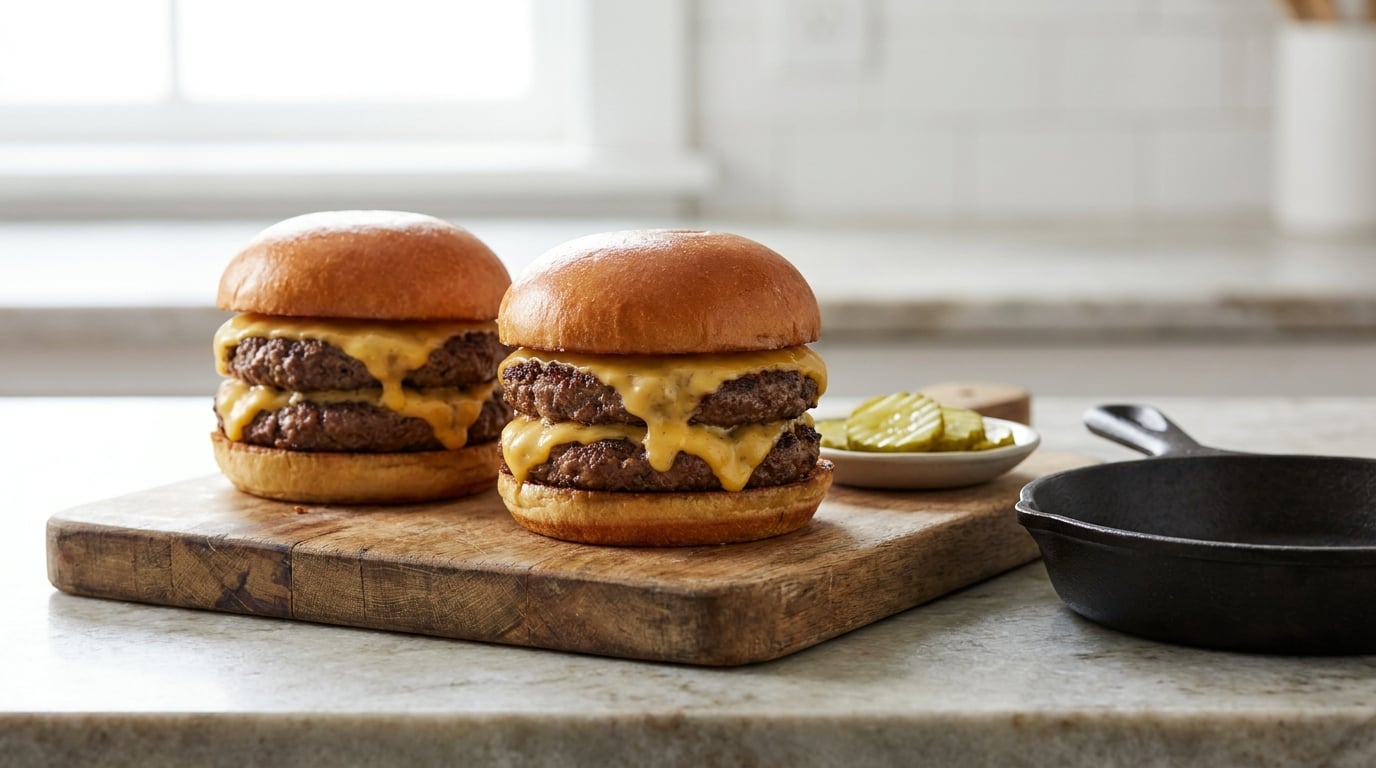
To make double cheeseburgers at home, divide 1 pound (450 g) of 80/20 ground beef into four thin patties, season them right before they hit the heat, then sear each side in a ripping hot cast iron skillet for about 2 minutes, add a cheese slice the moment you flip, and stack two cheese-topped patties in a toasted bun. It takes about 25 minutes start to finish, and the whole thing depends on getting your pan hot enough and your patties the same size.
Table of Contents
- What You Need
- Step-by-Step: How to Make Double Cheeseburgers at Home
- 1. Prepare the beef, cheese and toppings
- 2. Make two evenly sized patties for each burger
- 3. Sear the patties over medium-high heat
- 4. Melt the cheese over the patties
- 5. Toast the buns and assemble the burgers
- 6. Check doneness and serve immediately
- How to make double cheeseburgers without a cast iron skillet
- Making double cheeseburgers ahead
- Common Mistakes
- Patty falls apart when you try to flip it
- Patties cook unevenly and one burger is dry
- The beef shrinks away from the bun
- The patties slide out of the bun on the first bite
- You flip too early or crowd the pan
- The cheese does not melt or slides off
- The burgers taste dry even with good beef
- Grill flare-ups scorch the patties
- Frequently Asked Questions
- How do I keep double cheeseburger patties from falling apart?
- Can I use frozen ground beef for double cheeseburgers?
- What is the best cheese for melting on a double cheeseburger?
- How long should I cook each side of a double cheeseburger patty?
- How do I make a double cheeseburger without drying out the meat?
- How long can cooked double cheeseburgers be stored in the refrigerator?
- Conclusion
What You Need
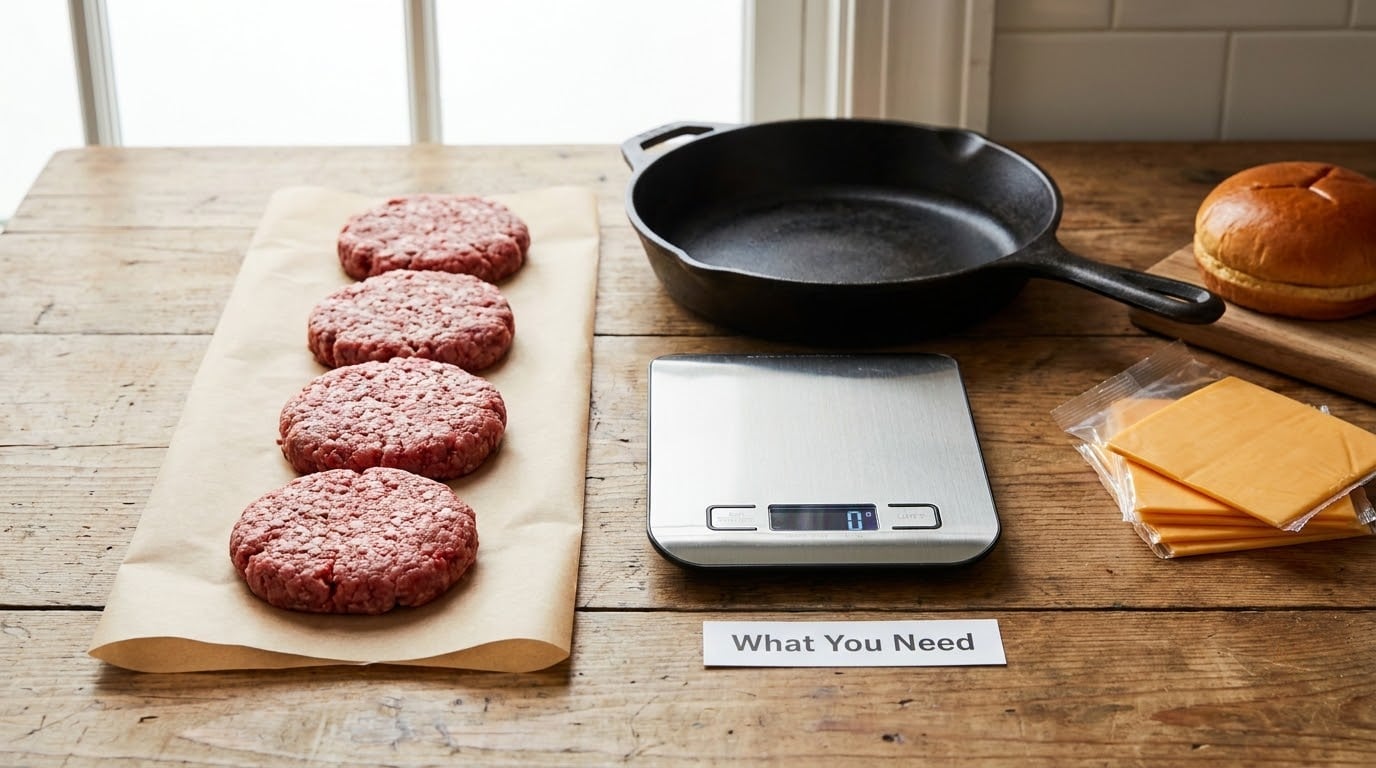
For two double cheeseburgers you are making four patties, not two. That is the single most common mistake: home cooks form two thick patties to fill the bun, and the result is a plain cheeseburger with a hard time staying juicy all the way through.
Ingredients for two double cheeseburgers
- 1 lb (450 g) ground beef, ideally 80/20 lean (20% fat), ground chuck or a chuck and brisket blend
- 4 slices American cheese, or 4 slices cheddar, Swiss or pepper jack
- 4 brioche or sesame seed buns
- 1 tsp kosher salt, plus 1/2 tsp coarse black pepper
- 1/4 tsp garlic powder (optional)
- 2 tbsp butter or oil for the buns
- Toppings: dill pickle slices, thinly diced white onion, ketchup, yellow mustard, mayo, shredded lettuce, tomato
A scale is genuinely useful here. If you do not have one, weigh 450 g on the first burger and eyeball the rest, but a kitchen scale removes the guesswork entirely and makes four patties the same width.
What else you need on the counter
- A heavy skillet, ideally cast iron or carbon steel, or a flat griddle
- A wide spatula with a squared-off edge, thin enough to slide under a patty without tearing it
- Tongs for the cheese and buns
- A small bowl for the raw patties so they stay cold while you prep everything else
Why 80/20 beef works best
Fat is flavor and fat is moisture. Ground beef at 20% fat renders enough fat during cooking to keep the patty juicy, while 10% fat patties go dry and tight in a very short time. Going leaner is not a healthier burger, it is a drier burger.
| Beef fat ratio | Fat content | What you get in the pan | Best for |
|---|---|---|---|
| 80/20 or chuck blend | 20% fat | Juicy, browned, slightly crisp edges | Classic double cheeseburgers |
| 85/15 | 15% fat | Balanced, a little firmer bite | Burgers that sit a few minutes before eating |
| 90/10 | 10% fat | Lean, drier, stronger beef flavor | Bowls, tacos, burgers with heavy sauce |
| 93/7 or lean ground | 7% fat or less | Dry, chewy, shrinks hard | Not recommended for this method |
Which cheese melts best
American cheese wins for a fast-food style result because it melts smoothly into the meat instead of sitting on top, and it survives the trip from pan to bun without tearing. Aged cheddar gives you more flavor but less melt, Swiss stretches well and adds a mild tang, and pepper jack melts beautifully if you want heat. Two slices of thin-sliced cheese per patty melt faster than one thick slice, so buy thin if your choice comes in both.
A simple burger sauce
Mix 3 tbsp mayonnaise, 1 tbsp ketchup, 1 tsp yellow mustard and 1 tsp pickle relish. That is enough for two burgers and it is what most of the copycat double cheeseburgers floating around online actually taste like. Thin it with a splash of pickle brine if you want it looser.
Step-by-Step: How to Make Double Cheeseburgers at Home
1. Prepare the beef, cheese and toppings
Keep the beef cold while you work. Put the package in the fridge while you dice onion, slice pickles, mix the sauce and set out the buns, because beef that has sat at room temperature for twenty minutes gets sticky, spreads like glue and cooks unevenly. If it starts to smear in your hand, chill it for another ten minutes.
Season right before cooking, not ten minutes before. Salt draws moisture out of the surface of the meat, and a dry surface is what you want for browning. If you salt early, the patties weep into the pan and steam instead of sear.
2. Make two evenly sized patties for each burger
Take the beef out and divide it into four portions of about 2.5 oz (70 g) each, or 1/4 cup loosely packed. For each portion, roll it into a ball to keep the fat distributed, then press it flat to about 1/4 inch (6 mm) thick and slightly wider than your bun.
Press lightly. Home cooks who squeeze the beef into a dense, tight patty end up with a burger that tastes like a hockey puck, and the density is exactly what pushes out the juice. A loose, slightly ragged patty browns better and stays tender, so leave the edges craggy rather than trimming them into perfect circles.
One helpful trick: press a shallow dent in the centre of each patty with your thumb. A thin patty domes as the sides contract during cooking, and the dome is a thick middle on an otherwise thin patty. A dent counteracts that pull and keeps the final patty flat enough to stack.
You have a choice to make here. Two thin patties, which is the classic double, give you more seared crust, more texture and more cheese. One thick patty, roughly 5 to 6 oz, is easier to cook to the same doneness as its partner and feels more substantial. The rest of this guide uses two thin patties.
3. Sear the patties over medium-high heat
Heat a cast iron skillet or griddle over medium-high heat for 5 minutes until a drop of water skitters and evaporates instantly. Add a thin film of oil, then lay the patties down with a couple of inches between them. Leave them alone for about 2 minutes, and do not press, poke or move them. The only acceptable contact is a gentle nudge to make sure nothing is sticking.
You are looking for a deep brown, almost mahogany crust, not a pale grey tan. Browning comes from the Maillard reaction, the reaction between meat proteins and sugars at high heat, and it only kicks in when the surface is dry and the pan is hot. Grey outside and pink inside usually means the pan was not hot enough or the patties were crowded. If the smoke is heavy and acrid before the crust forms, your heat is too high, so drop to medium.
4. Melt the cheese over the patties
Flip each patty with the spatula and put a cheese slice on immediately, one slice per patty, not two slices on one patty. The cheese hits a hot surface and a hot patty, so it starts melting in under 20 seconds.
Wait for the edges to soften and drape over the meat before you move anything. If the slice still holds its square shape, it is not melted yet and it will pull off the patty in the bun. You can speed this up by covering the whole skillet with a lid or a sheet of foil for 20 to 30 seconds, which helps the cheese melt against the meat instead of air cooling.
Cook another 60 to 90 seconds on the second side so the cheese fully melts and the patties come to temperature. If you are following safe minimums, this is where your thermometer check matters most, because two stacked thin patties in one bun take longer to heat through than a single thick one, and you cannot see inside once they are stacked.
5. Toast the buns and assemble the burgers
Toasting the buns while the second patty cooks is the faster route. Butter the cut faces and lay them in the same skillet for about 30 seconds until golden, then move them to a rack. Brioche buns toast quickly, so stand close.
Build the burger in this order: sauce on the bottom bun, first cheese-topped patty, pickles and onion, second cheese-topped patty, then the top bun with more sauce. Sauce at the bottom of the stack does two jobs: it seasons the bun and it adds friction so the patties do not slide out.
Line the two patties up with each other rather than setting one down randomly, and keep the bottom patty slightly back from the front edge of the bun. Two thin patties shifting out of alignment is the most common reason a double cheeseburger falls apart on the first bite, so give each one a matching pat of sauce. Pickles and onion on the middle layer are doing the same structural work: they act as shims between the patties and stop them sliding across each other.
Finish with salt and pepper on the cooked patties, lettuce and tomato if you want them, and a swipe of ketchup and mustard on the crown. Eat it right away.
6. Check doneness and serve immediately
The USDA recommends a minimum internal temperature of 160°F (71°C) for ground beef. With two patties in a stack, judge by temperature rather than color, because a nicely browned crust says nothing about the centre of the bottom patty.
Slide an instant-read thermometer horizontally into the side of the thickest patty, aiming for the middle, and read it after a few seconds. Check all four patties if you want to be certain, and remember that carryover cooking adds a few degrees after the pan comes off the heat. Pull at 160°F (71°C) and let the burger finish on the plate.
Double cheeseburgers are at their best within a minute of assembly. The steam escapes from between the layers, the bun softens, and two minutes later the bottom patty is sitting in a puddle of its own juice. Serve with a side of fries, a handful of dill pickle chips, or nothing at all beyond a cold drink.
How to make double cheeseburgers without a cast iron skillet
A stainless grill pan on the stovetop works almost as well: the raised ridges char the patties into stripes and let fat drain away instead of pooling. A nonstick pan is usable but harder, because it needs a bit more oil and it will not crust as aggressively. A grill over medium-high heat behaves the same way, with the smoke and flareups that come with it.
An air fryer at 400°F (205°C) for 6 to 8 minutes per patty gives a well-cooked patty with light browning; press the patty down with a foil square for the first three minutes to get more contact. An oven broiler works too, with the patties on a preheated sheet about 3 inches (8 cm) from the heat for 4 to 6 minutes, flipped once, with the cheese added for the final 30 seconds. Broilers vary a lot, so stand and watch.
Making double cheeseburgers ahead
Shape raw patties up to 24 hours in advance and keep them on a parchment-lined tray in the fridge, covered. Press a little extra weight on them before chilling so they hold together, and let them come out of the fridge for about 15 minutes before cooking. For longer storage, freeze the patties flat in a single layer, move them to a bag, and cook from frozen at 400°F (205°C) for roughly 5 to 6 minutes per side, still verifying 160°F (71°C) in the centre.
Cooked double cheeseburgers keep in the refrigerator for 3 to 4 days in a sealed container, though the bun turns soft and chewy after the first night. Most cooks are better off keeping patties and sauce separate and building to order, which takes under five minutes from a cold fridge.
Common Mistakes
Patty falls apart when you try to flip it
It is either too loose or too thin. A patty pressed at 1/8 inch (3 mm) has no structural integrity left, so 1/4 inch (6 mm) is the floor. If the patty tears anyway, let the first side cook a full 30 seconds longer and make sure you are using a wide, thin spatula going in low and at a shallow angle.
Patties cook unevenly and one burger is dry
Unequal thickness is almost always the reason, so divide the beef by weight and check each patty with a ruler rather than by eye. Cooking four patties at once in a crowded pan also drops the temperature of the whole pan. Cook in two batches if your skillet is under 10 inches (25 cm), and let the skillet recover between batches.
The beef shrinks away from the bun
That is the fat and water leaving under high heat, and it happens to every patty. It is why you form patties a little wider than the bun, and why 90/10 shrinks more than 80/20. Pressing a dent in the centre of each patty before cooking also reduces the contraction that pulls the edge inward.
The patties slide out of the bun on the first bite
Two flat patties have almost nothing to grip each other. Build the stack with sauce on the bottom bun and again over the first patty, and put pickles or diced onion between the patties as shims. Stacking both patties forward to overhang the front edge, and eating the burger tilted, both help more than people expect.
You flip too early or crowd the pan
The crust only forms when the meat is left alone. Resist the urge to press the patty flat while the first side cooks, keep the patties spaced, and resist turning them until the entire underside is set and releases cleanly from the spatula without scraping.
The cheese does not melt or slides off
Thick cheese slices, cold cheese and a cooling patty all melt slowly. Add the cheese right after the flip while the patty is hottest, use thin slices if you have the option, and cover the skillet with a lid or foil for 30 seconds. Melt the cheese fully in the pan before you try to move the patty to the bun, and put the cheese side up when you stack.
The burgers taste dry even with good beef
Check three things: the fat ratio, whether you pressed the beef too hard, and whether the patty went past 160°F (71°C). Grate a small amount of onion into the beef for moisture if you like, and use 80/20 instead of anything leaner. A thin coat of sauce or mayo on the bun also helps more than people expect.
Grill flare-ups scorch the patties
Longer, thinner patties drip more fat onto the coals. Push the burgers to a cooler zone, or cook over a medium zone rather than the hottest part of the grill, and keep the lid on so the fat smoke has a chance to wash away from the meat.
Frequently Asked Questions
How do I keep double cheeseburger patties from falling apart?
Divide the beef by weight, press each portion into a patty 1/4 inch (6 mm) thick and slightly wider than the bun, and handle the meat as little as possible. Add 1/4 cup of fine breadcrumbs or 1 tablespoon of cornstarch if your beef is very lean, then chill the shaped patties for 15 minutes before cooking. Press a dent in the centre of each one so they do not dome.
Can I use frozen ground beef for double cheeseburgers?
Yes. Thaw it in the fridge overnight, or microwave it on 50% power in short bursts until it is still partly frozen, then press it into a sheet. Working with meat that is firm rather than mushy makes the patties much easier to shape. Cook frozen formed patties at 400u0026deg;F (205u0026deg;C) for about 5 to 6 minutes per side, checking that the centre reaches 160u0026deg;F (71u0026deg;C).
What is the best cheese for melting on a double cheeseburger?
American cheese is the most reliable melt: it softens fast, drapes over the patty and stays put in the bun. Thin-sliced cheddar or provolone give a stronger flavour with a decent melt, while pepper jack and Swiss stretch well if you want something different. Buy thin slices, add the cheese right after you flip the patty, and cover the skillet for 30 seconds to push the melt along.
How long should I cook each side of a double cheeseburger patty?
About 2 minutes on the first side over medium-high heat, until the underside is deep brown and releases from the pan without scraping. Flip, add cheese, and give the second side another 1 to 2 minutes. Thicker patties or a cooler pan need closer to 3 minutes a side, so verify 160u0026deg;F (71u0026deg;C) with an instant-read thermometer rather than trusting color or time alone.
How do I make a double cheeseburger without drying out the meat?
Use 80/20 ground beef, press the patties firmly only enough to hold together, and keep them an even 1/4 inch thick so they cook through without overcooking. Salt just before they go in the pan so the surface stays dry enough to sear, and pull them at 160u0026deg;F (71u0026deg;C) since carryover cooking keeps adding heat. Stacking two patties traps steam and keeps the lower one moist.
How long can cooked double cheeseburgers be stored in the refrigerator?
Store them in a sealed container in the fridge for 3 to 4 days, and use them within that window. If you want to keep them from getting soggy, refrigerate the patties and sauce separately from the buns and build the burger when you are ready to eat. Reheat patties in a hot skillet for a minute per side rather than in a microwave, which dries the meat.
Conclusion
Start by putting 450 g of 80/20 ground beef on a scale and dividing it into four equal portions, then press each one into a thin, loose patty about 6 mm thick and a little wider than your bun. That one habit, four patties of identical size instead of two thick ones, is what makes the difference between a dry burger and a fast-food style double.
From there it is steady medium-high heat, about 2 minutes a side, cheese added the moment you flip, and a thermometer reading of 160°F (71°C) in the centre. Once the patties are right, toast the bun, add sauce and pickles so the stack holds together, and serve it in the first minute.