
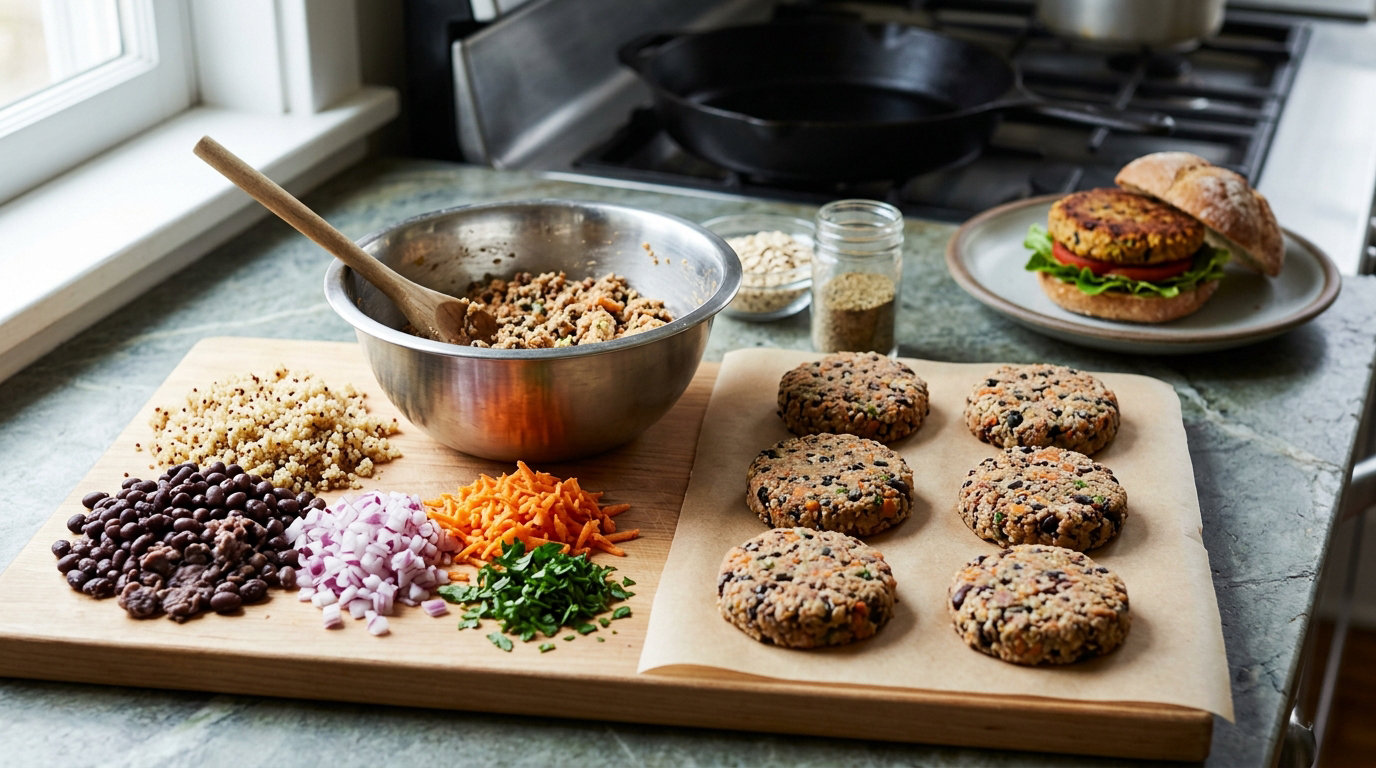
If you want to know how to make veggie burgers from scratch that actually hold together, mash 15 ounces of beans with 1 cup of cooked grain, 1 cup of chopped vegetables, and 1/2 cup of binder, then chill the mixture, shape it into patties, and cook until browned outside and hot through. It takes about 45 minutes and costs roughly the same as a box of pasta.
Most people who try this end up with something that tastes fine and then disintegrates in the skillet. That is nearly always one thing: too little binder for how much water is in the bowl. Get the ratio right and everything else is straightforward.
The formula below is the one I come back to. It also works for year-round meal prep, since the patties freeze well either raw or cooked.
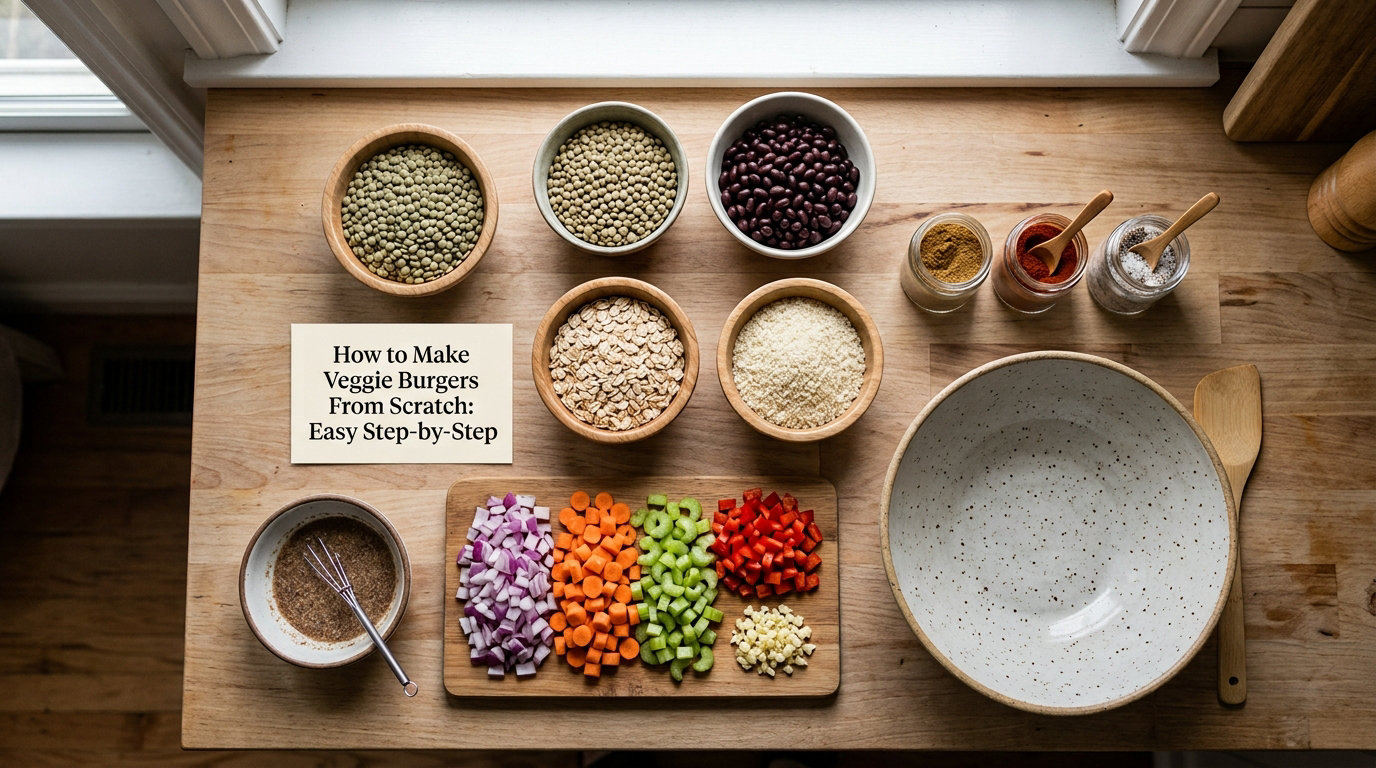
Table of Contents
- What You Need
- How to Make Veggie Burgers From Scratch: Step-by-Step
- Frequently Asked Questions
- What binder is best for veggie burgers made from scratch?
- Can I make veggie burgers without eggs or breadcrumbs?
- Why do my homemade veggie burgers fall apart?
- Can veggie burger patties be frozen before cooking?
- How do I cook veggie burgers in the oven or air fryer?
- What vegetables work best in a homemade veggie burger?
- What to Do First
What You Need
A veggie burger is four things in a bowl: a mashed bean or lentil base, a cooked grain for bulk and structure, vegetables for flavor and moisture, and a binder to hold it all together. The first three are easy. The fourth decides whether you get a burger or a pile of crumbs.
The base formula
| Component | Amount | Why it is there |
|---|---|---|
| Beans or lentils | 15 oz can, drained and rinsed (about 1.5 cups) | Protein, starch, and the mashed bulk of the patty |
| Cooked grain | 1 cup (brown rice, quinoa, oats, or bulgur) | Structure and a chewy bite |
| Vegetables | 1 cup total, finely chopped | Flavor and moisture |
| Binder | 1/2 cup (breadcrumbs, panko, oat flour, or chickpea flour) | The glue that survives a flip |
| Wet binder | 1 egg, or 1 flax egg for vegan | Cements everything into one piece |
| Seasoning | 1 tsp salt, 1/2 tsp each garlic powder, onion powder, smoked paprika; 1/4 tsp cumin | The difference between bland and good |
A standard 15 oz can of beans yields roughly 1.5 cups drained, which is why the ratio works without any math on your part. Use two cans if you are feeding four people.
Which binder should you use?
| Binder | Amount | Texture it gives | Good for |
|---|---|---|---|
| Panko or breadcrumbs | 1/2 cup | Crisp, light | The best all-round choice |
| Oat flour | 1/2 cup | Denser, earthier | Gluten-free, hearty burgers |
| Chickpea flour | 1/3 cup | Firm, slightly earthy | Adding protein, firm patties |
| Ground flaxseed meal | 2 tbsp plus 6 tbsp water | Firm, moist | Vegan patties, extra binding |
| Mashed potato | 1/2 cup | Soft, almost cakey | A no-grain version |
On the question of swapping one binder for another: oat flour and flax meal cover each other almost exactly, and swapping one for the other tends to give firmer patties that hold together on a grill. Hazelnut flour is the exception, since it leaves the mixture slightly moist and needs extra panko to hold. Sorghum flour works in place of wheat flour without any other change.
Equipment, and the no-processor path
A food processor is the fastest route, and pulsing rather than pureeing matters. You want a coarse rubble, not a smooth paste. But a processor is not required. A potato masher gives you more texture than a processor and works fine for most recipes. A fork works too, just expect to spend five extra minutes breaking the beans down.
Whatever tool you use, the beans should be about half mashed, with plenty of whole pieces still visible. That unevenness is what keeps the finished patty from turning to mush when you bite it.
How to Make Veggie Burgers From Scratch: Step-by-Step
- Drain and rinse. Drain the 15 oz can of beans and rinse under cold water until the water runs mostly clear. Rinsing removes the starchy can liquid that makes patties gluey and grey.
- Chop the vegetables finely. Dice one cup of onion, bell pepper, mushroom, or grated zucchini into pieces about the size of a lentil. Bigger pieces give you a salad in a bun instead of a burger.
- Drain the vegetables. If you are using mushrooms, zucchini, or anything grated, squeeze them in a clean towel. This is the step people skip and then blame on their pan.
- Mash the beans. Put the beans in a bowl and mash with a fork, a masher, or short processor pulses until about half of them are broken up.
- Mix everything together. Add the cooked grain, the vegetables, the dry binder, the seasoning, and the egg (or flax egg). Stir with a spatula until the mixture holds together when you squeeze a handful. It should feel like thick cookie dough, not like wet sand.
- Chill for 20 to 30 minutes. Cover the bowl and put it in the fridge. The starches in the beans and grain set in the cold, and a cold mixture holds its shape instead of slumping in your palm. Skipping this is the second most common reason patties break.
- Shape equal patties. Scoop about 1/3 cup of mixture per patty. Press firmly into a 3.5 to 4 inch disc, then press a shallow thumb indentation into the center. That dent stops the patty from puffing up into a dome as it cooks, which is what makes a burger hard to bite through.
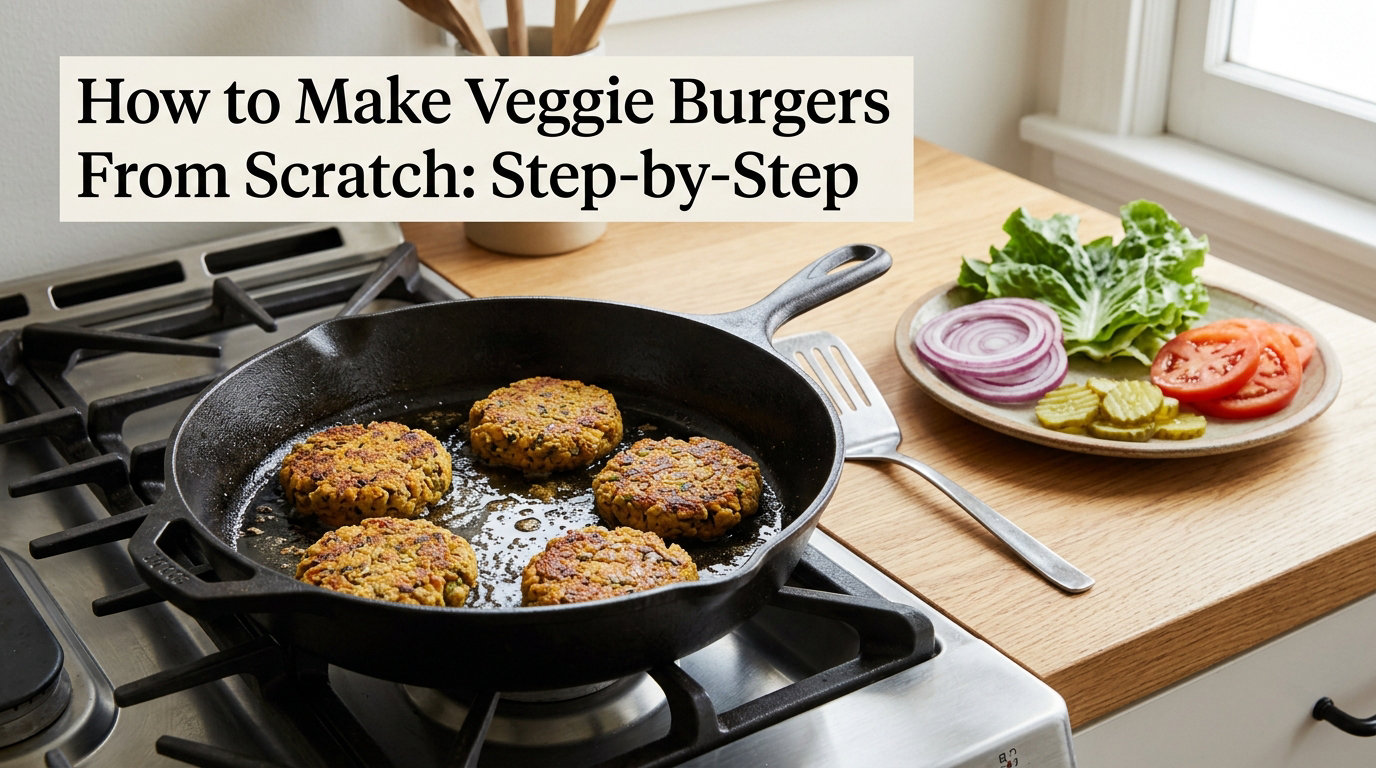
- Cook. Use one of the four methods below, following the times exactly.
Prepare the vegetables and mix the patty
The whole job comes down to moisture. Water in the bowl means a patty that steams instead of fries, turns pale, and dissolves when you flip it. Salting your chopped vegetables and letting them sit in a strainer for ten minutes pulls out water, and you skip it at your own risk.
Beyond water, you are managing one more variable: how much your mixture holds. The squeeze test settles it. Take a handful, squeeze hard, and if it clumps into a shape that survives you letting go, you are in range. If it crumbles, add another 2 tablespoons of your dry binder. If it sticks to your hand and feels dense, add a spoonful of grain or a few tablespoons of extra chopped onion.
Let the bowl sit in the fridge while you clean up. Those twenty minutes are the difference between patties that flip cleanly and patties that leave half their mixture welded to the pan.
Shape and cook the veggie burgers
| Method | Heat | Time | What you get |
|---|---|---|---|
| Pan-fry | Medium, 1/2 tbsp oil per patty | 4 to 5 minutes per side | The best crust, the least fuss |
| Bake | 400°F / 205°C, middle rack | 22 to 25 minutes, flipping at 12 | Even cooking, minimal hands-on |
| Grill | Medium-high over charcoal or gas | 4 minutes per side, one closed | Smoke and char, needs a firm patty |
| Air fryer | 390°F / 200°C | 12 to 15 minutes, flip at 7 | Fast and crisp, fragile if soft |
For air frying, the patty has to be firmer than you would make for a skillet. Air frying dries the surface very fast, so a soft patty crumbles at the flip. Press yours a little harder, or add an extra tablespoon of binder, and it holds.
For grilling, oil the patties rather than the grate, and give them a full 20 minutes in the fridge if you can. A patty that has been chilled properly and pressed firmly will not break on a grill, and that is worth more than any amount of sauce.
Because these patties contain no meat, there is no USDA minimum internal temperature to hit during cooking. When reheating a cooked patty, bring it to 165°F / 74°C so it is steaming hot, which is the safe handling rule for leftovers.
Store cooked patties in the fridge for up to 3 to 4 days. For freezing, lay them on a sheet pan until solid, then move them to a bag so they do not stick together. Raw patties freeze well and cook from frozen at 375°F / 190°C for about 30 minutes, flipping once. Reheating a cooked patty works best in a dry pan over medium heat, 2 to 3 minutes a side; the microwave works too and holds up fine, though the crust softens.
Common Mistakes
| What went wrong | Cause | Fix |
|---|---|---|
| Patties break in the pan | Not enough binder, or the mixture was never chilled | Add 2 tbsp binder per patty and chill 20 minutes before shaping |
| Patties taste watery | Wet mushrooms, zucchini, or canned bean liquid | Salt vegetables, let them drain, squeeze them dry |
| Patties are dense and pasty | Over-processed, or the binder is too heavy | Mash by hand, cut binder by 1 tbsp, add grain |
| Outside burns before the center cooks | Heat too high, patty too thick | Drop to medium and press to 3/4 inch thick |
| Patties puff into a ball | No center indentation | Press a thumb dent into each one before cooking |
| Everything tastes flat | Under-seasoned base, or seasoning only added to the surface | Mix the spices into the dry binder before combining |
One note on seasoning. Most people undersalt the mixture because the patty is coated later. Season the bowl, not the bun. Smoked paprika, chipotle powder, curry powder, or a spoonful of barbecue sauce all work, and adding them to the dry binder before it meets the beans spreads the flavor through the patty instead of leaving it on the crust.
Frequently Asked Questions
What binder is best for veggie burgers made from scratch?
For most recipes, plain breadcrumbs or panko at 1/2 cup per 15 oz can of beans is the best all-round binder, because it absorbs moisture without changing the flavor. Oat flour gives a denser, gluten-free patty, chickpea flour adds protein, and a flax egg plus 2 tablespoons of ground flaxseed works when you are cooking without eggs. Whatever you use, pair the dry binder with a wet binder, since dry crumbs alone usually cannot survive a flip.
Can I make veggie burgers without eggs or breadcrumbs?
Yes. Swap one egg for one flax egg, which is 1 tablespoon of ground flaxseed mixed with 3 tablespoons of water and left to sit for 10 minutes. For the breadcrumbs, use 1/2 cup of oat flour, chickpea flour, or 1/2 cup of mashed potato. Do not try to build a patty from beans and liquid alone; without something that absorbs water, the mixture will spread in the pan instead of holding its shape.
Why do my homemade veggie burgers fall apart?
Three causes cover nearly every case: too little binder, a mixture that was not chilled, and patties shaped too loosely. Use 1/2 cup of dry binder plus an egg or flax egg per 15 oz can, chill the mixed bowl for 20 to 30 minutes, then press each patty firmly with the palm of your hand rather than rolling it loosely. A thumb indentation in the center also keeps the patty flat and structurally sound.
Can veggie burger patties be frozen before cooking?
Yes, and freezing them raw actually firms the mixture up nicely. Shape the patties, lay them on a lined sheet pan, freeze until solid, then transfer to a bag or container so they do not stick together. Cook from frozen at 375°F / 190°C for about 28 to 30 minutes, flipping once, or thaw in the fridge overnight and pan-fry as usual. They keep for up to three months.
How do I cook veggie burgers in the oven or air fryer?
For the oven, heat to 400°F / 205°C, set the patties on a lined sheet pan, and bake 22 to 25 minutes, flipping at the halfway mark. For an air fryer, press the patties firmer and add an extra tablespoon of binder, since fast airflow dries the surface and crumbles a soft patty. Air fry at 390°F / 200°C for 12 to 15 minutes, flipping at 7 minutes, for the crispest result with the least oil.
What vegetables work best in a homemade veggie burger?
Finely chopped onion, bell pepper, shredded carrot, and corn all work, since they hold their shape and add sweetness. Mushrooms and grated zucchini are excellent for a meatier texture, but squeeze out the water first or the patty will steam. Zucchini also needs the grain ratio raised by a few tablespoons. Skip watery vegetables like cucumber and tomato, and add those raw as toppings after cooking instead.
What to Do First
Start with one can of beans and make four patties, following the ratios exactly rather than eyeballing them. Once you have the ratio right, the swaps are endless, and you can move on to flavor without worrying about the patty surviving the pan.