
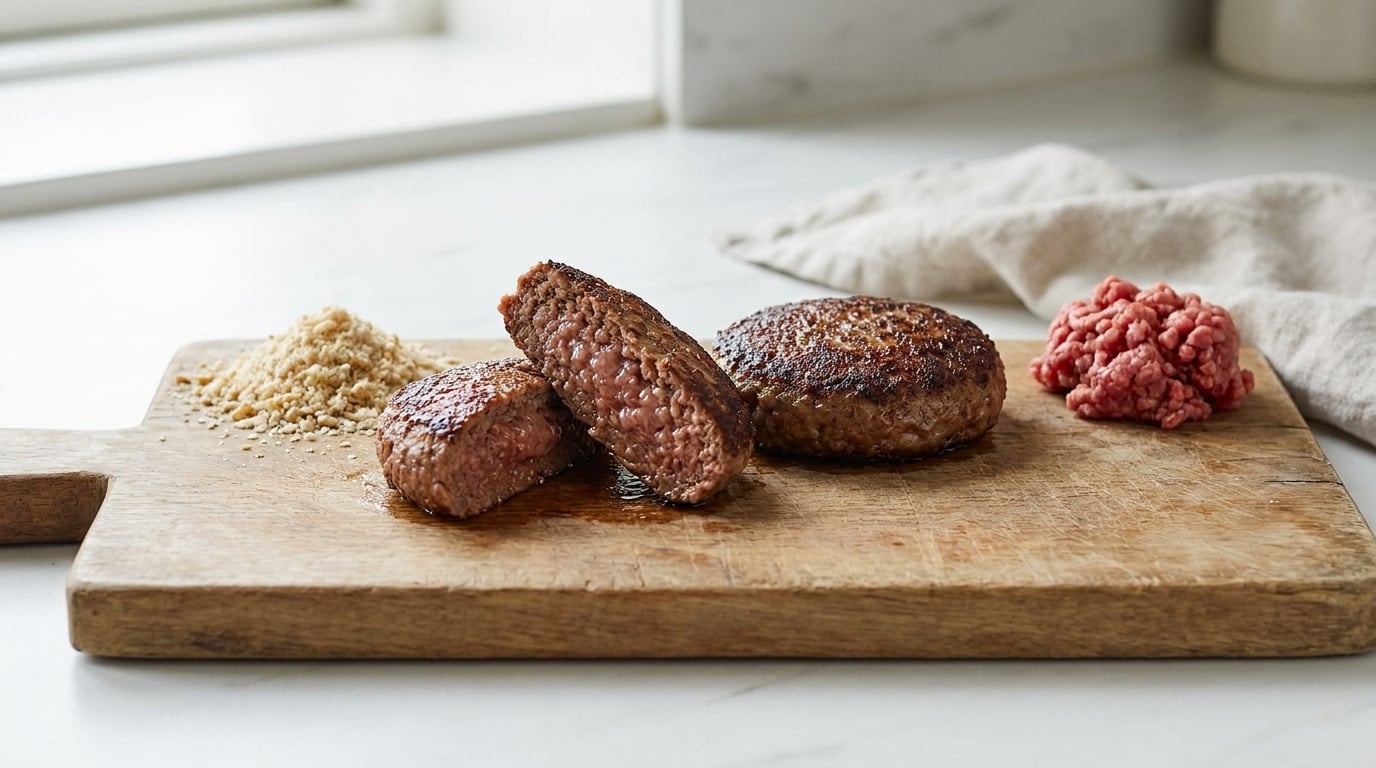
Short answer: breadcrumbs make a burger that holds together better and stays plumper, and no breadcrumbs make a burger that tastes more like beef. Both are legitimate methods, and the deciding variable is not the crumbs but the fat content of your meat. A well-made 80/20 chuck blend rarely needs a binder; a lean 90/10 blend, turkey, or black bean patty usually does.
That is the whole argument in a sentence, and the rest of this guide is the detail behind it: what crumbs actually do inside a patty, how much to use, and how to cook each version. Everything here runs on one food-safety baseline: ground beef to 160°F (71°C) internal, ground poultry to 165°F (74°C), and a thermometer is the only way to be sure.
Table of Contents
- How to Make Burgers With Breadcrumbs vs Without at a Glance
- What Is the Main Difference Between Breadcrumb and No-Breadcrumb Burgers?
- How Do Breadcrumbs Affect Burger Texture and Moisture?
- Which Method Produces Better Browning and Flavor?
- Which Method Is Easier for Home Cooks?
- How to Choose Between Breadcrumbs and No Breadcrumbs
- Which Should You Choose?
- Frequently Asked Questions
- Conclusion: Start With the Texture You Want
How to Make Burgers With Breadcrumbs vs Without at a Glance
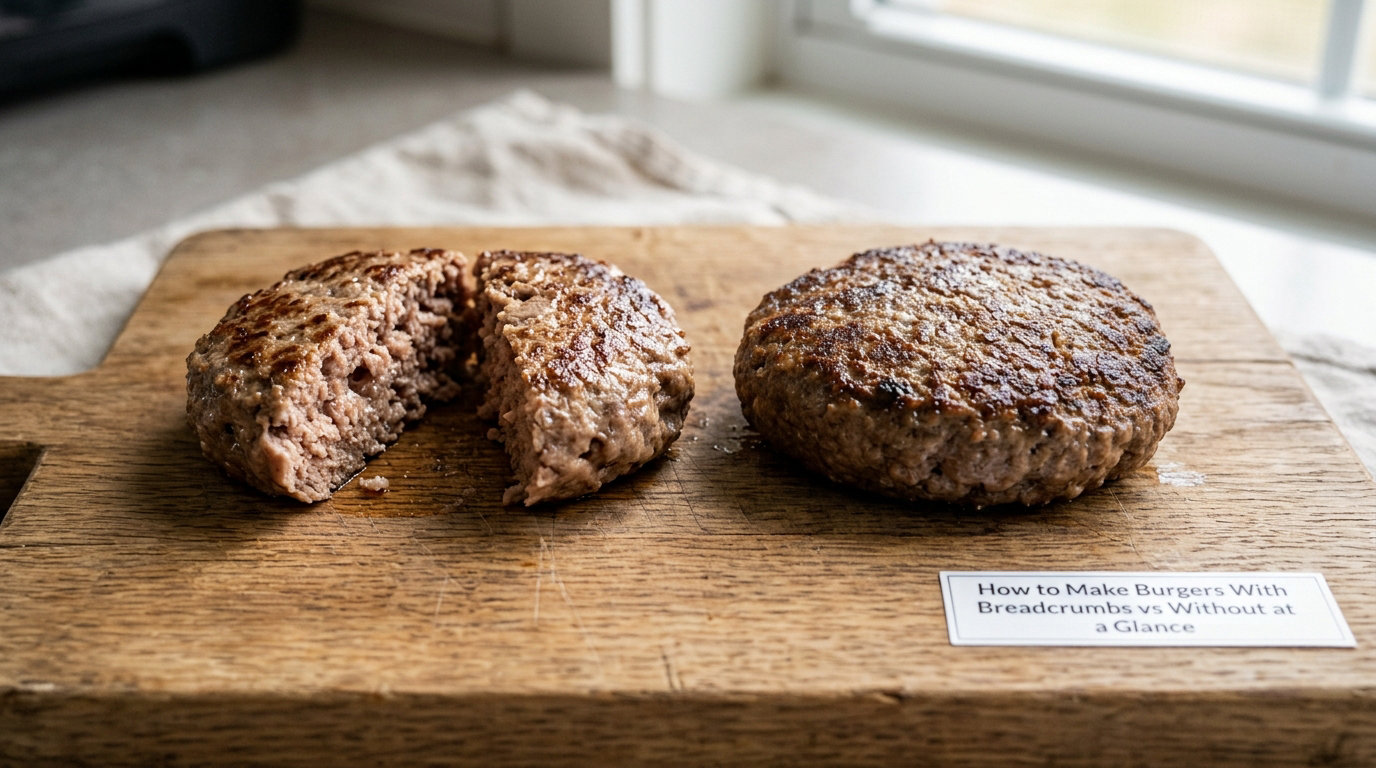
If you only read one part of this, read the table. Every difference between the two methods traces back to the same thing: crumbs give a patty structure that ground meat does not have on its own.
| Criterion | With breadcrumbs | Without breadcrumbs |
|---|---|---|
| Texture | Firm, cohesive, slightly springy; a faint starchy note in the bite | Tender, loosely packed, irregular, closer to a hand-formed steak patty |
| Juiciness | Plumper and more moist; crumbs absorb rendered fat and juice | Juiciness comes from the meat and the cook, not from a filler |
| Structure | Holds a clean edge, survives a flip, freezer and reheating | Fragile at the edges, especially on a grate or in a thin patty |
| Shrinkage | Less shrink, since some of the water loss is carried by the crumbs | More shrink and more drippings in the pan |
| Browning | Crust colours quickly and toasts darker; crumbs crisp at the edges | Even, hard sear with lacy edges, ideal for a smash |
| Flavour | Milder, faintly bready, seasoning reads a little dampened | Pure beef flavour, seasoning sharp and clear |
| Best meat fat | 90/10 and leaner, turkey, chicken, veggie, black bean | 80/20 chuck and anything fatter |
| Best method | Cast iron, gentle-medium heat, one flip | Grill, griddle, or a hard sear then lower heat |
| Easier for a beginner | Forgiving, especially for sliders and a big cook | Fewer ingredients but far less margin for error |
What Is the Main Difference Between Breadcrumb and No-Breadcrumb Burgers?
The main difference is scaffolding. Ground meat has no gluten structure, so it cannot hold a shape on its own the way a piece of steak does. What holds a breadless patty together is fat, cold temperature, and very light handling. A cook on r/ketoaustralia puts it plainly: a burger patty never needs egg or breadcrumbs, because it’s the fat that binds it and there’s no air in it.
What breadcrumbs add is a porous, dried matrix that soaks up moisture and rendered fat as the patty cooks. That matrix gives the patty an internal scaffold, which is why breadcrumb patties hold a clean edge and why they reheat better a day later.
How to Make Burgers With Breadcrumbs vs Without at the Mixing Stage
The mixing stage is where the two methods part ways. Without breadcrumbs, you want minimal contact: season the meat, handle it just enough to shape, and stop. Overworking is what turns a loose 80/20 patty into a dense, bready one.
With breadcrumbs, you are doing extra work on purpose. You fold the crumbs in until they’re evenly distributed, which is more handling than a breadless patty wants. That is the real cost of the crumb method, and it explains why a well-mixed crumb patty can still feel tight if you go overboard.
One useful distinction from r/AskCulinary: onion, herbs, and bacon are flavourings, and many cooks prefer to mince them straight through the meat. Egg and starches belong in the mix only at the hand-mixing stage, where they do their binding work.
How Do Breadcrumbs Affect Burger Texture and Moisture?
Breadcrumbs make a patty firmer and more compact, and they make it measurably wetter on the inside. On moisture there is published work worth knowing: research on lean poultry emulsions has found that adding wheat crumbs cut cooking loss by as much as 35 percent, because the crumb matrix holds water that would otherwise drip out. A burger patty is a different food from a sausage emulsion, but the mechanism is the same one that keeps a breadcrumb patty plump.
Readers describe the effect in the same terms. Someone on r/food described adding about half a cup of breadcrumbs because it soaks up the juice and keeps the patties plump, which is the most common home-cook justification for the method.
The trade-off is mouthfeel. A breadless patty crumbles slightly when you press it; a crumb patty springs back. If you bite into a crumb patty and notice a soft, bready interior, that is not a fault, it is the binder doing its job. On r/Cooking, one commenter put it as bread crumbs make a better binder than flour, in my opinion.
Which Method Produces Better Browning and Flavor?
The no-breadcrumb method wins on flavour and on crust. Pure beef, sharply seasoned, with a hard sear and lacy edges is exactly what the smash-burger method is built around, and crumbs work against it because they take up surface space and dilute the Maillard browning you want.
The breadcrumb method wins on colour consistency, not flavour intensity. Dry crumbs toast faster and darker than the meat around them, so a breadcrumb patty browns evenly all over and develops a slightly bitter, toasted note at the edge. Seasoning also reads slightly dampened, because the crumbs absorb salt and moisture before the meat does.
Cooking method matters here. Breadcrumb patties suit cast iron over medium heat, cooked patiently and flipped once. Breadless patties can take aggressive heat, which is the entire point of a smash, and they reward a hard sear followed by lower heat to finish.
Regional breaded traditions, from the Mississippi Slug Burger described on r/burgers to Salisbury steak and Italian polpette, exist precisely because the toast and the bready crumb are the dish, not an accident.
Which Method Is Easier for Home Cooks?
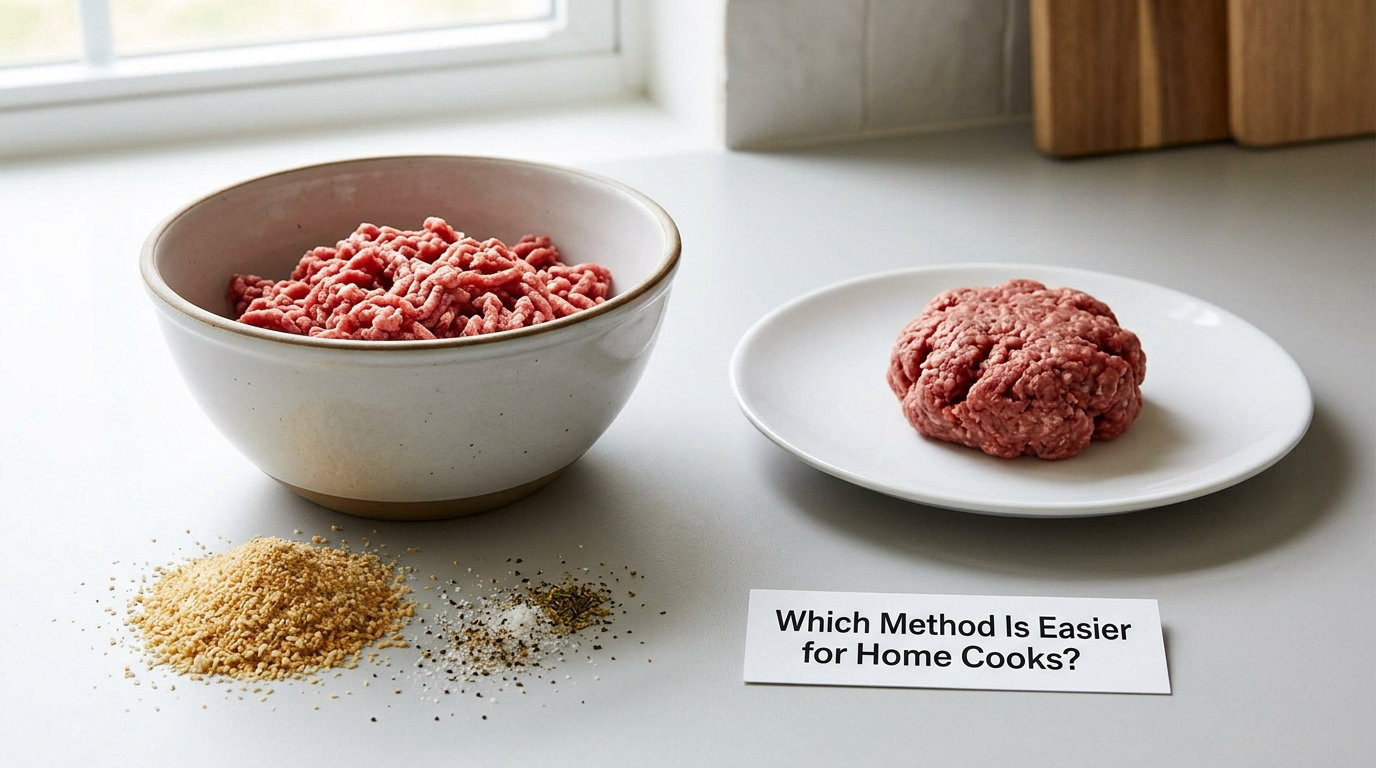
The breadcrumb method is easier for a beginner, and no-breadcrumb is easier for a cook with a hot grill and good beef. Crumbs buy you forgiveness: a patty that cracks on the grate still mostly holds, and you can make twenty for a cookout without shaping anxiety.
The breadcrumb method, step by step
For 1 pound of ground beef, use 1/4 to 1/2 cup of dry breadcrumbs, the tolerance most people land on. Start at a quarter cup for beef, go toward half a cup for turkey, chicken, or veggie patties. Panko works and gives a lighter, crunchier result; standard dry breadcrumbs give a finer, more integrated crumb.
Beat one egg lightly and stir it into the meat first, then add the breadcrumbs and your salt and pepper. Mix with a light hand until the colour is even, about 30 seconds, then stop. Chill the mixture for 15 minutes if you have time, shape into patties, and keep them at an even thickness so they cook at the same rate.
Cook to 160°F (71°C) for beef and 165°F (74°C) for any ground poultry, verified with a thermometer.
The no-breadcrumb method, step by step
Put the meat in a bowl, season it, and use your hands only to combine. Handle it as little as possible and never knead, which is the mistake most home cooks make. Form loose 3/4-inch balls, indent a shallow dimple in the centre of each so they lie flat, and press them gently at the last second.
Salt the outside just before cooking, not before, so the salt stays on the surface where it can crust. Sear hard for two to three minutes, turn once, then drop the heat and let it finish to 160°F (71°C). Rest a few minutes before serving so the juices settle instead of running out.
If the patties still fall apart
Five fixes cover most failures. Use 80/20 ground beef, since fat is the real binder. Keep the meat cold and keep the work short. Press a weight on the patty for the first minute of cooking so it stops moving. Do not flip until the crust releases on its own. And make the patty slightly thicker, which is the easiest fix of all and was the top suggestion on r/Cooking.
Ice water or a small ice cube mixed into lean meat is a common juiciness trick, along with pressing a small pat of margarine into the centre to catch drips. Both are on the ThriftyFun consensus list, and both work better when the patty has a binder holding its shape.
How to Choose Between Breadcrumbs and No Breadcrumbs
Choose by the four things that actually decide it. First, the style: smash burgers and thick restaurant patties want no crumbs, sliders and thin patties want them. Second, the composition: fattier beef and sausage-style blends bind on their own, lean meat, poultry, and plant-based patties do not.
Third, the cooking method. A high-heat grill or griddle rewards a breadless patty; cast iron over medium heat suits a crumb patty. Fourth, the texture you want to eat. If you want to taste beef, leave the crumbs out. If you want a patty that survives a spatula, a freezer, and a second round on the grill, put them in.
There is also a cost consideration worth stating plainly. Breadcrumbs are a stretcher, so a pound of beef plus a quarter cup of crumbs feeds more people than a pound of beef alone. That is the point of a Slug Burger and the point of every 1970s church supper recipe, but it is not the same as more meat.
Freezing works better with the breadcrumb method. A crumb patty holds its shape through freezing and reheating, where a breadless one tends to crack. Press each patty flat and separate layers with parchment before freezing, and reheat in a hot dry pan rather than a microwave.
Which Should You Choose?
For a classic beef burger with good chuck, go without breadcrumbs. That is the version where you taste the meat, and at 80/20 you have everything you need to hold a patty together. For a smash burger, definitely no crumbs; a thick seared crust and lacy edges are the entire point, and crumbs soften both.
For a thick restaurant-style patty, the decision narrows. A breadless patty gives the better flavour, but a crumb patty at 1/4 cup per pound gives you the juiciness and structure that makes a thick patty survive the trip from a very hot pan to the bun. Most cooks land on no crumbs for flavour and a light hand with the handle.
For turkey, chicken, and veggie patties, use breadcrumbs, and lean toward the upper end of the range. These patties have almost no fat to bind them, so a half cup of crumbs per pound is doing real structural work. Black bean and lentil patties are the same story, and a tablespoon of ground flaxseed with a splash of water is the vegan stand-in that works in place of egg.
For a casual weeknight dinner, whichever you make will feed people. That is the case where the breadcrumb method genuinely wins, because you are shaping eight patties and one bad flip is not worth thinking about.
Frequently Asked Questions
Are burgers better with or without breadcrumbs?
It depends on your meat, not the method. Skip breadcrumbs for fattier blends like 80/20 chuck or for smash burgers, where you want a hard sear and pure beef flavour. Add them for lean 90/10, turkey, chicken, and veggie patties, where structure and moisture come from the binder rather than the meat.
How many breadcrumbs should I add per pound of ground beef?
Start with 1/4 cup of dry breadcrumbs per pound of ground beef and go up to 1/2 cup for turkey, chicken, or plant-based patties. That range is wide on purpose. Panko gives a lighter, crunchier crumb than standard dry breadcrumbs, and fresh or soft breadcrumbs add moisture but bind less reliably.
Do breadcrumbs make burgers dry?
No, they generally do the opposite. Dried bread absorbs moisture and rendered fat that would otherwise drip out, which is why breadcrumb patties come out plumper and why published work on lean emulsions found crumbs cut cooking loss substantially. Patties taste dry when overmixed or overcooked, not when they contain crumbs.
Can I freeze and reheat burger patties made with breadcrumbs?
Yes, and breadcrumb patties freeze better than breadless ones because the crumb matrix keeps them from cracking. Press each raw patty flat, freeze in a single layer, then bag them with parchment between layers. Reheat in a hot dry pan with a little oil until the centre reaches 160°F for beef or 165°F for ground poultry.
What is the best binder for lean or veggie burger patties?
Breadcrumbs are the most reliable all-round binder, with egg as a partner that helps distribute them. Oat flour works well and adds a nutty note, ground flaxseed mixed with water is the vegan option, and finely ground tortilla chips add binding plus a corn flavour. Egg alone binds more weakly than crumbs, so use it with them rather than instead.
Conclusion: Start With the Texture You Want
If you prioritise a juicy, loosely formed burger that tastes like beef, start without breadcrumbs: good 80/20 meat, a light hand, a dimple in the centre, and one confident flip. If you prioritise a firm, cohesive patty that survives the grill, a spatula, and the freezer, start with breadcrumbs at a quarter cup per pound and go higher for lean or plant-based meat. Pick your fat content first, and the rest of the decision makes itself.