
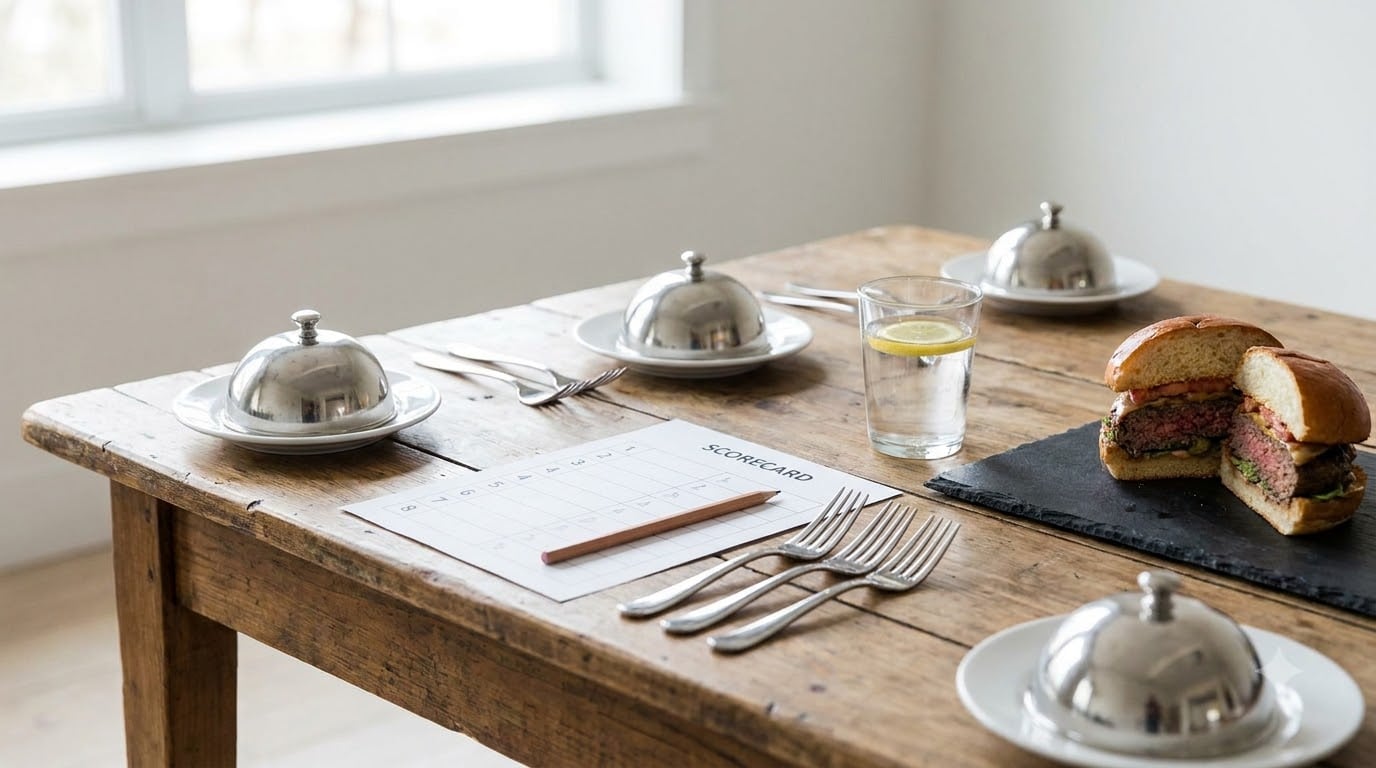
Judging a burger competition means scoring every entry against written criteria — usually appearance, patty flavor, texture and doneness, bun, toppings, and overall impression — on a fixed scale, using blind numbered samples so nobody knows which cook made which burger. Set the rubric before the first patty hits the grill, hand out identical tasting portions, write the score before anyone speaks, then combine the cards. That is the whole system, and it takes about an hour to build.
I have sat on panels at neighborhood cook-offs where the result came down to who knew the most people in the room. The fix is boring and it works: publish the weights, hide the names, force silence during tasting, and average the cards. Everything below is built around that.
Table of Contents
- What You Need
- Step-by-Step: How to Judge a Burger Competition
- 1. Confirm the rules, categories, and scoring limits
- 2. Set up safe tasting and food-safety procedures
- 3. Create numbered blind-tasting stations
- 4. Test every burger with the same method
- 5. Score flavor, texture, and execution separately
- 6. Calculate results and resolve ties
- 7. Review the judging and announce the results
- How doneness fits into a burger competition
- Common mistakes when judging a burger competition
- Frequently Asked Questions
- How many judges do I need for a burger competition?
- Should a burger competition be judged blind?
- Can judges award bonus points for beer pairings?
- How should judges handle different burger categories?
- What should I do if two burgers receive the same score?
- How can I give useful feedback without favoring one cook?
- Conclusion
What You Need
Most of the gear is paper. The expensive part is your own attention, and the part people skip is the rulebook.
- A one-page rules packet handed to every judge at the table: categories, required components, portion rules, garnishes allowed, cooking requirements, scoring weights, penalties, and how many winners you may declare.
- The judging rubric itself, printed as a scorecard with one row per criterion and a fixed score range. Organizers can reuse the table below as-is.
- Numbered sample trays or cups in sealed or covered form, one per entry per judge, labeled with a number that means nothing to the taster.
- Score sheets and pencils, one per entry per judge. Pencils beat pens on a scorecard because a single slip can be erased and re-signed without rewriting the whole card.
- Clean tasting forks and small plates, plus a water glass and plain crackers or bread for rinsing between entries.
- Hand sanitizer, gloves, and a sanitizer bucket for shared utensils and shared tongs.
- A probe thermometer if the contest scores doneness or requires a documented pull temperature.
- Optional but useful: a stopwatch for pacing, a small bell or timer between entries, and a second clipboard for the coordinator tallying cards.
Write the sample-portion rule into the packet too. Something like “one cross-section cut from the center of the patty, plus one corner piece of bun with toppings” removes the argument that happens when one cook’s entry is generous and another’s is stingy.
Step-by-Step: How to Judge a Burger Competition
Work through these seven steps in order. The order is the point — safety and blind setup come before anyone tastes, and calculation comes before anyone talks.
1. Confirm the rules, categories, and scoring limits
Meet before the doors open and read the rules aloud once. You want every judge hearing the same wording from the same person, especially about doneness requirements, garnish limits, and whether creativity scores at all.
Settle four things before anyone bites anything: which categories exist (classic cheeseburger, bacon, spicy, veggie and so on), what every entry must include, how many points or points-per-category each judge may award, and how many winners you are allowed to name. If a category will be judged separately, keep the scorecards and tallies separate too. Mixing categories into one leaderboard is the fastest way to produce a dispute nobody can resolve.
For doneness, decide whether judges score the requested doneness, the actual served temperature, or only safety. Write the answer into the packet. Entrants who planned for medium-rare lose badly when the rule was never stated.
2. Set up safe tasting and food-safety procedures
Ground beef must reach 160°F (71°C) for safe consumption, and that floor applies to competition entries just as it does at home. Entrants supply their own probe readings, or the coordinator spot-checks with a sanitized thermometer before the sample goes out. A burger that reads under 160°F on arrival is held and not served to judges.
Build in cross-contact control. Every entry gets its own utensils, its own cutting board, and a fresh pair of gloves. No shared tongs, no shared slicing knife, no passing a plate around the table for seconds. Judges sample, they do not share bites from a single plate.
Keep the tasting pace short and set samples out in small waves rather than a full tray of twelve, which encourages people to nibble instead of commit to a score. If the plan involves a pairing with beer, keep beer out of the scoring room entirely — you cannot score cleanly through a haze, and you cannot fairly score a pairing that only some judges drank.
3. Create numbered blind-tasting stations
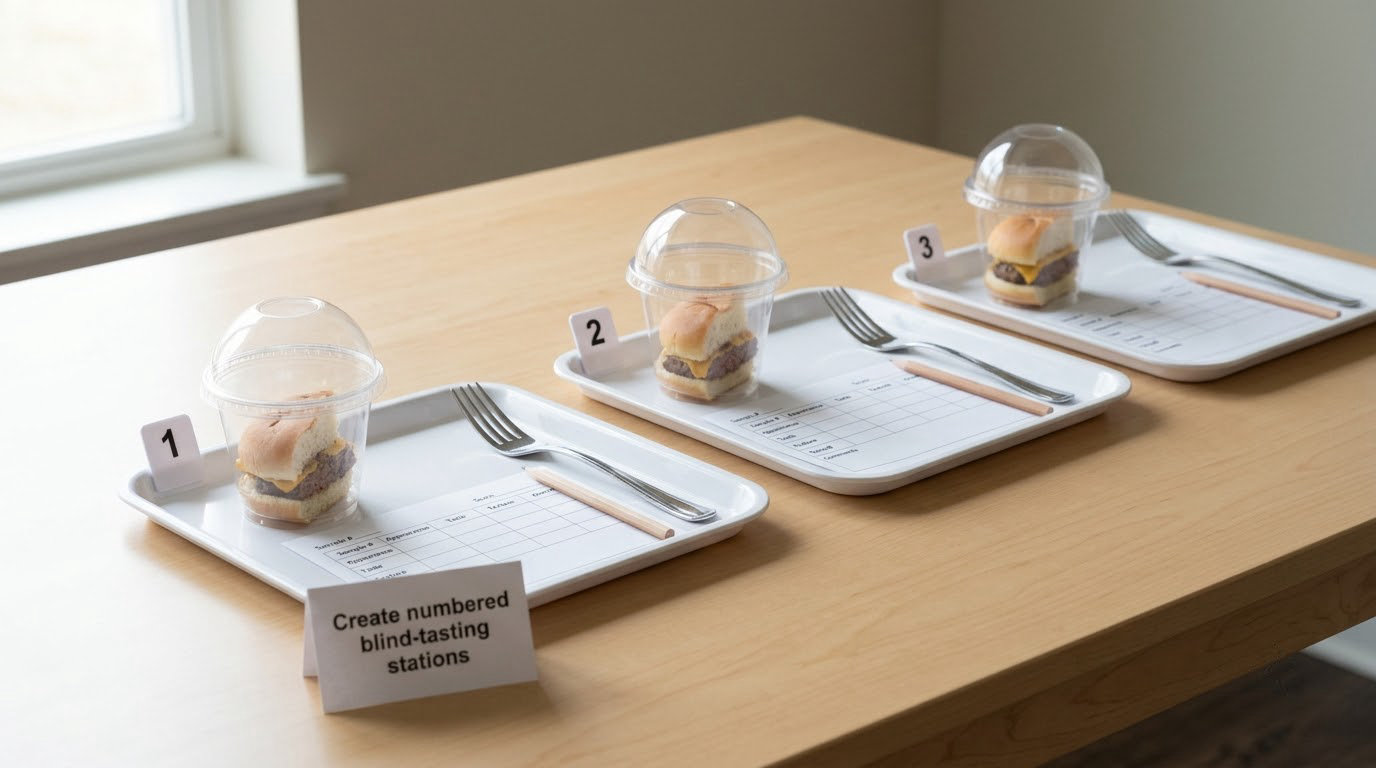
One coordinator distributes the samples. Each entry gets a number, and that number travels with every portion handed to every judge. Judges never see a name, a restaurant, a table number, or a plating style that identifies the cook. If your event serves entries on a station table in the open, that is not blind judging — have a runner carry sealed portions instead.
Blind numbering sounds obvious and still gets skipped at small cook-offs, usually because a cook is also the organizer. Say plainly in the packet that names are revealed only after all cards are signed, and put a coordinator in charge who is not an entrant. Proof of fairness matters more than politeness when someone finishes second by half a point.
Label the scorecards with the entry number only. Judges score the number, not the burger’s lineage.
4. Test every burger with the same method
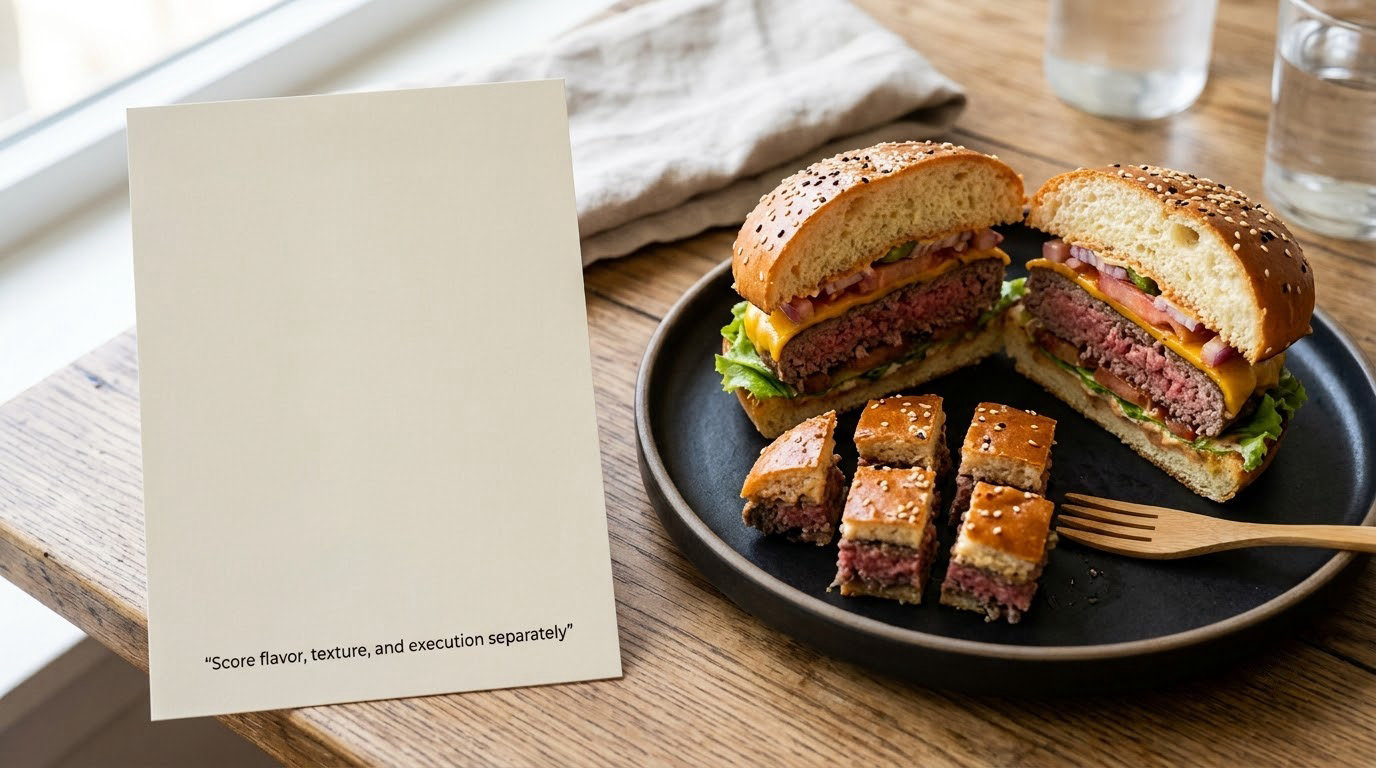
Cooking forum users who judge at home cook-offs keep landing on the same move: deconstruct. Look at the entry, then take one bite of the patty alone, one bite of bun, and one bite with everything together. You learn three separate things instead of one blended impression, and a soggy bun cannot hide behind a strong sauce.
Then hold the method constant for every entry. Same specified portion, same order of components, same fork, same number of bites, same time spent chewing before scoring. Write this as a fixed sequence and read it out once at the start.
Two details that matter more than they sound. Score before you talk, because one judge’s “that sauce was incredible” will pull the next judge’s number whether they agree or not. And rinse between entries with water and plain bread, because cumulative richness flattens your ability to tell a good burger from a great one by the ninth sample. That flattening has a name — palate fatigue — and it is why entry three and entry twelve get systematically different scores from the same palate.
5. Score flavor, texture, and execution separately
Most burger competitions score seven things. Here is a weighted version that already balances to 100 percent, with plain-language anchors so two judges scoring the same burger do not land in different centuries.
| Criterion | Weight | What a high score looks like | What a low score looks like |
|---|---|---|---|
| Appearance and presentation | 10% | Clean build, tidy edges, components that stay in the sandwich when lifted | Sliding stack, cracks, soggy base, garnish stacked for show |
| Patty flavor | 25% | Beef reads as beef, seasoning balanced, a browned crust that tastes, not just looks, seared | Flat, oversalted, no crust, taste dominated by the sauce |
| Texture and tenderness | 20% | Juicy without rubbery, springy bite, tender, no dry chew | Dry crumbly meat or tough chewy band |
| Doneness and temperature | 10% | Matches the declared target, hot through, consistent center | Cold middle, raw center, overcooked and dry |
| Bun and bread | 15% | Toasted and lightly sweet, absorbs sauce without collapsing | Bland, untoasted, dissolves into the patty |
| Toppings and sauce balance | 15% | Every component is intentional, nothing masks the meat, acidity and salt land in balance | One topping drowns the burger, slippery and unholdable |
| Overall impression | 5% | Would order it again, feels like a deliberate burger | Fine, nothing more — pleasant but forgettable |
Meat carries the most weight because that is what a burger is. Bun gets more weight than most guides give it, because half the sandwich is bread and a bad bun sinks an otherwise excellent patty. Messiness can be scored, but only against a defined line: a burger that is slightly loose is fine, a burger that cannot be lifted in one piece without a plate is not.
Now match a numeric range to your panel. A 1 to 10 scale is the easiest for first-time volunteer judges. A 1 to 9 anchored scale, borrowed from competitive barbecue judging, is stricter and better for trained panels: 9 is excellent, 5 is average, 2 is bad, and 1 is reserved for a rule violation, which effectively disqualifies the entry. A 100-point weighted scale gives you the finest separation between close entries but needs the rubric above to mean anything.
Whichever you choose, write the anchors down. A panel that all gives 8s and 9s has failed regardless of scale, because a scale that cannot separate entries is decoration. Give judges a reference sample to calibrate against, and tell them a 5 means average for this room today, not average for the entire universe of burgers.
6. Calculate results and resolve ties
Totals are simple arithmetic with one optional complication. Average every judge’s score, or drop the single highest card and the single lowest card per entry and average the remainder, which is common barbecue practice and pulls results away from one enthusiastic or one hostile judge. Publish which method you use in the packet, not after the tally.
Record every deduction with a reason at the moment it applies: entry above the garnish limit, temperature below the safety floor, missing required component, late arrival. A deduction nobody can explain later is the one that ends the event early.
Declare tie-breakers before judging, in a fixed order. The usual order is flavor total first, then texture, then the lowest raw single score. Only if those are still level does a panel discussion happen, and then only to apply the rule you already wrote down, not to renegotiate it. If the tie survives every rule, declare the tie and run a re-judge on fresh samples with a different panel.
7. Review the judging and announce the results
The coordinator checks arithmetic and penalties before anything is announced. Then compare the judges’ totals, and check whether any judge produced identical scores for every entry — a judge who is not discriminating is not helping, and in some formats that panelist’s card gets discarded.
Open a short feedback session after results are posted. Give cooks the categories where they lost points rather than a verdict, since “texture dropped you to second” is coachable and “not good enough” is not. Take appeals seriously but route them through the written rules: the answer to most disputes is a line in the packet that somebody did not read out loud.
How doneness fits into a burger competition
Doneness is where most home cook-offs lose clarity, because people mean three different things by it. Requested doneness is what the cook set out to make. Served doneness is what the patty actually is in front of you. Safety is whether it cleared 160°F (71°C) for ground beef, which is a floor, not a preference.
Score them separately and you stop penalizing the same mistake twice. Our burger internal temperature guide for doneness breaks down the temperature targets and carryover cooking, which matters in a cook-off where a patty pulled at medium can sit to 135°F-plus in a closed sample box before anyone tastes it.
Patty thickness changes the picture too. A thick patty holds heat through the hold time and tolerates a wider serve window; a thin smash patty needs to be tasted closer to the pull. If your rules set one hold time for everyone, say so in the packet.
Common mistakes when judging a burger competition
Almost every disputed burger result traces back to one of these.
Favoritism toward a known name
The fix is structural, not personal: blind numbering, five to seven judges, and averages. Ask a judge to describe a burger without the patty visible — many cannot. That is worth knowing before they score, not after.
Score inflation
Every entry gets an 8, the panel splits a full point across twelve burgers, and a real result turns into a coin flip. Give judges the anchor “5 is average for this room” before the first sample, and instruct them to use the top of the range rarely.
Changing standards mid-event
Run a calibration sample first, scored aloud as a group. After that, everyone holds the same reference for the rest of the day. If your rubric anchors change, change them before entry one, never after the fifth burger.
Oversized sample portions
The entry that arrives with a double stack scores on generosity rather than craft. Cut identical portions from the center of each patty, and specify the size in the rules.
Scoring the decoration
A stacked, garnished, photograph-ready burger can still be dry inside a flat bun. Appearance gets its own row and its own weight, then you stop thinking about it.
Letting the table talk
Discussion during tasting is the fastest route to a room that agrees. Silence until every card is signed, then talk.
Ignoring safety rules to keep things moving
A sample under the safety floor is held, not served, and the delay gets explained to the room. Same for shared utensils and unwashed hands.
Unexplained penalties
Log every deduction with a rule reference at the moment it happens. If you cannot point at the line, drop the deduction.
No feedback at all
Judging, done well, teaches. Ten minutes of category-level comments after the announcement keeps next year’s field deeper.
Practical judging tips that help
Water between entries, and a bite of plain bread to reset. Score patty and bun separately before scoring the assembled burger. Write your one-line tasting note at the table — “savory, dry center, great crust” is more useful later than a number alone, and it forces you to taste rather than react. If you want more on patty construction before an event, our guide to how thick a burger patty should be is worth a read, since thickness drives hold time, temperature loss, and texture scores.
Frequently Asked Questions
How many judges do I need for a burger competition?
Five to seven judges is the working standard for a burger cook-off. Three is enough for a friendly home contest, but with three, one strong opinion is a third of the result. Use an odd number, seat judges from different backgrounds, and combine the cards by averaging, or by dropping the highest and lowest card per entry if your rules say so.
Should a burger competition be judged blind?
Yes, whenever the number of entries allows it. Distribute numbered, covered sample portions through a coordinator who is not an entrant, and label scorecards with the entry number only. Names come back after every card is signed. Blind sampling is what separates a real cook-off from a popularity contest, and it is the single cheapest fairness upgrade you can make.
Can judges award bonus points for beer pairings?
Only if the rules announce it in advance, and it needs care. Pairing points work when every judge tastes every pairing and the beer is served in small measured amounts. Keep beer out of the scoring room if you can, since a judge who tastes five burgers on a full stomach scores very differently from one who has not eaten all day.
How should judges handle different burger categories?
Score each category on its own rubric and keep separate tallies. A bacon entry and a spicy entry should not compete on a single leaderboard, because creativity that suits one category is irrelevant in another. Some organizers score two rounds, flavor-only first and full rubric second, which stops a strong showpiece from hiding a dry patty.
What should I do if two burgers receive the same score?
Apply the tie-breakers you published before judging day: highest flavor total, then highest texture total, then lowest single raw card. If all of those are level too, declare a tie or run a re-judge on fresh samples with a different panel. Never settle a tie by discussion in the room, because that is where preference replaces criteria.
How can I give useful feedback without favoring one cook?
Give category-level comments, not verdicts: which two criteria earned or lost the most points and what specifically caused it. Refer to entries by number while feedback is anonymous, use the same sentence structure for every cook, and announce the schedule for feedback in advance so nobody interprets silence as punishment.
Conclusion
How to judge a burger competition comes down to four things you decide before anyone takes a bite: the categories and their weights, the food-safety floor of 160°F (71°C) for ground beef, the score range with written anchors, and the rule that every card is completed before anyone discusses a burger.
If you are organizing one this month, start with the rubric table above, print it, and hand it out as part of the rules packet. If you are sitting on the panel, bring water, taste the patty and the bun separately, and trust your note more than your number. Update your rules after every event, because the first version is never the version you want to hand the next cook.