
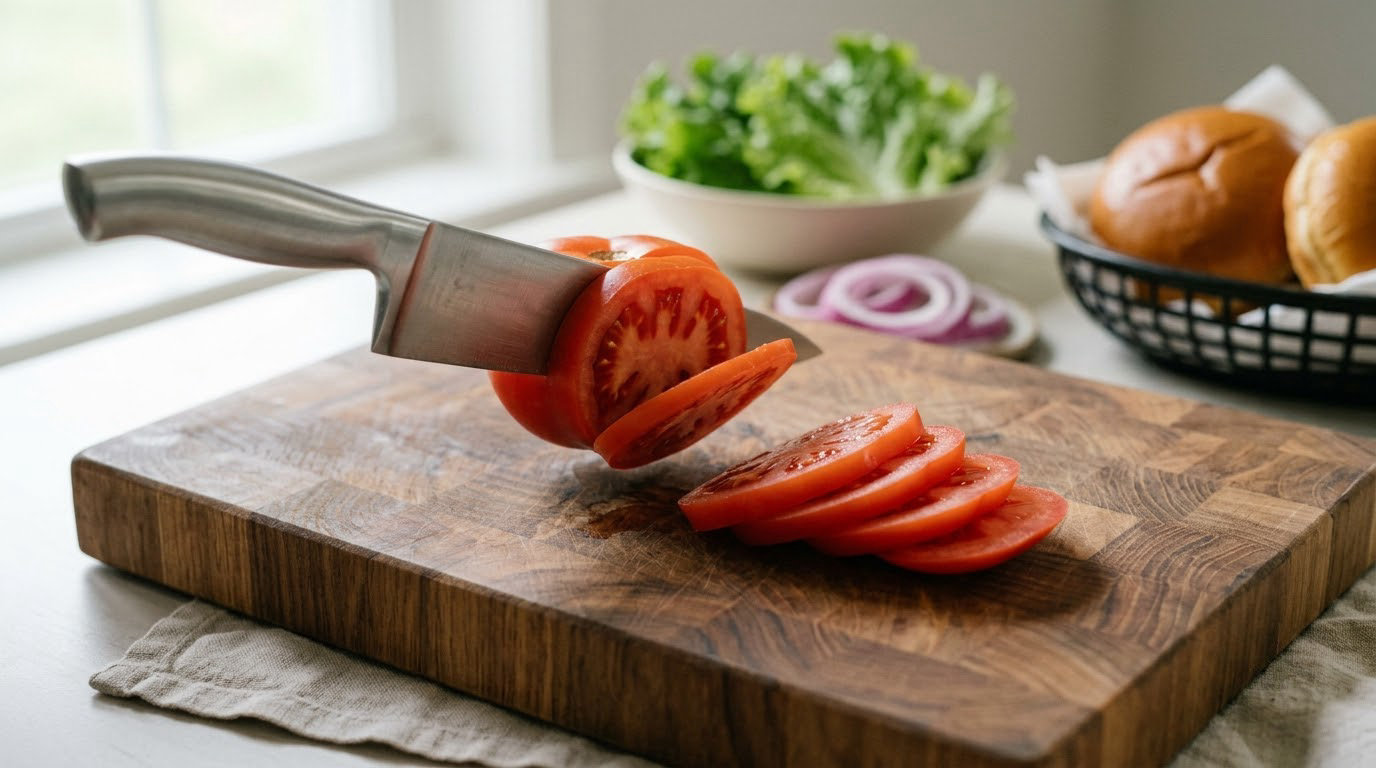
How to slice tomatoes for burgers neatly comes down to three things: a genuinely sharp serrated knife, a tomato firm enough to hold its shape, and one steady crosswise cut at a set thickness of roughly 3 to 6 mm. Do that and you get round, identical slices that sit flat on the patty and leak noticeably less juice onto the bun. The whole job takes about two minutes once your hands know the rhythm.
The reason most home-cut tomato slices look ragged is almost never the tomato. It’s a blunt straight-edged knife pushing soft flesh sideways instead of cutting through it, and slices cut at whatever thickness the hand happened to produce. Both are fixable in a single session.
What You Need
You need a short list, and only one item on it is really non-negotiable.
- A sharp serrated knife. A serrated blade grips the flesh and saws through it, so the tomato compresses instead of smearing. A straight-edged chef’s knife on a ripe tomato drags and tears — this is the single most common complaint people have with their burger tomatoes.
- A stable cutting board. Put a damp kitchen towel underneath it. A wet tomato on a dry board is the reason half of all slices come out half-moons.
- A firm, evenly shaped tomato. Cool room temperature, not fridge cold. Cold fruit is brittle and cracks; fruit straight off a warm counter slices clean.
- Optional: a tomato corer or the back of a teaspoon for lifting out the seed cavity, and a bench scraper to move finished slices to the board without your fingers.
You’ll also want a pinch of salt and a couple of paper towels within reach, though that part is about water rather than cuts. If you’re building the rest of the burger, my guide to pickling red onions for burgers takes the same knife-and-board setup and the same ten-minute mindset.
How to Slice Tomatoes for Burgers Neatly: Step-by-Step
How to Slice Tomatoes for Burgers Neatly
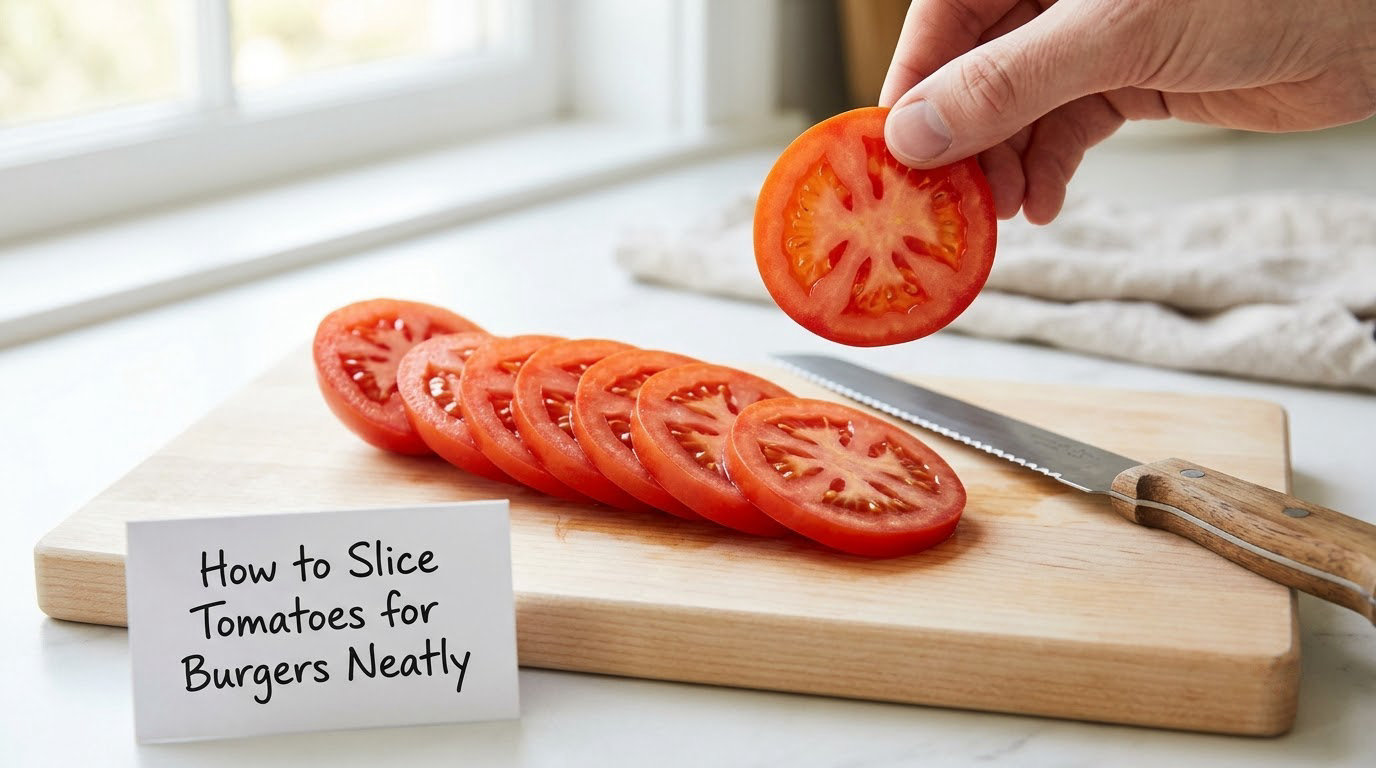
The core technique is a stabilized tomato, a set blade height, and one controlled downward motion per slice.
Set the tomato stem-side down on the board, then lay your palm flat on top with fingers spread. The tomato cannot roll if your hand is on it, and the hand also takes the downward force so the knife only has to slice. Put the serrated blade against the cut face about 3 to 6 mm from the top and rock the blade down and forward in one continuous sawing motion.
Don’t saw back and forth four times to get through. One long, unhurried stroke per slice keeps the cut face clean, and the serrations do the separating while the tip travels. Lift the slice off with the blade itself and lay it flat on the board instead of picking it up.
How do you know it’s right? Line the finished slices up edge to edge and look at them from the side. If the row rises and falls like a washboard, your thickness is drifting, and the next slice should be set slightly thicker to match the top of the last one. Even, matched rounds are the whole game, and it’s the reason a fast-food counter can stack a tomato-heavy burger without it collapsing: every slice comes off the same blade setting.
Choose the Right Tomato and Thickness
Pick a beefsteak-style tomato that feels heavy for its size and gives slightly at the shoulder. Avoid anything with a soft, hollow-feeling patch, and avoid heirlooms unless you like the challenge — their ribbed, irregular shoulders make even rounds genuinely hard, which is worth knowing before you start.
Thickness is a diameter problem as much as a texture problem. Measure your bun once, then match the slice to it: a standard potato bun wants slices in the 5 to 6 mm range, a tall brioche bun handles 6 to 8 mm slices without looking mean, and a thin slider bun wants 3 to 4 mm or the tomato overhangs and squeezes the top bun off.
Two slices suit a single patty. Three suit a double. If you’re checking doneness as you go, remember ground beef is safe at 160°F (71°C) measured at the thickest point, and a whole cut off the bone wants 145°F (63°C) with a three-minute rest.
Prevent Juice Loss and a Slippery Burger
Water is what ruins the stack, and water comes from the seed cavity in the middle of the fruit.
Halve the tomato top to bottom, cut out the core, and swipe the seeds and gel out with the back of a spoon or your finger. Home canners land on the same motion — halve, core, swipe — and it costs about twenty seconds per tomato. What is left is the firm outer ring that actually tastes of tomato.
Two more tricks matter. Salt the cut faces lightly, lay them cut-side down, and give them five to ten minutes on a paper towel; the salt draws water out of the flesh before it ever reaches the bun. Then slice as close to assembly time as you can, transfer slices with a slotted or wide spatula rather than tongs, and put tomato near the top of the stack so any moisture stays away from the bottom bun. Build order matters for the same reason: tomatoes high, lettuce underneath as a barrier.
If you like cooked tomato instead, sear thick slices in a hot pan for a minute per side and slice them onto the burger warm — the heat drives off water and the slices hold their shape better than raw. And if the whole stack is going to sit for more than a few minutes, leave the tomato off entirely and bring it to the table separately. Caramelized onions survive a long hold beautifully; raw tomato does not.
Common Mistakes
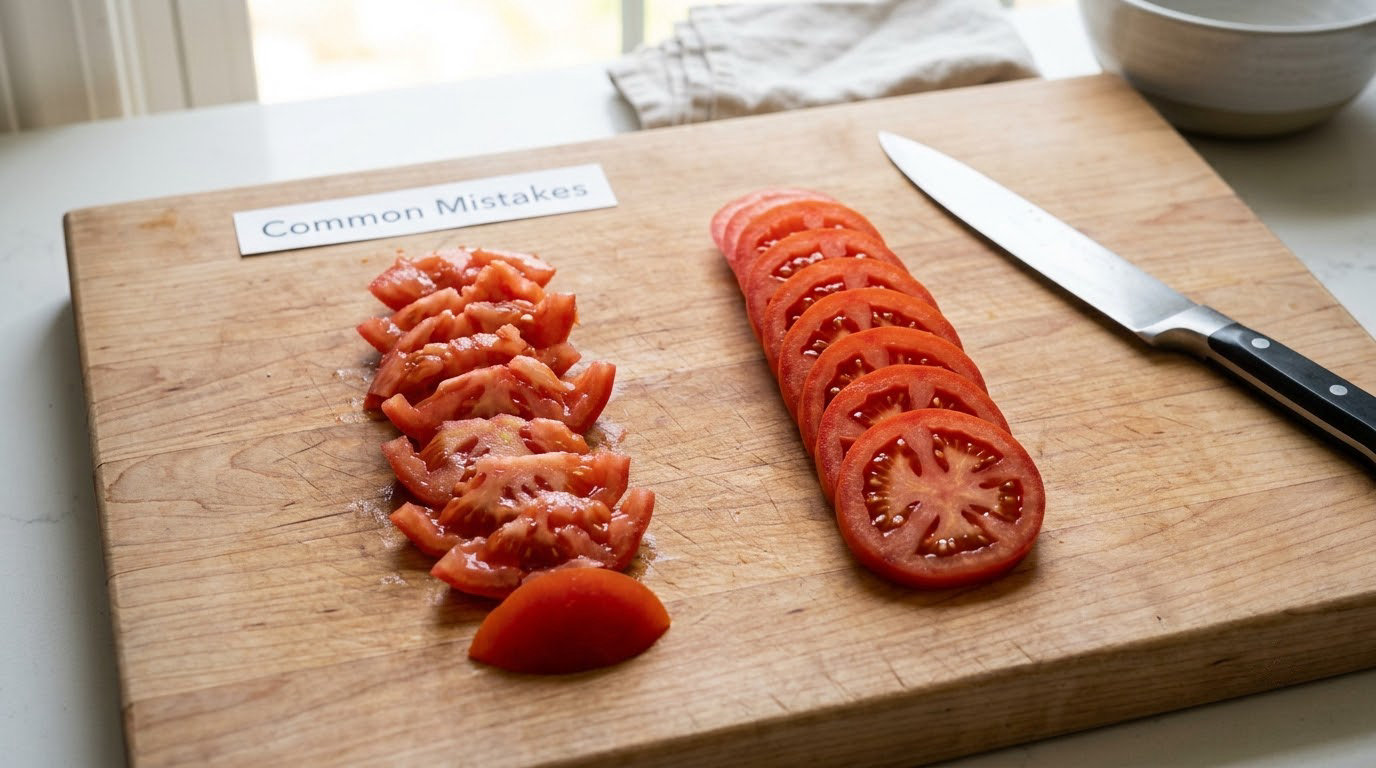
Almost every bad tomato slice traces back to one of six things.
A dull straight-edged knife squashes the fruit and drags the cut face into a wedge. Fix: sharpen, or switch to a serrated blade, and cut while the fruit is firm rather than dead-ripe.
A rolling tomato gives you a slice with one thin edge and one thick edge. Fix: palm on top, fingers spread, and a damp towel under the board.
Cutting straight over the assembled burger means the trimmed ends and loose juice land on the patty and the bun. Fix: slice on the board, transfer with the blade or a wide spatula, and throw away the two uneven end slices.
Thin paper-thin slices tear under the weight of a patty and slide off it. Fix: 5 to 6 mm on a standard bun, and never thinner than 3 mm.
Skipping the seed cavity guarantees juice on the bottom bun within minutes. Fix: core and swipe, or salt and drain.
Overripe fruit has no structure left to hold a round. Fix: use those tomatoes for sauce, and buy a firmer one for the stack.
One tip covers the rest: wipe the blade dry between every few slices. A wet blade is a slipping blade, and a slipping blade is a torn slice.
Frequently Asked Questions
Should tomato slices be cut thick or thin for burgers?
For a standard potato bun, cut between 5 and 6 mm. A tall brioche bun can take 6 to 8 mm slices without the stack looking skimpy, while a thin slider bun wants 3 to 4 mm so nothing overhangs. Anything thinner than 3 mm tears when you set it on a patty. The easiest way to keep thickness consistent is to set the blade against the previous cut face rather than judging it by eye each time.
What is the best knife for slicing tomatoes neatly?
A sharp serrated knife. The teeth catch the soft flesh and saw through it, so the tomato compresses rather than smearing into a wedge. A straight-edged chef’s knife pushes the flesh sideways and drags, which is why so many home-cut slices look torn and wet. Whichever knife you use, hone it first and keep the blade dry between cuts, because a wet blade slides off the skin.
How do I stop sliced tomatoes from making a burger soggy?
Remove the seed cavity, which is the wettest part of the fruit. Halve the tomato top to bottom, cut out the core, and swipe the seeds and gel away with a spoon or your finger. For an extra margin, salt the cut faces lightly, lay them cut-side down on a paper towel for five to ten minutes, and assemble as late as you can. Keep the tomato high in the stack so moisture stays away from the bottom bun.
Can I slice tomatoes with the skin on for a burger?
Yes, and you should. The skin is part of what holds a slice together once it’s sitting on a patty. It also stops the slices bleeding juice onto your plate and your hands during assembly. If you do want to remove it, score a shallow X in the base, cover the tomato with boiling water for about a minute, and the skins will slip off while the flesh stays intact.
How can I make tomato slices fit the size of a burger bun?
Buy a tomato whose diameter is slightly smaller than your bun and slice it crosswise, perpendicular to the stem-to-base axis, at the widest point. A tomato wider than the bun will overhang and lift the top bun, so use those large fruit for a single thick slice in a chopped salad instead. If you are stuck with an oversized tomato, cut it into two halves first and slice each half separately for smaller rounds.
Conclusion
Start with a firm tomato, a sharp serrated knife, and one measured cutting motion at 3 to 6 mm. Hold the tomato with your palm down so it cannot roll, take the first slice, then set every slice after it against that cut face so the thickness repeats itself.
That is the whole technique. You get rounds that match each other, sit flat on the patty instead of sliding off, and carry far less water onto the bottom bun — which is what people actually mean when they say a burger looks restaurant-neat.