
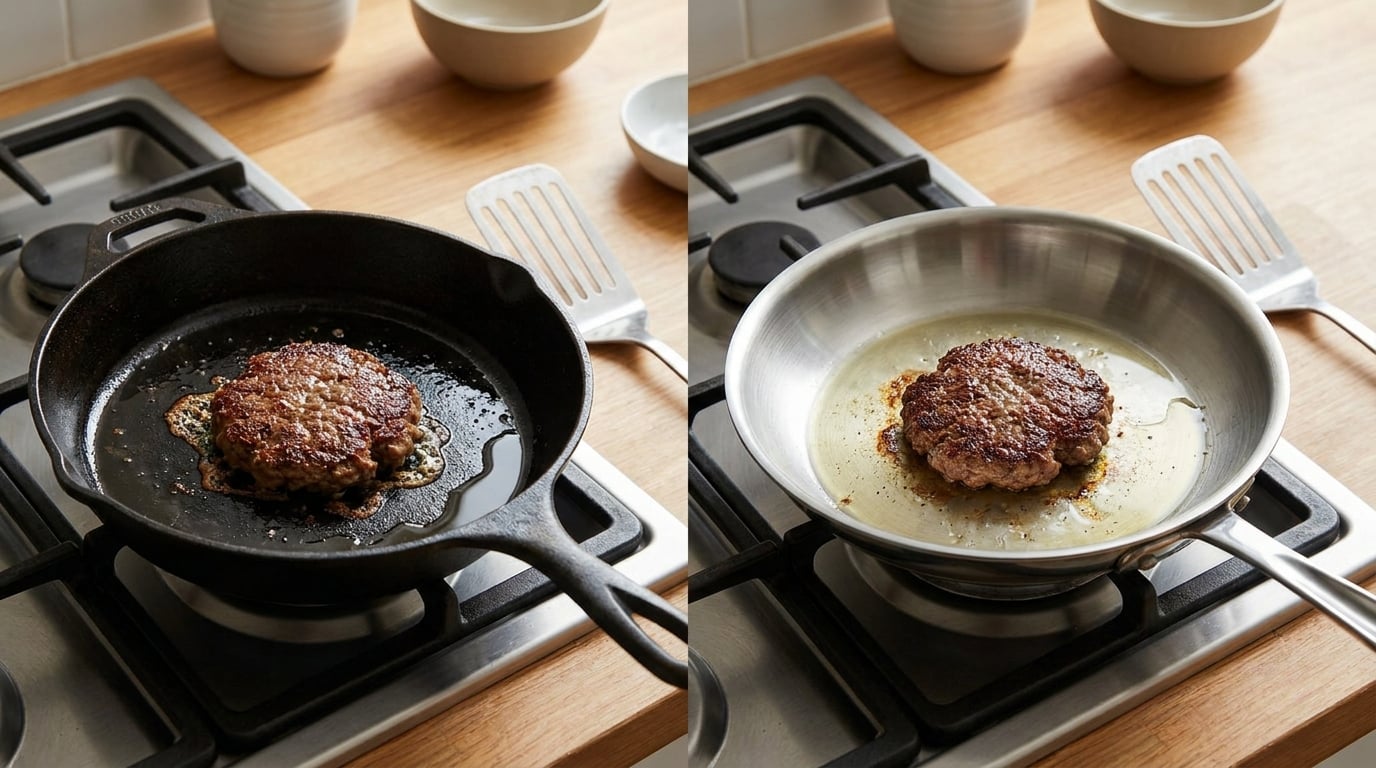
Cast iron wins for burgers, and the reason is heat. Its thermal mass holds a searing surface temperature through the whole cook, so a thin patty hits the Maillard reaction hard and comes off with a deep brown, lacy, properly crunchy crust. Stainless steel wins on speed, cleanup and weeknight convenience, and it cooks thick pub-style patties without any special technique at all. If you can only own one pan for burgers, pick the one that matches how you actually cook.
Almost every burger recipe says cast iron, and for a long time I took that at face value. It turns out the honest answer is conditional: the material that wins a ninety-second smash loses to stainless on a thick, gently cooked patty, and the pan most people reach for on a Tuesday is not the pan a diner would hand you. Here is how the two compare, what the physics is doing, and where the sticking complaints come from.
Table of Contents
- Cast Iron vs Stainless Steel for Burgers at a Glance
- Which Pan Produces a Better Burger Crust?
- Heat Retention and Temperature Recovery
- How Easily Do Burgers Release From Each Pan?
- Durability, Maintenance, and Cleaning
- Temperature Control and Versatility
- Which Should You Choose?
- Frequently Asked Questions
- Is cast iron better than stainless steel for burgers?
- Do burgers stick less in cast iron or stainless steel?
- Should I season a cast iron skillet before making burgers?
- Can I use a cast iron or stainless steel pan in the oven?
- Which pan is easier to clean after cooking burgers?
- What is the best pan material for searing a burger?
Cast Iron vs Stainless Steel for Burgers at a Glance
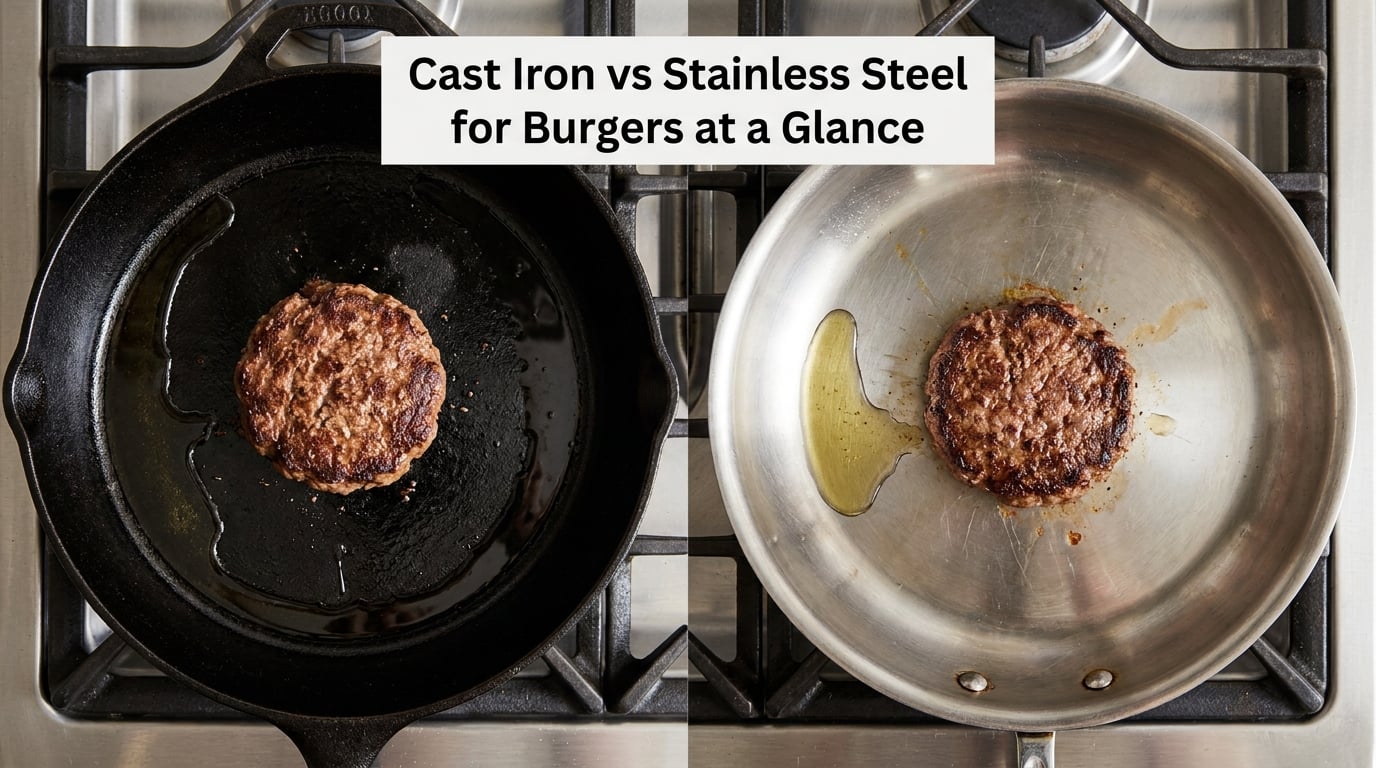
Short version: cast iron is the sear machine, stainless steel is the easy machine. Everything else in this comparison is downstream of that single difference in how much heat each pan can hold and give back.
| Attribute | Cast Iron | Stainless Steel |
|---|---|---|
| Heat retention | Very high, holds temperature through the entire cook | Low, cools quickly when cold meat hits it |
| Time to preheat on a home burner | Longer, several minutes over medium-high | Fast, roughly half the wait |
| Crust on a thin patty | Deep brown, lacy crisp edges | Good but thinner, needs a hotter surface |
| Crust on a thick patty | Good, easier to scorch the outside | Very good, more forgiving |
| Sticking risk | Low once seasoned, higher if the pan is dry or not hot enough | Moderate, controlled with a thin oil film |
| Temperature control | Slow to respond, steady once there | Fast to respond, easy to overshoot |
| Cleaning | Hand wash, no dishwasher, dry on the burner | Dishwasher safe, no seasoning to strip |
| Rust resistance | Needs care, thin oil film after washing | Rust resistant by nature |
| Weight | Heavy, awkward for a one-handed smash | Light, easy to flick and tilt |
| Best for | Thin smash burgers, diner-style crusts | Thick patties, weeknight cooking, one-pan meals |
What each material brings to a burger
The same five labels apply to both pans, which makes the trade-off easy to hold in your head:
- Heat retention: cast iron stays hot; stainless drops as soon as the patty lands.
- Crust development: cast iron browns faster and deeper; stainless gives a clean golden sear with a thinner crust.
- Sticking: seasoned cast iron releases on its own; stainless releases only when fat and heat are right.
- Heat response: cast iron is slow to change; stainless is immediate, which is a real advantage on a thin patty.
- Maintenance: stainless is nearly maintenance-free; cast iron asks for five minutes of care after most washes.
Which Pan Produces a Better Burger Crust?
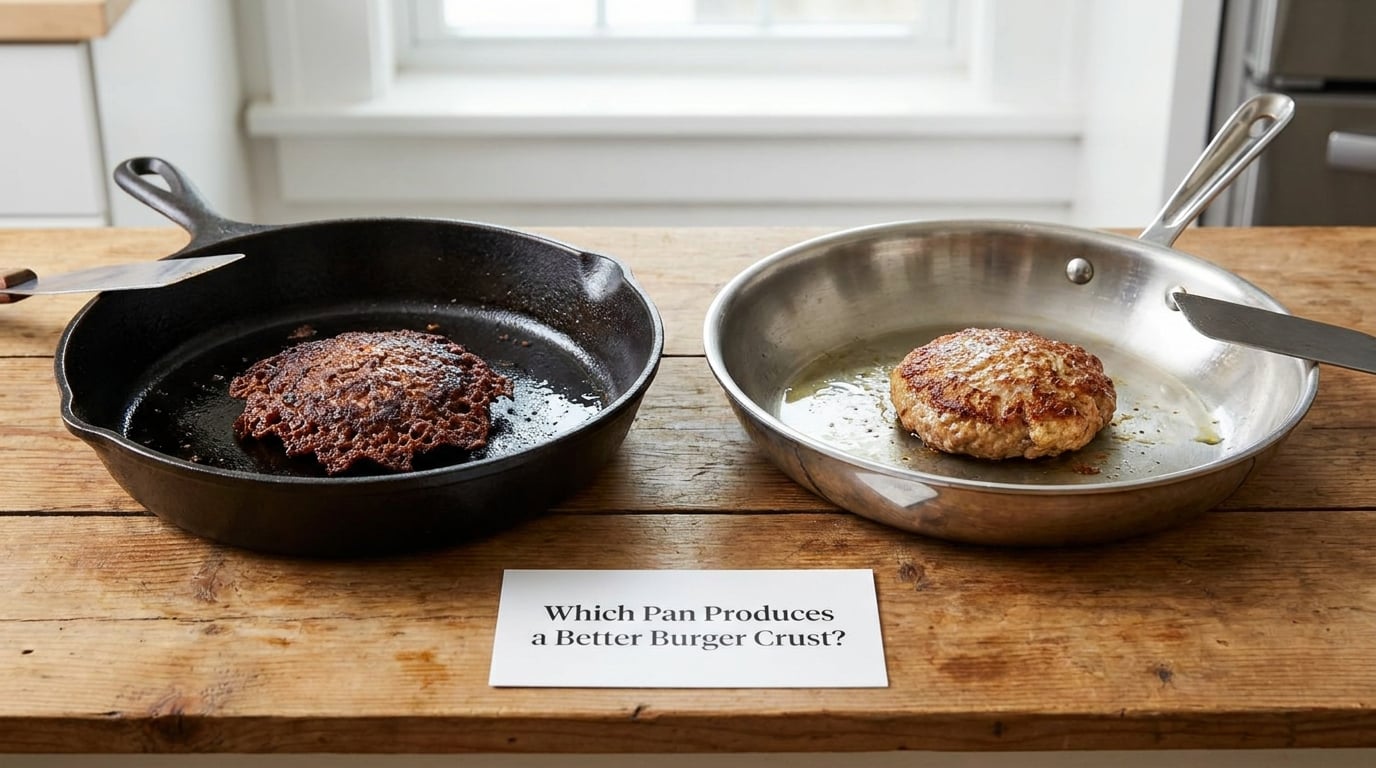
Cast iron produces the better burger crust, and the explanation is a temperature window rather than a brand. Browning starts somewhere around 300 to 350F and accelerates as the surface climbs toward 400 to 450F. A thin smashed patty is done in well under three minutes, so the pan has to already be in that range when the meat touches it. Cast iron is usually there. A stainless skillet dropped on the same burner often is not.
The rest is what happens when the surface sags. On a lighter pan, cold beef pulls heat out of the metal, the surface drops into the low hundreds, and the patty spends its remaining time steaming in its own juice instead of browning. The middle stays juicy, which sounds like a win, but you end up with a gray band under the crust and a rubbery texture. That band is the tell in almost every disappointing home burger I have cooked.
Stainless still produces a genuinely good sear, and I want to be straight about that rather than pretending it is a consolation prize. Given a hard preheat, a thin coat of oil, and a firm press, a stainless skillet will give you lacy edges and a browned crust. It is also harder to scorch, so for a thick pub-style patty that needs six or seven minutes to finish, the fast response of a light pan is an advantage. Cast iron advocates tend to ignore how often that trade favors stainless.
One more thing worth knowing: the Maillard reaction needs a dry surface. A patty sitting in a puddle of rendered fat or oil cannot get above roughly 212F no matter how hot the pan is. Before you place the meat, blot or scrape off excess fat. Diner griddles handle this with a scraper and a squeeze bottle, and it is the same principle at home.
Heat Retention and Temperature Recovery
Cast iron heats slowly and holds heat superbly; stainless steel heats quickly and holds it poorly. Every other difference in this comparison comes out of those two sentences. On a home range, a cast iron skillet can take a good five minutes over medium-high before it is ready, and a stainless skillet can be there in two or three.
Temperature recovery is the part that matters most. When you drop a cold quarter-pound ball of 80/20 beef onto a hot cast iron skillet, the pan barely notices. It has enough stored energy to keep the cooking surface in searing range for the whole ninety seconds, and the underside of the patty is what drives water off and produces those fringed, lacy edges. The same patty on a cold-ish stainless skillet drops the surface immediately, the fat renders slowly, and you press instead of sear.
That stainless behavior is a real asset in reverse. Turn the burner down and the stainless pan follows within seconds; the cast iron skillet stays hot for a while, then lags behind on the way down. A cook making four patties in a row on a light pan has precise control over each one. A cook working one patty at a time on a heavy pan has stability.
How do you know when cast iron is ready without a thermometer? Hold the back of your hand a few inches above the cooking surface. When you feel a strong, steady wave of heat that makes you pull it back, the pan is close enough. This is the hand-hover test that cast iron cooks have argued about for years, and it beats any timer. You will also see a faint shimmer on the surface, and a drop of water flicked on will dance rather than sit.
Skip the folklore about preheating for twenty minutes. A well-seasoned pan does not need it, and very long preheating can smoke the oil out of the seasoning on a thin film. A few minutes over medium-high until the hand-hover test passes is the working rule. Aim for the surface to feel like the radiant side of a toaster oven, not like a grill pan that is smoking.
The 5-6-7 rule that circulates in burger circles is a decent sanity check for the cook, not the pan: roughly a five-minute sear on one side, six minutes on a thicker patty, seven with a bone-in or heavily topped burger. It describes timing on the heat source rather than any material property, so it applies to either pan. A ninety-second smash burger sits well outside that range, which is why the two cooking goals really are different jobs.
How Easily Do Burgers Release From Each Pan?
Seasoned cast iron releases more easily, and stainless releases more predictably once you learn the fat and heat sequence. Those are different advantages, and confusing them is why people blame a pan for a technique problem.
On cast iron, a thin patty placed on a well-seasoned skillet should release on its own within about thirty seconds. If it does not, the causes are usually one of four: the pan is not hot enough, the pan is dry and the seasoning is not polymerized, the meat was blotted poorly so it steamed itself onto the surface, or you tried to flip too early and tore the top layer off. Cast iron is not naturally nonstick. What it has is a hard, glassy layer of polymerized oil that behaves like a coating, and it needs oiling after washing or a hot dry pan will strip it back.
On stainless steel, sticking happens when there is not enough fat in the pan, not enough fat in the meat, or not enough heat. The fix sequence that works almost every time: preheat harder than feels necessary, add a thin film of high-smoke-point oil, lay the patty down away from you, press once, and leave it alone. A thin smear is enough. Poured oil pools around the patty, spatters, and keeps the surface below browning temperature.
Raw 80/20 ground beef carries enough fat to season the pan as it cooks. Leaner blends, like 90/10, need a bit more added fat and a slightly longer sear to render before the crust sets. Many home cooks using stainless deliberately pick a fattier blend to compensate for the leaner cooking surface, which is a sensible adjustment rather than a rule.
The flip is where most people lose the patty, and it is a technique failure that makes stainless look worse than it is. Use a thin, flexible metal spatula or a wire rack, get under the entire edge, and scrape in one motion. A thick rigid turner will lift the patty halfway and leave you tearing off a strip of crust. The same failure happens on cast iron, but people blame the seasoning.
Fatty, sugar-containing burgers make sticking worse on both materials. Pre-cook bacon in the pan first and render out the grease, then wipe the pan, then add fresh oil before the patty. A thin burger with cheese on top releases even more willingly, which is why cheeseburgers are forgiving and plain smash patties are not.
Durability, Maintenance, and Cleaning
Stainless steel is the lower-maintenance pan by a wide margin. It is non-reactive, rust resistant, tolerates the dishwasher, and there is no seasoning layer to strip or rebuild. Its weakness is not care, it is that it does nothing for you beyond conducting heat: every burger starts from zero, and nothing about the surface improves over time.
Bare cast iron rewards a little attention. Rinse hot, scrub with a chainmail or stiff brush, dry on the burner for a minute, and wipe on a paper towel with a very thin film of cooking oil. That is the whole routine. Skip the oil and a grey bloom appears; soak the pan or run the dishwasher and the seasoning goes with it. Soap is fine for a modern well-seasoned pan; old advice about soap being ruinous does not hold up. Enameled cast iron sits in between, and its enamel surface is closer to a nonstick pan, so it will never develop a comparable crust.
Rust is the real long-term cast iron risk. It comes from water sitting on a bare or under-oiled surface, not from cooking. A single forgotten wash followed by a damp cupboard will give you orange flecks, and scrubbing them off also means rebuilding the seasoning. Dry the pan properly and this basically stops happening.
Weight is the underrated factor. A 12-inch cast iron skillet is heavy enough that a one-handed smash takes deliberate practice and a fast cook may find a lighter pan easier to flick, tilt and drain grease from. Stainless is easy to move and lets you tilt a patty back toward the flame without repositioning your wrist. If you are cooking a lot of single patties in a cramped kitchen, that matters.
Temperature Control and Versatility
Stainless steel is the more versatile pan across a whole meal, and cast iron is the specialist that also does several other jobs well. Both tolerate oven use and both handle searing steak, which is where most cookware comparisons start. The real difference shows up when the job needs quick adjustment.
A stainless skillet heats fast enough to go from a hard sear to a gentle finish in the time it takes to decide you want a cheeseburger instead. That is why it suits a weeknight plate of seared burger patties, bacon, eggs and a pan sauce in sequence, with a plate of toasts warming nearby. Bacon renders fat into the pan and the burger goes in afterward; the drippings season the whole dish, which is the best argument for stainless on a midweek night.
Cast iron is better for the finish. A thick patty seared hard then moved to a 425F oven holds a steady surrounding heat while the center catches up, which reduces the gap between a burned edge and a raw middle. A heavy skillet also takes a beating from utensils, goes from burner to oven to table, and handles the rough service that comes with cooking outside. For a fried egg or cornbread it is a superb tool; for a delicate fish fillet it is more brute force than the job needs.
Both materials work on gas and electric. Induction is the one place to think: a bare cast iron skillet heats fine, but enameled cast iron has a glass layer between the metal and the cooktop, and it can warm more slowly. Stainless with a magnetic base is a strong choice on induction and the fastest to preheat of anything here. A flat top griddle beats both for volume, since it is essentially a large seasoned steel surface, and users with big families often report switching from skillet to griddle for exactly that reason.
Which Should You Choose?
Choose cast iron if you cook thin, smashed patties and care about the crust, and if you are the type who will oil a pan after washing it. Choose stainless steel if you cook thick patties, cook most nights, want a pan in the dishwasher, or do not own a cast iron skillet and do not plan to start maintaining one.
By burger style, the split is clean. Thin smash burgers go to cast iron, hands down, because the ninety-second cook needs stored heat. Thick pub-style patties go to stainless, which gives you fast control and forgiving timing. Bacon or cheese-topped burgers are a tie; both release well once the grease is rendered out first. Batch cooking for a group is a griddle question more than a skillet question, and a large flat top lets you start eight patties without fighting the thermal mass of a deep cast iron pan.
Carbon steel is the honest third option. It is lighter than cast iron, heats and responds more like stainless, and seasons into a comparable natural release over time. For someone who wants smash-burger heat without a 12-pound pan, that is a genuinely good fit. The compromise is rust: carbon steel demands a drying habit quickly, and it will not forgive being left wet.
What restaurants actually use matters here, because diner burger chains do not cook on cast iron. They use flat top griddles and hard-anodized or stainless surfaces, driven by service speed and volume rather than by crust quality. A home cook is optimizing for a different variable, which is why the restaurant answer and the home answer legitimately differ. A single cast iron skillet is the closest home equivalent to that flat top.
Two myths worth clearing up. Cast iron does not add meaningful iron to your food, and it is not a meaningful health upgrade over stainless, so cook with whichever you like. And polymerized seasoning is not a dangerous chemical coating; it is ordinary cooking oil bonded to iron, and it is what every nonstick pan is doing at a thinner layer. The health argument for cast iron over stainless is weak. The crust argument is strong.
If you already own a stainless skillet and want to try a smash burger this week, do it with the pan you have. Preheat it harder than is comfortable, add a thin film of oil, use 80/20 beef, press firmly, and flip in about ninety seconds. You will get a decent burger. Then decide whether a heavier cast iron skillet is worth the space and the drying habit, because for thin patties the gap is real.
Frequently Asked Questions
Is cast iron better than stainless steel for burgers?
For thin smashed patties, yes. Cast iron holds a searing surface temperature through the whole cook, so the beef hits the Maillard reaction hard and comes off with a deeper brown, lacy, crunchy crust. For thick patties cooked six or seven minutes, stainless steel is the better pan, because it responds to burner changes quickly and is far harder to scorch. The honest answer depends on the burger, not the pan brand.
Do burgers stick less in cast iron or stainless steel?
A well-seasoned cast iron skillet releases a thin patty almost on its own after about thirty seconds. Stainless steel sticks unless fat and heat are handled deliberately, but once you preheat it hard and add a thin film of high-smoke-point oil it releases cleanly too. Sticking on cast iron usually means the pan was not hot enough, was dry, or the patty was flipped too early and tore.
Should I season a cast iron skillet before making burgers?
Yes, and most pans need it after a few months of regular cooking. Seasoning is polymerized oil bonded to bare iron, and a new or neglected pan lacks the coating that gives cast iron its natural release. Two or three thin coats of a high-smoke-point oil baked in, or several rounds of cooking fatty food, will do it. Skip the coating and you will need a light film of oil at every cook instead.
Can I use a cast iron or stainless steel pan in the oven?
Both handle oven heat, and both work for finishing a thick burger at about 425F. Cast iron is the stronger choice for an oven finish because the heavy body keeps surrounding heat steady while the center catches up. Stainless is fine for reheating or a fast broil. One caution: a cast iron skillet is extremely hot to handle, so use a dry oven mitt and set it on a burner or a wood board, never a cold countertop or laminate.
Which pan is easier to clean after cooking burgers?
Stainless steel, easily and without caveats. It is non-reactive, rust resistant and safe in the dishwasher, and there is no seasoning to strip. Cast iron needs hand washing, immediate drying, and a thin wipe of oil afterward. Putting a cast iron skillet in the dishwasher strips the seasoning, and a dropped dish soap is not the problem people think it is.
What is the best pan material for searing a burger?
For a thin, smashed patty, cast iron is the best pan material because stored heat is what builds the crust. For a thick patty, stainless steel wins on control. A flat top griddle is the best option overall for volume, and carbon steel is the best middle path for someone who wants smash-burger heat in a lighter pan. Whichever you use, the patty needs a dry surface, a 400 to 450F cooking surface, and a firm press.
One rule to remember: thin and fast goes to cast iron, thick and adjustable goes to stainless. Preheat properly, keep the surface dry, and the rest is a ninety-second job in either pan.