
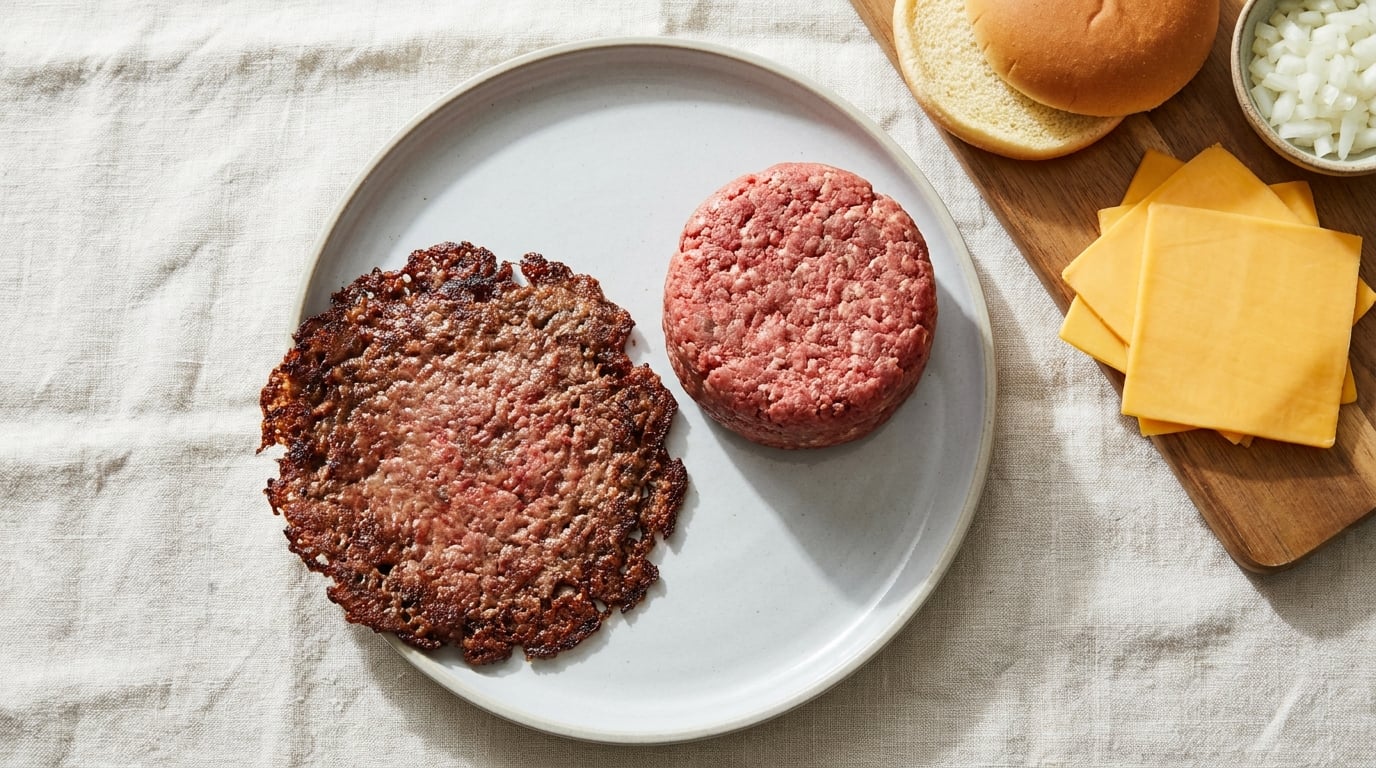
A smash burger is made by pressing a loose ball of ground beef flat onto a screaming-hot griddle, cooking it thin and fast to build a hard, lacy crust. A regular burger uses a thick, pre-formed patty cooked over several minutes for a soft sear and a juicy center. The choice comes down to one thing: how much crust you want versus how much juice you want.
Both styles started from the same ingredient, and both are defensible. What separates them is technique, not novelty, and that distinction is worth understanding before you buy beef, fire up a griddle, or order from a place whose menu says “smash.”
I’ll walk through the two methods side by side, the physics that make a thin patty taste different, the places each one fails, and how to pick the right one for the burger you’re actually making.
Table of Contents
- Smash Burger vs Regular Burger Differences at a Glance
- What Is a Smash Burger?
- What Is a Regular Burger?
- How the Cooking Method Changes the Burger
- Texture and Juiciness: Which One Wins?
- Flavor, Toppings, and Bite-Size Differences
- Smash Burger vs Regular Burger: Which Should You Choose?
- Frequently Asked Questions
- How thick should a smash burger patty be?
- Is a smash burger healthier than a regular burger?
- Is Five Guys a smash burger or a regular burger?
- What are the most common smash burger mistakes?
- Do you put oil on the griddle before cooking smash burgers?
- What is the difference between smash and smashed burger?
- Conclusion
Smash Burger vs Regular Burger Differences at a Glance
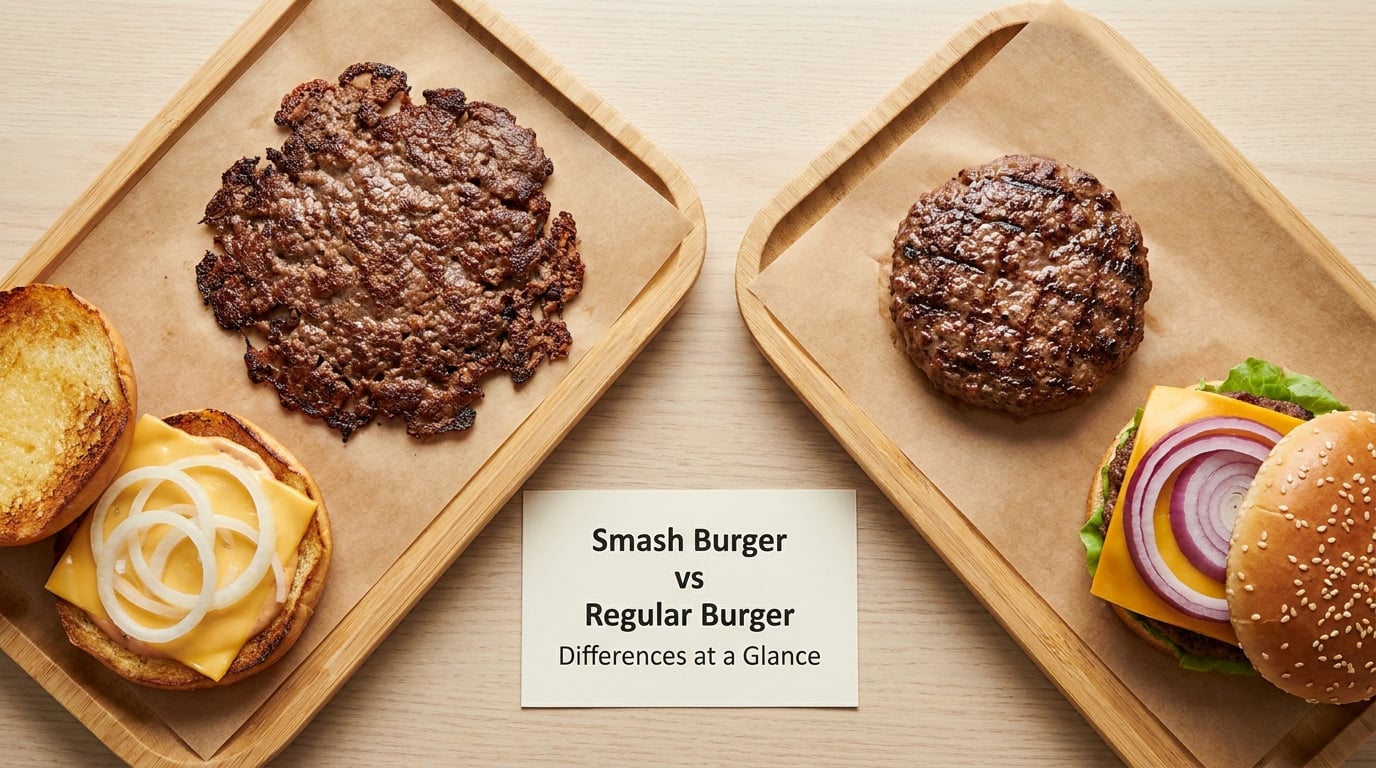
Here is the short version. A smash patty is about a quarter inch thick, weighs roughly two ounces, and hits a griddle at 375 to 400°F for 45 to 60 seconds total. A regular patty is usually three quarters of an inch thick, weighs a quarter pound or more, and cooks for three to four minutes a side on a moderate heat.
| Factor | Smash burger | Regular burger |
|---|---|---|
| Patty thickness | About 0.25 inch, pressed thin | About 0.75 inch, formed and rested |
| Typical patty weight | 2 ounces, often two patties stacked | 4 ounces or more in a single patty |
| Cooking surface | Flat-top griddle or heavy cast iron | Griddle, skillet or grill, any heat |
| Surface temperature | 375 to 400°F | 325 to 350°F |
| Total cook time | 45 to 60 seconds | 6 to 8 minutes |
| Flips | One, right after the press | Two or three, or none at all |
| Crust | Hard, lacy, deeply browned, crisp edges | Soft golden-brown sear, rounded edges |
| Interior | Tender, fully cooked, almost no pink | Thick, moist, often still pink in the center |
| Beef fat needed | 20 percent or higher for lacy edges | 15 to 20 percent holds moisture better |
| Topping capacity | Low, wide and fragile, best with few toppings | High, tall stack, takes heavy toppings |
| Typical bun | Potato bun, cut small, toasted | Brioche or sesame, cut large |
| Best for | Maximum browning, fast cooking, batch cooking | Juiciness, a substantial bite, forgiving heat |
| Calories per burger | Often 500 to 750 with bun, cheese and sauce | Often 550 to 900 with bun, cheese and sauce |
One note on the calorie row, because it surprises people. A smash burger is thin, but chains usually make up the weight with a double patty, and a higher fat ratio means more calories per ounce of beef. A single smashed patty on its own is lighter. A double smash with cheese and sauce often is not.
What Is a Smash Burger?
A smash burger is a burger built around a very thin patty pressed against very hot metal. You ball up fresh ground beef, drop it on a preheated flat-top, and press it with a weighted spatula for about 15 seconds until it spreads to roughly the width of the bun and a quarter inch thick. Then you leave it alone for under a minute, flip once, and pull it off.
That short contact with the griddle is what creates the lacy edges people argue about. The ragged fringe around the patty is where fat and finely ground meat liquefy and re-solidify into shards. Each shard is thin enough to brown in seconds, so you get crunch where a thick patty has a soft, chewy rim.
The beef has to be reasonably fatty, usually 20 percent or more, and the grind should be fine. Lean beef dries out before it can brown, and a coarse grind leaves chunks that stay gray. Chuck and brisket are the usual choices, sometimes blended with a little beef fat for flavor.
Smash burger vs smashed burger: is there a real difference?
Not a meaningful one. “Smash” and “smashed” are the same technique described from opposite ends, the way “grilled cheese” and “cheese grilled” are. Restaurants use both. If a menu lists one, the technique behind it is the same press-against-hot-metal step described above.
One genuine distinction worth knowing: a “double smash” is two thin patties stacked, while a “single smash” is one. A double smash gives you more crust per bite and a taller burger, but it also doubles the seam where sauce gets squeezed out.
What Is a Regular Burger?
A regular burger, sometimes called a classic or thick burger, starts from the opposite direction. The meat is formed into a patty about three quarters of an inch thick, usually from meat that has been loosely balled and shaped, sometimes rested in the refrigerator so it holds its shape. It gets salted, seared on a moderate heat, and cooked for several minutes a side.
That method trades browning for moisture. A thick patty has a much larger interior volume relative to its surface, so the middle cooks slowly and stays juicy while the outside builds a pleasant golden sear. The edges are rounded rather than ragged, so the texture is soft and chewy instead of crisp.
The other difference is temperature tolerance. A thick patty can sit in the center of a hot pan without instantly burning, which means it is far more forgiving. You can add toppings, chat with someone, get distracted for a minute, and still end up with a decent burger. A smash patty goes from perfect to ruined in about fifteen seconds.
Regular burgers also carry more weight per patty, usually a quarter pound of beef or more, which is why they feel like a meal and why a smash burger with a double patty exists to compete with them.
How the Cooking Method Changes the Burger
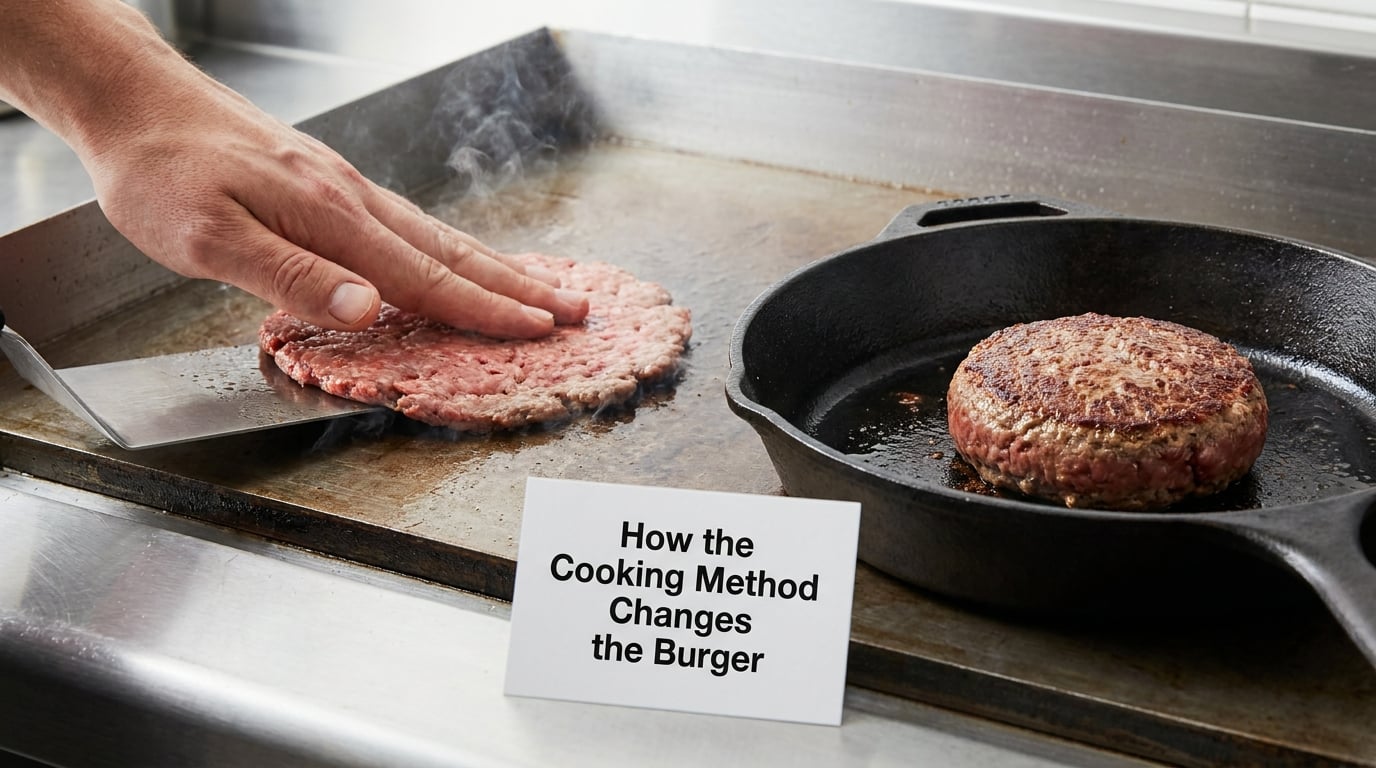
The cooking method is the whole difference, and it changes three things at once: how much of the beef browns, how much water leaves the patty, and how the heat reaches the center.
Heat and surface area decide how much crust you get
Browning beef is the Maillard reaction, a chemical reaction between amino acids and sugars that needs serious heat, generally above 300°F, to get going. It is also blocked by water. A surface that is wet steams instead of browns.
So the technique has two jobs. Press the meat thin to expose as much surface as possible, and put that surface on metal hot enough to drive moisture off fast. A smash burger does both at once. That is why a restaurant griddle runs at 375 to 400°F while a home stovetop pan for a thick patty sits closer to 325 to 350°F.
There is a popular argument in burger forums that a thin and a thick patty have the same total surface area top and bottom, so the smash burger has no real advantage. The numbers are right, and the conclusion is wrong. What differs is the ratio of crust to interior, and how thin the fragments are. A quarter-inch patty browns to its full depth in under a minute. A three-quarter-inch patty only browns the outer few millimeters, leaving the rest of the surface softer and paler for the whole cook.
The press and the single flip
Pressing is a brief, heavy, no-extra-ingredients step. You lean a weighted spatula or a press onto the meat for about 15 seconds, just long enough to spread it to bun width. Many home cooks press far too hard or far too long, and that is the number one reason a homemade smash patty comes out dry and gray instead of laced with fat.
Then the single flip. Smash patties are cooked 20 to 30 seconds on the first side, flipped, and finished in another 20 to 30 seconds. A second flip tears the thin patty apart and peels the crust off. Thick patties can be flipped several times or not at all, because the interior has time to catch up.
Moisture, steam and rendered fat
A thin patty loses moisture fast by design. That water leaves as steam during the first seconds, which is why the surface dries and starts browning. Fat behaves differently: it renders at a lower temperature, pools on the griddle, and crisps the tiny fragments pushed out to the edges. That is the source of the lacy fringe, and it is also the flavor people describe as beefy and roasted.
A thick patty traps its own steam for most of its cook, which keeps the interior moist and gives the outside a gentler sear. Its fat renders too, but more slowly, and it stays inside the patty rather than forming a lace.
Carryover cooking matters more in the thick version. A patty pulled at 130 to 135°F keeps rising as it rests, while a smash patty leaves the griddle already near its final temperature because it is so thin. USDA guidance is a minimum internal temperature of 160°F for ground beef, and thin patties cross that line in seconds, which is why almost no smash burger has a pink center.
Texture and Juiciness: Which One Wins?
Neither one wins at both, and pretending otherwise is the fastest way to start a fight in a comment section.
If you judge a burger on crust, the smash burger wins and it is not close. You get a hard, thin, brittle shell on both faces and a rim of crisp shards that shatters when you bite. People describe it as meat candy, and that phrase, from a home cook in r/food, is more accurate than any menu copy I have read.
If you judge a burger on juiciness, the thick patty wins. It has more interior volume, more fat per bite and a slower cook, so the middle arrives moist and hot. A smash patty gives you a lot of crust and a comparatively small, leaner center.
Here is the honest part most guides skip. Smash burgers can absolutely come out dry. Press too long, use lean beef, or crowd the griddle and let the temperature drop, and you get a hard shell wrapped around a tough middle. Several regulars in r/burgers have complained that smash burgers are dry, and the complaints are fair. Execution decides the result far more than the label does.
There is also a temperature split. Forum cooks who like a juicy center tend to want a thick patty with some pink in it, and the argument against smash burgers is often exactly that: no pink, less juice, all crust. If that is your preference, a regular burger will serve you better and a smash will frustrate you.
One more texture difference bites people unexpectedly. A smash patty has essentially no structural integrity once cooked. It cracks, folds and slides. A thick patty holds together, which is why a smash burger has to be eaten in a particular way, fast and in halves, or it ends up on your plate in pieces.
Flavor, Toppings, and Bite-Size Differences
Flavor is where the two styles diverge most, and it is not simply about taste buds. It is about how much browned surface ends up in your mouth per bite.
What the smash burger vs regular burger differences do to flavor
A quarter-inch patty is nearly all surface, so a large share of every bite is Maillard reaction. That produces roasted, savory, almost barbecue-adjacent notes that come from browning, not from seasoning. A thick patty tastes more like beef itself, with the sear playing a supporting role rather than the lead.
Salt behaves differently too. On a smash patty, salt on the surface pulls moisture to the outside within seconds, which helps the browning. On a thick patty, salting too early draws juice out and can dry the interior, so most cooks season closer to the end.
Why a smash burger looks small but can weigh plenty
This trips people up constantly. A smash patty spreads wide but weighs about two ounces. A regular patty is a tall four-ounce puck. Yet a typical chain smash burger arrives with two smashed patties, so the total beef weight matches or beats a single regular patty. It just looks flatter and narrower in the bun.
That is also why a smash burger needs a smaller bun. A potato bun cut about half an inch smaller than usual matches the patty width. Put a smash patty on a full-size brioche bun and you get a sad, flat sandwich with bun overhang and no sauce containment.
How toppings behave on each style
A smash patty is a wide, fragile platform. It holds a light layer of sauce, a slice of cheese, maybe a thin smear of caramelized onion. It does not handle a tall stack, and wet toppings push out through the edges almost immediately. Double patties make this worse, since sauce finds the seam between them and runs down your hand.
A thick patty handles heavy loads. Lettuce, tomato, multiple patties, bacon, a fried egg, pickles, whatever you want, and the burger keeps its shape. This is the customization argument that regular-burger fans make, and it is the practical reason many people still prefer the classic style at home.
Cheese is a good middle ground. Melted cheese on a smash patty adds salt, fat and structure, and it holds the fragile edges together a little. Sharp sliced cheese works better than shredded, because shredded cheese traps steam and slides off.
The bun matters more than most people expect. A potato bun has less sugar and less fat, which keeps the bun from competing with the beef and lets the crust stay crisp. A brioche bun is richer and softer, which pairs better with a thick patty. Putting a rich bun under a smash patty is how you end up with a soggy bottom.
Smash Burger vs Regular Burger: Which Should You Choose?
Here is my position after weighing both camps: the smash burger is better when browning is the point, and the regular burger is better in almost every other case. That is not fence-sitting, it is how the technique is built.
The smash burger maximizes one variable, crust, at the expense of juiciness, portion height and forgiveness. Get that trade right and the result is genuinely excellent. The regular burger does not maximize anything, and that is the point: it is the balanced option that stays moist, holds toppings and survives a distracted cook.
Choose based on the burger you are making:
- Crispy edges and maximum browning: smash. Cook it fast, hot, and eat it right away.
- A juicy center with a pink middle: regular burger. Nothing else gets you there.
- A tall, heavily topped burger: regular burger. A smash patty will not carry the stack.
- Cooking for a group: smash. A griddle at 400°F cooks eight patties in a couple of minutes and they hold fine for a few minutes afterward.
- Cooking on a stovetop in a thin pan: regular burger. A heavy pan cannot recover temperature fast enough for a proper press, and you will get a pale patty.
- You like your beef fully cooked with no pink: smash. A thin patty is done in under a minute.
- Outdoor cooking on a grill: regular burger. Direct grill heat roasts the thin patty before the crust sets.
- Anyone who dislikes a dry burger: regular burger, with a lean-to-medium fat ratio and a short rest.
If you order instead of cook, the same logic applies. Look for a place that presses thin patties on a flat-top and cooks them in under a minute, not one that just calls a thick patty a smash. That distinction is the entire point.
If you are making smash burgers at home and they keep coming out wrong, the fix is almost always one of four things: the griddle was not hot enough, the beef was too lean, you pressed too long, or you crowded the pan and dropped the temperature. Fix any one of those and the result changes completely. Press for about 15 seconds, cook 45 to 60 seconds total, and use beef at 20 percent fat or higher.
Frequently Asked Questions
How thick should a smash burger patty be?
Aim for about 0.25 inch, roughly 2 ounces of beef per patty. Ball the meat loosely, then press it on a preheated griddle at 375 to 400°F for about 15 seconds until it reaches bun width. Thin enough to see a little griddle through the meat is about right. If you can see thick chunks of raw meat standing up, it is not flat enough to brown evenly.
Is a smash burger healthier than a regular burger?
Usually not, and this is the most common misconception about the style. A thin patty has a higher fat ratio, and most smash burgers use two patties to match the weight of one regular patty, which pushes calories and sodium up rather than down. A single smashed patty on its own is lighter than a quarter-pound regular patty, but a double smash with cheese and sauce usually lands in the 500 to 750 calorie range.
Is Five Guys a smash burger or a regular burger?
Five Guys serves a regular thick-style burger. The patties are thin-ish by fast-casual standards, but they are pressed onto a flat-top, seasoned heavily, and cooked long enough to sear both faces while keeping a thick, moist interior. It is closer to a griddled thick burger than to a sub-minute smash. A true smash is defined by a hard lacy crust from a very thin, very fast-cooked patty.
What are the most common smash burger mistakes?
Four mistakes cause almost every bad smash patty. Pressing too long and too hard squeezes out moisture and dries the meat. Using beef under 20 percent fat means the edges never lace properly. A griddle that is not hot enough steams the meat instead of browning it, so it comes out gray. Crowding the pan drops the temperature fast. Salt lightly, press about 15 seconds, and cook on plenty of surface area.
Do you put oil on the griddle before cooking smash burgers?
You do not need to. Fat renders out of the beef and seasons the griddle naturally, and a film of oil on a hot flat-top can let the thin patty slide and smear instead of staying in place. Scrape off the browned bits from the previous batch, wipe the surface with a paper towel, and let it heat up again. A cast iron skillet benefits from a very light wipe of oil; a nonstick or well-seasoned griddle does not.
What is the difference between smash and smashed burger?
There is no real difference. Smash and smashed describe the same technique from two directions, the way grilled cheese and cheese grilled do, and restaurants use both words interchangeably. The only distinction worth tracking is single versus double smash, which means one thin patty or two stacked patties. Two patties add crust and weight, but also create a seam where sauce and juices squeeze out.
Conclusion
The smash burger vs regular burger differences all trace back to one choice: a quarter-inch patty on very hot metal for under a minute, or a three-quarter-inch patty on moderate heat for several minutes. The first buys you browning, crunch and speed. The second buys you moisture, height and patience.
If you want the crust, heat a griddle to 375 to 400°F, use beef at 20 percent fat or higher, ball about 2 ounces, press for 15 seconds, and cook 45 to 60 seconds. Salt it, add cheese, and eat it immediately while the edges are still shattering.
If you want the juice, form a thick patty, cook it gently, and rest it. That is the better burger for a pink center, a tall stack of toppings, and anyone who finds a dry patty disappointing.
Either way, start with the beef. Good meat at the right fat ratio matters more than any step that follows it.