
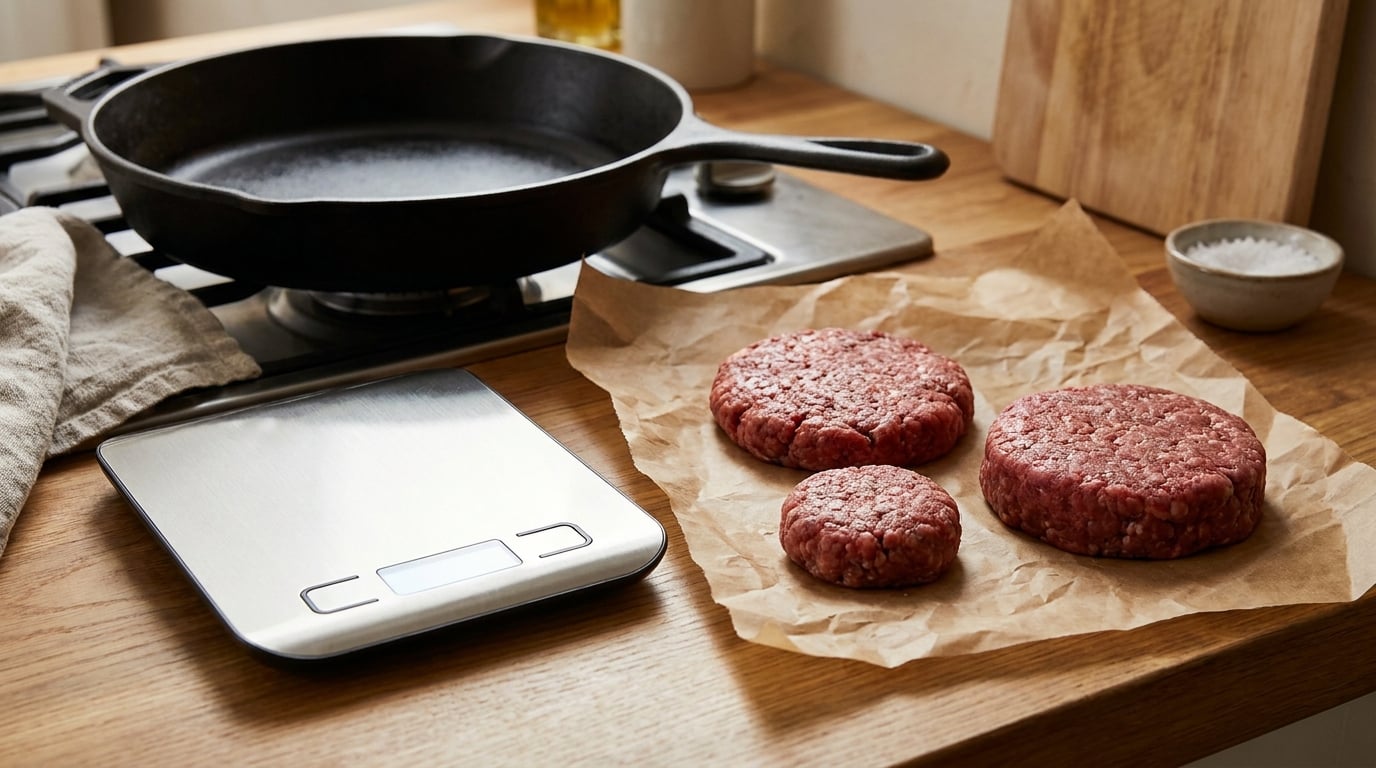
For one standard burger patty, use 4 ounces (about 113 g) of raw ground beef. Smash doubles want 2 to 3 ounces each, thick pub-style patties take 4 to 6 ounces, and a slider is around 1 ounce. How much meat per burger patty you actually need comes down to the width of your bun and how thick you want the finished burger to be.
Most home cooks overshoot without meaning to. They pull a 6-ounce ball out of the fridge, flatten it, and end up with a patty wider than the bun and drier in the middle than they wanted.
Weight is only one part of it. A 4-ounce patty pressed thin and smashed is a completely different burger from a 4-ounce patty left thick, and the same raw weight behaves differently on a grill than in a skillet.
This guide breaks the answer down by burger style, then shows you how to portion meat so every patty cooks at the same rate. I have made this mistake more than once, so the numbers here are the ones I now measure before anything hits the heat.
How Much Meat per Burger Patty? Quick Guide
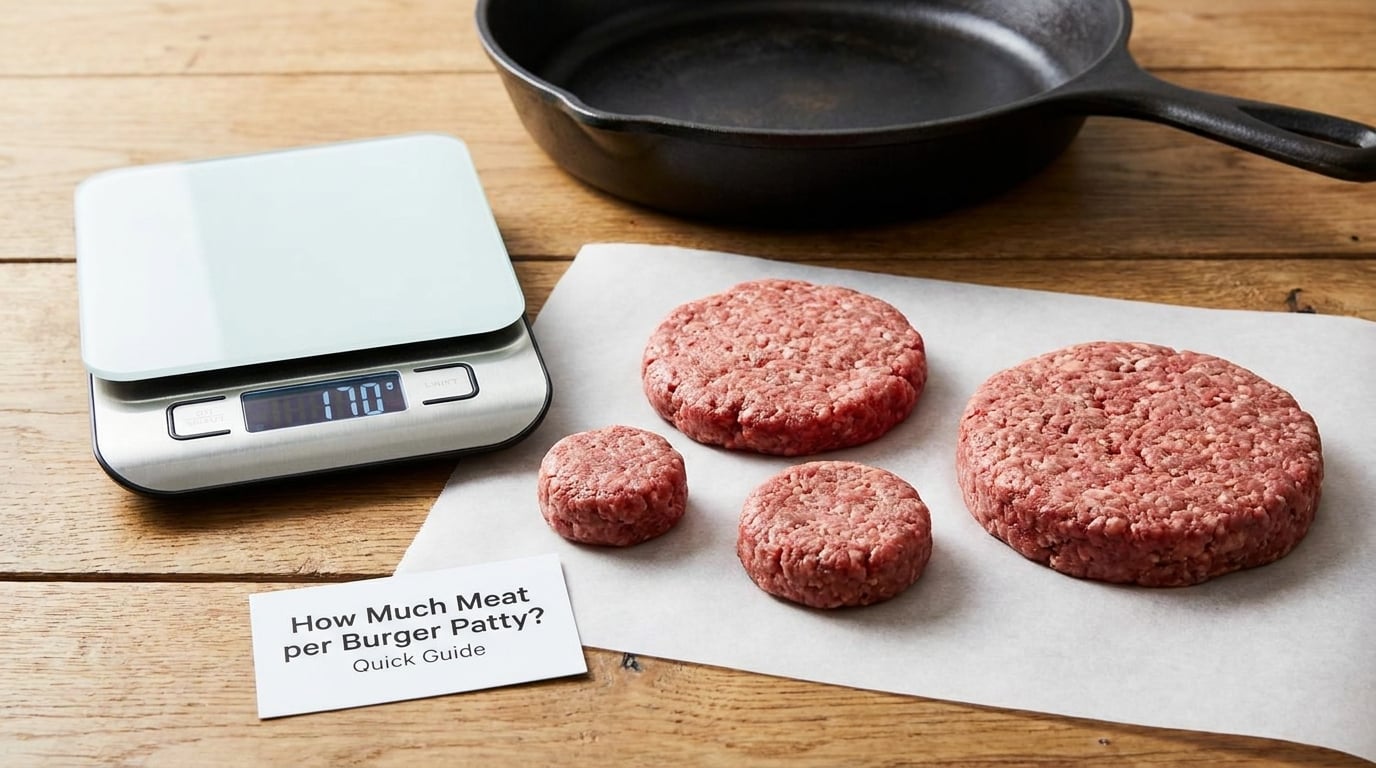
Here is the short version. Measure raw weight, before cooking, and match the diameter to your bun.
| Burger style | Raw meat per patty | Grams | Patty diameter | Best for |
|---|---|---|---|---|
| Slider | 1 oz | 28 g | 2 to 2.5 inch | Kids, party trays, tasting portions |
| Standard single | 4 oz | 113 g | 4 to 4.5 inch | Regular buns and most family meals |
| Loaded or oversized | 6 to 8 oz | 170 to 227 g | 5 inch and up | Brioche buns, double toppings, big appetites |
Three things move that number. The bun gives you a hard limit on diameter. The cooking method decides how much the meat shrinks. And the number of patties you are stacking changes the ratio, since two thin patties fill a bun better than one thick one.
If you only remember one figure, make it 4 ounces. That is the patty that works on a standard 4-inch bun without hanging over the edges, and it is the one I default to when someone asks me to make burgers for guests.
What Determines the Right Patty Size?
Patty weight is not a preference you pick in isolation. It is a decision made from the bun you have, the pan you own and the person eating.
Bun width sets the ceiling
Measure the bun across its widest point, then subtract about a quarter inch on each side. A 4-inch bun supports a 3.5-inch patty. That quarter inch of clearance is what keeps the burger from turning into a meatslide when you pick it up.
Slice the bun and measure it. A brioche bun can swell as it toasts, and a ciabatta roll spreads open, so both give you more usable width than the label suggests.
How thick you want the patty
Thickness drives the cooking method more than weight does. A thin patty sears fast and stays tender. A thick one needs a longer cook and an internal temperature of 160F (71C) to be safe to eat.
Cooking method
Griddles and cast iron run hot and dry, so patties lose more moisture there than in the oven. Grilling over direct heat shrinks them further because of the drippings that fall away.
Appetite and toppings
Lean, heavily topped builds need less meat. Two ounces works fine under a thick slice of cheese, pickles and a heavy sauce, where the toppings are doing the flavor work. A plain burger with just lettuce and tomato wants the full 4 ounces or more.
How long the patties sit before serving
Hold patties too long and they dry out and shrink again. If you are cooking more than fifteen minutes ahead, portion them a touch heavier and keep them in a single layer in a warm pan with a splash of water or a lid on top.
How Much Meat to Use for Common Burger Styles
These are raw weights, weighed on a scale before shaping.
| Style | Raw weight | Grams | Raw thickness | Notes |
|---|---|---|---|---|
| Slider | 1 oz | 28 g | 1/4 inch | Eight patties per pound |
| Smash single | 3 to 4 oz | 85 to 113 g | Pressed to 1/8 inch | Cooks in about 90 seconds |
| Smash double (per patty) | 2 to 3 oz | 57 to 85 g | Pressed to 1/8 inch | Two patties per burger |
| Classic pub-style | 4 to 6 oz | 113 to 170 g | 1/2 to 3/4 inch | Suits a sturdy bun |
| Restaurant-style thick | 6 to 8 oz | 170 to 227 g | 3/4 to 1 inch | Finish with a low-heat phase |
| Double cheeseburger (total) | 4 to 6 oz | 113 to 170 g | Two thin patties | Two thin patties beat one thick |
| Turkey patty | 3 to 4 oz | 85 to 113 g | 1/2 inch | Cook to 165F (74C) |
| Veggie patty | 3 oz | 85 g | 1/3 inch | Follow the package cook time |
Two thin patties are usually the better call over one thick patty, because each one gets its own crust and the middle of the burger stays moist. That is also why smash-double patties are lighter than smash singles.
Sticking to 80/20 ground beef gives you the best balance of crust and moisture. Leaner blends dry out at these thicknesses, and fattier 70/30 blends cause flare-ups on a home griddle without adding much flavor.
How to Portion Burger Meat Evenly
Even patties cook evenly. Inconsistent ones are the reason for a burger that is burnt on one side and raw in the middle, and they are the reason a batch takes twice as long.
- Weigh the total meat first. A pound of ground beef fills about two cups when packed firmly, and a scale beats a cup for portioning.
- Divide before you shape. For eight 2-ounce patties, cut the meat into eight equal chunks with a dull knife or a bench scraper, then roll each chunk into a loose ball.
- Pack it loosely. Handle the meat as little as possible. Tight packing squeezes out air and gives you a dense, dry burger, while a loosely packed ball keeps moisture in.
- Give each ball a slight dome. A flat puck slides around the griddle and tears when you flip it. The dome sets flat under the press and stays intact.
- Chill for 20 to 30 minutes. Cold patties hold their fat and smash cleaner, and firming up makes fast cooking safer.
- Plan for shrinkage. Ground beef commonly loses about a quarter of its raw weight on the griddle, so a 4-ounce patty finishes closer to 3 ounces. Weigh to the finished size you want, not the raw size.
For a batch, the useful conversion is simple. One pound divided by your target patty weight gives you the count: 1 pound at 2 ounces makes 8 patties, at 3 ounces makes about 5, and at 4 ounces makes exactly 4.
Does Patty Thickness Change the Meat Needed?
Yes, and it is the variable people miss. A thick patty and a thin patty made from the same 4 ounces of beef are two different burgers.
| Patty type | Raw weight | Cook time per side | Result |
|---|---|---|---|
| Thin smash | 2 to 3 oz | 45 to 60 seconds | Wide contact, crisp lacy edges, tender middle |
| Medium restaurant patty | 3 to 4 oz | 2 to 3 minutes | Deep sear with a juicy center |
| Thick home-style patty | 6 to 8 oz | 4 to 5 minutes, then low heat | Little crust contrast, very tender if not overcooked |
Thin smash patties use less meat because they are pressed flat before cooking. A 2-ounce ball spread to 1/8 inch covers far more surface area than a 4-ounce ball left at 1/2 inch, and that surface area is what creates crust through the Maillard reaction.
Thick patties need the opposite treatment. Cook them hard for the first side to build a crust, then move them to a cooler zone or lower the heat so the inside catches up without drying out. A 6-ounce patty that only ever sees direct heat burns outside while staying cool in the middle.
Weight-loss testing from The Barbecue Lab measured 4-ounce patties and found 70/30 beef shed the most at about 1.2 ounces, 80/20 shed about 1 ounce and 90/10 shed just under an ounce. Fattier beef loses more, which is worth keeping in mind for thick burgers.
How to Adjust for Cooking Method and Serving
The pan changes the number. A very hot griddle or cast iron skillet needs a slightly heavier patty, since the sear pulls more water out. A gentler oven cook dries less.
Griddle or cast iron
Pre-heat until a drop of water skates and evaporates in a couple of seconds, then lay patties on without crowding. Leave the fat in the beef to do the work rather than adding oil, and press each patty flat for the last 15 seconds of the first side so the edges get lacy.
Charcoal or gas grill
Grilling is the hardest on moisture, because drippings fall away through the grate. Start 1 ounce heavier than you would indoors, and keep thick patties over indirect heat until they reach 160F (71C).
Oven and broiler finish
Many home cooks sear on the stove and finish in a 400F (200C) oven, which is the easiest way to get a crust without drying the inside. Start at 4 ounces for a standard patty and check at 10 minutes.
Precooked and frozen patties
Pre-cooked patties are already seasoned and often shrink less, so follow the package weight guidance rather than your own. If you freeze your own formed patties, separate them with parchment, cook from frozen at 400F (200C), and expect roughly 20 to 25 minutes for a thick 6-ounce patty.
How much meat to buy for a group
Budget on the finished burger rather than the patty. A single adult serving lands at 6 ounces of raw meat (one 4-ounce patty plus extra for shrinkage), 8 ounces for a double, and 4 ounces for a slider portion.
| Meat bought | Smash doubles | Smash singles | Thick pub burgers | Adults fed (single each) |
|---|---|---|---|---|
| 1 lb | 2 | 4 | 2 | 2 to 3 |
| 2 lb | 5 | 8 | 5 | 4 to 5 |
| 3 lb | 8 | 12 | 8 | 7 to 8 |
| 5 lb | 13 | 20 | 13 | 12 to 14 |
| 10 lb | 26 | 40 | 26 | 25 to 28 |
Add a margin for hungry guests. I buy roughly 20 percent more than the table says, and I always count children as half a serving unless they are teenagers.
Frequently Asked Questions
How many ounces of meat should I use for one burger?
Four ounces raw is the standard for a single patty on a regular bun. Go lighter at 2 to 3 ounces when you are stacking two patties for a double, and heavier at 6 to 8 ounces for a pub-style burger that should stand taller than the bun. Adjust from there based on the size of your bun and how many people you are feeding.
How much beef does a slider patty need?
About 1 ounce (28 g) raw per slider, which gives you eight patties from one pound. They cook in well under a minute on a hot griddle. Kids and party guests usually eat two sliders each, so a single pound comfortably serves four people at a party.
Should I make burger patties thicker for a restaurant-style burger?
Yes. Restaurant-style burgers start around 3/4 inch thick and weigh 4 to 6 ounces, while smash patties get pressed to roughly 1/8 inch. A thicker patty needs a longer cook on each side and loses noticeably less water, which is where the juiciness comes from.
How do I stop burger patties shrinking so much?
You cannot stop it, but you can plan for it. Ground beef commonly loses about a quarter of its raw weight on the griddle, so start heavier than the finished size you want, weigh every patty to the same number, and shape them with a slight dome. Packing loosely and chilling formed patties also cuts the shrink.
Is 4 ounces of meat enough for one person?
For most adults, yes. Four ounces raw is a normal single serving and lands at roughly three ounces cooked. Serve it on a bun with toppings and a side. Bump up to 6 ounces for someone with a big appetite, and drop to 2 or 3 ounces if you are serving two patties instead.
How much meat should I use for a double burger?
Two patties at 2 to 3 ounces each, so 4 to 6 ounces of raw beef in total. Stacking two thinner patties beats one thick one, because you get a crust on both and the middle stays moist. Most home cooks land on 2.5 to 3 ounces per patty.
So start at 4 ounces for a standard patty, then move up or down from there: lighter for doubles and sliders, heavier when the burger should stand taller than the bun. Weigh the raw meat, match the diameter to the bun, and plan on about a quarter of the raw weight disappearing by the time it reaches the plate.
Keep raw ground beef in the fridge for no more than a day or two before cooking it, or freeze it for three to four months. Cook patties to an internal 160F (71C) before serving.