
Learning how to read a beer label takes about two minutes per bottle, and the whole job is four checks in a fixed order: who brewed it, what style it is, how strong it is, and when it was packaged. Everything else on the label — IBU, SRM, date codes, allergen lines — is detail that fills in the picture once those four are settled. Start there and the jargon stops looking like a locked vocabulary test.
It also helps to know what a label cannot do. The big word on the front is a marketing decision, the beer name is often a trademark rather than a style, and no number on the can tells you whether the brewer cared. But style name, alcohol by volume, bitterness, ingredients and a freshness stamp are measurements and legal statements, and those are worth learning.
Table of Contents
- What You Need
- How to Read a Beer Label Step by Step
- How to read a beer label by beer style
- How to read a beer label: check ABV and IBU
- Read the hops, malt, yeast, and other brewing details
- Check the origin, brewery, and style clues
- How to read beer date codes and freshness stamps
- How to decode a stamped date code and batch number
- Ale vs lager, and what that word tells you
- Use flavor descriptions and tasting notes
- Common mistakes
- Frequently Asked Questions
What You Need
You need the container. That is the whole equipment list.
No brewing gear, no glasses, no thermometer. If you want to actually taste what you read, our guide on how to taste beer like a pro covers the sensory side, but the label reading itself happens with the bottle or can in your hand.
One structural thing to know before you start: most bottles carry two labels. The neck label at the top is usually a small strip with the beer name and sometimes an ABV. The body label holds the government-required statements, the ingredient list, and the date. A few people misread the neck label as the whole story and miss everything useful. On cans, breweries often print the back-panel information directly onto the metal instead of sticking a paper label on, so the “back label” you are looking for may be ink rather than paper.
Reading order matters more than most people expect. Do it in the wrong order and you end up choosing a beer because of an illustration.
How to Read a Beer Label Step by Step
How to read a beer label by beer style
The style name is the single most useful thing on the label because it is a shared vocabulary. Two people in two different states who both order a pilsner are expecting something close to the same glass, and that expectation is what the style name is for. Read it before anything else about flavor.
| Style name on the label | What to expect in the glass |
|---|---|
| Pilsner | Very pale, crisp, cracker-dry, heavy on bitter hop bite at the end |
| Helles or Munich-style lager | Soft, bready malt up front, light hop finish, easy drinking |
| Pale ale | Amber, balanced, moderate hop aroma, nothing extreme |
| IPA | Hop aroma forward — citrus, pine, tropical fruit — with firm bitterness |
| Double or imperial IPA | Everything an IPA does, pushed harder, and usually stronger |
| Wheat beer | Cloudy, soft, bready and banana-sweet, low bitterness |
| Stout | Dark, opaque, roast coffee and cocoa, creamy, usually dry rather than sweet |
| Porter | Dark but lighter-bodied than a stout, toast and chocolate, gentle bitterness |
| Saison or farmhouse ale | Dry, peppery, fruity, highly carbonated, very refreshing |
| Sour beer | Sharp acidity — vinegar, lemon, tart cherry. Not a fault, it is the point |
If a name has no style in it at all — a word like “Reserve,” “Gold,” or a dog’s name — you have to find the style somewhere else on the label, usually in small print near the ABV.
How to read a beer label: check ABV and IBU
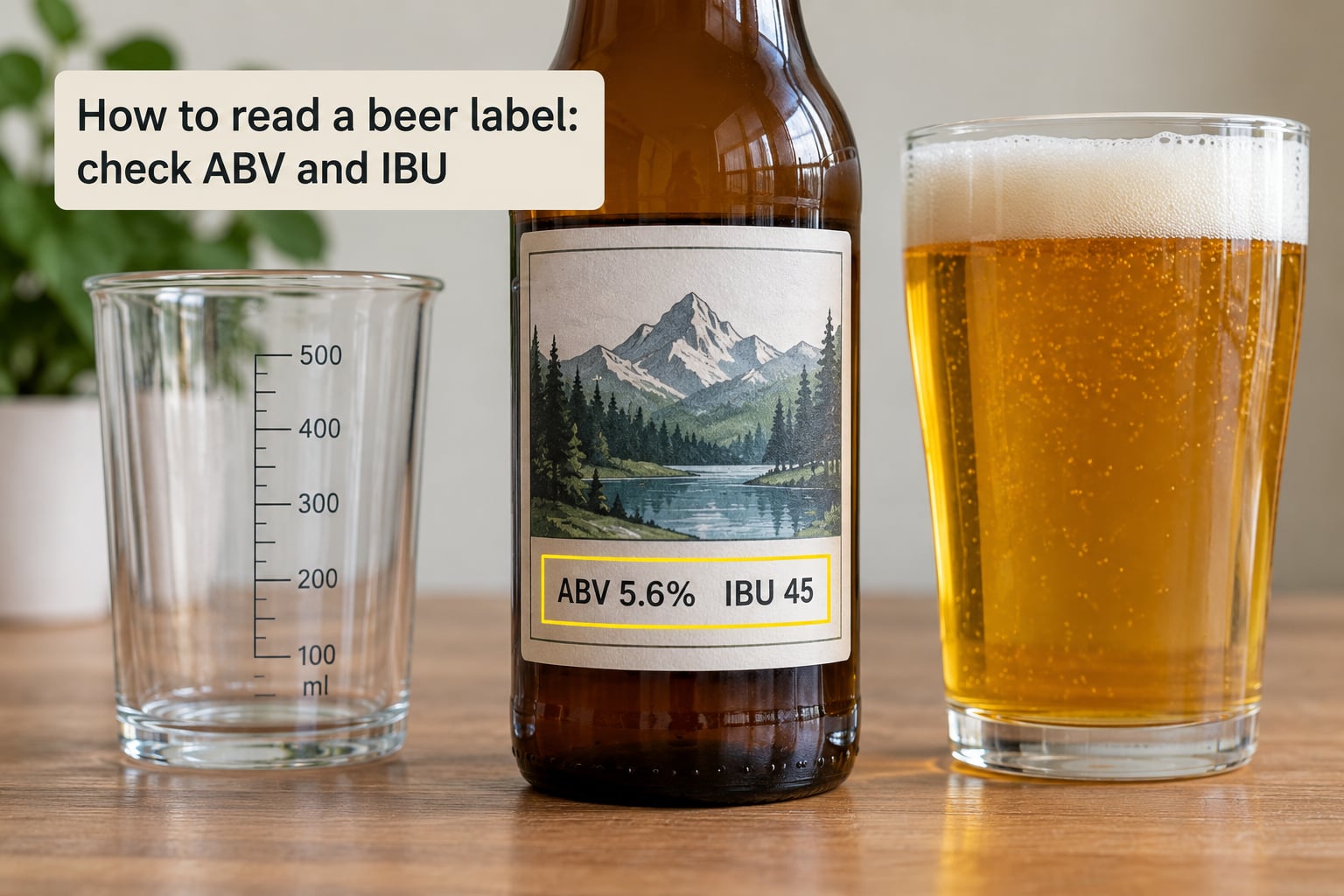
ABV means alcohol by volume: the percentage of the liquid that is alcohol. So 5.2% ABV means 5.2% of the fluid is ethanol. It is a measurement, not a rating. IBU means International Bitterness Units, a scale that estimates how much bittering came from the hops during the boil.
Neither number predicts quality. A 9% beer can taste like a light lager, and a 3.5% beer can be the hardest drink on the table. What ABV tells you reliably is how much alcohol is in the serving, and that is worth doing arithmetic on.
| ABV range | Category | Typical examples |
|---|---|---|
| 2.5–4.0% | Session-strength | Light lagers, cream ales, German wheat, session IPAs |
| 4.0–6.0% | Mainstream | Pale ales, pilsners, amber lagers, most craft lagers |
| 6.0–7.5% | Strong | West coast IPAs, stouts, Belgian tripels, strong ales |
| 8% and up | Barrel-aged and imperial | Imperial stouts, double IPAs, barley wines, many barrel-aged releases |
Container size is the part people miss on the shelf, because a tall can and a standard can look similar at arm’s length. One standard drink in the US is roughly 0.6 fluid ounces of pure alcohol, which makes a 12 oz pour at 5% about one standard drink, a 16 oz pour at 5% about 1.3, and a 22 oz pour at 8% about 2.3.
| Container | At 4.5% ABV | At 6.5% ABV | At 9% ABV |
|---|---|---|---|
| 12 oz can or bottle | About 0.9 | About 1.3 | About 1.8 |
| 16 oz can | About 1.2 | About 1.7 | About 2.4 |
| 22 oz tall boy | About 1.6 | About 2.4 | About 3.3 |
Those figures are standard drinks, not something to worry about. They are here because a 16 oz can at 8% reads as “one beer” on a shelf and is not.
IBU needs more context, because a number on its own is meaningless. It measures hop-derived bitterness, not hop aroma — which is why a hazy IPA can be bursting with grapefruit and still print a modest IBU.
| Style | Typical IBU | How it actually tastes |
|---|---|---|
| Gose, wheat beer | 4–10 | Barely perceptible bitterness |
| Pilsner | 25–45 | Noticeable snap, still clean |
| Porter | 20–40 | Roast bitterness, softened by dark malt |
| Pale ale | 30–50 | Balanced, medium bite |
| Stout | 25–45 | Roast character dominates; hop bite fades |
| IPA | 40–70 | Firm, sustained bitterness under the aroma |
| Double or imperial IPA | 60–100+ | Aroma first, then real heat at the back |
Perceived bitterness is not the same as measured bitterness. A high-IBU beer served cold can taste smoother than a 30-IBU beer served warm, and malt-heavy dark beers can measure high while reading as mild.
Read the hops, malt, yeast, and other brewing details
The smaller print tells you how the beer was made, and some of it is genuinely useful for predicting flavor.
Hop varieties get named on craft labels because aroma is the point of an IPA: Citra, Mosaic and Simcoe tend to read as citrus and tropical fruit, while Centennial and Magnum lean herbal and resinous. “Dry-hopped” means hops were added after fermentation for aroma only, which is why those beers smell far more hoppy than their IBU suggests. “Bottle-conditioned” or “unfiltered” means yeast stayed in the package and keeps conditioning, so the beer arrives slightly cloudy with a fine sediment and a bit more carbonation.
Malt is less often named. Expect it in words like “malted barley,” “rye,” “wheat” or “oats” in the ingredient list. Adjuncts are anything added that is not the core grain or hop — corn, rice, oats, fruit, coffee, cocoa, spices. They are legal and common; they just change the character.
“Nitro” means nitrogen was used for carbonation, producing a dense cascading head and a silkier mouthfeel. “Barrel-aged” means it rested in a wooden barrel, usually for months, which adds oak and, if it was a bourbon or wine barrel, flavors that are not from the brewery’s recipe alone.
Here is the acronym decoder. Most of the rest of these show up on enthusiast packaging or a tap menu rather than a standard bottle.
| Term | Definition | What it tells you |
|---|---|---|
| ABV | Alcohol by volume | Strength of one serving |
| ABW | Alcohol by weight | Strength by mass; rare on US labels |
| IBU | International Bitterness Units | Estimated hop bitterness, not aroma |
| SRM | Standard Reference Method | Color scale; pale lagers around 2–6, stouts 40 and up |
| OG | Original gravity | How much sugar the brew started with |
| FG | Final gravity | How much sugar was left after fermentation |
| Plato | Alternative to gravity, used in Europe | Same idea as OG and FG |
| PLC / P.E. | Packaged or bottled at date | When it left the brewery |
| Net contents | Volume in fluid ounces or milliliters | Actual fill size |
Original gravity and final gravity tell you about strength and dryness, but they do not tell you whether the brewer did a good job. Treat them as trivia unless you enjoy trivia.
Check the origin, brewery, and style clues
The brewery name is the first thing to check and the most-skipped. Beer gets better when the brewer is consistent, because a brewery that nails one style will keep nailing it across releases. A brewery you have enjoyed before is the safest pick on a crowded shelf.
Distinguish the brewery from the brand. Large beer groups own multiple brands, and some beer is brewed under contract by a brewery whose name never appears on the front. The back label is where a brewed-and-bottled-by line usually lives, and the government warning statement gives the state of bottling, not necessarily where the beer was fermented. Geography tells you something — German labels on a pilsner, a Belgian address on a tripel — but it is a clue, not a guarantee of quality.
Regulated statements include the government warning about alcohol during pregnancy, the net contents, the deposit or refund indication where one applies, and the alcohol content. Ingredients and allergen statements are also regulated. Everything else on the label — the tagline, the story about the mountain, the illustration — is advertising, which is why “premium,” “bold,” “crisp” and “refreshing” mean nothing measurable.
How to read beer date codes and freshness stamps
No, the date on a beer is not an expiration date. It marks the end of a quality window, and going past it will not make you sick. Beer gets stale in aroma, flattens in carbonation and can taste papery or oxidized — a disappointment, not a hazard. What actually makes beer unsafe is contamination: a swollen or bulging can, a leaking or broken bottle, a popped or broken seal.
| What the label says | What it means |
|---|---|
| Best by | Suggested drinking window; flavor starts to drift near the end |
| Enjoy by | Same idea, softer wording |
| Born on | Mainly used for bottle-conditioned and barrel-aged beer, where aging is a feature |
| Packaged on | The factual date it left the brewery — the most precise stamp you can get |
| No date at all | Very common on macro lager and on beer that has aged for years in a cellar |
People who buy fresh beer consistently say they now refuse anything undated. That is a reasonable habit rather than a rule, and it matters most for hop-forward beers, which lose their aroma within a few months of packaging while stouts, barley wines and other strong styles keep improving. Heat is the real enemy here — a garage or a closet next to a water heater will stale a beer long before its printed date, and sunlight can react with hop compounds to produce a skunky smell that never fades.
How to decode a stamped date code and batch number
This is the part that confuses people most, because breweries use stamped codes with no key printed anywhere on the container. Most of them follow one of a handful of common formats.
| Code looks like | Format | How to read it |
|---|---|---|
| L23145 | Letter plus Julian day | L is the year, 23145 is the 145th day of 2023 — late May |
| 260118 | YYMMDD | Year, month, day: 18 January 2026 |
| 2026045 | YYYY plus day of year | The 45th day of 2026 — 14 February |
| BEST 03/24 | MM/YY | End of the recommended window, March 2024 |
| Lot 24-A17 | Batch identifier | Traceability only — no date encoded |
If a stamp resists all of these, the brewery’s website or a quick note to them will decode it. Nobody expects a shopper to guess. Batch and lot numbers are for recalls and quality tracing: if the brewery ever issued a recall for your beer, that code is how they would identify which bottles to pull, and it is worth photographing when you particularly love a release.
Ale vs lager, and what that word tells you
Ale and lager describe yeast and fermentation temperature, not strength, color or quality. Ales ferment warmer with top-fermenting yeast and tend to have fruitier, more ester-driven aromas. Lagers ferment cooler with bottom-fermenting yeast and tend to taste crisper and cleaner.
That is the whole distinction. It does not mean ale is stronger, darker, sweeter or craftier. Budweiser and Miller are lagers. Coors Light is a lager. A stout is always an ale, and some lagers come in at 5% and above. If a bottle does not say which, the style name usually reveals it.
Use flavor descriptions and tasting notes
The last line of flavor words on a label is an impression, not a measurement — but impressions are still useful. “Citrusy,” “piney,” “juicy” and “tropical” point to hop aroma. “Malty,” “caramel” and “toasty” point to malt character. “Roasty,” “coffee” and “chocolate” point to dark malt. “Dry,” “crisp” and “clean” describe mouthfeel and finish rather than a flavor additive, and “balanced” means nothing is pushing past the others.
Watch for words that promise more than beer can deliver — “smooth,” “perfect,” “unfiltered perfection.” A brewery describing its own beer has every reason to describe the best version of it. Our guide to what hoppy actually means goes deeper on the aroma side, and once you know the vocabulary the tasting notes become a genuine shortcut.
Common mistakes
The first mistake is treating high ABV as a quality ranking. Strength is a style choice, not a scoreboard. A 10% imperial stout and a 3.8% session IPA are both trying hard at opposite ends, and the 10% one will put you on the floor faster than the artwork suggests.
The second is reading IBU as harshness. It measures bitterness from hops during the boil, and hop aroma is added separately and largely unhinted by it. Compare a 60-IBU pilsner with a 40-IBU imperial IPA and you may find the reverse of what the numbers implied.
The third is confusing style with color, or color with flavor. A dark beer is not automatically stronger, bitterer or more complex. SRM measures color alone, and many people assume a ruby-red ale or a jet-black stout will taste a particular way based on the pour.
The fourth is ignoring freshness. Hop-forward beer sitting in a warm cupboard for four months will taste flat and dull, and you will blame the brewery instead of the shelf. Check the date before you decide anything else.
The fifth is reading marketing as data. “Craft,” “premium,” “bold” and “artisan” are unregulated words on a label. Style name, ABV, ingredients and date are the parts with meaning behind them.
The sixth is ignoring container size. A tall boy at 8% is closer to three standard drinks than one, and the label will not warn you. Read the ounces at the bottom of the can.
Once the vocabulary is familiar, the rest gets easy. If you want a shortcut for the table, how to pair beer with burgers maps the same style names onto food.
Frequently Asked Questions
Is the date on beer an expiration date?
No. A printed date on beer marks the end of a quality window, not a safety cutoff. Past it, hop aroma fades, carbonation goes flat and the beer can taste papery or oxidized. It will not make you sick. What can make beer unsafe is contamination, which shows up as a swollen can, a leaking bottle or a broken seal.
What does ABV stand for on a beer label?
ABV stands for alcohol by volume. It is the percentage of the beer that is alcohol, so a 5.2% ABV pour is 5.2 percent ethanol by volume. It is a measurement, not a rating, which is why a 9% beer can taste surprisingly easy and a 4% beer can knock you over.
Is 20 IBU high?
No. Twenty IBU is gentle. Most pilsners land between 25 and 45, pale ales around 30 to 50, and IPAs between 40 and 70. At 20 IBU you are barely going to notice the bitterness, which is normal for wheat beers, goses and a lot of dark malt-driven stouts.
Is 7% ABV high for beer?
Seven percent sits at the top of the mainstream range. Below 4% is session-strength, 4 to 6% is where most pale ales and lagers live, 6 to 7.5% is strong-ale territory, and 8% and up is imperial and barrel-aged territory. A 7% IPA tastes strong in aroma and drinks lighter than the number suggests.
What does gluten-free versus gluten-reduced mean on a beer label?
Gluten-reduced means the brewer reduced gluten through processing or enzymes, without a certified testing threshold. Gluten-free is the firmer claim, generally under 20 parts per million. Neither style name is a safety guarantee, and most barley malt contains gluten, so anyone with celiac disease should read the ingredient line on every can.
How do I choose a beer when every style name is unfamiliar?
Start from what you already enjoy rather than the label. If you like crisp and light, begin with lagers such as pilsners or helles. If you like malt and roast, try a porter or stout. If you want aroma and fruitiness, go with a pale ale or IPA. Reading a beer label becomes easy once you anchor new names to a flavor you know.
Take those four steps in order on the next bottle you pick up: brewery, style, ABV, date. That takes under a minute, and everything else on the label becomes reference material rather than noise. Last reviewed for 2026, and we keep the ranges above current as brewers shift their recipes.