
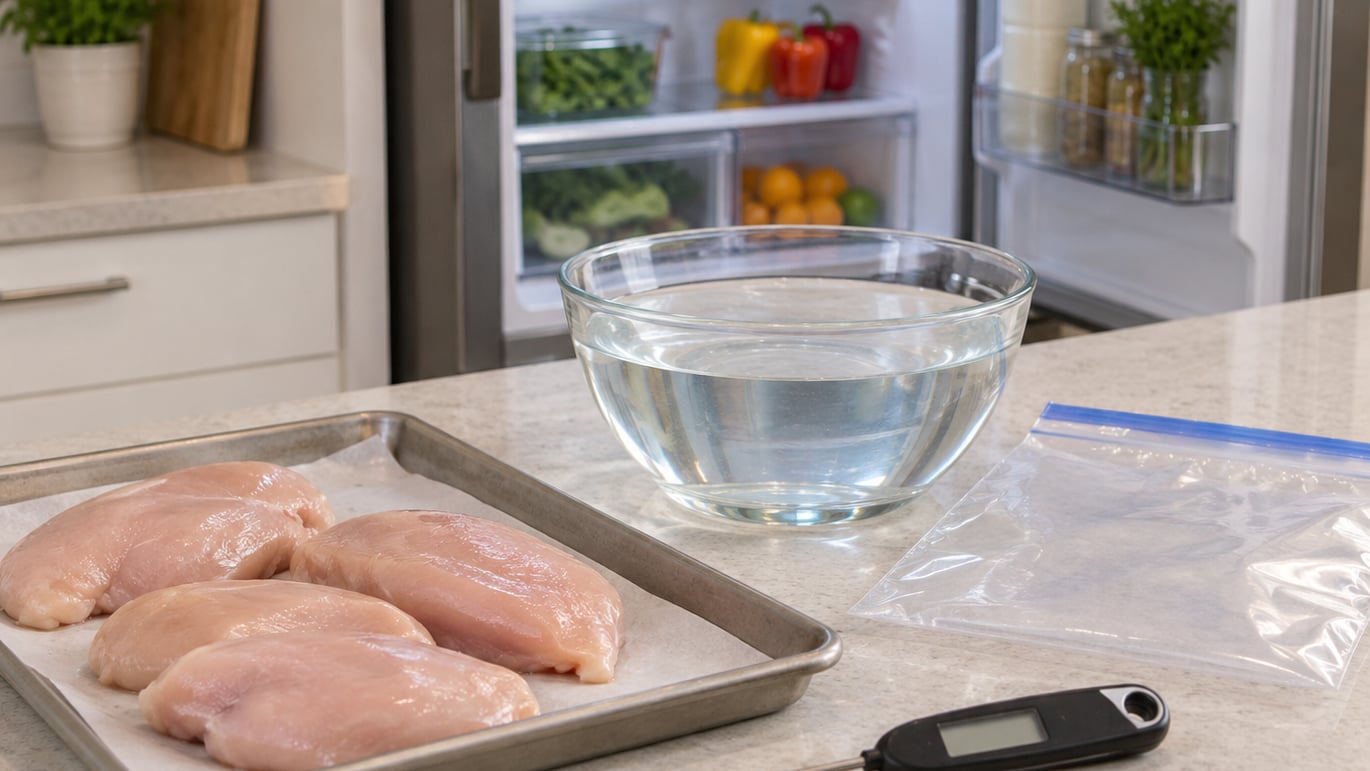
The safest way to thaw chicken is in the refrigerator at 40°F or below, on the bottom shelf, in a container that catches drips. Cold running water is the next fastest approved method, and the microwave works only if you cook the chicken straight away. Learn how to thaw chicken safely with all three, plus what to do when the chicken has already been out too long.
The reason this matters comes down to one temperature band. Between 40°F and 140°F sits the food safety danger zone, where Salmonella and Campylobacter multiply fast on raw poultry but are not hot enough to be killed. Freezing pauses bacterial growth; thawing badly restarts it. The USDA estimates that roughly 4% of raw chicken sold in U.S. supermarkets carries Salmonella, so thawing is where a good dinner can quietly go wrong.
Most home cooks already know the fridge rule. What they want is what to do on a Tuesday at 5pm when the chicken is still a brick, so the methods below are ordered by how fast they work and what each one costs you in texture.
What You Need
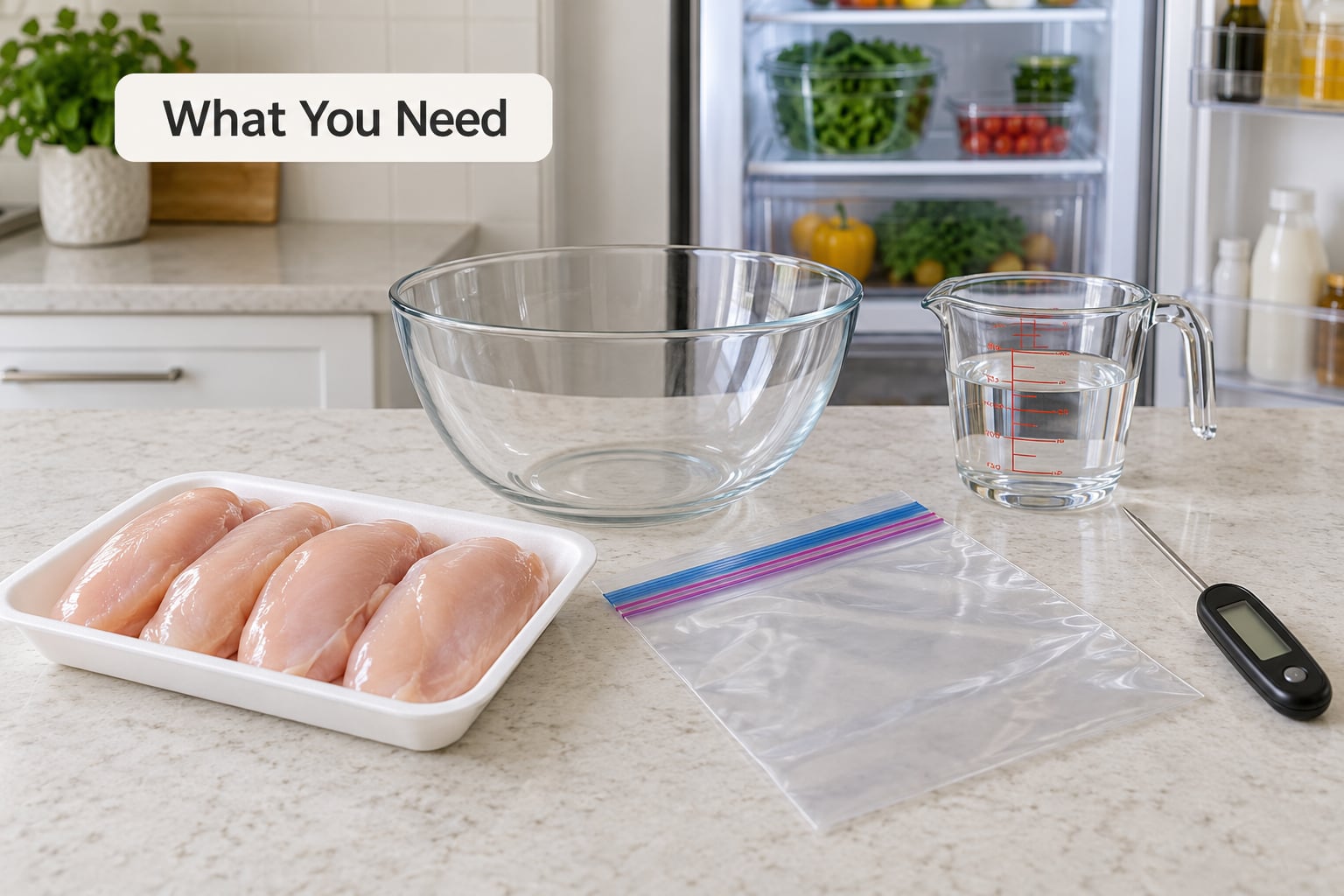
Almost nothing. You need a refrigerator at 40°F or below, a leak-proof bag or sealed container, a bowl or baking sheet to catch drips, and an instant-read thermometer you can check the internal temperature with later. A microwave with a defrost setting helps, though 50% power works fine if yours lacks one.
Two habits matter more than the gear. Put raw poultry on the bottom shelf of the fridge so juices cannot drip onto produce or cooked food below, and keep a separate cutting board for raw meat. Cross-contamination during thawing is the quiet way a safe thaw turns into a contaminated dinner.
Before you start, check your fridge thermometer. A lot of refrigerators run warm near the door and cold at the back, and the back is the steadier spot for a long thaw.
Step-by-Step: How to Thaw Chicken Safely
There are three thawing methods the USDA considers safe: refrigerator, cold running water, and microwave. A fourth option, cooking from frozen, skips thawing altogether. Each trades time for a different risk, so pick by when you plan to cook rather than by which one is fastest.
| Method | Approximate time | Best for | Can you refreeze? |
|---|---|---|---|
| Refrigerator, 40°F or below | 12 to 48 hours | Planning ahead, meal prep, quality results | Yes |
| Cold running water, 70°F or below | About 1 hour per pound | Same-day dinner, whole birds up to about 4 pounds | No, cook immediately |
| Microwave, defrost setting or 50% power | 5 to 20 minutes | Small portions cooking right away | No, cook immediately |
| Cook from frozen | 25% to 50% longer cooking time | Breast fillets, cutlets, chops, not whole birds | Not applicable |
Thaw times by cut differ a lot, so here is the range for the refrigerator method, which is the one most people will use:
- Whole chicken, 3 to 4 pounds: 24 to 48 hours
- Whole chicken, 5 to 12 pounds: 48 to 72 hours
- Boneless skinless breast halves: 12 to 24 hours
- Boneless thighs or drumsticks: 12 to 24 hours
- Wings: 12 to 24 hours
- Small portions, 1 to 2 inches thick: 6 to 12 hours
Thaw Chicken in the Refrigerator
Put the chicken in its original wrapping or in a leak-proof bag, then set it in a container, bowl, or baking sheet on the bottom shelf of the refrigerator. The container catches the pink juice that collects as the meat warms, and the bottom shelf keeps that juice away from everything else.
Plan on 24 hours for a whole chicken, 12 to 24 hours for breasts, thighs, drumsticks, or wings, and 6 to 12 hours for small portions. If you are buying a bulk pack, a 10-pound bag of frozen breasts will not fit most fridges as one solid block. Thaw it in a bowl with a weight on top, or break it into sections by hitting the plastic lightly with the back of a heavy knife until the pieces separate, then thaw them apart.
This is the only method that leaves the chicken cold enough to refreeze later, and it is hands-free. Set it in the fridge before you go to bed and dinner the next day is handled.
Thaw Chicken with Cold Water
Cold running water is best, not cold or hot. Put the chicken in a leak-proof bag or watertight container, seal it, and submerge it in a sink or bowl of cool tap water at 70°F or lower. Running water works best because moving water carries heat away from the surface faster than still water does.
Allow about 1 hour per pound, and change the water every 30 minutes so it stays cold. A 2-pound bag of breasts takes roughly 2 hours; a 4-pound whole chicken takes about 4. If you put it under a trickle of water for half an hour and walk away, the outer layer sits in a warm zone and the center is still frozen, which is the worst of both outcomes.
Cook it immediately after. Chicken thawed in water goes straight into the pan or the oven, not back into the fridge. The same timer-and-temperature logic applies to other meat, which is covered in How to Thaw Ground Beef Fast and Safely: 4 Proven Methods.
Thaw Chicken in the Microwave
Place the chicken on a microwave-safe plate to catch drips, set the microwave to defrost, or drop it to 50% power. Work in 1 to 2 minute intervals, checking after each one, and turn or flip the pieces so they thaw evenly instead of cooking on the outside while frozen in the middle.
Stop as soon as there is no ice left, even if the chicken still feels firm. The outer edges will already be warm and slightly cooked, which is why microwave-thawed chicken often turns rubbery and why it must be cooked straight away. Never microwave-thaw chicken and then leave it to sit while you marinate it. The outer layer spends that time sitting in the danger zone while the center stays cold.
Microwave thawing is the right call for a single portion heading straight into a skillet. It is the wrong call for a whole chicken or for a big tray of breasts.
Use an Emergency Method Only When Necessary
Warm water, hot water, and thawing on the counter are not safe methods, no matter how much faster they seem. Warm water pushes the surface of the meat into the 40°F to 140°F range immediately while the center stays frozen, so bacteria get a head start with no kill step coming.
Salt water and vinegar are the two most searched “fast thaw” hacks and neither does much. Salt draws a little moisture out of the meat, which damages the texture and can make thawed chicken watery when you cook it. Vinegar on the surface does nothing meaningful to ice that is still solid.
Two real options remain when dinner is tonight and the fridge is empty. The cold water method above is the safe emergency: 1 hour per pound, cold water changed every 30 minutes, cooked immediately. For a fully frozen boneless breast that is still flat and flexible, a 15-minute sealed hold at room temperature followed by an air fryer or oven finish can work, but only for thin, even pieces, and the food must be cooked immediately afterward. Anything with a thick, icy core goes to the sink with cold running water.
Check That Chicken Is Fully Thawed
Fully thawed raw chicken bends easily without cracking and feels flexible when you press it, especially at the thickest point. For a whole chicken, the cavity and breastbone area should give with little resistance. If you can still feel hard ice crystals or the meat resists bending, it needs more time.
A food thermometer checks doneness, not thawing. It tells you whether the chicken reached the safe internal cook temperature of 165°F, which is a separate question from whether it finished defrosting.
Cook Thawed Chicken Safely
Thawing safely only pays off if the cooking finishes it. Cook poultry to an internal temperature of 165°F, measured in the thickest part of the breast, thigh, and the wing area if you are cooking a whole bird. Cooked chicken you cannot check with a thermometer needs a full 165°F and 15 minutes of resting time.
Thawed chicken from the refrigerator should be cooked within 1 to 2 days. Keep it covered on the bottom shelf, and once it is cooked, refrigerate leftovers within two hours and use them within 3 to 4 days. For the grill side of things, How to Grill Chicken Breasts Without Drying Them Out covers what happens after the thermometer hits 165°F.
Common Mistakes
Thawing on the counter. This is the most common mistake and the one that matters most. The outside of the chicken enters the 40°F to 140°F danger zone while the inside is still frozen. The two-hour rule applies: perishable food should not sit in that range for more than two hours, or one hour when the room is above 90°F. Correct it by moving the chicken to the fridge or the cold water bath immediately, and remember that overnight on the counter is unsafe no matter how cold the kitchen feels.
Using warm or hot water to speed things up. Warm water moves the surface of the meat into the danger zone almost at once and there is no later heat high enough to make it safe. Stick with cool water at 70°F or lower and change it every 30 minutes.
Microwaving on full power and walking away. Full power cooks the edges while the middle stays frozen, which wastes the chicken and leaves the outer layer sitting in a warm zone. Check in 1 to 2 minute intervals on 50% power or the defrost setting, and cook the chicken immediately once the ice is gone.
Refreezing and rethawing over and over. Each thaw and refreeze cycle loses moisture and hurts texture. Chicken thawed in the refrigerator can go back in the freezer safely, but chicken thawed by cold water or microwave must be cooked and not refrozen. For storage, keep thawed chicken sealed on the bottom shelf and use it within 1 to 2 days.
Letting partially thawed chicken sit out. Chicken that is still partly frozen and sitting on the counter is the worst case, because it looks safe while the surface warms. Get it into the fridge or the cold water bath straight away, and if it has been in the danger zone for over two hours, throw it out rather than cooking it and hoping.
Cross-contamination during the thaw. Juices from raw chicken drip in the fridge, sit in a bowl on the counter, or splash in the sink while you thaw under running water. Keep raw poultry on the bottom shelf, use a separate cutting board, and sanitize the bowl, the sink, and your hands with hot soapy water before you touch anything else. If you are reusing oil after cooking, How to Reuse Frying Oil Safely for Crisper Food covers the storage rules for that.
Frequently Asked Questions
How long does it take to thaw chicken safely?
In the refrigerator at 40F or below, a whole chicken needs 24 to 48 hours, breasts, thighs, wings, and drumsticks need 12 to 24 hours, and small portions need 6 to 12 hours. Cold running water is about 1 hour per pound, and a microwave takes 5 to 20 minutes in short intervals.
Can I thaw chicken in hot water?
No. Warm or hot water moves the surface of the chicken into the 40F to 140F danger zone while the center is still frozen, so bacteria multiply without ever getting hot enough to be killed. Use cool tap water at 70F or lower and change it every 30 minutes.
Can frozen chicken be cooked without thawing?
Yes, for some cuts. Frozen boneless skinless breasts, chops, and small portions can go straight into an oven, skillet, or air fryer. Allow 25% to 50% more cooking time and check with a thermometer. A whole chicken or a large frozen block should be thawed first so the outside does not overcook before the center reaches 165F.
Is it safe to refreeze chicken after thawing?
It depends on the method. Chicken thawed in the refrigerator at 40F or below can be refrozen safely, though texture may drop slightly. Chicken thawed in cold water or the microwave must be cooked immediately and cannot be refrozen. Cooked chicken can be refrozen once, and after a second thaw it should be cooked right away.
How do I thaw chicken without making it soggy?
Pat the chicken dry with paper towels right after it thaws and before seasoning, because surface moisture steams instead of browning and leaves the meat wet. Skip marinating already-thawed chicken, since salt draws out water. Cooking from frozen or using the microwave for a single portion also limits water loss, because less time passes between thawing and heat.
The refrigerator wins whenever you have the time. Put the chicken on the bottom shelf the night before, and dinner is solved with no risk and no soggy meat. When the fridge is not an option, use cold running water at 70°F or below, change it every 30 minutes, and cook it straight away, then take it to 165°F before you serve.