
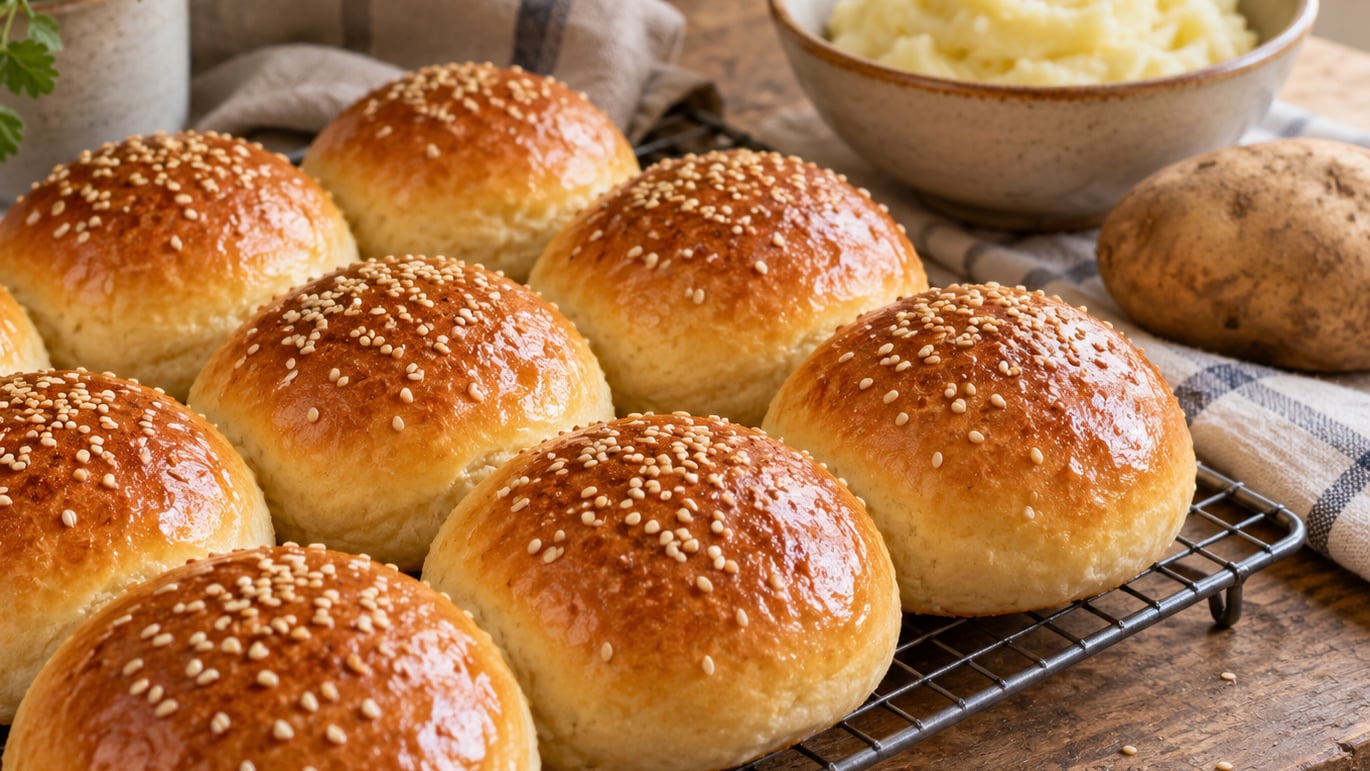
To make potato buns, cook and mash potatoes, stir them into a warm yeasted dough along with milk, egg, butter and flour, let the dough rise twice, shape it into discs on a lined sheet pan, and bake at 375 F for 18 to 20 minutes. Start to finish you are looking at about four hours, and most of that is waiting.
So how to make potato buns that are still soft on day three instead of hard by morning? The potato does two jobs at once. Its starch holds water the flour alone cannot, and it slows the staling process that turns an ordinary roll into a brick overnight. That is the whole gap between a decent burger bun and one people finish fast.
A stand mixer helps, but nothing here needs one. I mix this enriched potato dough by hand and it comes together just as reliably.
What You Need
The recipe below makes 12 burger buns, roughly 120 g (4 oz) each. Weigh the potato and the flour if you can. Potato dough runs wet enough that volume estimates drift, and the flour is the one ingredient you do not want to guess at.
For the potatoes
- 2 large russet potatoes (about 325 g / 11 oz), peeled and cut into 2 cm chunks
- Salted water, enough to cover the chunks
For the dough
- 5 1/2 cups (690 g / 24 oz) bread flour, or all-purpose flour plus an extra 1/2 cup
- 2 1/4 teaspoons (7 g) instant yeast
- 3 tablespoons (60 g / 2 oz) granulated sugar
- 1 1/2 teaspoons fine salt
- 3/4 cup (180 ml) warm milk, 100 to 110 F (38 to 43 C)
- 3/4 cup (180 ml) warm water, about the same temperature
- 1 large egg, room temperature
- 1/4 cup (60 g / 4 oz) unsalted butter, softened
- 1 tablespoon vegetable oil, for the pan
For the wash and topping
- 1 egg plus 1 tablespoon milk or water
- Sesame seeds, poppy seeds or everything bagel seasoning
- Flaky salt, for the top right after they come out of the oven
Tools
- A potato ricer or sturdy masher
- A large mixing bowl with a wooden spoon or spatula
- Two rimmed baking sheets lined with parchment paper
- An instant-read thermometer, useful for the liquid, the potatoes and the finished buns
Active dry yeast works too. Dissolve it in the warm water with the sugar, wait about 10 minutes for foam, then carry on. Instant yeast goes straight into the dry ingredients.
Step-by-Step: How to Make Potato Buns
1. Prepare the mashed potatoes
Simmer the chunks in salted water for 15 to 20 minutes, until a knife slides in with no resistance. Drain, spread on a plate, and let them steam dry for about 5 minutes. Wet potatoes mean wet dough, and wet dough spreads instead of holding a round shape.
Rice or mash them while they are still hot. A ricer gives the finest crumb; a masher leaves small lumps that you can feel in the finished bun. Push the mash through a ricer twice if you want it as smooth as possible.
Let it cool to lukewarm, roughly 100 F (38 C). Straight from the pot it will kill the yeast, and you end up waiting on dough that never moves. A hand should rest on the mash comfortably, with no sting.
Leftover mashed potatoes from Sunday dinner work well. Use them cold, straight from the fridge, and skip the boiling. Instant potato flakes also work: 1 cup of dry flakes plus enough hot water to make 1 cup of mash stands in for about 1 cup of prepared potato. Potato flour is a different thing entirely and cannot replace mashed potato here. It carries no gluten structure of its own, so the dough comes out dense and chalky.
Why potato at all? During boiling, starch granules swell and set into a gel. Over the following days the starch in flour slowly re-links into firmer crystals, and that is what you chew as staling. Potato starch is coarser and slower at that job, and the extra moisture it locks in keeps the crumb pillowy for several days.
2. Mix the dough
Whisk the flour, yeast, sugar and salt together in a large bowl. Add the warm milk and water and stir until no dry flour is left in the corners, then work in the mashed potato and the egg.
Add the softened butter a tablespoon at a time, stirring or kneading after each piece. It is the slowest part of this dough and the part that turns people off it, so give it the time it asks for.
The dough will look sticky and loose here, and that is right. Resist the urge to dump in more flour, because extra flour is the single biggest reason potato buns come out dense. If you decide you need any at all, add it one tablespoon at a time, after the dough has already rested.
3. Knead until smooth and elastic
- By hand: 8 to 12 minutes of pushing away and folding back. Potato and butter take longer to come together than plain dough, so let it run to 15 if it still looks ragged.
- Stand mixer: dough hook on low for 5 to 6 minutes, until the dough pulls cleanly off the bowl.
- No knead: mix until combined, cover, and let time do the work. Refrigerate 8 to 12 hours, or leave at room temperature about 3 hours.
You are aiming for a smooth, slightly tacky ball that springs back slowly when you poke it. Pull a small piece and stretch it thin: see a translucent window before it tears and the gluten is developed. Snap straight away means another 3 minutes.
If the dough fights you and sticks to everything, rest it 10 minutes and try again. I reach for a little oil on my hands before I reach for more flour, and the dough behaves far better for it.
4. Divide and shape the potato buns
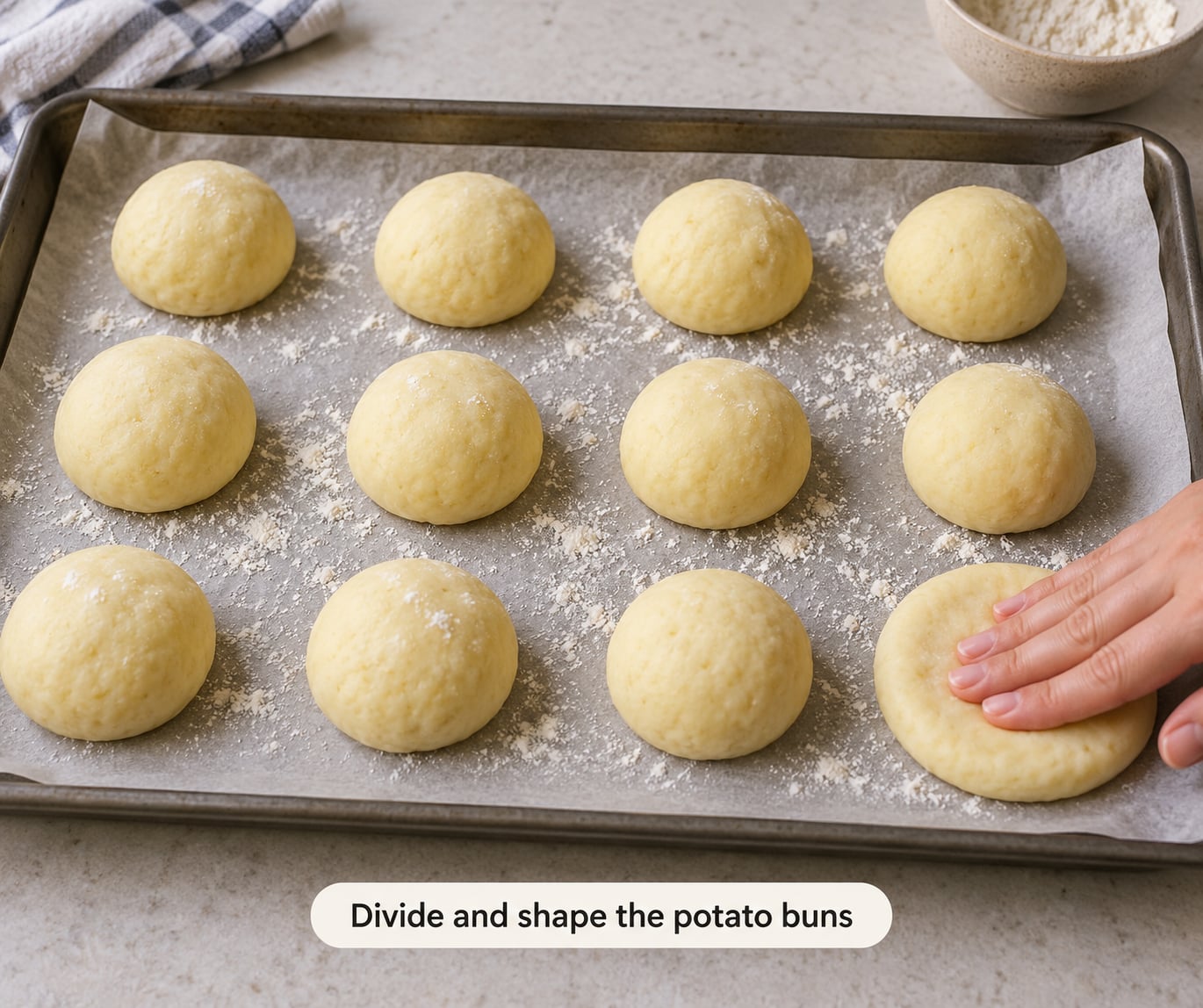
Punch the dough down once, turn it onto a lightly floured surface, and divide it into 12 equal pieces, about 120 g each. A scale turns this into a ten-second job. Cup each piece and tuck the edges underneath until you have a smooth, taut little sphere with no seam showing on top.
Pick a shape now, since it is hard to change later:
- Round rolls: keep the sphere. Good for dinner rolls and sliders.
- Burger discs: flatten each ball with your palm to about 9 cm (3.5 in) across and 2 cm tall. This is the shape most people want on burger night.
- Sliders: roll each one to 6 cm (2.5 in) and space them about 4 cm apart, since they rise sideways.
Set them 4 to 5 cm apart on a lined sheet pan so they have room to spread. Then put the pan somewhere warm: the oven switched off with the light on, or a corner of the kitchen under a towel.
5. Proof until puffy
Let the dough rise at about 78 to 80 F (26 to 27 C) until it has clearly doubled in size and feels full of air, roughly 1 hour. Cold mash pulled from the fridge slows this down, and room-temperature mash moves faster.
After shaping, do the shorter second rise of 30 to 45 minutes. Buns go into the oven when they look inflated, feel pillowy, and jiggle a little when you nudge the pan. A poked finger that snaps back with no dent means the dough is still tight; one that springs back slowly and leaves a slight dent is exactly where you want it.
A cold kitchen is where the second rise usually stalls. Put the pan back under the oven light or into a warm cupboard and give it 20 more minutes rather than reaching for more yeast.
6. Bake and cool the buns
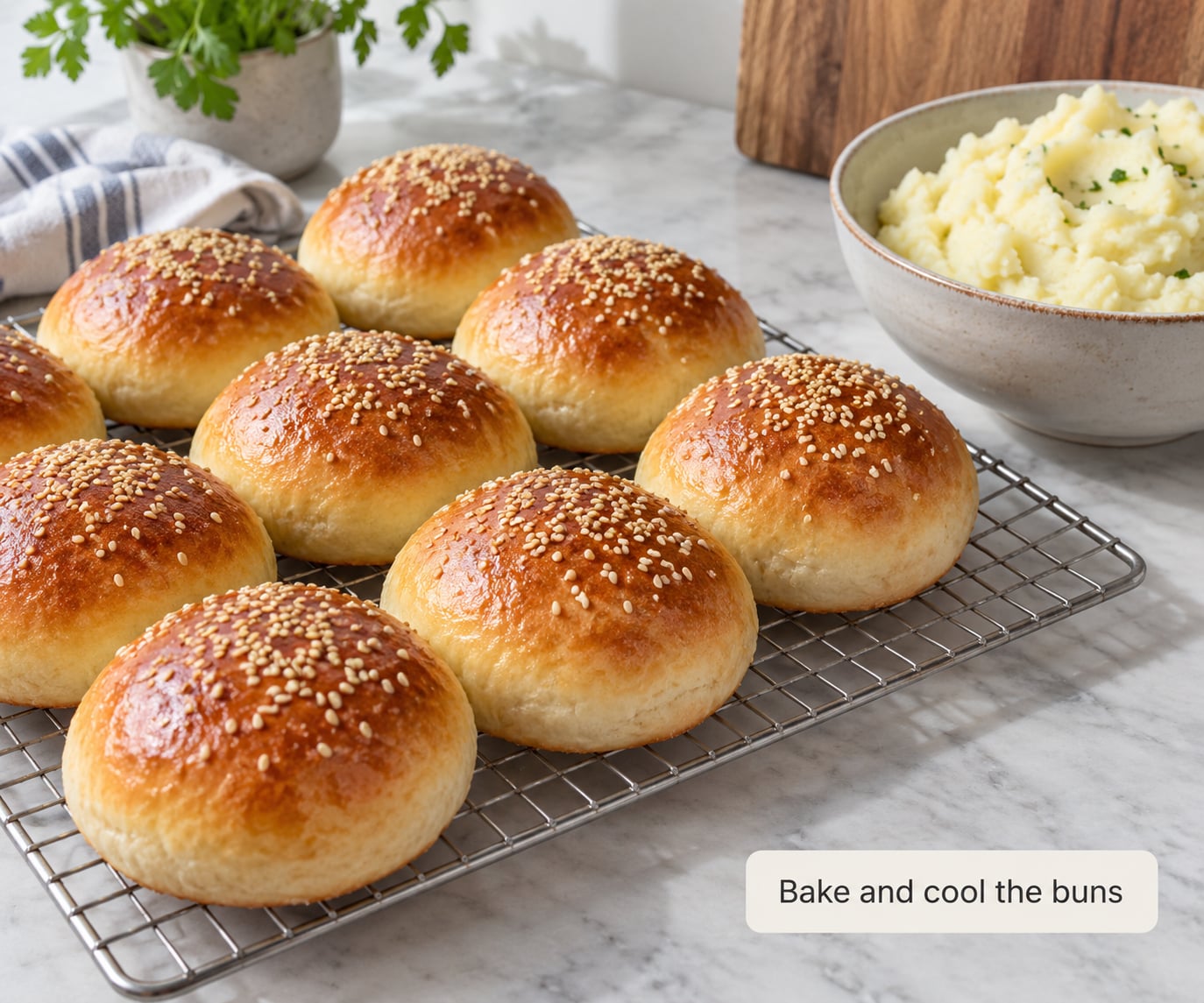
Heat the oven to 375 F (190 C). Brush the tops with the beaten egg and scatter on sesame seeds or flaky salt. Slide the pan in and bake for 18 to 20 minutes.
- 350 F (175 C): 22 to 26 minutes, for a paler and softer crust.
- 400 F (205 C): 10 to 12 minutes, useful for a big batch, but the bottoms colour fast.
Buns are done at a deep golden brown, when the base sounds hollow when you tap it, or when the centre reads about 190 F (88 C) on a thermometer. Any one of those three will do.
Move them to a wire rack and wait at least 15 minutes before cutting anything. The crumb is still setting as it cools, and cutting early gives you a gummy middle. Those minutes also matter structurally: a fully cooled bun holds a heavy patty instead of squashing under it.
Common Mistakes and Fixes
Nearly every problem below traces back to two habits: adding flour when the dough feels sticky, and cutting the second rise short. If you would rather start with the plain version, our guide to making burger buns from scratch runs the same shaping and proofing stages without the potato.
- Dense, heavy crumb: too much flour, or proofing cut short. Weigh the flour, wait for a true double on the first rise, and give the second proof until the buns jiggle. Dough that is dense but smells yeasty usually needed more time, not more yeast.
- Dough stuck to everything: this is expected with potato dough. Rest it, knead 2 more minutes, and oil your hands or bowl instead of adding flour. A tablespoon of flour is harmless; half a cup undoes the recipe.
- Buns that collapse or spread: the second proof ran long, or the kitchen was too warm. Watch the dough rather than the clock, and keep it below 80 F (27 C).
- Pale, floury crust: the egg wash ran off, or the buns went in before the oven was fully preheated. Brush generously and give the oven a full 10 minutes at temperature.
- Burnt bottoms, pale tops: the oven runs hot underneath. Bake on the middle rack and rotate the pan once halfway through.
- Torn or lumpy surfaces: the potato was too wet or the dough was under-kneaded. Steam the boiled potatoes dry and check the windowpane stretch in step 3.
- Gummy interior: cut too early, or underbaked. Check the internal temperature rather than the crust colour alone.
Tips for Better Potato Buns
Richer buns. Swap the water for another 3/4 cup of milk and add 2 more tablespoons of butter if the dough feels lean. A second thin coat of egg wash brushed on 5 minutes into the bake gives a shinier top. While the second proof runs, you can make garlic butter for burger buns and spread it on once they cool.
A softer crust. Put a tray of boiling water on the oven floor for the first 10 minutes. The steam slows the crust from setting hard, which is what most people actually mean by soft potato buns.
Which potato you use.
- Fresh mashed potato: the standard, and the best crumb.
- Leftover mashed potato, cold from the fridge: works well, just reheat and mash it smooth again.
- Instant potato flakes: reconstitute to the thickness of thick mashed potato and use it cold.
- Potato starch water: save the cloudy water from boiling, and swap it for a quarter of the liquid for extra tenderness.
- Potato flour: not a substitute. It leaves the dough dense and crumbly with no structure to hold it.
No stand mixer, no yeast. Mix cold mashed potato with an egg, plain Greek yogurt, baking powder and just enough flour to bring it together. Rest it 10 minutes, shape it, and bake at 350 F (175 C) for 10 to 12 minutes. It lands closer to a potato dumpling than to a yeasted roll, so expect a tighter crumb, and expect it in under an hour.
Sliders and a big crowd. Roll the dough to 6 cm for sliders, and expect the same dough to make about 24. Scaling to double works in one bowl as long as the pot of mash gets big enough to keep mixing evenly. Bake two pans and swap them halfway so both batches colour the same.
Storing and freezing. Cool the buns completely, then keep them at room temperature in a paper bag or a cloth-lined box for three to four days. Skip the fridge, since cold speeds up staling. For longer, wrap each bun and freeze for up to three months, then thaw on the counter or reheat from frozen at 350 F (175 C) for 8 to 10 minutes.
These make a sturdy base for more than burgers. They hold lobster rolls and hot dogs, and cooked patties still need to reach 160 F (71 C) before they go anywhere near the bread. On the side, my oven method for crispy sweet potato fries runs alongside the buns without stealing oven space.
Frequently Asked Questions
Do potato buns need mashed potatoes?
Mashed potatoes are not strictly required, but they are what gives this recipe its soft, tender crumb. About 325 g of cooked potato against roughly 690 g of flour is the ratio that works. Without them you have still made a good burger roll, just not a potato bun.
Why are my potato buns dense?
Dense potato buns almost always come down to flour or proofing. Adding extra flour to tame sticky dough is the most common cause, followed by a first rise that stopped short of doubled. Weigh the flour, wait for a full double, and give the second proof until the buns jiggle.
How do you keep potato buns soft after baking?
Cool the buns completely on a wire rack, then store them at room temperature in a paper bag or a cloth-lined box for three to four days. Potato starch stales more slowly than wheat starch, but refrigeration speeds that up, so keep the fridge out of it.
Can you freeze potato buns?
Yes. Freeze them fully cooled and wrapped individually, where they keep for about three months. Thaw at room temperature, or reheat from frozen at 350 F for 8 to 10 minutes. You can also freeze shaped unbaked buns after the second proof and bake them from frozen, adding 5 to 10 minutes.
Can you make potato buns without yeast?
You can, and it takes about half the time. Mix cold mashed potato with an egg, Greek yogurt and baking powder, rest the dough, shape it, and bake at 350 F for 10 to 12 minutes. The crumb is closer to a dumpling than to a yeasted roll, so expect it tighter and a little denser.
Should potato buns bake at 350 F or 375 F?
Both work, and the difference shows up in the crust. At 375 F you get a deeper golden top in 18 to 20 minutes. At 350 F, allow 22 to 26 minutes for a paler, softer crust. On a convection oven, drop either number by about 25 F and start checking five minutes early.
Start with the plain 12-bun version and get the two rises and the shaping right before you change anything else. Once that clicks you will end up using these for sliders, hot dogs and lobster rolls too, and the first batch will almost certainly be the roughest one you make.