
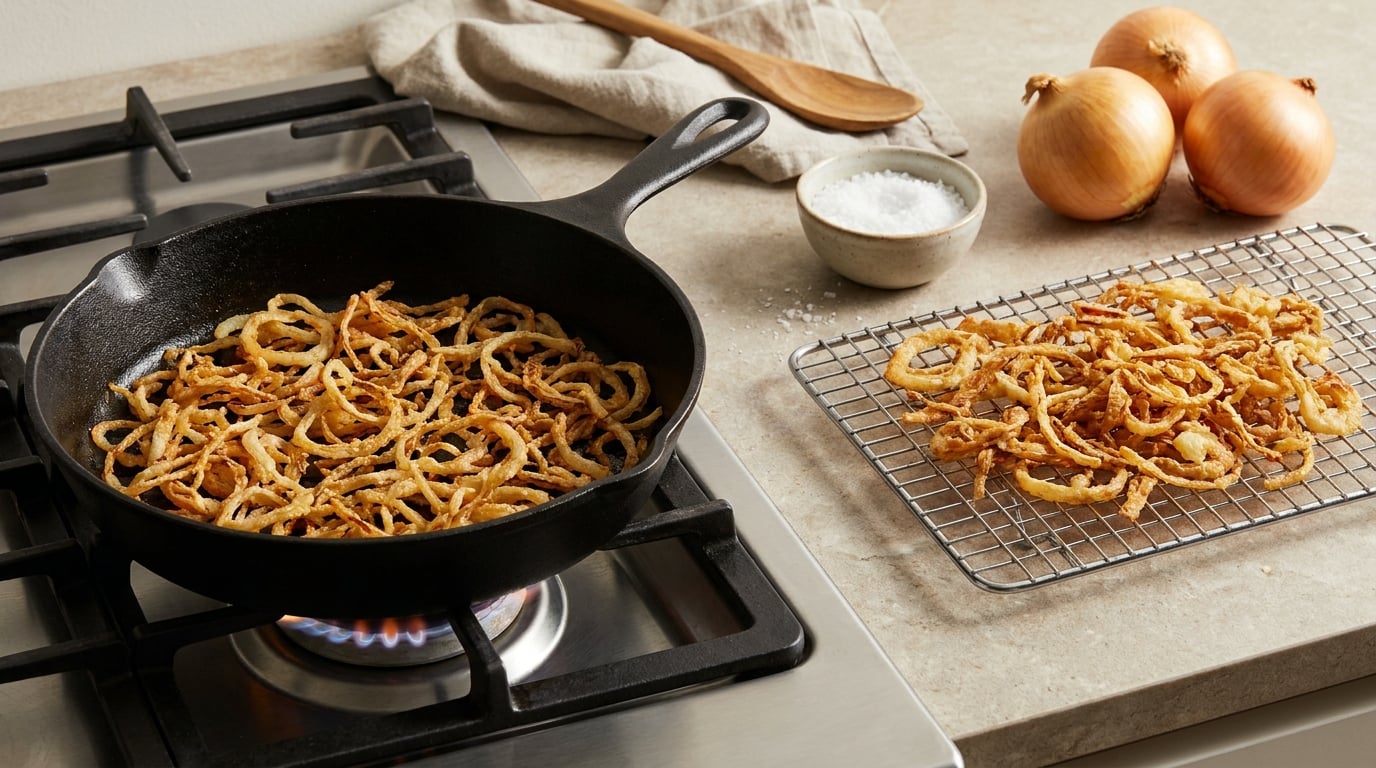
To make crispy fried onions for burgers, slice two yellow onions paper-thin, pat them dry, and shallow-fry them in a thin layer of neutral oil held around 350°F until they turn deep golden, about 8 to 10 minutes total. Drain on a wire rack, not a pile of paper towels, and add them to your burger right before it leaves the kitchen.
This is the bare style, the one you scatter over a patty melt or a smash burger so every bite has crunch in it. No batter, no buttermilk, no deep fryer. It takes about 20 minutes start to finish, and the whole thing hinges on two things most people skip: getting the onions as dry as you can and keeping the oil steady in that band where water boils off fast.
What You Need
Shopping list is short. Most kitchens already have everything on it.
- Two medium yellow onions (about 1 pound / 450 g) — the workhorse. Yellow has real sugar content, so it browns properly and tastes like something.
- Neutral oil — canola, vegetable, grapeseed, or peanut. Roughly half a cup (120 ml). Avoid olive oil; it smokes well below 350°F and tastes like olives.
- Fine salt — 1 teaspoon, plus more for finishing.
- Optional: a splash of vinegar — 1 teaspoon white vinegar tossed through the raw slices. It pulls back any sharpness so you taste onion, not bite.
- Paper towels and a wire cooling rack — both matter, and they are not interchangeable.
- A heavy skillet — cast iron or stainless, 12 inch / 30 cm. Thin pans swing temperature wildly, and temperature swings are what make onions greasy one batch and burnt the next.
A thermometer is worth more than any gadget here. Guessing at 350°F with a stove dial is the single most common reason onions fry unevenly.
Step-by-Step
1. Slice the onions thinly and evenly
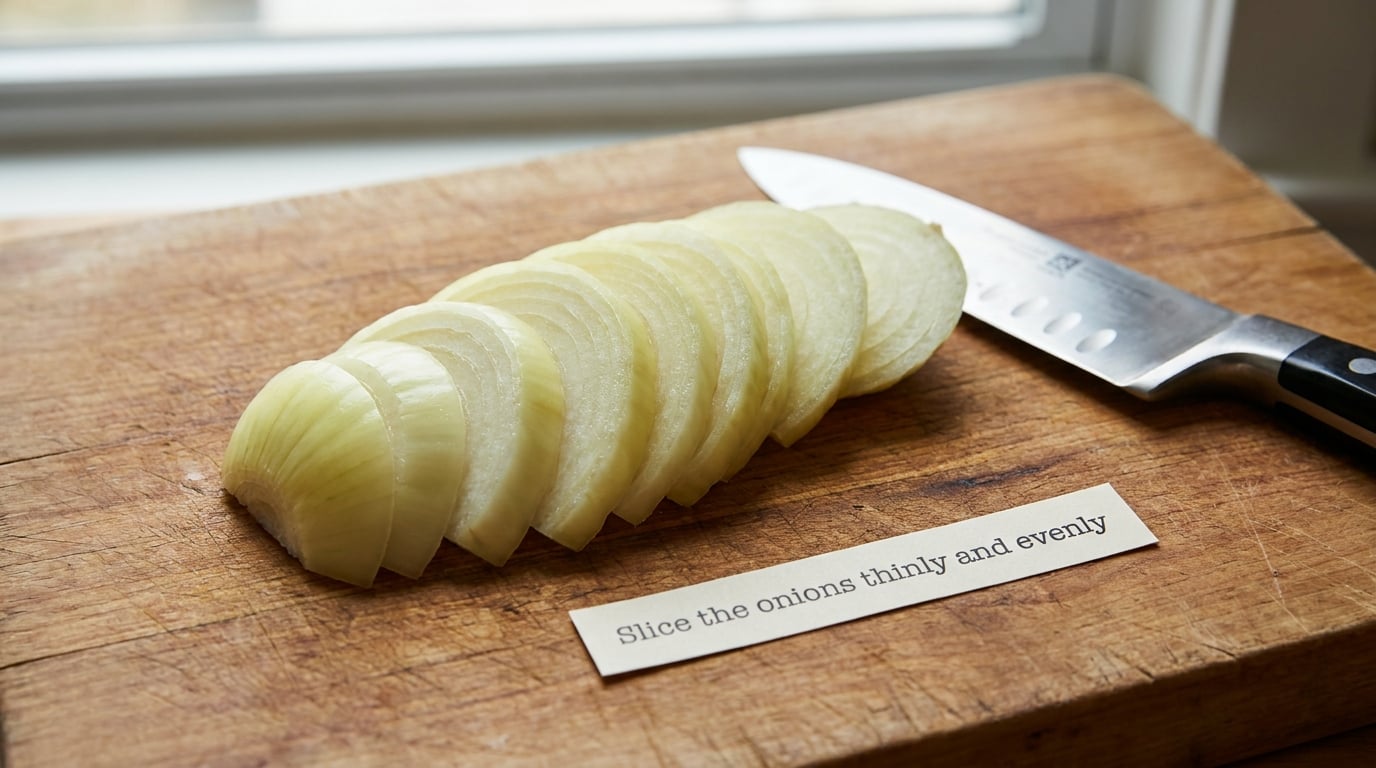
Thickness decides whether you get crisp or whether you get a pan of half-burnt shreds. Cut the onions into slices about 1/8 inch (3 mm) thick, pole to pole, so every piece cooks at the same rate.
That evenness is the real trick. An uneven pile means the thin slivers go dark brown while the thick wedges are still sweating. If you hit a tough spot, press the cut side down and rock the blade through it rather than sawing.
Separate the slices into loose handfuls and swish them in the cold water for about a minute, then dry them. That rinse pulls off surface sulfur and the outer starch, which is where a lot of the limpness comes from.
2. Dry and season the onions
Pat the rinsed slices thoroughly with a clean towel, then spread them across a second towel or a sheet pan and leave them uncovered for 10 to 15 minutes while you heat the oil.
Any water left on the surface turns to steam the moment it hits hot oil. Steam is the enemy of crisp — it softens the onion, dulls the color, and makes the whole pan sputter. Dry onions hit the oil, sizzle, and turn crisp within seconds.
Season right before they go in, using about three quarters of the teaspoon. Seasoning earlier pulls more moisture out of the onion, and those onions are already drier than you want them.
3. Heat a thin layer of oil
Pour about a quarter inch (6 mm) of oil into the skillet. That depth is enough to fry the onion slices, and it lets you tilt the pan and move the oil around with the food rather than swimming them.
Heat over medium-high to 350°F (175°C). Clip a thermometer to the base of the pan if you have one. Without a thermometer, drop a single onion sliver in: it should sizzle loudly and steadily the second it touches. Bubbling weakly means the oil is too cool and the onions will soak it up. Thin smoke or a dark haze means you overshot.
4. Fry the onions in batches
Add one loose handful at a time, spreading it into a single even layer. A crowded skillet drops the oil temperature fast, and that is exactly how you end up with greasy first-batch onions and burnt last-batch onions in the same pan.
Stir with a spatula every 20 to 30 seconds so the pieces move around and brown on all sides. Stirring constantly is the other common mistake — you want to keep the pieces separating, not mash them into the oil. The sound should stay a lively, even sizzle the whole time; if it quiets down, nudge the heat up a notch.
Watch color, not clock. Pale yellow is raw, light gold is where most people stop, and deep golden brown is where the flavor actually lives. Pull them at deep gold, roughly 3 to 4 minutes per batch. If you are nervous, pull one out early and let it cool on the rack — it should be hard and glassy, not bendable.
5. Drain the onions until completely crisp
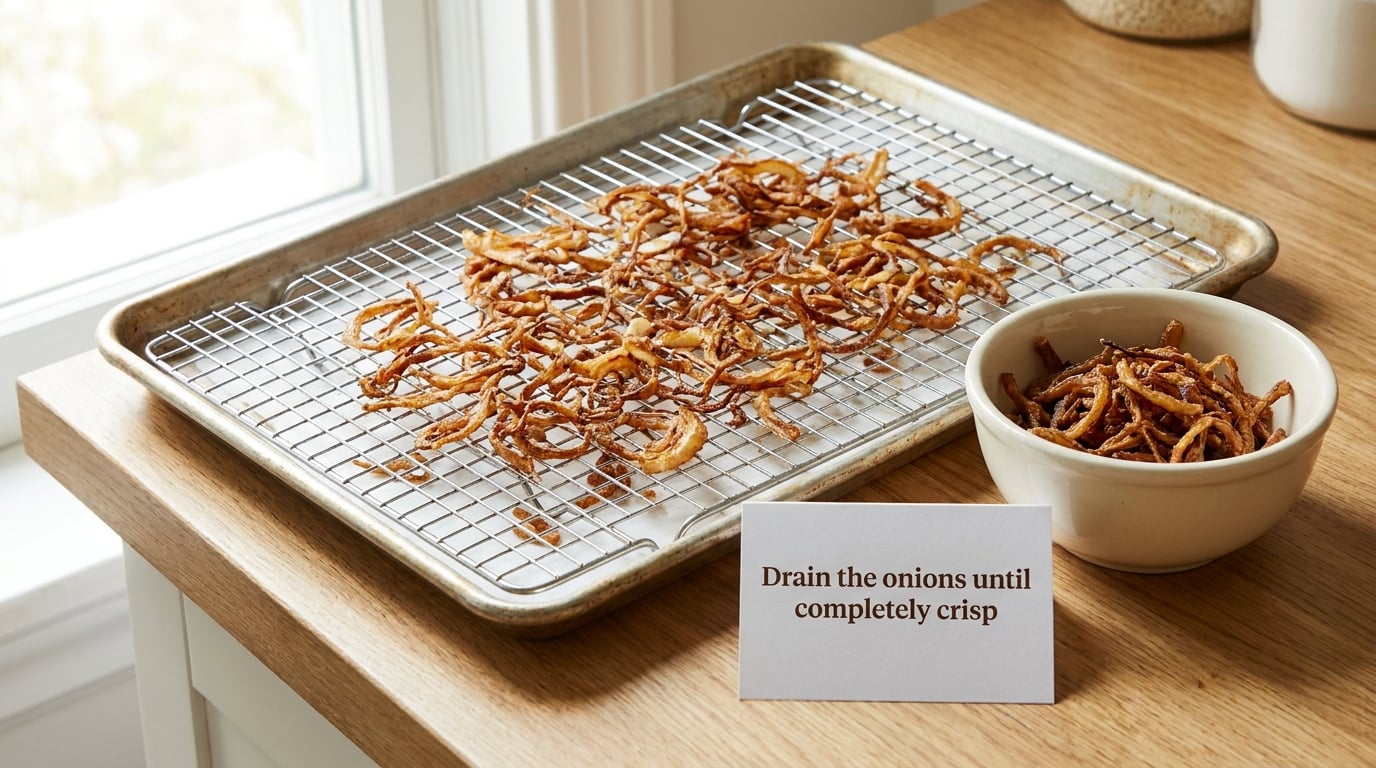
Tilt the skillet and use a slotted spoon or spider to lift the onions out and spread them on the rack in a single layer. Crowding them while they drain steams them, and steamed onions never fully crisp.
Racks beat paper towels because air circulates under the strands. If all you have is paper towels, use two layers and change them often, since oil soaking back into a damp pile softens the bottom pieces.
Leave them fully uncovered. They finish crisping as they cool, and any trapped steam has somewhere to go. Ten minutes on the rack is enough.
6. Store and use the crispy onions
For a cookout, make them up to an hour ahead and store them loosely covered at room temperature. Do not seal them in a container while they are still warm; trapped condensation is what turns a crisp batch limp in 20 minutes.
For later, cool them completely, then refrigerate in an airtight container for 3 to 4 days. Spread a single layer on a baking sheet and freeze solid, then bag it, and you have about a month. Re-crisp in a 350°F oven for 5 to 8 minutes, or 3 minutes in an air fryer at 400°F, with the basket spread in one layer.
On the burger, add the onions last. Put them on after the sauce goes down but before the top bun, and serve immediately. On a hot patty with wet sauce, any topping softens in about two minutes, so nobody should be assembling burgers ahead of time.
Seasoning variations all work after frying: smoked paprika, cayenne, curry powder, dried dill, or a pinch of flaky salt. A drizzle of honey mixed with hot sauce makes a decent buffalo version for chicken burgers.
Common Mistakes
Almost every disappointing batch traces back to one of five things.
- Onions went straight from the bag to the pan. Wet surfaces steam. Rinse, dry, rest, then fry.
- The pan was full. A dense layer drops the oil temperature and the onions soak it up instead of frying. Two or three small batches beat one big one.
- The heat was too low or too high. Too low gives greasy, pale onions. Too high burns the thin edges before the middle cooks. Hold 350°F and adjust, rather than guessing.
- The onions were stirred constantly. Constant stirring slows browning. Every 20 to 30 seconds is plenty.
- They were salted early or stored warm. Salt before frying pulls out moisture, and storing warm onions traps steam. Season right before frying and store only once fully cooled.
One more worth naming: pulling them too early. Pale gold onions taste flat and go limp on the bun. Wait for deep golden brown, and err one shade darker than feels right, since they lighten as they drain.
Frequently Asked Questions
What type of onion is best for crispy fried onions?
Yellow onions are the best all-round choice because their higher sugar content gives you real browning and a sweet finish. Sweet onions like Vidalia work well too, though they need a few extra minutes in the pan. White onions are milder and more delicate, and red onions hold their color and look striking on a burger. Slice whatever you choose as evenly as you can, since uniform thickness matters more for crispness than the variety.
Should I dry the onions before frying them?
Yes, and this is the step that most often separates crisp onions from limp ones. Any surface water turns to steam the instant it hits hot oil, and steam softens the onion and stops it browning. Rinse the slices, pat them thoroughly with a clean towel, then spread them on a second towel or sheet pan for 10 to 15 minutes before they go anywhere near the pan.
Why are my fried onions soggy?
Soggy onions usually trace back to four causes: they went into the pan wet, the pan was overcrowded so the oil temperature collapsed, the heat was too low to drive off moisture, or they were stored while still warm. Fry in small batches, keep the oil near 350°F, and drain on a wire rack uncovered. If you want to bring already-soft onions back, spread them on a rack and blast them in a 350°F oven for 6 to 8 minutes.
How hot should the oil be for crispy onions?
Around 350°F (175°C) is the target. Hot enough that water boils off quickly, cool enough that the sugars in the onion caramelize rather than scorch. Test without a thermometer by dropping one sliver in: it should sizzle loudly and immediately. Weak bubbling means the oil is too cool and the onions will drink it up. Visible smoke means it is too hot and you should pull the pan off the heat for a moment.
What oil is best for frying onion strings?
A neutral, high-smoke-point oil is the right call: canola, vegetable, grapeseed, peanut or sunflower all handle 350°F without smoking or adding flavor. Olive oil breaks down below that temperature and will taste grassy and bitter. For the bare style, where flavor matters more than coating, a tablespoon of butter browned first and the oil added after gives you a nuttier result without sacrificing the smoke point.
Conclusion
Start with the step most recipes bury: slice the onions thin, rinse them, and let them dry properly. Get the oil to 350°F, fry in small batches, and pull them at deep golden brown. Drain them on a wire rack, season while they are still warm, and scatter them on the burger immediately before it gets served.
Once that one method is dialed in, the variations are easy. A full onion takes about 20 minutes, and the finished batch works just as well on hot dogs, green bean casserole, a Cobb salad, or French onion soup.