
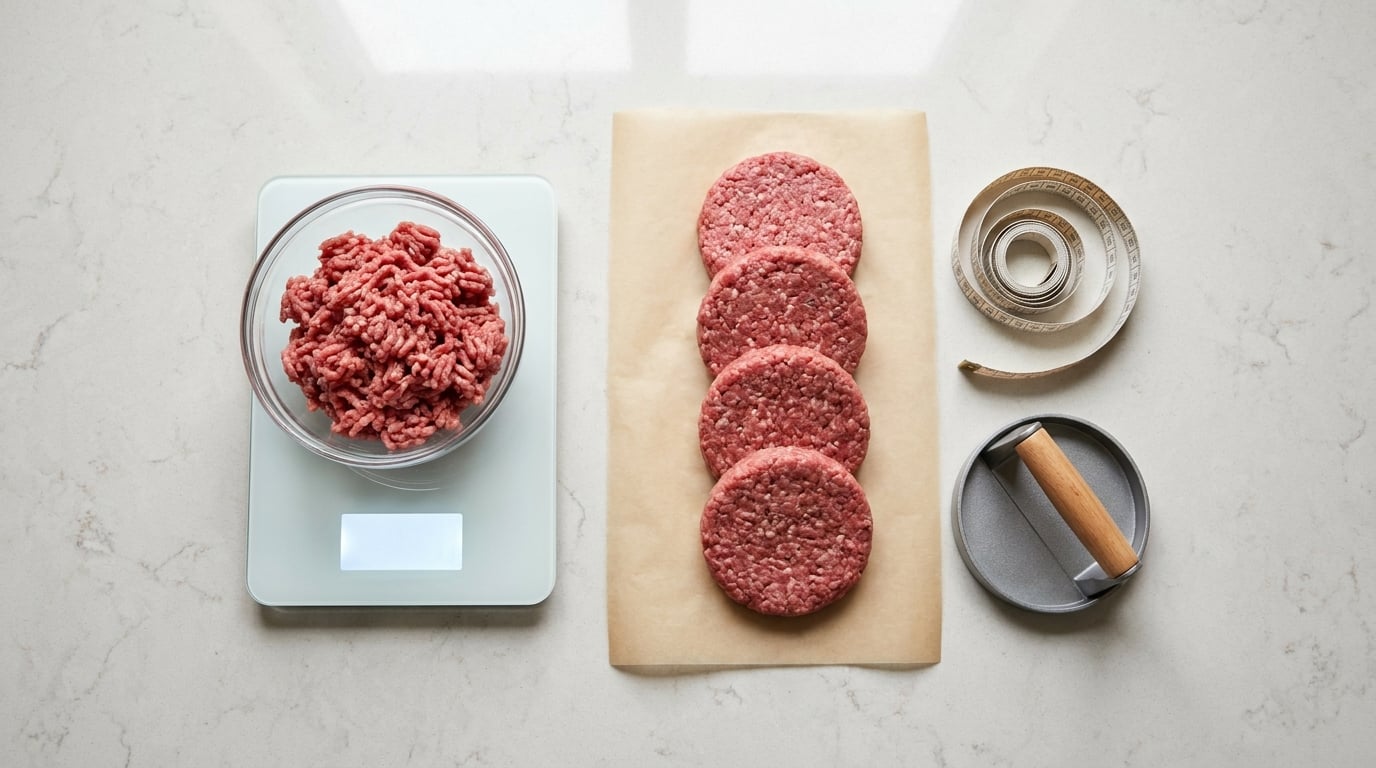
The most reliable way to make burger patties all the same size is to weigh every portion on a kitchen scale, then press each one to the same thickness and diameter. Four ounces or 113 grams is the standard home portion, and 3/4 inch or 1.9 cm thick is the standard thickness.
No scale? A portion scoop, a burger press, or two equal baking sheets pressed together will get you within a few grams from one patty to the next. What you are chasing is simple: equal raw weight, equal thickness, equal diameter.
Here are the five methods, ranked by how exact they are. Jump to whichever fits your kitchen.
- Weigh each portion on a scale. The only method that gives you a repeatable number.
- Measure by volume. A quarter cup of loosely packed meat lands close to 4 ounces.
- Use a burger press. A plunger press fixes the diameter, a cast or stainless press fixes the thickness.
- Press between two equal baking sheets. Zero cost, zero equipment, surprisingly accurate.
- Shape by hand and check against a template. Use a drawn circle or a lid rim as your ruler.
Uniform size is not a cosmetic thing. Heat moves through a patty by thickness, so a 1/2-inch patty and a 1-inch patty from the same batch will never finish at the same time, and they will not shrink at the same rate either. Identical patties cook evenly edge to edge, dome at the same speed, and come off the grill looking like they came from a restaurant rather than a home kitchen.
Table of Contents
- What You Need
- Step-by-Step: How to Make Burger Patties All the Same Size
- How to Keep Patties From Shrinking Unevenly
- Common Mistakes
- Frequently Asked Questions
- How do I make burger patties exactly the same size without a scale?
- What thickness should burger patties be for even cooking?
- Why do my burger patties shrink at different rates?
- How do I keep shaped burger patties from sticking to the counter?
- How much ground meat should I use for each burger patty?
- Can I make equal burger patties ahead of time?
- Conclusion
What You Need
You need very little. The tools below are ordered by how much precision they add, so you can stop wherever your budget and patience run out.
- Digital kitchen scale. The one tool worth buying. A cheap one with one decimal place is plenty.
- Shallow bowl or a piece of plastic wrap. Raw meat should never sit directly on the weighing surface.
- Flat work surface. A cutting board, a clean counter, or a baking sheet.
- Parchment or wax paper. Cut into squares or circles. It stops patties sticking and it lets you stack them for the freezer.
- Optional portion scoop or disher. A quarter-cup scoop is the standard 4 ounce measure.
- Optional burger press. Spring plunger types for speed, cast aluminum or stainless types for thickness control.
- Optional rolling pin or heavy flat skillet. For flattening by hand without a press.
Pick a target weight and a target diameter before you touch the meat. Here is the conversion I use most often, from a 2 ounce slider up to a 12 ounce patty.
- 2 oz slider: 57 g. Raw diameter 2.5 inch / 6.4 cm, cooked about 2.25 inch / 5.7 cm. Fits a mini bun.
- 4 oz patty: 113 g. Raw diameter 4 inch / 10 cm, cooked about 3.5 inch / 9 cm. Fits a standard 3.5 to 4 inch bun.
- 6 oz patty: 170 g. Raw diameter 4.5 inch / 11.5 cm, cooked about 4 inch / 10 cm. Fits a brioche or potato bun.
- 8 oz patty: 227 g. Raw diameter 5 inch / 12.7 cm, cooked about 4.5 inch / 11.5 cm. Fits a large bun.
- 10 to 12 oz patty: 283 to 340 g. Raw diameter 5.5 inch / 14 cm, cooked about 5 inch / 12.7 cm. Fits a split ciabatta.
One ounce equals 28.35 grams. Cooked diameter is an estimate based on typical shrinkage for ground chuck, so treat it as a target rather than a rule.
Six ounce patties are the sweet spot for a lot of home cooks, and salting the meat an hour ahead of shaping helps it bind. It also makes the patty hold its shape on the grill without any binder.
One safety note before you start. Keep the meat cold, below 40 F or 4 C, for the whole shaping session. Warm meat turns sticky, smears on the paper and springs back instead of holding a flat edge. If you are working a big batch, put the unused portion back in the fridge while you portion, and keep a bowl of ice nearby.
Step-by-Step: How to Make Burger Patties All the Same Size
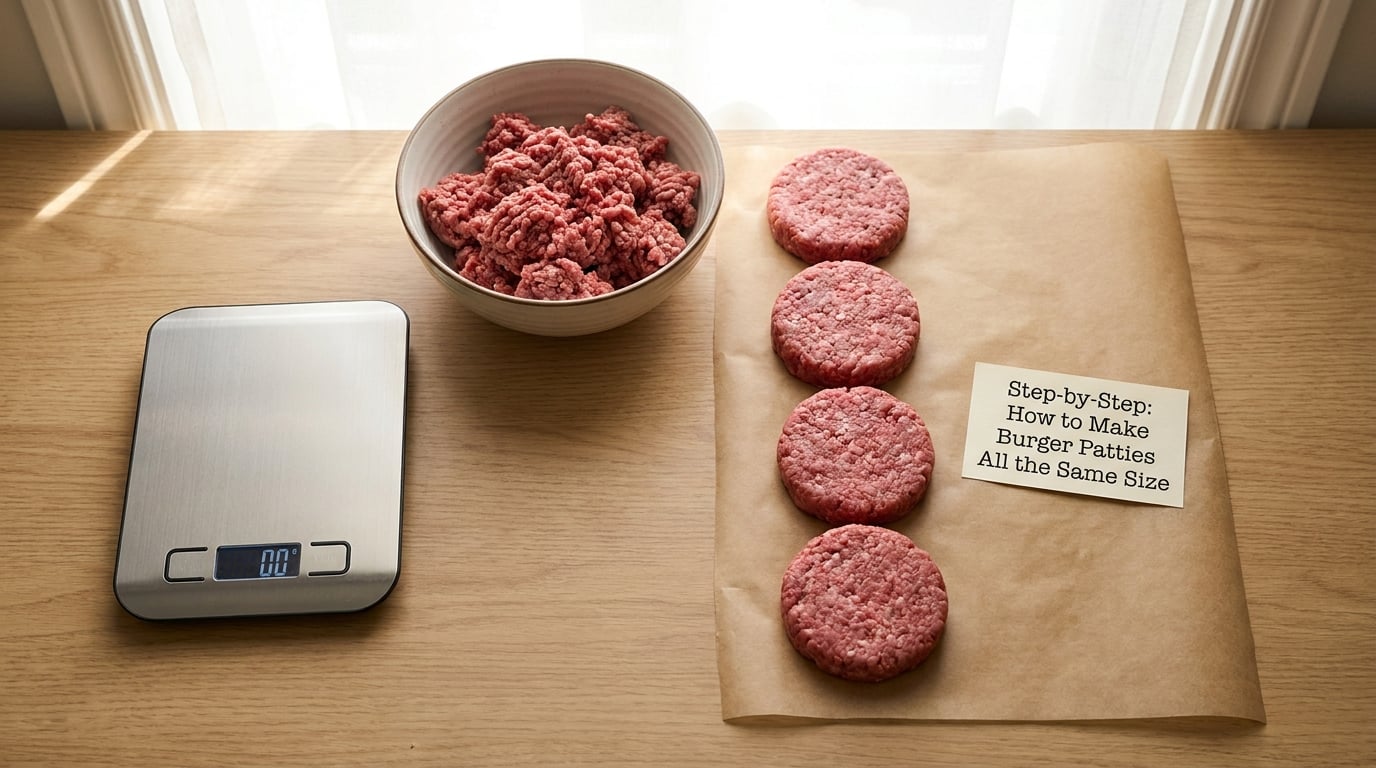
1. Weigh the Total Ground Meat First
Put all the meat on the scale and write the number down. If it reads 5 pounds and 4 ounces, that is 84 ounces total.
Now divide by the number of patties you want. 84 divided by 20 gives 4.2 ounces per patty, and 84 divided by 14 gives exactly 6 ounces per patty. That target number is the whole game. Everything after this step is just hitting it repeatedly.
If you are dividing a large block, do the math in two passes. Split 10 pounds of beef into two 5-pound chunks, weigh each chunk, then work one chunk at a time so the meat never warms up while you shape.
2. Divide the Meat Into Equal Portions
Set a piece of plastic wrap or a shallow bowl on the scale and tare it back to zero. Drop meat into it until the display hits your target, then lift the portion off and set it aside. Repeat.
Adjust the last portion to make the numbers work. If the total does not divide evenly, make one or two patties slightly heavier rather than shaving every patty down. For example, 5 pounds into 6 patties gives you one 4 ounce patty and five 4.33 ounce patties, not six 3.75 ounce patties.
Roll each portion into a ball. Balls are much easier to handle than flat patties, and they chill faster on a tray while you portion the rest.
3. Shape Each Portion to the Same Thickness
Equal weight does not equal equal size. A dense 4 ounce patty can be half the thickness of a loosely packed one, and the thin one cooks in half the time. Thickness is the variable that actually decides how your burgers turn out.
Press each ball to 3/4 inch or 1.9 cm. A rolling pin, the flat bottom of a skillet, or the palm of your hand all work. Check the first one with a ruler so you know what the target looks like, then eyeball the rest against it.
Press a shallow thumb indent in the center of each patty. Without it the patty domes as it cooks and the juices pool in the middle instead of staying in the meat. Keep the edges slightly rounded rather than razor thin, since thin edges dry out and crack first.
Handle the meat gently. Overworked ground beef tightens up and turns springy, which is why a hard knead feels wrong. Tap and pat, do not squeeze.
4. Use a Volume or Ruler Method When Needed
No scale? A quarter cup measure gets you very close. A quarter cup of loosely packed ground meat is about 4 ounces, and a 1/3 cup measure lands near 5 to 5.5 ounces. The catch is that volume is only accurate as long as you pack the meat the same way every time.
For diameter, draw a circle on a piece of parchment with a bowl or jar lid you like the size of, and use it as a stencil. Put the meat inside the line and shave off the overhang. A ruler held across the top of the patty at a set height also works as a quick thickness guide.
The no-purchase press is the two-sheet method. Put a ball of meat between two squares of wax paper, lay a second baking sheet of the same size on top, and press down evenly with both hands. Lift the top sheet, and you have a flat patty with a clean edge every time. It is the trick doing the rounds on social, and it works because the sheet gives you a hard flat surface to press against.
If you want a zero-equipment version of the same idea, roll the meat to about tennis-ball size, sandwich it in wax paper, and press it with any large flat canned good. It sounds like a joke and it produces some very even patties.
5. Check the Batch Before Cooking
Line the patties up in a row on parchment and look at them from eye level. Thickness is easier to judge edge-on than from above, so crouch down and compare the edges. Anything sticking out or sagging gets pressed back into line.
For a batch that really matters, measure one patty. Diameter across the middle and height at the center, then trim the outliers to match. A second trick is to place one patty on top of another; a matched pair will sit flush, and a mismatched pair will wobble.
Make all the corrections before the meat hits the heat. Once they are cooking, you are out of options.
How to Keep Patties From Shrinking Unevenly
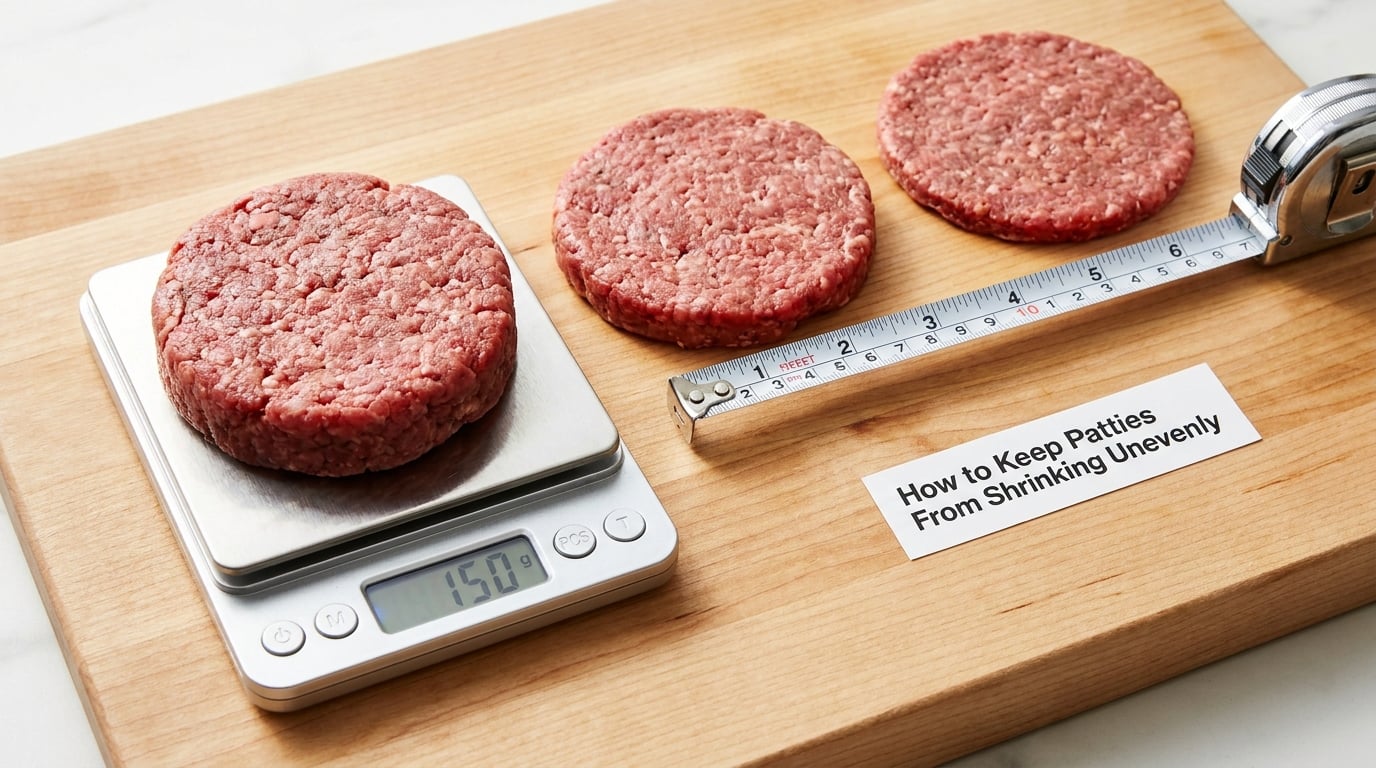
Uneven shrinkage almost always comes down to uneven thickness. Heat drives moisture out of a patty from the surface inward, and a thick center loses that moisture later than a thin edge, so the thick one appears to shrink more even though the edge curled and tightened first.
Other things make it worse. Overworking the meat compacts it, so it loses more water under heat. Very high heat sears the outside before the middle can set, and the patty tightens and pulls in hard. Pressing down with a spatula while it cooks squeezes out the juices that were keeping the patty moist.
Four fixes cover almost every case. Indent the center before cooking. Shape gently and keep the meat cold. Cook over a moderate grill or skillet temperature, and let a patty develop a crust before you move it. Then flip it once, not four times, and stop pressing.
Expect a drop of roughly a quarter of the raw weight on a well-cooked patty, which is why the raw portions need to be a little larger than the finished burger you want. Line cooks working commercial griddles size raw portions at about 4 ounces precisely because the cooked weight comes in lower.
Patties also shrink at different rates if they are different weights. A 4 ounce slider and a 10 ounce patty will not lose the same percentage, so if you are mixing sizes in one batch, expect the small ones to look tighter than the large ones.
Common Mistakes
Portioning by eye. Eyeballing sounds fine until the third patty, which is always smaller than the first. Weigh the first four, then you will be able to eyeball the rest against a reference you trust.
Going too thick or too thin. Anything past 1 inch cooks like a meatloaf and dries out in the middle. Under 1/2 inch burns on the outside before the middle ever cooks through. Hold to 3/4 inch.
Packing the meat firmly. Pressing hard makes a dense patty that shoves out juice on the grill. Pat it into shape instead.
Cooking over intense heat. A screaming hot griddle crusts the outside instantly and the middle cooks unevenly. Medium to medium-high gives you an even cook and browning you can taste.
Comparing raw patties and expecting them to match cooked ones. If your raw patties vary in thickness, the cooked ones will vary more. Match the raw thickness and the shrinkage evens itself out.
Forgetting to rest the finished burgers. Thirty seconds on a warm plate lets the juices settle back into the meat instead of running out on the first bite.
On handling safety: keep raw ground meat cold, wash hands and surfaces after, and cook ground beef to an internal temperature of 160 F or 71 C. Patties formed in advance should stay refrigerated and be used within a day or two, or frozen with paper between each one.
Frequently Asked Questions
How do I make burger patties exactly the same size without a scale?
Use volume and a template together. A quarter cup measure of loosely packed ground meat comes out near 4 ounces, and a 1/3 cup measure lands near 5 to 5.3 ounces. Pack the meat the same loose way every time, then draw a circle on parchment paper with a bowl or jar lid and trim each patty to that line. Two equal baking sheets pressed together over a ball of meat also gives you a flat, even patty with no equipment at all.
What thickness should burger patties be for even cooking?
Three-quarters of an inch, or about 1.9 cm, is the standard target and the number most grilling guides recommend. It cooks through evenly on a home grill, stays juicy in the center, and holds its shape. Anything past 1 inch dries out before the middle cooks, and anything under 1/2 inch burns on the outside. Press a shallow thumb indent in the center of each patty so it stays flat instead of doming.
Why do my burger patties shrink at different rates?
Thickness is almost always the reason. Heat pushes moisture out from the surface inward, so a thick center loses its water later than a thin edge and pulls in harder. Overworked meat compacts and shrinks more, very high heat sears the outside before the center sets, and pressing with a spatula while cooking squeezes out the juice. Equal weight, equal 3/4 inch thickness, gentle shaping and one flip will make a batch shrink at the same rate.
How do I keep shaped burger patties from sticking to the counter?
Work on parchment or wax paper rather than a bare counter or a wooden board, and put a square of paper under every patty as you shape it. A light dusting of cornstarch on the work surface also helps, though it can leave a pale film on the meat. If you are using a press, line the plate with a paper circle every time. Cold meat sticks far less than warm meat, so keep the rest of the batch in the fridge while you work.
How much ground meat should I use for each burger patty?
Most home cooks land on 4 to 6 ounces, or 113 to 170 grams, per patty. Four ounces suits a standard 3.5 to 4 inch bun, and six ounces suits a 4.5 inch brioche or potato bun. Watch the side for a smaller 4.5 inch bun, go to 8 ounces or 227 grams, and hold the raw diameter at 5 inches. A quarter pound is 4 ounces and a third of a pound is 5.3 ounces, so those are the easy fractions to remember when the pack is measured by weight.
Can I make equal burger patties ahead of time?
Yes, and it is the easiest way to guarantee a matching batch. Weigh and shape the patties up to two days ahead, lay them on a tray with parchment or wax paper between each one, and refrigerate them covered. Raw patties keep about one to two days in the fridge, or you can freeze them in a single layer first and then stack them. Cook from chilled straight on a hot griddle, and add a minute to the cook time for frozen patties.
Conclusion
Weigh the whole batch of meat, divide that number by the patties you want, and hit that same target weight every time. Then press each portion to 3/4 inch and 4 to 4.5 inches across, with a thumb indent in the middle.
Start by weighing just one serving before you commit to the full batch. It takes five minutes and it sets the number everything else follows. Once you see one correct patty, you have a reference for the other four methods too.