
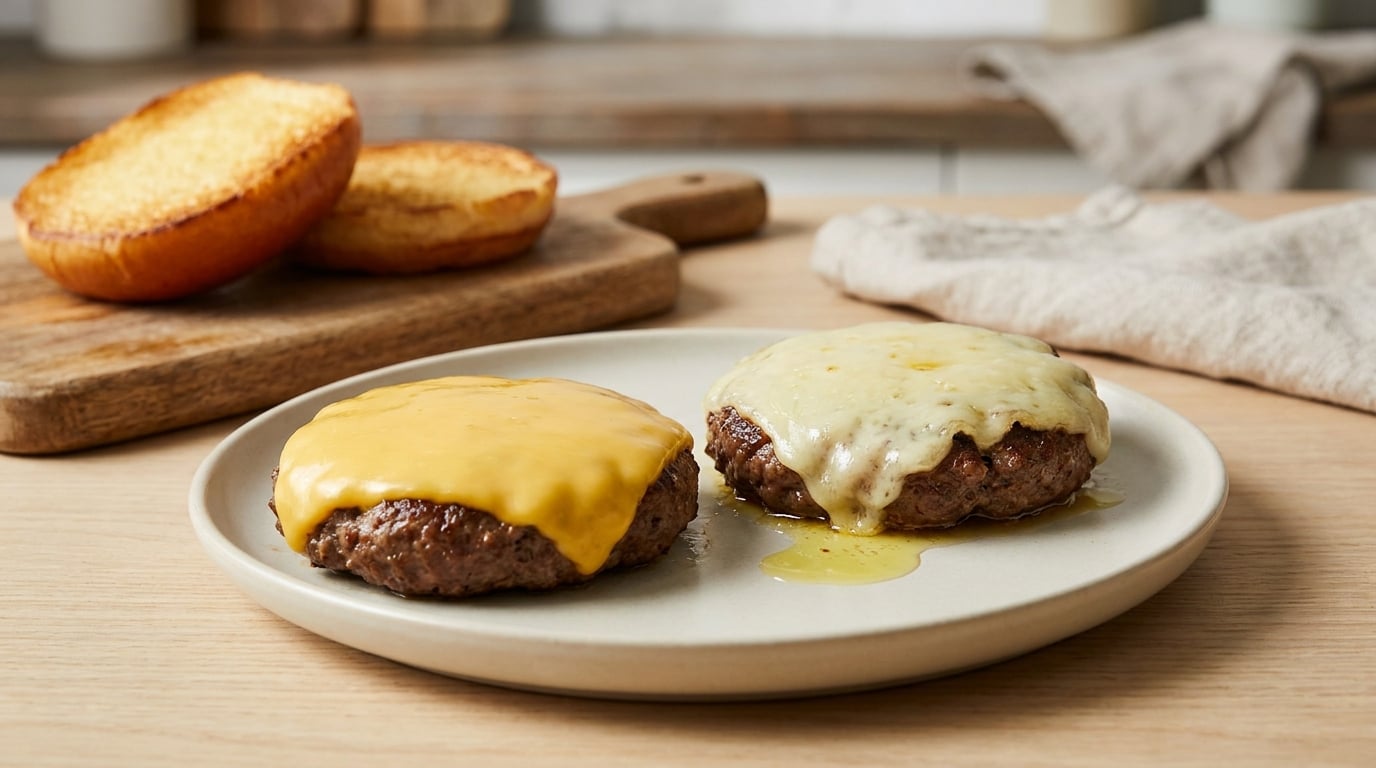
American cheese is the better choice for a thin smash patty because it melts evenly in seconds and never breaks into an oily slick. Sharp cheddar wins on a thick grilled burger, where its tangy, aged flavor is the whole point. If you want both, use a slice of American as the melt base and add cheddar on top.
That is the short version of american cheese vs cheddar on burgers. The long version is that the two cheeses are built for completely different jobs, and the right one depends on how thick your patty is, how hot your surface gets, and whether you want the beef or the cheese to be the loudest thing on the plate.
I have cooked both on the same weeknight smash patty more times than I care to admit, and the difference is not subtle once you are looking for it. One drapes. The other pools, tightens, and pulls at the bun.
Table of Contents
- American Cheese vs Cheddar on Burgers at a Glance
- Flavor: Which Cheese Tastes Better on a Burger?
- Melt: Which Cheese Covers a Burger Better?
- Texture: Which One Stays Smoother?
- Browning and Crisping: Which Cheese Handles Heat Better?
- Best Uses for American Cheese on Burgers
- Best Uses for Cheddar on Burgers
- How to Choose the Right Cheese for Your Burger
- Which Should You Choose?
- Frequently Asked Questions
- Bottom Line
American Cheese vs Cheddar on Burgers at a Glance
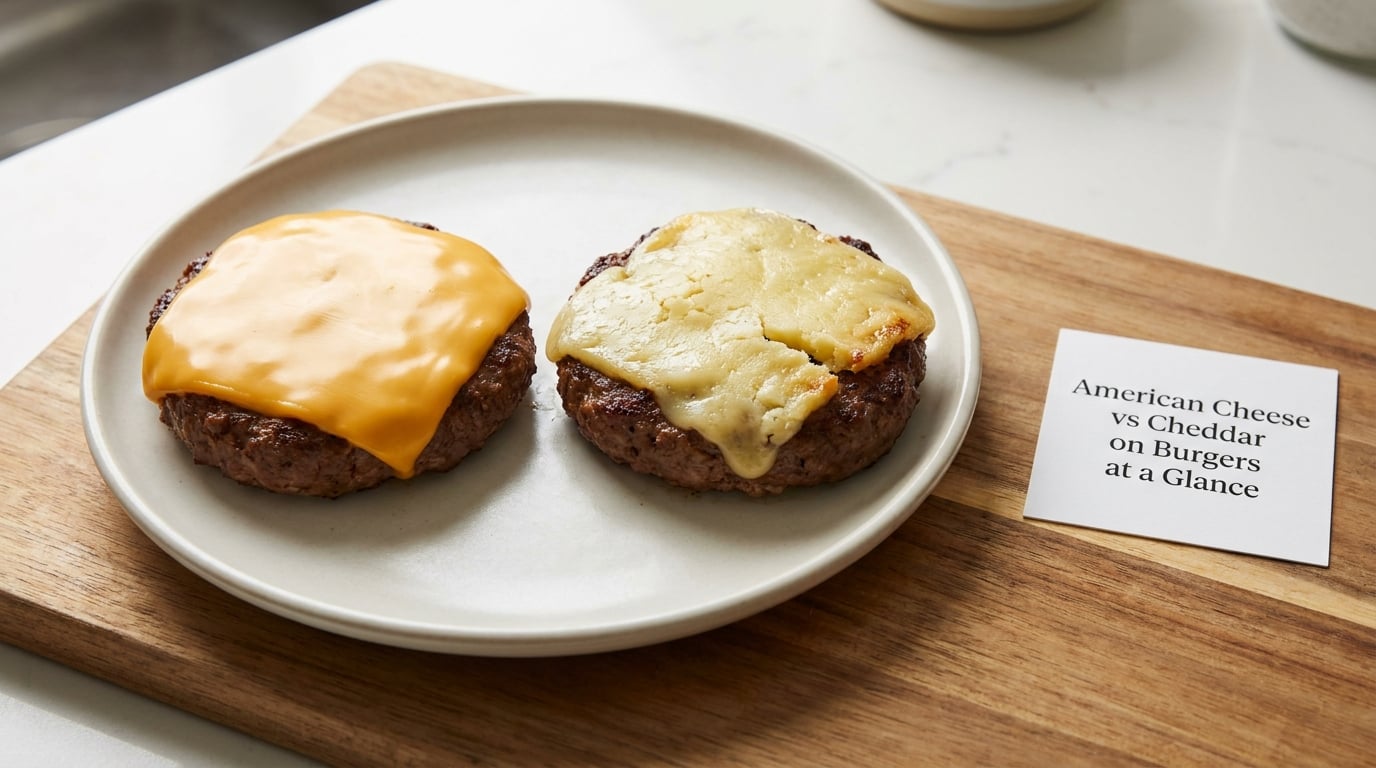
| Criterion | American cheese | Cheddar |
|---|---|---|
| Flavor | Mild, buttery, slightly tangy and salty | Nutty to sharp and tangy, aging adds complexity |
| Melt speed | Melts in roughly 20 to 30 seconds off residual heat | Takes sustained direct heat, often 45 to 60 seconds |
| Coverage | Drapes edge to edge in a thin even layer | Softens in patches, often misses the corners |
| Texture when melted | Creamy, smooth, glossy, mildly stretchy | Silky when hot, can turn rubbery as it cools |
| Fat behavior | Stays emulsified, no fat slick | Can release oil and pool on the griddle |
| Browning | Browns and crisps fast at the edges | Browns more slowly, tightens and pulls away |
| Sharpness range | One consistent mild profile | Mild, medium, sharp, extra sharp |
| Sodium per serving | About 300 mg for one 21 g slice | About 180 mg for a 35 g slice of sharp cheddar |
| Calories | Around 70 per single slice | Around 115 per ounce |
| Best for | Smash burgers, diner-style cheeseburgers, kids, carryout | Thick grilled patties, double stacks, open-faced melts |
| Watch out for | Can read as plasticky or bland to sharp palates | Grainy clumps, oil slick, sliding off the patty |
Those numbers are typical label values, and they matter more than most people expect. A single American slice carries roughly as much sodium as a slice of sharp cheddar does, even though the slice is smaller, which surprises people who assume processed means the heavy lifting on salt.
Flavor: Which Cheese Tastes Better on a Burger?
American cheese tastes like dairy in its most friendly form. It is a blend of real cheese, usually cheddar and Colby, loosened with milk or whey and bound with emulsifying salts, then seasoned to taste roughly like mild cheddar. The result is soft, buttery and faintly tangy, with a saltiness that reads as savory rather than sharp.
Cheddar tastes like cheese in its most specific form. It is a natural cheese made from milk, cultures, rennet and salt, then aged anywhere from a few months to several years. That aging builds the tang and the crystalline crunch that people mean when they say a cheese has character.
On a burger, the two do different jobs with the beef. American steps back and lets a thin patty taste like beef. Cheddar steps forward and becomes half the sandwich.
American Cheese vs Cheddar on Burgers: The Flavor Difference
On a plain smash burger with pickles and nothing else, American is the better flavor call. There is barely any fat or sauce to carry flavor, so a mild melt lands as clean and savory rather than as a cheese-flavored patty.
On a bacon cheeseburger, the logic flips. Bacon brings salt and smoke of its own, and the burger is usually built with a sauce, so mild cheddar layered on top has something to sit against. That is the version where the cheese flavor reads as a bonus instead of a distraction.
On a spicy burger with jalapenos, charred onions and a hot sauce, sharp or extra sharp cheddar is at home. The heat and the tang amplify each other, and a mild cheese would get swallowed whole.
Cooks complain all the time that cheddar tastes too strong and sandwichy on a homemade patty. That reaction is common, and it is not a mistake on their part. Sharp cheddar on a lean 90/10 patty with no toppings is a lot of cheese flavor for a small amount of meat to balance.
The bun matters too. A soft potato bun mutes sharpness and amplifies melt. A toasted sourdough or brioche slice adds its own tang, which pushes a mild or medium cheddar toward tasting sharp whether it is or not.
Melt: Which Cheese Covers a Burger Better?
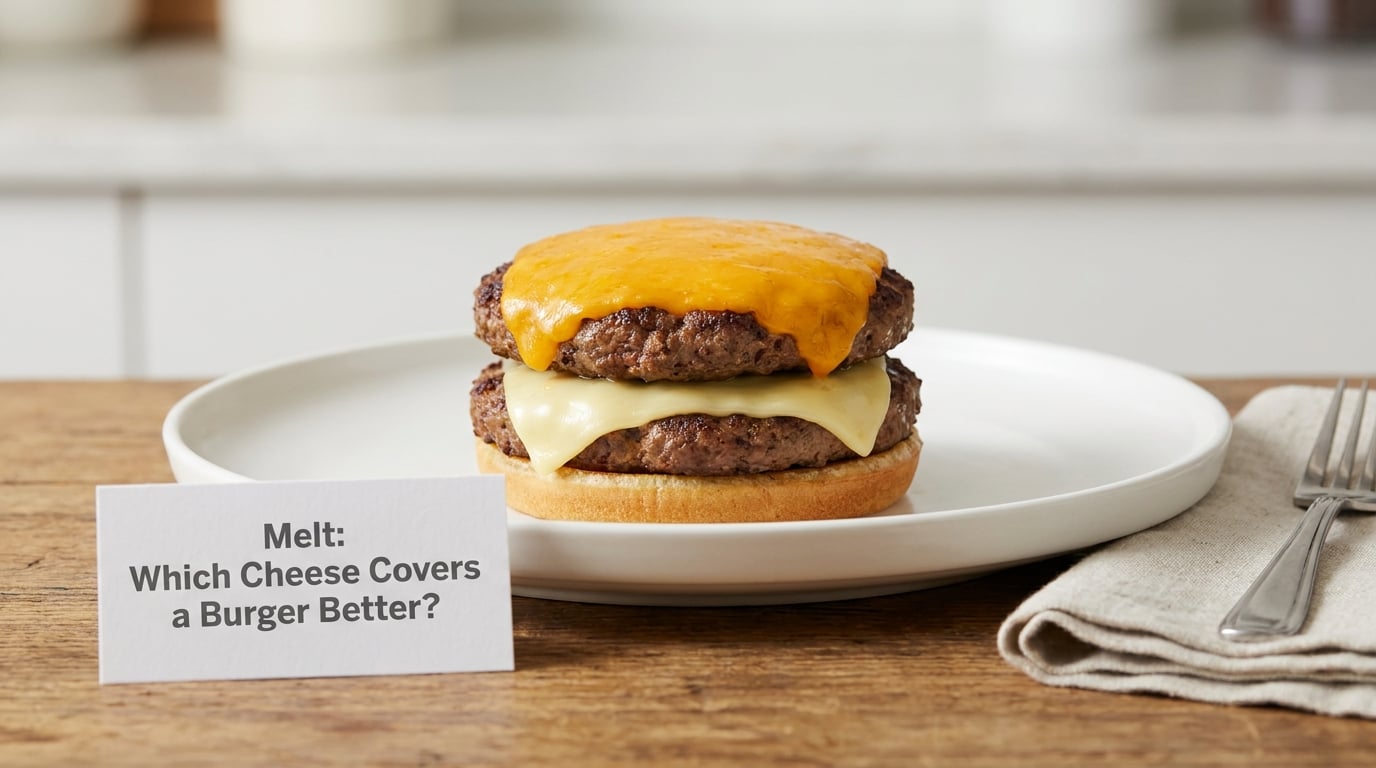
American cheese covers a burger better. That is the single clearest difference between the two, and it comes down to what is holding the cheese together.
Natural cheddar is mostly a casein protein matrix with fat embedded in it. Cheddar is also relatively low in fat and fairly firm, so heat has a harder job: it has to break down the casein structure before the cheese softens. By the time the middle gives way, the fat has already liquefied, and you get a rubbery curd sitting in an orange slick.
American cheese gets around that with emulsifying salts, most often sodium citrate or sodium phosphate. Those salts interact with the casein and break it into smaller water-soluble fragments that keep the fat and water suspended in one uniform emulsion. The practical effect is that the slice softens at a lower temperature, spreads instead of shrinking, and stays glossy when it cools.
That is also why a slice of American laid on a patty that just came off a hot griddle will be fully melted within about half a minute without any extra heat at all. The residual heat in the beef is enough. Cheddar on the same patty at the same moment will still have firm spots in the middle.
When is a visible cheese layer the right goal? When you are building a double cheeseburger and want two distinct slices, when the patty is thick enough to hold a slab, or when you want the cheese to be the texture rather than the flavor. A melted-to-nothing American layer is ideal on a thin patty and wrong on a tall pub-style burger.
Texture: Which One Stays Smoother?
American stays smoother through the whole arc of a burger, from griddle to bun to the first few bites. It is creamy rather than stringy, and it stays soft as the patty cools because the emulsion does not re-harden the way a cheddar curd does.
Cheddar is silky while it is genuinely hot, which is a nicer texture than most people give it credit for. The trouble starts as it cools. A slice that looked creamy on the griddle can turn tacky and then rubbery within a couple of minutes, especially a low-fat or reduced-fat slice, which has less fat to keep it supple.
Texture is also where people notice the sogginess problem. American, melted thin, will not steam the bun on its own. Two slices of thick cheddar on a double will trap steam between the patty and the bread, and a slippery bottom bun is the most common complaint in burger threads about either cheese.
One thing both cheeses do is slide. Cheese pulls the top bun off the patty if you close the burger too early. Build on the flat top, then cap it, and give the sauce a minute to settle before you pick it up.
Browning and Crisping: Which Cheese Handles Heat Better?
American handles high heat better because it is engineered to. A thin slice laid on a very hot flat top browns and crisps at the edges in a way that reads as a fried cheese crust, which is exactly what diner cheeseburgers are going for.
Cheddar browns more gradually and behaves less predictably under direct heat. It tightens as it cooks, so a slice that covered the patty at first can pull at the corners and leave bare spots. It also releases oil sooner, and that oil is what browns, so the patty underneath picks up a fried color rather than a toasted cheese color.
There is a real upside to that. A slice of sharp cheddar left on a hot griddle for a few seconds per side will brown and crisp like a classic grilled cheese, and sandwiched into a patty it gives you a crunch line that American never quite produces.
Direct flame is a different story again. On a charcoal grill, American cheese tends to scorch before it melts because it hits its melting point and its browning point at nearly the same time. Cheddar handles a flame better but needs a lid to trap steam. On cast iron, both brown fast, so keep the heat lower than you think and watch the patty, not the cheese.
Best Uses for American Cheese on Burgers
American cheese earns its place on four kinds of burger.
Smash burgers. This is its best case. Ball the meat, press it hard on a screaming hot flat top for about 60 to 90 seconds, scrape, flip, and lay a single slice on immediately. The cheese will be fully melted by the time the second flip is done, and it will not fight the crust.
Diner-style cheeseburgers. One slice, thin, no toppings that add water, and a toasted bun. This is the configuration the cheese was designed around, and it is why fast food chains standardize on a processed slice rather than a block of cheddar.
Barbecue and hot-sauce burgers. A mild, salty melt balances a tangy sauce instead of competing with it. If your burger is already doing a lot of flavor work, American is the quieter cheese.
Carryout and delivery. This is the least obvious win. Melted American holds its texture when it cools, so a burger that sits in a bag for 20 minutes is still worth eating. Melted cheddar reheats separated and slick, which is a big part of why the same cheese looks different in a restaurant than in a takeout bag.
On slice count, one slice per patty is the standard. For a double, put one slice on each patty rather than two slices on one patty, so you get two melted layers instead of one thick slab.
Best Uses for Cheddar on Burgers
Cheddar earns its place on burgers where the patty can carry it.
Thick grilled patties. A 3/4 lb patty cooked to medium has enough beef character to stand next to a sharp slice. This is the burger most often built with cheddar, and the one where the cheese flavor is the point.
Double stacks. Two patties, one slice each. Mild or medium cheddar keeps the stack readable, and you avoid the dense, rubbery center that comes from stacking slices on a single patty.
Open-faced melts and loaded patty burgers. A thick slice on a smashed patty, run under the broiler briefly with caramelized onions, is where cheddar shines as texture rather than as a layer.
Where sharp aged cheddar is the wrong call: on a lean thin patty, on a burger eaten outdoors in the heat, or on a kids’ plate. Extra sharp in particular tends to taste like a sandwich rather than a burger, and the sharpness flattens everything around it.
Two techniques fix most cheddar problems. Shred it from cold and melt it slowly with a lid on, or drape slices over the patty and cover the whole burger for 20 seconds so the trapped steam finishes the melt. Grating pre-melted cheese is what produces grainy clumps, because the shreds are already softening unevenly before they hit the heat.
How to Choose the Right Cheese for Your Burger
Five questions settle it in about ten seconds.
How thick is the patty? Thin patties need American. Thick patties can handle cheddar.
How loud is everything else on the burger? Bacon, hot sauce, blue cheese, jalapenos or a strong house sauce push you toward mild or medium cheddar. Pickles, onions, lettuce and tomato, or a plain patty, push you toward American.
How hot is the surface, and how long will it sit? Fast and hot favors American. A gentler cook with a lid and a minute of patience favors cheddar.
Who is eating it? American for kids, picky eaters and anyone who describes cheese as a texture. Cheddar for people who want to taste the cheese.
Is it traveling? American. Melted cheddar does not come back from a carryout bag the way it went in.
On timing, add American within about 15 seconds of the final flip and cap the burger immediately. Add cheddar right after the flip too, but give the patty another 20 to 30 seconds of cooking so there is enough heat left to do the work.
Label reading matters more than brand loyalty for American. A slice that is pasteurized process cheese is emulsified and melts reliably. A product labeled as a process cheese food with less real cheese in it tends to be thinner and slickier, and a one-pound block of American is a different tool altogether. Among singles, more real cheese generally means a better flavor, and there is no settled consensus on which brand wins, so buy two and compare.
Which Should You Choose?
Choose American cheese when the patty is thin, the cook is fast and hot, the toppings are mild, or the burger has to survive a trip. Choose cheddar when the patty is thick, the cook has a few extra seconds, and you want the cheese to be one of the main flavors.
Choose both when you want the melt and the flavor. Put a slice of American on the patty for the even layer, then add a slice or a small handful of sharp cheddar on top just before you cap the burger. The American softens first and gives the cheddar something to sit in, which is the practical fix for cheddar that will not cooperate on a single thin patty.
One more note on the plastic question, since it comes up constantly. American cheese is not plastic, but it is also not a block of cheese. Under FDA standards, a product sold as pasteurized process cheese is at least 51 percent real cheese, with the rest milk, whey or milk protein concentrate, emulsifying salts, salt and seasoning. Anything with less real cheese in it is labeled process cheese food or spread, with a lower floor. If the first ingredient is not a cheese, that tells you the ratio.
Frequently Asked Questions
Which cheese melts better on a burger?
American cheese melts better. Its emulsifying salts, usually sodium citrate or sodium phosphate, soften the slice at a lower temperature and keep the fat and water in one uniform emulsion, so a single slice drapes over a hot patty in about 20 to 30 seconds and stays glossy as it cools. Cheddar needs longer direct heat, softens in patches, and releases oil once the casein structure breaks down.
Does cheddar or American cheese make a burger greasier?
Cheddar is more likely to. Natural cheddar is relatively low in fat with the fat held inside a casein matrix, so once that structure breaks under heat the fat liquefies and pools on the griddle. American cheese keeps the milkfat dispersed in microscopic droplets, which is why it does not sweat or leave a fat slick. Shredded cheddar cooked on a very hot flat top is the worst case for greasiness.
Is cheddar better than American cheese for a double cheeseburger?
For a double cheeseburger, put one slice on each patty rather than two slices on one. American is the safer choice if the patties are thin and the cook is fast, since each slice melts evenly and does not pull the bun off the stack. Cheddar is the better choice if the patties are thick and you want sharp flavor, but go mild or medium rather than extra sharp so the stack does not collapse into rubber.
Can you use American cheese and cheddar on the same burger?
Yes, and it is the most reliable way to get an even melt with real cheese flavor. Put a slice of American on the patty first so it softens and covers edge to edge, then add a slice of sharp cheddar or a small handful of shreds on top just before you cap the burger. This is also the practical fix for cheddar that will not melt evenly on a thin patty.
What is the best cheese for smash burgers?
American cheese, by a wide margin. A thin smash patty cooks in 60 to 90 seconds a side and has almost no fat of its own, so it needs a cheese that melts instantly and evenly without competing for attention. Lay one slice on right after the flip, cap the burger, and the residual heat finishes the job while you toast the bun.
Bottom Line
Start with processed American cheese if you want a smooth, even melt and the classic burger flavor, and move to cheddar when pronounced cheese flavor is the priority on a thicker patty. Cook the patty first and add the cheese at the last possible moment, and either one will land well.