
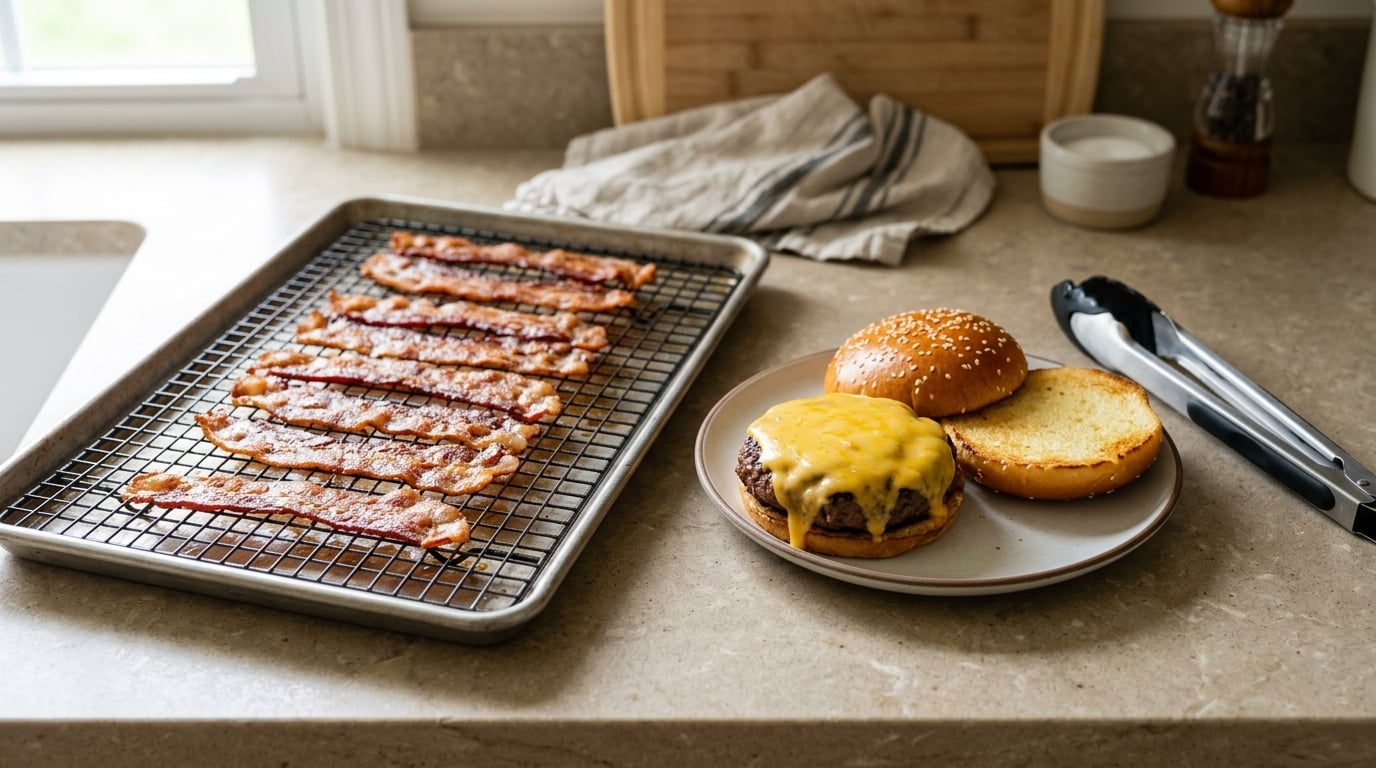
The reliable way to cook bacon for burgers evenly is to bake it in a single layer at 400F, spaced so no two strips touch, and check it from the 15-minute mark until the fat is translucent and the edges are crisp. Standard-cut strips take about 18 to 22 minutes; thick-cut needs 22 to 28.
That is the whole trick, and it is easier than most people make it sound. A hot pan with a crowded pile of bacon gives you burnt strips next to pale ones, because the meat hits a searing surface before the fat has had time to melt away. An oven with airflow and space gives every strip the same gentle, even heat.
The part people forget is timing. Bacon goes from perfect to ruined in about two minutes, and it keeps cooking after it leaves the oven. So the real skill is knowing when to start it relative to your patties.
What You Need
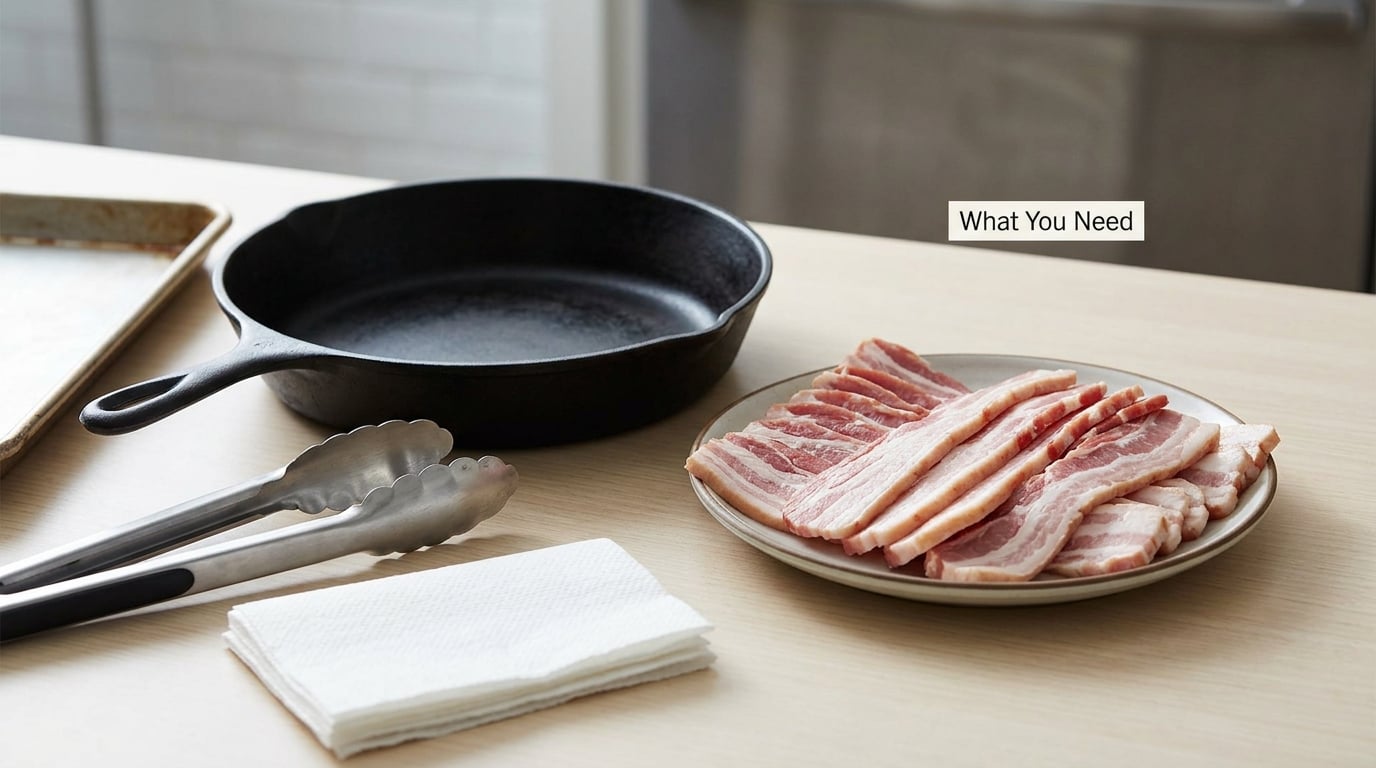
You need very little, and most of it you already own. The pan matters more than the bacon, honestly.
- A rimmed baking sheet or sheet pan. A flat surface is what stops the strips curling into tubes. Skip the deep casserole dishes; bacon needs to lie flat.
- A wire cooling rack that fits inside the sheet pan. This is the single biggest upgrade for even cooking. Fat drips off the underside instead of pooling under the strip, so the bottom renders and crisps like the top rather than stewing in its own grease.
- Parchment paper or aluminum foil for the liner. Parchment is easier to lift; foil is better if you want to fold the edges up and contain splatter.
- Tongs for turning and lifting. A slotted spatula works too, but tongs keep the strip flat.
- Paper towels on a plate or on a second rack. Draining is not optional if you want crisp bacon in a bun.
On the bacon itself, pick thick-cut or standard-cut rather than thin-cut. Thin strips go from done to charred in under a minute and there is no margin for error. If you are using smoked bacon, sort the strips by length and put the long ones at the edge of the pan where they will sit first.
Seasoning is optional. A light sprinkle of black pepper and a pinch of smoked paprika before cooking works well, and a small brush of maple syrup in the last three minutes gives you sweet edges without burning the sugar.
Step-by-Step: How to Cook Bacon for Burgers Evenly
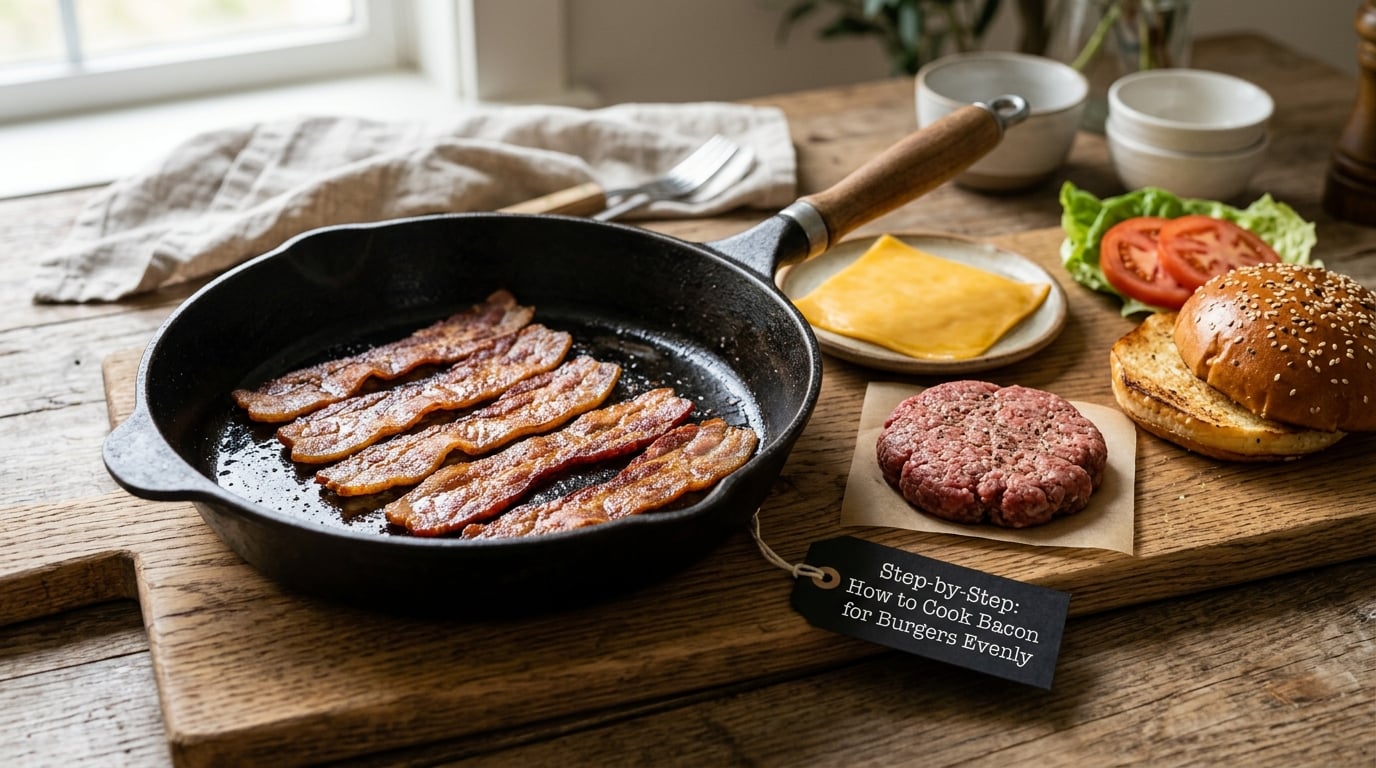
Three rules produce an even batch. Keep them in your head and almost any method works: one consistent heat source, one single layer, and enough space between strips that nothing curls into its neighbour.
How to Cook Bacon for Burgers in a Skillet
The stovetop is faster, which makes it the right call when you are cooking four burgers and out of time. It is also the easiest way to get a batch uneven, so go slowly.
- Start at medium-low and let the pan warm. Put your strips in a cold, dry cast-iron skillet if you want the gentlest possible start. A screaming-hot pan sears the stripes before the fat renders, and that is where the burnt edges come from.
- Add the bacon in a single layer with a finger’s width between strips. If the strips touch, they cook as one lump. Cook in batches if you must; three good strips beat eight crowded ones.
- Cook 4 to 6 minutes without touching them. You are waiting for the fat to melt and run clear, not for browning. The strips will shrink and straighten as they render, which is exactly what you want.
- Turn with tongs and cook 2 to 3 minutes more. Use lower heat than feels right. If the fat stops sizzling, nudge the burner up; if the edges darken before the middle crisps, take it down.
- Drain on paper towels immediately. A hot pan keeps cooking a strip through carryover cooking, so resting it on a hot burner or a warm plate pushes it past what you wanted.
If you want crisp fat and tender lean with no guesswork, there is a water-start version. Lay the strips in a cold skillet, add enough water to come about a quarter inch up the sides, bring it to a boil, then drop the heat to medium until the water evaporates. The bacon cooks gently in the water, then crisps in its own rendered fat. It takes about five minutes longer and it is very hard to ruin.
How to Cook Bacon for Burgers in the Oven
This is the method I use for more than four strips, and the one that scales to a cookout. The oven gives you one even heat source instead of a hot spot under each burner, and your hands stay free while the patties cook.
- Heat the oven to 400F. If you have convection, use it and drop the time by about 3 to 4 minutes. Do not line the tray with a silicone mat; bacon needs a hard, flat, heat-tolerant surface.
- Set a wire rack inside a lined sheet pan. This is the step people skip, and it is why their bacon is crisp on top and chewy underneath.
- Lay the strips in a single layer with space between them. Every strip should have air on both sides. If the pan is crowded, the middle strips steam and the outer ones scorch.
- Check at 10 minutes and turn each strip with tongs. One flip levels out a hot spot in the oven. At 15 minutes the fat will be translucent and the lean will have firmed up, so start checking every 2 minutes from there.
- Pull at 18 to 22 minutes for standard-cut. Done means the fat is fully transparent and crisp and the lean is cooked through. If you want the extra-crisp edge, move the pan under the broiler for 30 to 60 seconds and watch it the entire time.
- Drain straight onto paper towels. Transfer with tongs, not a spatula, and spread the strips so they do not steam each other.
| Bacon cut | Conventional oven, 400F | Convection, 375F | Stovetop, medium-low |
|---|---|---|---|
| Thin-cut | 12 to 15 min | 10 to 12 min | 3 to 4 min per side |
| Standard-cut | 18 to 22 min | 15 to 18 min | 4 to 6 min per side |
| Thick-cut | 22 to 28 min | 18 to 22 min | 6 to 7 min per side |
Two more ideas worth knowing. First, the cold-oven start: put the pan of raw bacon into a cold oven, then set it to 400F and close the door. The gentle ramp means the fat has time to render before the heat gets serious, and the result is flatter, more even strips. Check from 20 minutes, then every 3 minutes after.
Second, the bacon weave for a burger that holds together. Lay strips in a lattice on a sheet pan, bake until crisp, then cut the wafer into squares, one per burger. It stops a stack of bacon and cheese from sliding out at the first bite.
Common Mistakes
Strips of different thickness in the same batch. This is the most common cause of uneven cooking and no oven setting fixes it. Sort the pack before you start, cook the thick ones a couple of minutes ahead, or just accept two batches. That is a real answer, not a cop-out.
Crowding the pan. Touching strips cook as one block: the underside steams, the top burns, and the middle stays pale. Two sheets of six beat one sheet of twelve every time.
Heat too high. Bacon renders at a low temperature. Sear it hard and the lean meat cooks before the fat leaves, so you get charred edges wrapped around chewy, greasy strips.
Letting it curl. Curl comes from uneven thickness and from the protein band. Flat weight keeps strips down, and a wire rack lets anything that does lift dry out on the underside rather than fry in a puddle.
Leaving it on the hot pan. A cast-iron skillet at 400F keeps cooking a finished strip for another two minutes. Move it to a plate, not back to a warm burner.
Soggy bacon in the bun. Two causes. Undrained grease pools under the strip and softens the bun within a minute, and bacon left out too long reabsorbs moisture. Drain on paper towels, then add it to the burger in the last 60 seconds before you close the bun.
Getting the timing wrong against the patties. Ground beef should hit 160F in the centre, which usually takes 3 to 4 minutes a side depending on thickness. Start the bacon so it comes out about 2 minutes before the patties rest, then hold it on a rack over a warm tray, not in a pile. For a cookout, cooked bacon keeps well covered at room temperature for up to 2 hours; beyond that, refrigerate it and re-crisp in a hot pan or under the broiler for 2 minutes.
Do not put raw bacon into the pan with raw patties and walk away. Bacon needs a long, gentler cook than a seared patty, and raw pork and raw ground beef in the same pan puts the low-temperature meat over a surface you need at high heat for the beef. Cook the bacon first or in the oven alongside.
Frequently Asked Questions
What is the best way to cook bacon evenly?
The oven wins. Heat the oven to 400F, set a wire cooling rack inside a sheet pan, lay the strips in a single layer with space between them, and bake 18 to 22 minutes for standard-cut bacon. Check from 15 minutes. The rack lifts the rendered fat away from the underside so both sides crisp instead of the bottom stewing.
Is it better to bake bacon at 350 or 400?
400F for a burger cook. At 350F you are looking at 25 to 30 minutes and more spread-out results, because the gentler heat lets moisture linger longer. At 400F the fat renders faster, the strips shrink flat, and you get crisper edges in less time. Drop to 375F if you are using convection, since the fan already adds heat.
Is 20 minutes at 400 enough to cook bacon?
For standard-cut bacon, yes, 20 minutes at 400F is right in the sweet spot. Thin-cut is done around 12 to 15 minutes and thick-cut needs 22 to 28. Rather than trust the clock, watch for the fat turning fully translucent and crisp with the edges browning, and start checking at 15 minutes.
Should I flip bacon while it cooks?
Yes, once, at about the 10-minute mark in a 400F oven, using tongs. Flipping equalises the two sides when your pan has a hot spot, and it is the quickest fix for a batch where some strips are browning faster than others. One flip is plenty, and more handling makes the strips break and curl.
Can you cook bacon and burgers in the same pan at the same time?
Not raw, together. Bacon needs a long gentle cook while a patty needs a hard sear, and the temperatures do not get along. Cook the bacon in the oven or a skillet first, drain it, then sear the patties. You can absolutely time both so they finish within a minute of each other.
How do I cook bacon ahead of time for a party?
Bake a full single layer earlier in the day, drain the strips on paper towels, then store them in an airtight container in the fridge, separating the layers with parchment. Spread a batch on a rack and let the residual heat escape for ten minutes, then keep it covered at room temperature for up to two hours. Re-crisp under the broiler for two minutes if it softens.
Conclusion
The most reliable method is the oven at 400F with a wire rack and a single spaced layer, checked every couple of minutes from 15 minutes onward. Start it about 2 minutes before your patties need to rest, and drain it on paper towels so it stays crisp in the bun.
First thing to do: sort your strips by thickness, set the rack in the pan, and space the bacon out properly. That single spacing decision solves most of the uneven batches people complain about.