
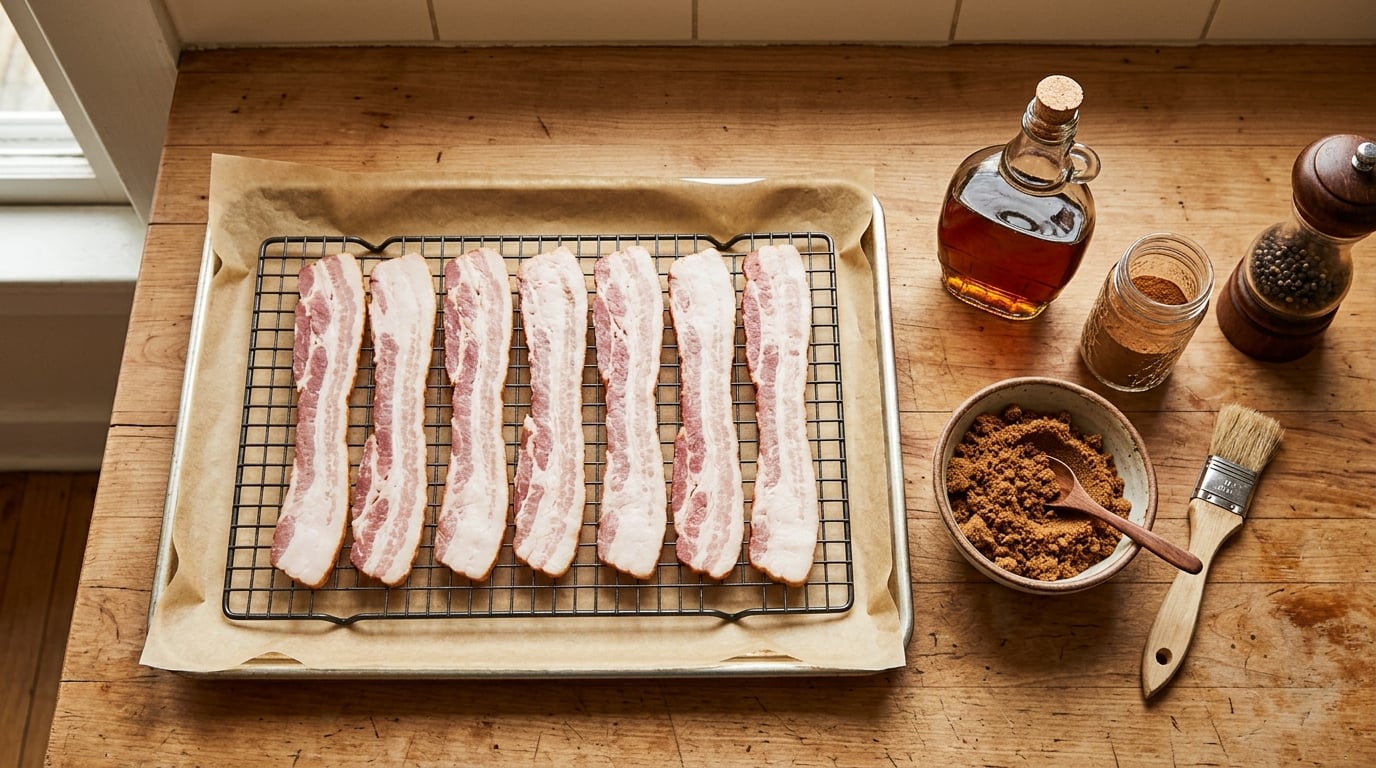
Candied bacon is oven-baked bacon strips coated in brown sugar, usually mixed with maple syrup and warm spices, that caramelizes into a glassy, sticky-sweet shell over salty, smoky bacon. To make candied bacon you need three things working together: bacon with some fat left on it, a thin even layer of brown sugar, and a rack that keeps air moving under the strips.
From prep to serving takes about 35 minutes, and the whole thing happens in one pan. The only real trap is heat: sugar caramelizes and starts to burn well before the bacon is as crisp as you’d like, so the method below leans on visual cues rather than a timer.
Some people call this pig candy, a name that comes straight out of barbecue culture. Wherever you learned it, the technique is the same, and it is the easiest thing in my kitchen to make for a crowd.
What You Need
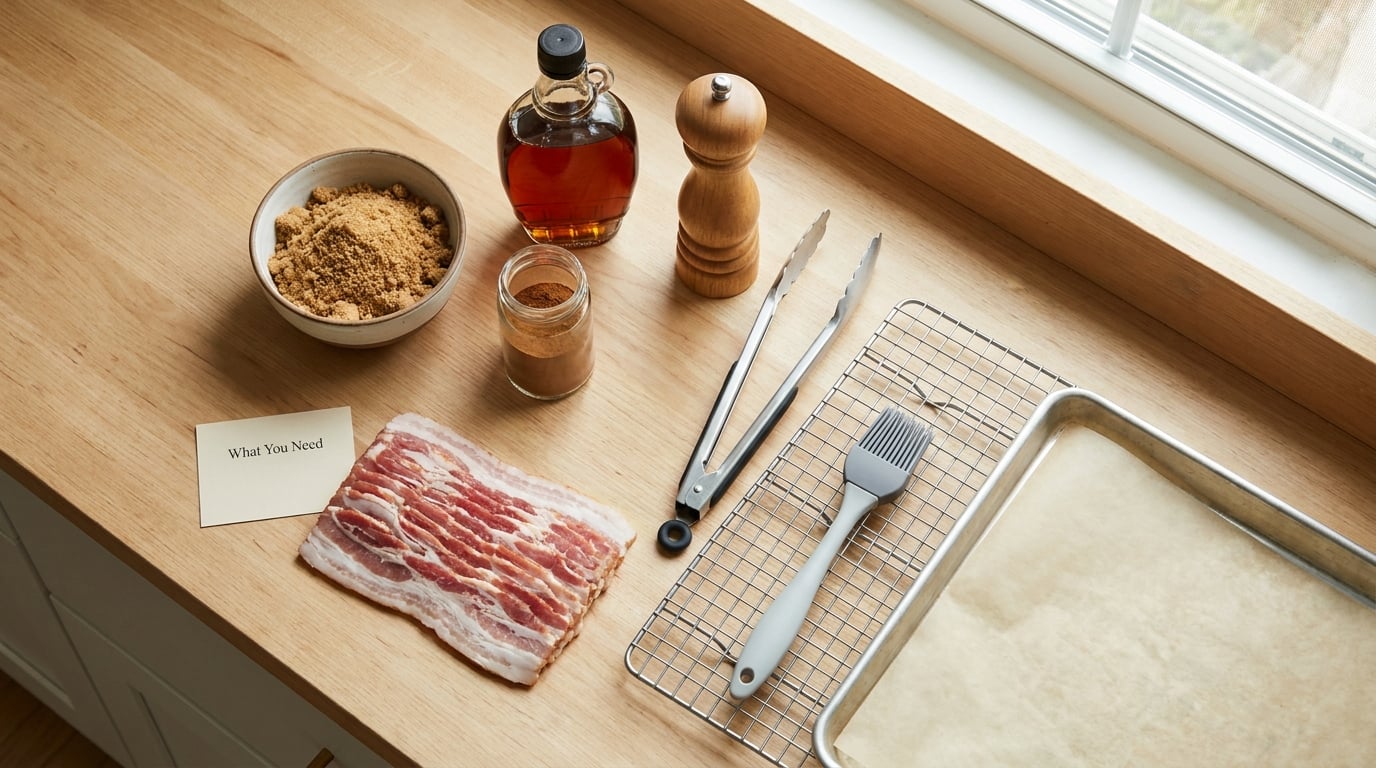
The core recipe (about 12 strips, 8 servings as an appetizer)
- 1 pound bacon, thick-cut or short-cut, not extra-thin (450 g)
- 1/2 cup packed light brown sugar (100 g)
- 2 tablespoons pure maple syrup (30 ml)
- 1 teaspoon freshly ground black pepper
- 1/2 teaspoon ground cinnamon, optional
- 1/4 teaspoon cayenne or chili powder, optional
Equipment
A rimmed baking sheet, a wire cooling rack that fits inside it, parchment paper or foil for the drip, and a basting brush or the back of a spoon. Nothing here is specialized.
Choosing the bacon
Thick-cut and short-cut strips both work well. Extra-thin strips go from done to burnt inside a few minutes and rarely survive the sugar, so I’d skip them. Center-cut is fine and leans a little leaner, which means crisper edges. Whatever you pick, the strips should still have visible fat, because that fat is what renders out and keeps the finished candy from turning to leather.
Pat the raw strips dry with paper towel before they go near sugar. Surface moisture is the reason a coating slides off into one thick patch instead of clinging evenly.
Picking the sugar and syrup
Light brown sugar gives a mild, balanced caramel. Dark brown sugar adds a deeper molasses note and can go bitter if you push the bake too far, so it wants slightly lower heat and a shorter time on the pan.
If your brown sugar has hardened into a brick, press it through a heavy pin or the flat side of a knife, or microwave the bag in ten-second bursts and knead it soft again. Clumped sugar won’t coat a strip properly, and one lump of it on a hot pan is exactly how sugar burns.
Pure maple syrup adds moisture and a woodsy sweetness that balances the salt. Pancake syrup is mostly corn syrup and extra sweet, so use less of it, about one tablespoon. Honey works in the same slot, and hot honey turns the whole thing into a sweet-heat snack.
Swapping things out
- No brown sugar: use white sugar for a cleaner, harder caramel, coconut sugar for a milder one, or maple syrup alone with a little honey. Skip artificial sweeteners entirely, they don’t caramelize and they scorch.
- No maple syrup: the sugar-only version is classic pig candy. Brush the dry sugar on with a little water or a spritz of cooking spray if it will not stick.
- Gluten-free or paleo: use sugar and a small amount of maple or honey, and check that your bacon has no malt in it.
Food safety notes
Cook the bacon through to at least 145°F (63°C) even though it will look far past that, and refrigerate the finished strips within two hours. Keep them in an airtight container and use them within four days, or freeze them for up to two months. Candied bacon goes soft fast at room temperature, so don’t park the pan on the counter while dinner finishes.
Step-by-Step: How to Make Candied Bacon
1. Choose and Prep the Bacon
Preheat the oven to 375°F (190°C). Lay the strips out and check each one: if a piece is twice the length or width of the others, trim it or cut it in half so everything finishes at the same time. Cut crosswise into two-inch pieces if you’re topping burgers, which also gives you more crispy edges per bite.
Pat every strip dry. While you’re at it, preheat the rimmed baking sheet in the oven for ten minutes, because bacon hitting a cold pan starts to steam before it starts to brown.
2. Make the Candy Coating
Stir the brown sugar, maple syrup, black pepper, and any spices together in a small bowl until the dry ingredients are damp and evenly colored. You want the mixture to look like damp sand, not a wet paste.
For a sweeter finish, keep the maple and add a pinch of cinnamon and nutmeg. For something smoky, swap the cinnamon for chipotle powder, which is smoky rather than sweet. Add heat by raising the cayenne to a full teaspoon, and taste the raw mixture on a finger: it should read as salty, sweet and sharp all at once before it ever meets heat.
3. Cook the Bacon
Set the hot sheet pan in the oven, lay the wire rack on top, and arrange the strips in a single layer with a finger’s width between them. Crowding is the number one reason a batch steams instead of crisping.
Bake for 8 to 10 minutes at 375°F. The bacon will be bending but not yet colored, the fat will be pooling on the parchment, and the sugar will not have touched the strips yet. Pull the pan at this point, which is the cue that matters more than the clock.
4. Add the Coating and Caramelize It
Carefully lift each strip with tongs, turn it fat-side down onto the rack, and press half the sugar mixture over the top in an even layer. Press it on with your fingers so it hugs the surface rather than sitting in a loose layer that can slide off later.
Return the pan to the oven for another 8 to 10 minutes. The sugar will bubble, go from matte to glossy, and darken to amber. At that point the underside of the strips will have rendered and crisped from the heat coming up through the rack.
Pull the strips out when the edges are deep amber and the bubbles look slightly matte, and when a strip lifted with tongs feels stiff in the middle rather than floppy. That’s the finish. If you wait past that point because you’re waiting for a timer, the sugar goes from dark to black and the whole tray smells like scorched sugar. The color is the only reliable signal; the recipe cards that tell you to bake 30 minutes at 375°F are assuming a thick, generously coated strip, not a thin one.
5. Crisp, Drain, and Cool the Bacon
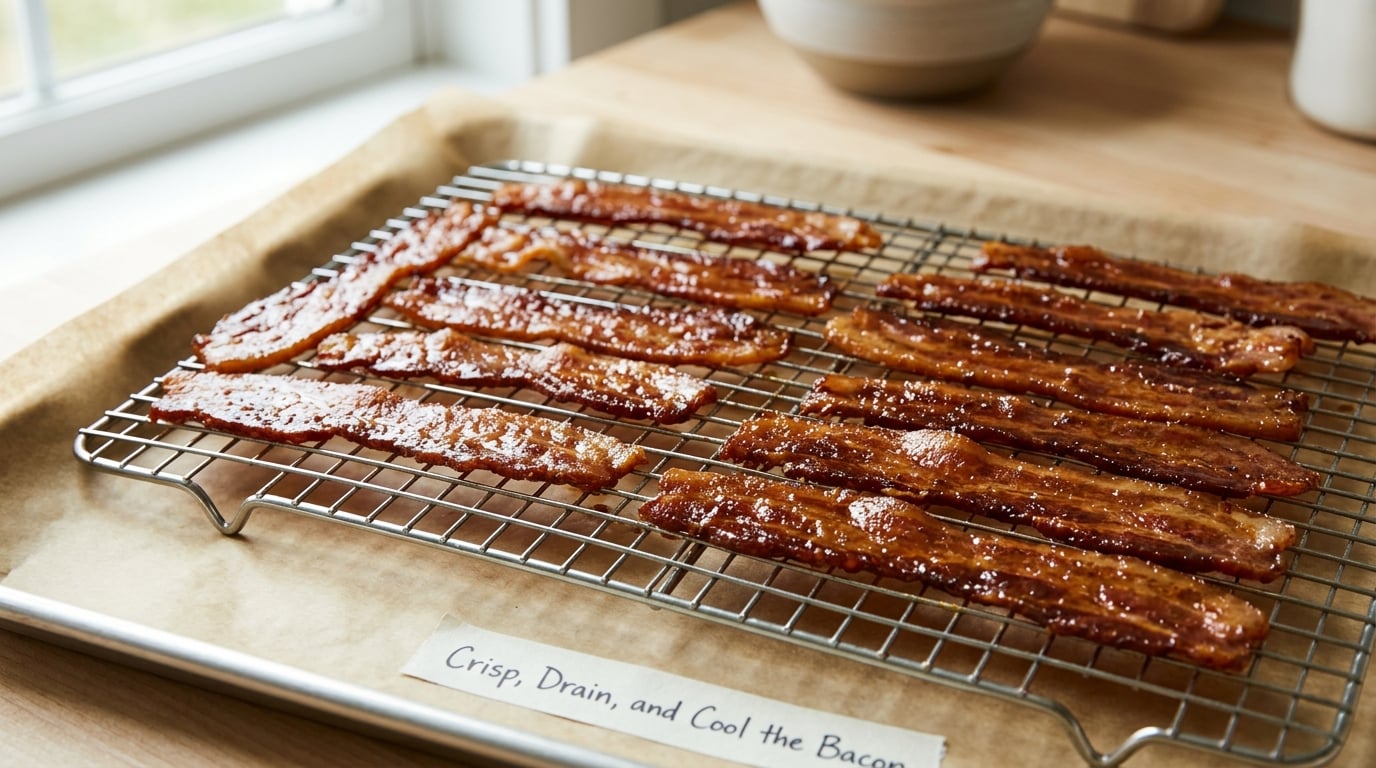
Transfer the strips to the rack and leave them in a single layer until they stop steaming, which takes about 10 minutes. Cooling on the rack instead of a paper towel or a plate is what keeps the crunch, because air circulates under each strip and the residual fat drains away rather than soaking back into the sugar.
Don’t stack the strips while they’re warm. Warm strips pressed together fuse into one soft slab, and that slab will still be chewy the next day.
How to Make Candied Bacon in the Oven
That is the oven method, and it’s the one I’d use most of the time. The method is worth restating as a compact routine for anyone who wants the short version: render the bacon first, coat it, then return it to a hot oven so the sugar caramelizes on contact.
Two oven variations come up constantly. For a softer glaze, brush the strips with plain maple syrup instead of a sugar mix and bake at 350°F (175°C) for 18 to 20 minutes, which is closer to the short-bake method most people mean when they ask about the well-known 350°F version. For a heavier crust, bump the oven to 400°F (200°C) and drop the second bake to 6 minutes, watching it closely.
Do not flip the strips. The underside crisps on the rack on its own, and flipping breaks the caramelized shell and leaves a bare patch on top.
The Secret to Perfect Candied Bacon
Thin and even beats thick and generous. A heavy coat of sugar takes a long time to reach a safe temperature, so the outer layer burns while the inside is still raw and the bacon underneath is still pale. Press on a light layer, and you’ll get a shell that is crisp, amber and fully cooked in far less time.
The second thing to know is what you should expect from the texture. Sugar holds onto moisture, so candied bacon is crisp-chewy rather than shatter-crisp like plain oven bacon. That’s chemistry, not undercooking, and a very common source of frustration. If you want a shattering snap, skip the sugar.
Third, keep the pan hot. A preheated sheet and a rack give you heat from below, underneath the glaze, so the bacon crisps at the same rate the sugar colors. On a cold pan, dripping sugar pools on the liner and burns into a smoky mess that also strips the flavor out of the bacon above it.
Other Ways to Cook Candied Bacon: Smoker, Air Fryer, and Dehydrator
Pig candy started on a smoker, and a pellet grill or offset gives you a smoke flavor no oven can fake. Here’s how the main methods compare.
| Method | Temperature | Total time | Resulting texture | Best for |
|---|---|---|---|---|
| Oven | 375°F (190°C) | 16-20 min | Crisp shell, chewy center, even browning | The reliable default |
| Stovetop skillet | Medium to medium-low | 12-15 min | Closer, slightly softer crust | Last-minute bacon with fat still hot |
| Air fryer | 390°F (200°C) | 8 min total, 4 min flipped | Fastest crisp, slight edge char | Small batches and thick cuts |
| Smoker or pellet grill | 225-250°F (107-120°C) | 45-60 min | Deeper, drier, noticeably smokier | True pig candy with real smoke |
| Dehydrator | 160°F (71°C) | 4-6 hours | Jerky-firm, uniform, long storage | Larger batches and gifts |
On the stovetop, render the strips in a cold skillet first so the fat comes out slowly, then raise the heat to medium. Brush with the coating once the edges start to brown, turn once, and pull them off while the underside is still sizzling.
In the air fryer, coat the raw strips generously, set them in a single layer, and air fry at 390°F for 4 minutes. Flip, air fry 4 minutes more, then add two more minutes if you want a darker edge. Crowding the basket is the one thing that ruins this method, since the strips need the air moving around them.
On the smoker, set the strips on a rack over a drip pan at 225°F to 250°F and smoke them plain for about 20 minutes first. Then brush with the sugar mixture, roughly a teaspoon of brown sugar per strip, and let the sugar set into the meat over another 25 to 40 minutes. Many barbecue cooks add cayenne to the sugar for a sweet-heat version, which is the traditional pig candy profile.
In a dehydrator, coat the raw strips and lay them on the trays without touching, at 160°F for 4 to 6 hours. They come out firm, uniform and stable in a tin for weeks, which makes them the easiest batch to make ahead for a holiday tray.
Common Candied Bacon Mistakes
Almost every bad batch traces back to one of six things, and all six are fixable.
- The sugar burned. Too much sugar, too thick a layer, or too long in a hot oven. Pull at amber, not at brown, and remember that carryover keeps darkening the sugar after the pan leaves the heat.
- The bacon came out greasy rather than crisp. Strips were touching, or the rack was sitting in a puddle of drippings. Leave a finger’s width between strips and set the rack high enough that the drippings fall below it.
- The coating slid off. The strips were wet, or the sugar was applied before the surface fat had set. Press the coating on while the bacon is still hot and tacky, and don’t turn the strips afterwards.
- The pieces were uneven. Thick and thin strips on the same tray finish at wildly different times. Cut them to the same length and thickness before you start.
- The pan was overcrowded. More than a single layer of strips means steam, soft bacon, and a sugar mixture that never dries between pieces.
- The bacon was stored while still warm. Warm strips stored in a container steam each other and turn soft within hours. Cool them on the rack, uncovered, for a full 10 minutes first.
Two smaller flavor notes. Pepper added at the very end tastes sharper than pepper baked in, so a light grind on the finished strips is worth doing. And if the whole tray tastes flat, the fix is salt, not more sugar.
Storing and Serving Candied Bacon
Candied bacon stays properly crisp for about three days in an airtight container at room temperature, longer in the fridge, where it keeps roughly a week but picks up moisture from other foods. Freezing is the best option for more than a few days: lay the strips in a single layer on a tray to freeze solid, then move them to a freezer bag so they don’t clump. Thaw on a rack, not on a plate.
To bring it back, spread the strips on a rack in a 350°F oven for 5 minutes, or warm them in a dry skillet over medium heat for a minute or two on each side. Microwaving works but leaves the sugar patchy and the bacon tough, so skip it.
Now for serving. The most popular use by a wide margin is a burger topper, where the sweet shell cuts the salt of a double cheese and stands up to a heavy patty. Chop it and fold it into a BLT in place of plain bacon, scatter it over a brunch salad with sliced avocado, or add it to a quiche Lorraine in place of the raw bacon bits. It also works as a waffle topping, a chopped garnish on a burger with blue cheese, and a piece on a charcuterie board next to sharp cheddar and pickles.
Scale the recipe the same way for a crowd, and don’t crowd the pan. Two pounds of bacon needs two pans, and three pounds will fill an oven outright. If you’re making a batch for a party, do the coating and the render in the first pan while the second tray finishes, then cool everything on racks and store it airtight so the crunch survives the trip.
Frequently Asked Questions
What is the best type of bacon for candied bacon?
Thick-cut or short-cut strips work best, and center-cut is fine if you want crisper edges. Avoid extra-thin bacon, which goes from done to burnt in a few minutes and rarely survives the sugar. Choose strips with visible fat still on them, since that fat renders out and keeps the finished candy from turning tough.
Can I make candied bacon ahead of time?
Yes, and it actually holds up well frozen. Cool the strips fully on a wire rack, freeze them in a single layer until solid, then transfer them to an airtight freezer bag so they don’t clump together. Thaw on a rack rather than a plate, and refresh them in a 350°F oven for 5 minutes before serving.
How do I keep candied bacon crisp?
Cool the strips in a single layer on a wire rack for about 10 minutes before touching them, and never stack them while they are still warm. Store airtight once completely cool, not while any warmth is trapped inside. Expect crisp-chewy rather than shattering, because the caramelized sugar always holds some moisture.
What can I serve with candied bacon?
It is most often used as a burger or cheeseburger topping, where the sweet shell balances the salt of a heavy patty. It also works chopped into a BLT, scattered over brunch salad with avocado, added to a quiche Lorraine, or set on a waffle. A charcuterie board with sharp cheddar and pickles is a good appetizer spread.
Can I make candied bacon in an air fryer?
Yes. Coat the raw strips generously, arrange them in a single layer, and air fry at 390°F for 4 minutes. Flip the strips and air fry 4 minutes more, then add 2 more minutes if you want darker edges. Leave space between the pieces, since crowded strips steam and never crisp properly in the basket.
Why is my candied bacon soggy instead of crispy?
Three causes account for nearly every soggy batch. The strips were touching, so they steamed instead of crisping. The sugar coating was too thick, which holds moisture against the meat. Or the bacon was stored or stacked while still warm, so the pieces steamed each other and the trapped moisture softened the shell.
Conclusion
To make candied bacon, render the strips first, press on a thin and even layer of brown sugar and maple, then let a hot oven do the rest. Pull the pan when the sugar reaches deep amber and the bubbles turn matte, not when the clock says so.
Then give the strips a full 10 minutes on a wire rack before they go anywhere near a container. That cooling step is the difference between a snap and a slab, and it’s the part most recipes skip.