
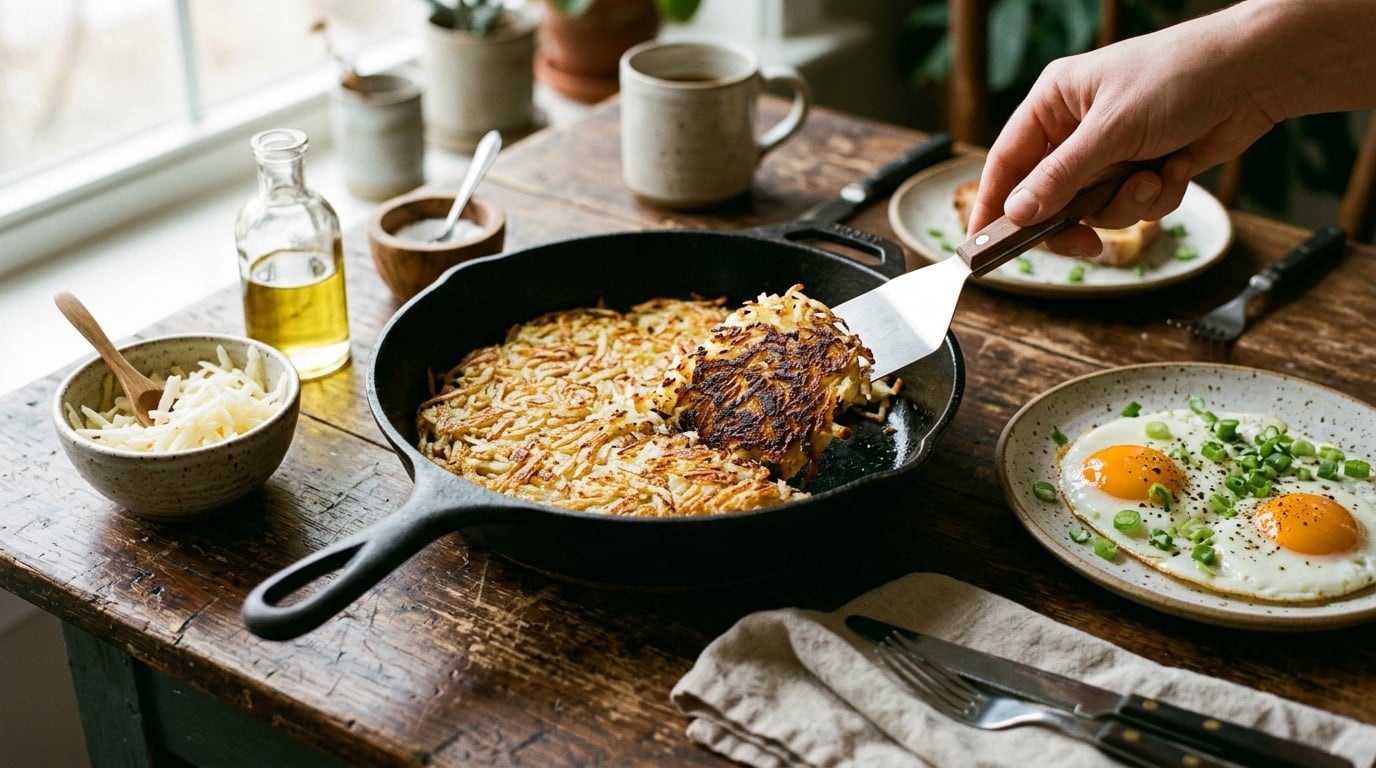
How to make hash browns for brunch is mostly about moisture: grate the potatoes, get the water out, press them into a thin even layer in a properly preheated pan, and leave them alone until the underside is deep golden. That method gives you a shatteringly crisp crust with a tender center, and it scales from one skillet to a sheet pan for a crowd. Prep takes about 15 minutes, cooking another 12 to 15, and the whole thing is beginner-friendly if you stop moving the potatoes.
I’ve cooked hash browns on a Saturday morning more times than I can count, and the batch that comes out well is almost never the batch I planned. The plan works when the potatoes are dry, the oil is hot, and the pan isn’t crowded. A brunch adds one more problem the weeknight version doesn’t have: the gap between “done” and “everyone sits down.” I’ll cover that too, because soggy potatoes sitting in a covered pan is the most common brunch failure I see.
A note on terminology first, since the words get used loosely. Hash browns are grated raw potato, cooked until they bind into a crust. Home fries are diced and usually par-cooked in water first, which is why they brown so fast. O’Brien hash browns are hash browns cooked with onion, and breakfast potatoes is a catch-all for either. If you want the grated kind that shatters, skip the par-cook step.
What You Need
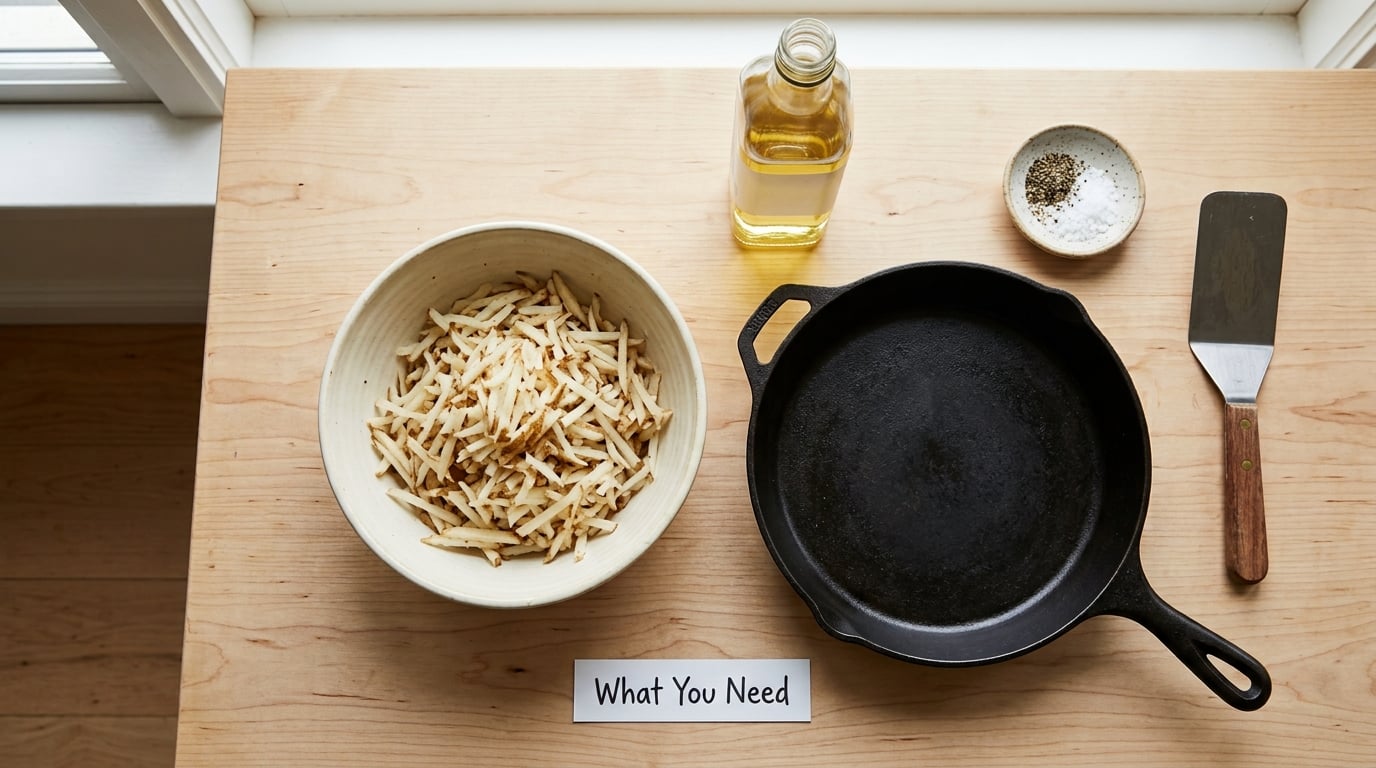
For one skillet that serves three or four as a side:
- 3 large russet potatoes, about 1.5 pounds (680 g) total, scrubbed but not peeled
- 2 tablespoons of a high smoke point oil, such as avocado, canola, or grapeseed
- Kosher salt and coarse ground black pepper, for seasoning before and after cooking
- 1 to 2 teaspoons potato starch or cornstarch per cup of shreds, optional but it firms up the crust noticeably
- Optional toppings: shredded sharp cheddar, sliced scallions, crisp bacon, fried or poached eggs, sour cream, salsa, hot sauce, smoked paprika, onion powder, garlic powder
Choose a starchy potato. Russets are the standard because their high starch content is what browns and binds. Yukon Gold works and gives a creamier, more evenly golden result, and it’s a good pick if you want a softer center. Waxy potatoes like red bliss or fingerling hold their shape but stay pale and fall apart, so skip them for hash browns.
Leave the peel on. A surprising amount of that golden crust is fried potato skin, and peeling strips away both color and structure. If you really want them peeled, peel thinly and expect a softer hash.
On the pan: a 10 to 12 inch cast iron skillet is the best stovetop option because it holds heat and gives you a wide surface for a thin layer. A heavy stainless skillet works well, and a nonstick skillet is usable but releases less browning flavor. The water droplet test tells you when the pan is ready: flick a few drops of water on, and if they sizzle and skate rather than steam, it’s hot enough.
Oil matters less than people think, but smoke point matters. Butter burns at skillet temperatures, so use it for flavor only after the potatoes are already browning, or use clarified butter, which keeps most of the milk solids out of the pan. And use more oil than feels reasonable. One community description of the real trick, which I think is right, is pulling as much water out as you can and being generous with fat.
Because the crowd question comes up constantly, here’s how the methods compare. No one method wins outright, and each trades pan time for hands-on attention.
| Method | Temperature | Time | Batch size | Hands-on effort |
|---|---|---|---|---|
| Cast iron skillet | Medium-high stovetop heat, 1 to 2 tablespoons oil | 12 to 15 minutes per side | 3 potatoes, serves 3 to 4 | High, you stand at the stove and flip once |
| Sheet pan, oven | 425°F (220°C), preheated pan, oiled parchment or brushed metal | 30 to 40 minutes, flip once at 20 | 2 full sheet pans, serves 12 to 16 | Low, mostly oven time |
| Air fryer | 400°F (205°C), preheat the basket 5 minutes | 15 to 20 minutes, shake twice | 1 to 2 cups of shreds | Medium, batches of small amounts |
| Waffle iron | Medium, no added oil needed | 8 to 10 minutes | About 1 cup of shreds | Medium, 2 minutes of work per batch |
So is it better to fry or bake? For a table of six or more, bake them. The sheet pan gives you more surface area per minute of effort, and the oven supplies the steady even heat that a home stovetop can’t quite match across a wide pan. For four people or fewer, a cast iron skillet produces a better crust in less total time. Whichever route you take, this is the single decision that shapes how to make hash browns for brunch for a crowd.
Step-by-Step: How to Make Hash Browns for Brunch
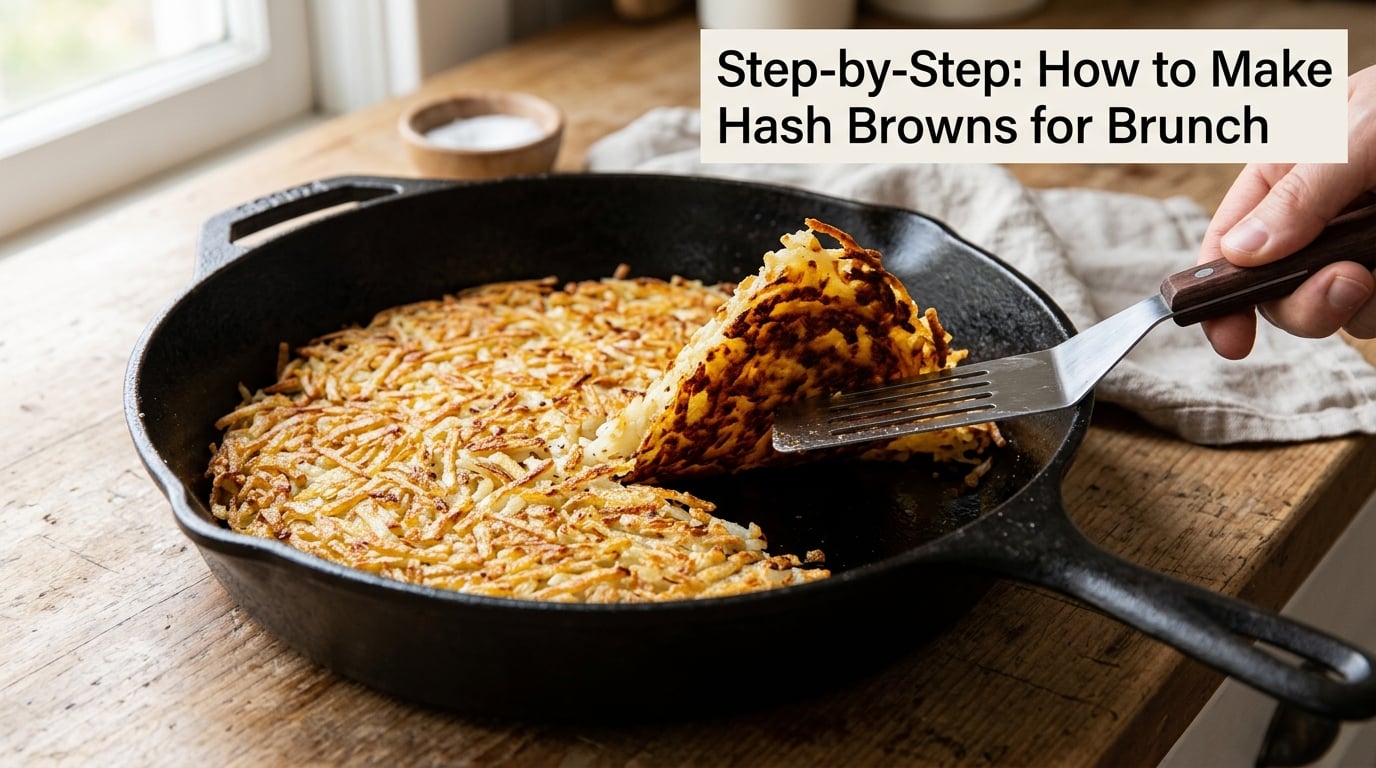
1. Prepare the potatoes
Scrub the potatoes and grate them on the large holes of a box grater, or use the coarse shred disc on a food processor. A food processor is faster for a big batch, but a hand grater gives you more control over the shred size, and consistent shreds matter more than speed here.
Now get the water out, which is the single most important step. Pile the shreds into a clean kitchen towel, twist it, and wring hard over the sink until barely anything drips. A potato ricer is even better and faster if you have one. If the towel trick feels like a gimmick, notice that reviewers and home cooks consistently report a large improvement in crispness once they start squeezing.
Do you need to rinse or soak first? Here’s the definitive answer: no for a skillet hash, and this is where most conflicting advice comes from. The starch on the surface of a freshly grated potato is what browns into a lacquered crust and what binds the shreds into a sheet you can flip. Rinsing or soaking washes that starch away, and a rinsed hash brown usually turns out pale, crumbly, and soggy at the center. Some home cooks soak successfully by changing the water every 20 minutes and then drying hard, but the simplest rule is: skip the soak unless you’re par-cooking for home fries. If you soak, 30 minutes is a reasonable limit, and any longer just leaches starch with no benefit.
If you’re using frozen shreds, thaw them in the refrigerator, not on the counter, and press out the water the same way before they go anywhere near the pan.
2. Season the potatoes and heat the pan
Put the pan on medium-high heat with the oil in it, and let both get hot together. While you wait, toss the dry shreds with a light pinch of salt and, if you like, 1 to 2 teaspoons of potato starch or cornstarch per cup. Toss starch in loosely, because more than that turns the shreds gluey rather than crisp.
There’s a timing debate here worth settling. Salting the raw potatoes in advance draws water out of them by osmosis, which is exactly the problem you’re trying to avoid, so hold the salt until after the flip. You can still season generously with pepper and any powdered spices before cooking, and add the salt at the end.
Test the oil with a water droplet while you wait. Sizzling and skating means ready. If the oil shimmers and looks thin but the water sits still, wait another minute.
3. Form the hash brown layer
Dump the potatoes into the pan in one pile in the center, then press and spread them with your spatula into a single thin, even layer reaching the edges of the pan. Thin means about an eighth of an inch. Even thickness is what makes one flip possible, and a layer that reaches the edges is what gives you the crisp fried rim that makes a hash brown look like brunch hash browns.
Press the surface flat but don’t compact it into a brick. You’re trying to knit the shreds together, not press them into paste.
Do not overcrowd the pan. If you can’t fit a single thin layer, cook in batches or switch to a sheet pan, because potatoes stacked on top of potatoes steam instead of brown. That’s the mistake behind most soggy pans, and it’s also why the sheet pan is the better choice for a crowd.
4. Cook until deeply golden underneath
Leave it completely alone for 6 to 8 minutes. No pressing, no poking, no rearranging, no sliding the spatula underneath to check. The crust forms through undisturbed contact, and every time you move them you tear the forming crust loose.
You’re looking for a deep golden brown, not a pale yellow, on the bottom and along the visible edges. If the top is browning before the bottom does, your heat is too high; drop to medium and let the underside catch up. The potatoes will still be a bit soft on top at this point, and that’s expected.
Peek at the bottom by lifting one edge with the spatula for a second. If the underside is patchy, give it another two minutes rather than flipping it early.
5. Flip and finish the second side
Slide a wide spatula all the way under the hash and lift. For a large skillet, divide it into two or three sections with a knife first, then flip the pieces rather than trying to flip a whole round hash in a pan full of hot oil. A failed flip into a full skillet is how people end up with hash brown hash.
If the first side releases in a sheet, you’ve done it right. If it tears, the potatoes were too wet or the pan was crowded.
Cook the second side for another 6 to 10 minutes, until it’s golden and the center yields to the back of a spoon without feeling wet. Test by pressing the center firmly with your fingertip; if it feels like firm, cooked potato rather than a soft raw core, it’s done. Lift a corner and look at the cross section. You want a distinct browned shell with a pale, tender, fully cooked interior.
Season now with the salt you held back, plus a final grind of pepper.
6. Top and serve: how to make hash browns for brunch that hold their crust
Move the hash to a wire rack set on a baking sheet, not a plate. A wire rack lets air circulate underneath, and a plate traps steam that softens the bottom. A paper towel underneath catches the oil that pushes out, so the hash browns stay crisp instead of sitting in a puddle of grease.
Drain any excess oil by resting on the towel for a minute, which is a real fix for hash browns that feel greasy rather than crisp.
Here’s the rule that protects a brunch: wet toppings go on at the last second, dry toppings go on early. Cheese, scallions, bacon bits, and herbs can go on the moment it leaves the pan. Sour cream, salsa, and any egg topping should wait until a plate is in front of the person eating. The wet toppings are exactly what turns a crisp crust into a soft one while the food sits.
For a top bar, set out bowls of shredded cheese, caramelized onions, scallions, cooked bacon, smoked paprika, hot sauce, and salsa, and let people build their own. Keep the wet items in squeeze bottles or small bowls with spoons so nobody pours them over a whole platter at once. The loaded hash brown is genuinely a different dish from the plain one, and a topping bar takes almost no active work from you, which matters when you’re also cooking eggs.
Common Mistakes
Nearly every disappointing batch traces back to one of eight things, and every one of them has a specific correction. If you’re wondering how to make hash browns for brunch that taste like the ones from a diner, run down this list before you blame the recipe.
The potatoes were wet. This is the number one cause of soggy hash browns. Surface water turns the pan into a steamer for the first few minutes instead of a fryer. Fix: wring the shreds in a towel or ricer until nothing drips, and spread them before adding more than a pinch of salt.
You rinsed or soaked them. Rinsing strips the surface starch that browns and binds. You get a pale hash that falls apart. Fix: grate and dry, don’t rinse. If you must soak, change the water every 20 minutes and keep it under 30 minutes.
The pan was crowded. Overlapping potatoes steam each other and nothing gets crisp. Fix: one thin layer, edges to edges, batches of 3 potatoes per 10 to 12 inch skillet. Anything beyond that belongs on a sheet pan, where you can also use two pans at once.
The heat was too low, or the oil too thin. Lukewarm oil wets the potatoes instead of searing them, and they absorb oil and turn greasy. Fix: medium-high heat, an oil film that just covers the pan bottom, and don’t move the potatoes once they land.
You flipped too early. Peeling the lid off a pale hash to check on it breaks the crust before it has set. Fix: wait for deep golden on the bottom and set edges, usually 6 to 8 minutes, and use a water droplet to peek at one spot if you must.
You cooked too long. Once both sides are golden, further cooking dries the interior and hardens the crust into something brittle. Fix: stop at the cross section check, and pull it a minute earlier if your pan runs hot.
You added the wet toppings early. Sour cream, salsa, and eggs put moisture straight onto the crust. Fix: keep those for the last second at the table, and let guests add them to individual plates.
You left them sitting covered. A lid traps steam, and a pile of hash browns steams itself. Fix: single layer on a wire rack, uncovered, in a 250 to 300°F (120 to 150°C) oven if you need to hold them for more than about 15 minutes. To re-crisp, give them 4 to 8 minutes at 400°F (200°C), or 3 to 4 minutes in a hot air fryer.
Frequently Asked Questions
What type of potatoes should I use for hash browns?
Use a high-starch potato, which means russet for the classic result. Its starch browns into a lacquered crust and binds the shreds into a slice you can flip. Yukon Gold is a good second choice, slightly creamier and more evenly golden. Skip waxy varieties like red bliss or fingerling; they hold their shape but stay pale, taste sweet rather than earthy, and fall apart in the pan. Leave the skin on either way, since a large part of that browning is the skin itself.
Can I make hash browns without a cast-iron skillet?
Yes. Any heavy skillet with a thick, flat bottom works, and a 10-inch stainless steel pan is the next best thing after cast iron because it holds heat well. Nonstick is usable but browns less flavor into the crust. A griddle set at 350 to 375u0026deg;F is a good substitute for a crowd, and a sheet pan at 425u0026deg;F does the same job for two pans’ worth of potatoes. The pan matters far less than drying the potatoes and preheating the surface before they go in.
Why are my hash browns sticking to the pan?
Sticking means the pan wasn’t ready or the potatoes were wet. Oil that hasn’t heated properly lets the surface water soak into the metal and weld the shreds down, and a damp shred releases starch that glues itself to the pan. Test with a water droplet: if it sizzles and skates, the pan is ready. Wring the shreds until nothing drips, spread them immediately, and leave them untouched for the first 6 to 8 minutes. If a whole sheet is tearing when you lift it, the crust needs more time.
How do I keep hash browns crisp until brunch is served?
Hold them in a single layer, uncovered, on a wire rack in a 250 to 300u0026deg;F oven. The rack matters because a plate or a covered pan traps steam that softens the underside within minutes. Never stack them, and keep any sour cream, salsa, or eggs off until service. If they go soft anyway, spread them on a sheet pan and blast them at 400u0026deg;F for 4 to 8 minutes, or 3 to 4 minutes in a preheated air fryer, and they will come back close to fresh.
Can I prepare hash browns ahead of time?
You can do most of the work the night before, but not the cooking. Grate the potatoes, wring them dry, toss them with salt, and store them sealed in the refrigerator for up to 24 hours. In the morning, press them again to pick up moisture the salt pulled out, add the pan and oil, and cook as normal. The fully cooked version also holds: refrigerate leftovers in a sealed container within 2 hours, use within 3 to 4 days, and reheat to 165u0026deg;F in a hot skillet or oven to bring the crust back.
Can hash browns be made in the oven?
Yes, and for six people or more it is the better method. Heat a heavy sheet pan at 425u0026deg;F for 10 minutes first, brush it with oil, spread the dried shreds in a single layer, and roast for 30 to 40 minutes without stirring, flipping once at the 20 minute mark. Parchment paper works if you are worried about sticking, but a preheated oiled pan gives a stronger crust. Salt at the end for the same reason as stovetop hash browns, then rest on a rack for a few minutes.
Conclusion
Start with the potatoes: grate them, wring them until nothing drips, and get the pan and oil properly hot before they go anywhere near it. Everything after that is patience, not skill. Press the shreds into one thin even layer, leave them untouched for 6 to 8 minutes, flip once, and salt at the end.
Three variables decide whether hash browns turn out crisp. Water on the surface makes them steam, so dry them hard. Starch left on the potato is what browns and binds, so don’t rinse. Contact with a preheated pan surface is what builds the crust, so give them space and don’t crowd the pan. Get those three right and how to make hash browns for brunch stops being guesswork, whether you’re cooking for four in a skillet or for sixteen on two sheet pans. The rest is just timing.