
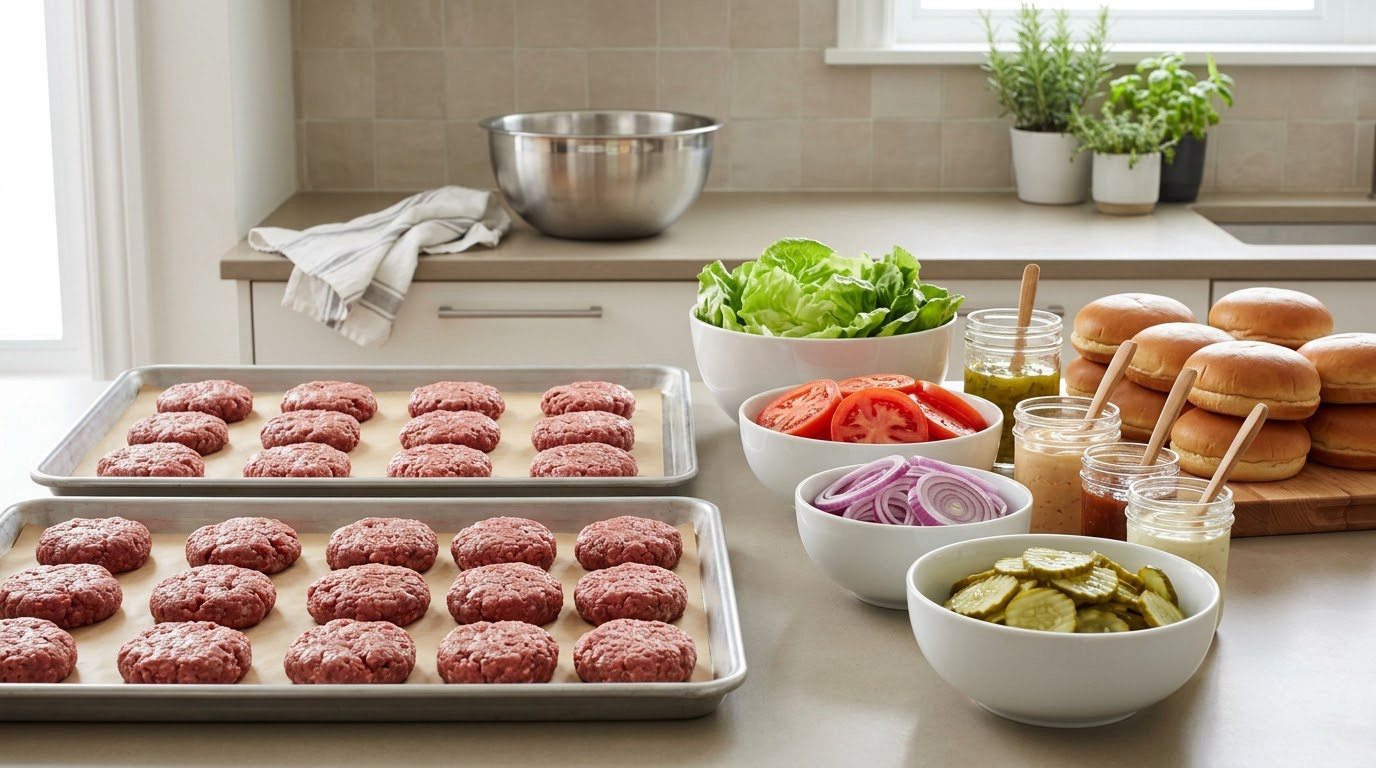
Doubling a burger recipe for a crowd is arithmetic plus logistics: multiply every ingredient by the same number, weigh each patty so they cook identically, then cook in batches your griddle can handle without crowding. Two thin patties per bun means four patties for a two-serving batch, and a doubling never means doubling the heat or the pan.
Most failed cookouts are not recipe failures. A recipe that makes four perfect burgers will make forty equally good ones if you scale it properly, pre-portion everything, and change how you cook. The two halves of the question rarely get answered together, so this guide covers both: the doubling math, then the crowd cooking plan that follows it.
What You Need
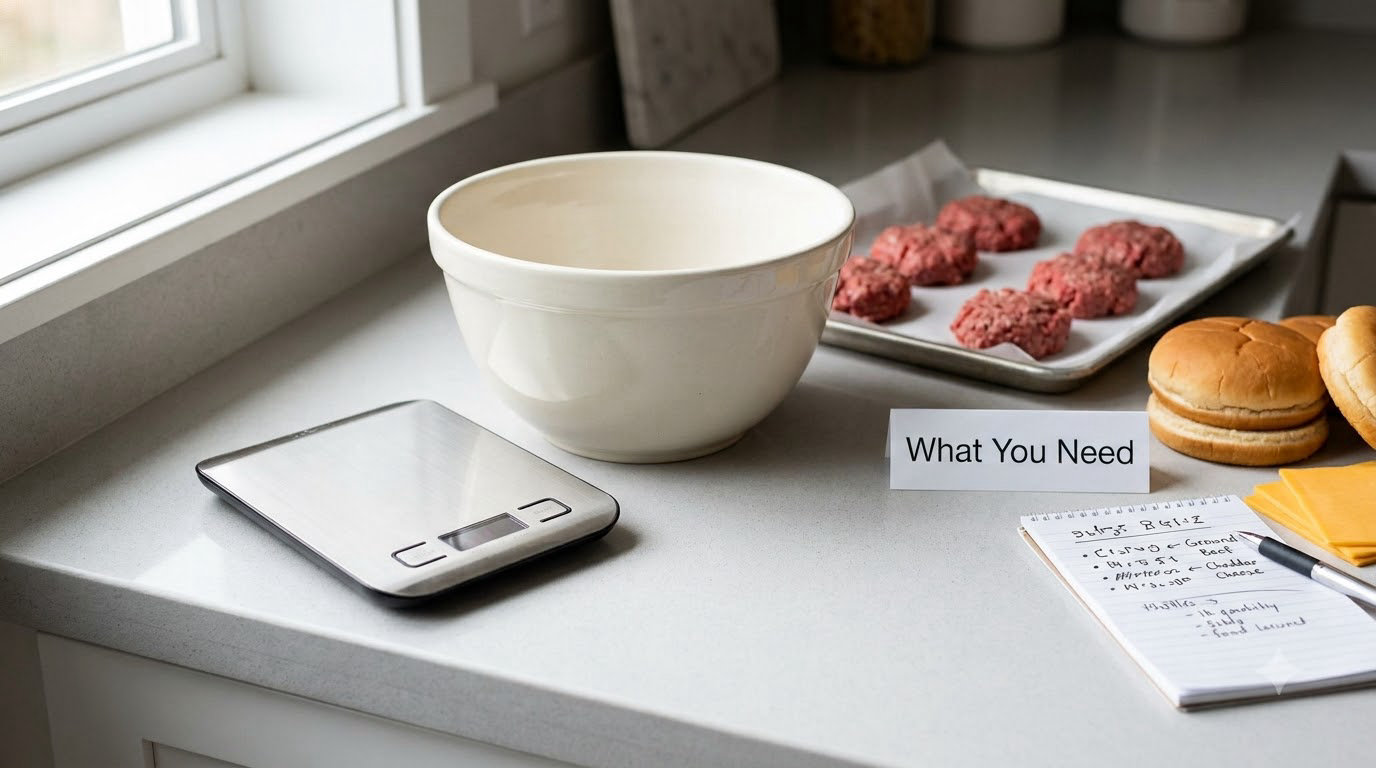
You need the original recipe in writing, a kitchen scale, and a cooking surface bigger than a skillet. That is the short version. The longer list below covers the tools that turn a doubled batch into forty consistent burgers instead of forty irregular ones.
- The base recipe and a multiplier. Write down the original serving count before you touch anything. A recipe that says “makes 4” is a multiplier of 5 for twenty servings; one that says “makes 6” is a multiplier of about 3.3.
- A digital food scale. Dividing beef by eye gives you patties that differ by an ounce or more, and those cook unevenly. Weighing is the single highest-value habit when scaling up.
- One large mixing bowl for the doubled meat mixture, and a second bowl or the counter space for formed patties.
- Parchment-lined sheet pans to hold raw patties without them sticking to each other or to the metal.
- A cast iron griddle, flat-top griddle, or grill with a two-zone fire. A skillet cooks four patties at a time and nothing like a crowd.
- An instant-read thermometer. Ground meat must reach 160°F (71°C) internally, and a thermometer is the only reliable way to know with twenty patties on the griddle.
- A wire rack set over a sheet pan for holding cooked patties. Foil traps steam and softens the crust, a rack does not.
- A low oven or a warming drawer at 170-200°F (75-95°C) if you are cooking far ahead of serving.
- Serving space. Count your platters, your bun capacity, and your table space before you start, because a doubled batch does not fit in the dish you used for the single batch.
Step-by-Step: How to Double a Burger Recipe for a Crowd
Scale first, shape second, cook third, hold last. Skipping straight to the grill with a doubled pile of beef is how you end up with twenty patties cooked three different ways.
1. Double the Base Recipe
Multiply every quantity in the written recipe by the same number, then adjust the few items that should not scale linearly. The rule is simple: bulk meat, buns, cheese and sauce double exactly, while salt, leavening and any seasoning you added by taste need a smaller bump.
Here is what to watch. Seasoning is the one place blind doubling goes wrong, because doubling the beef already doubles the volume you season. Increase salt and pepper by about 1.5 times rather than 2 times, then taste a cooked test patty before committing the whole batch. If the recipe includes a breadcrumb or binder, scale it with the meat so the patties still hold together at the larger size. Onions, pickles, and sauce double cleanly. Cooking oil or butter for the griddle does not: a bigger surface needs more fat, but you can add it in rounds rather than pouring it all at once, since excess fat pools and steams instead of searing.
Do the whole calculation on paper, in one place, before you start. Writing it down is what stops you from discovering at the grill that you bought buns for sixteen and have beef for twenty.
2. Weigh and Shape the Patties
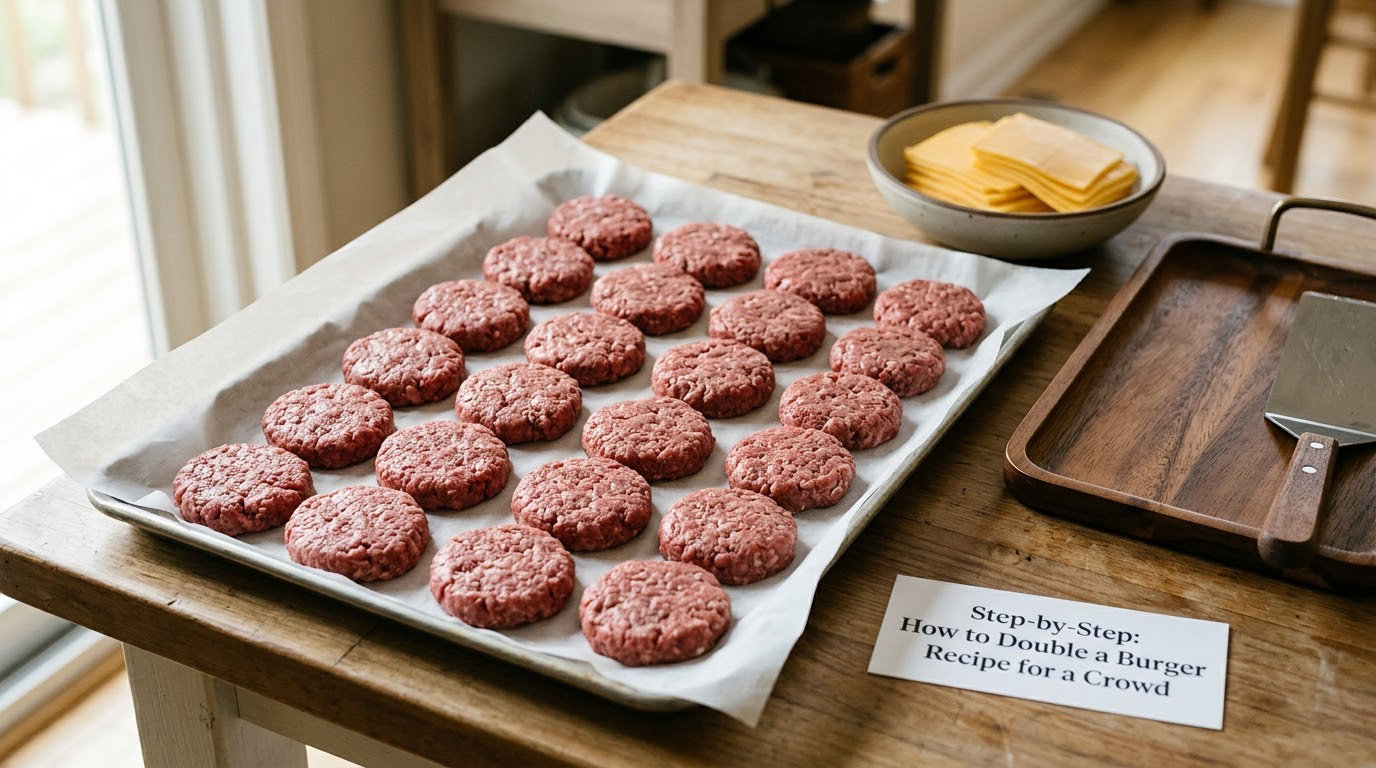
Divide the doubled meat into equal portions, then weigh the first one and match every other patty to it. Patties that match in weight and thickness cook at the same rate, which is the whole point of a crowd batch.
A standard patty runs 110-125 g (about 4 oz) for a regular burger, 80-90 g (about 3 oz) for a thin smash-style patty, and 35-40 g (about 1.25 oz) for a slider. If a doubled recipe uses thin patties and you are using a home griddle rather than a commercial flat-top, press them a little thinner and a little wider than the original. A thin patty develops its crust fast and finishes in roughly two to three minutes a side; a thick patty takes four to five and needs a longer rest before assembly.
Handle the meat cold and quickly. If your kitchen is warm, chill the bowl in the refrigerator for ten minutes before rolling, because fat that melts on your hands makes patties that smear and tear. Press the centre thinner than the edge so the patty lies flat, and keep the surface rough rather than packed smooth, since more surface area is what gives you the browned crust.
When you need to scale a patty up rather than just count more patties, the trick is a cold binder rather than more handling. A tablespoon of ice water per pound of beef, or a light coating of breadcrumbs, gives the patty something to hold onto. Overwork is the opposite fix and it is the common one: kneading beef to hold together makes it dense and dry.
3. Prepare the Cooking Area
Set up your cooking area so the first patty hits a hot surface and the last patty still gets a hot surface. That means picking equipment by guest count and testing the heat before you load it, not after.
| Cook surface | Patties per load | Works well for | Watch out for |
|---|---|---|---|
| Cast iron skillet | 2 to 3 | Up to 6 guests | Uneven heat, so rotate patties |
| Cast iron griddle | 6 to 8 | 8 to 12 guests | Heats slowly; start 10 minutes early |
| Home flat-top or large grill grates | 10 to 16 | 15 to 30 guests | Hot spots at the edges |
| Two-zone charcoal or gas grill | 12 to 20 | 30+ guests | Needs a cooler side for holding and toasting |
The spacing rule matters more than the number. A patty needs about a quarter inch of clearance on all sides to brown rather than steam, so if your planned load looks crowded, cut it in half and run two batches. A crowded griddle drops to a simmer, the patties grey, and the batch takes twice as long, which then makes the last burgers arrive cold.
Set up a two-zone fire if you are using a grill: one side over direct heat for searing, the other side for toasting buns and holding patties that finish early. Set out a separate plate for raw patties and a separate one for cooked ones, and never let a cooked patty sit on the tray the raw ones were on. Keep a metal lid or a lid-style fire extinguisher within reach of the griddle, and keep a bucket of water for other mishaps: a grease flare is smothered with a lid or extinguisher, never with water, which can throw burning fat across the yard.
4. Cook Until Safe and Juicy
Cook ground beef to an internal temperature of 160°F (71°C), verified with a thermometer in the thickest part of the patty. That is the food-safety floor, and it is also the point where a properly timed patty is still juicy rather than dry.
For thin patties on a very hot surface, expect roughly 90 to 120 seconds on the first side and the same again on the second, with cheese laid on during the final 30 seconds so it melts without the patty overcooking. For thicker patties, budget three to four minutes a side and check the temperature rather than the clock. Press the centre of a thin patty once at the halfway point to confirm it springs back; if it does not, give it more time.
Rest cooked patties for three to five minutes on the rack before they go into buns. Resting lets the juices settle instead of running out onto the board, which is the difference between a burger that tastes seasoned and one that tastes like salt and beef fat.
Between batches, wipe the griddle down and let it reheat for a few minutes. A surface that has dropped in temperature will cook batch three badly no matter how carefully you timed batch one.
5. Hold and Serve the Burgers
Hold cooked patties on a wire rack set over a sheet pan, uncovered, in a warm spot. Covering them with foil or a lid traps steam and softens the crust you just worked for.
Assemble at the last moment where you can. Toast the buns, spread sauce, add patties and toppings, and hand them over. If you are running a long buffet line, build burgers in waves of six to eight rather than all at once, because a burger assembled twenty minutes before service has already lost its texture.
Plan the sequence so people are actually served when they arrive. Cook the first batch as guests show up rather than all at once, hold the rest, and put out a tray of raw patties with buns so nobody starves waiting for the grill.
Common Mistakes
Almost every crowd burger problem traces back to scaling the recipe but not scaling the plan. These are the ones that come up most, each with a fix you can apply before the event rather than during it.
- Seasonings doubled exactly. The fix: scale salt and pepper by about 1.5 times the meat, and always cook one test patty first.
- Patties rolled to the same size by eye. The fix: weigh the first patty, then match the rest to it on the scale. A one-ounce difference is a one-minute difference on the griddle.
- Patties pressed too thick for a doubled batch. The fix: thinner and wider patties cook faster and more evenly, and a home griddle needs the help.
- Overloading the pan. The fix: keep a quarter inch around each patty and split the load into two batches rather than one. Crowding steams instead of sears.
- Griddle temperature dropping mid-cook. The fix: preheat before the first patty, do not add oil all at once, and give the surface a few minutes to recover between batches.
- Holding finished patties under foil or in a sealed container. The fix: rack over a pan, uncovered, in a warm oven at 170-200°F (75-95°C). A closed container softens the crust within about ten minutes.
- Toppings added too early. The fix: sauce on the bun, raw toppings on the patty, and crisp items like lettuce added at the moment of handoff.
- Running short on buns, cheese, or gas. The fix: count portions before the event, treat condiments as a bigger risk than beef because people use them freely, and keep a backup loaf of bread for stragglers rather than skipping the buns.
Tips for Scaling Any Burger Recipe
Most burger recipes scale cleanly once you separate the build from the cook. A few specific cases need their own approach.
Cheeseburgers
Two slices per patty is standard, so a doubled batch needs four times the original slices. Slice cheese thin if you are cooking more than a dozen patties at once, since it melts faster and covers more of the patty surface. American-style cheese melts smoother than cheddar and is the better choice for a large batch, and adding it during the last 30 seconds prevents the rubbery edge you get from cheese left on too long.
Bacon burgers
Cook bacon ahead of the burgers, not between batches. Crisp bacon sitting under a patty on a warm rack goes soft, and you lose the crunch that made it worth adding. Hold it on a rack in the same warm oven, and count three strips per person as a reasonable starting estimate.
Veggie patties
Vegetable and plant-based patties need a different plan from ground beef. They do not need 160°F (71°C), they hold together better when pressed firmly rather than loosely, and most brands instruct you to cook them in batches rather than all at once, because they steam in a pile. Follow the package directions for the time, and check the internal temperature the package specifies if it gives one.
Heavily topped burgers
More toppings per burger means more assembly time, not more meat. At 20 guests, budget a few extra minutes of assembly space and pre-portion the toppings into separate bowls so the person at the grill is not measuring caramelised onions between batches. Onions can be cooked in advance and reheated, since they hold up far better than lettuce or tomato.
Make-ahead and storage
You can form raw patties two days ahead. Lay them on a parchment-lined tray, freeze until solid, then transfer to a bag or container and keep frozen; they hold for three to four months. Cook from frozen on a griddle for about four minutes a side, or thaw them in the refrigerator overnight and cook as normal.
Cooked ground beef keeps three to four days in the refrigerator and three to four months in the freezer. For a large event, the par-cook strategy works: cook the patties until they are close to done, chill them, and finish them to order later, or freeze them and reheat to 165°F (74°C) before serving. Reheated patties lose some crispness, so finish them on a hot surface rather than in a microwave if you can spare the time.
Metric and US amounts
If you are converting a recipe that lists ounces, a standard crowd patty of 4 oz is about 113 g, and 2 lb of beef is roughly 900 g. Metric readers tend to portion by ball rather than by scale, so weighing 85 g per ball is the equivalent habit for a thin patty.
Frequently Asked Questions
What is the 5-6-7 rule for burgers?
The 5-6-7 rule is a party-planning shortcut: plan 5 portions per person for a spread of many small foods, 6 when burgers are one of two or three main items, and 7 when burgers are the main event. For a standard 4 oz patty, 6 portions per person works out to about 1.5 pounds of ground beef per guest, so 20 guests means roughly 30 pounds. Adjust down for slider portions and up for very long events.
How many burgers do I need for 20 people?
For a standard party where burgers are one of several foods, plan about 6 portions per person, so 20 guests means 120 patties. At two patties per burger that is 60 burgers, or 60 buns, 120 cheese slices, and roughly 30 pounds (13.6 kg) of ground beef at 4 oz per patty. If burgers are the only main item and the event runs long, go to 7 portions per person and add 10%.
How to cook a lot of hamburgers at once?
Cook in batches rather than all at once. Preheat a griddle or flat-top fully, leave a quarter inch around each patty for browning, and load only what fits without touching. Cook thin patties about 90 to 120 seconds a side, flip once, add cheese in the last 30 seconds, and verify 160u0026deg;F (71u0026deg;C) with a thermometer. Between batches, wipe the surface and let it reheat. Holding finished patties on a rack in a 170-200u0026deg;F oven keeps them hot without steaming them.
How do I bulk up hamburger patties so they hold together?
Add a binder rather than working the meat harder. A tablespoon of ice water per pound of beef, or a light coating of breadcrumbs, gives the patty moisture and structure. Keep the mixture cold, handle it quickly, and avoid kneading, which makes patties dense. If the recipe already includes a binder, scale it with the meat so the proportions stay the same when you double the batch.
How many people will 10 lb of hamburger feed?
Ten pounds of ground beef is about 4.5 kg, which at 4 oz per patty gives you roughly 40 standard patties. Counting two patties per burger, that is 20 burgers: enough for 10 people as a main course, or 20 people where burgers are one of several foods. If you are making sliders at about 1.25 oz each, 10 pounds makes about 64 patties.
What is the best order to stack a burger?
Start with a toasted, buttered bottom bun, spread sauce on the lid side so it does not slide. Add the first patty, then cheese, then the second patty, then a second slice of cheese so the heat of the top patty melts it. Finish with raw toppings like lettuce, tomato and onion, and close with the crown bun. Crispy items go last so they stay crisp.
Conclusion
Start with the arithmetic, not the grill. Multiply every quantity in your base recipe by the number of batches you need, adjust the seasoning down slightly, weigh every patty to the same weight, and cook in loads your griddle can brown properly rather than one crowded batch. Do those three things and doubling a burger recipe for a crowd stops being a gamble and becomes the same recipe you already trust, made forty times.