
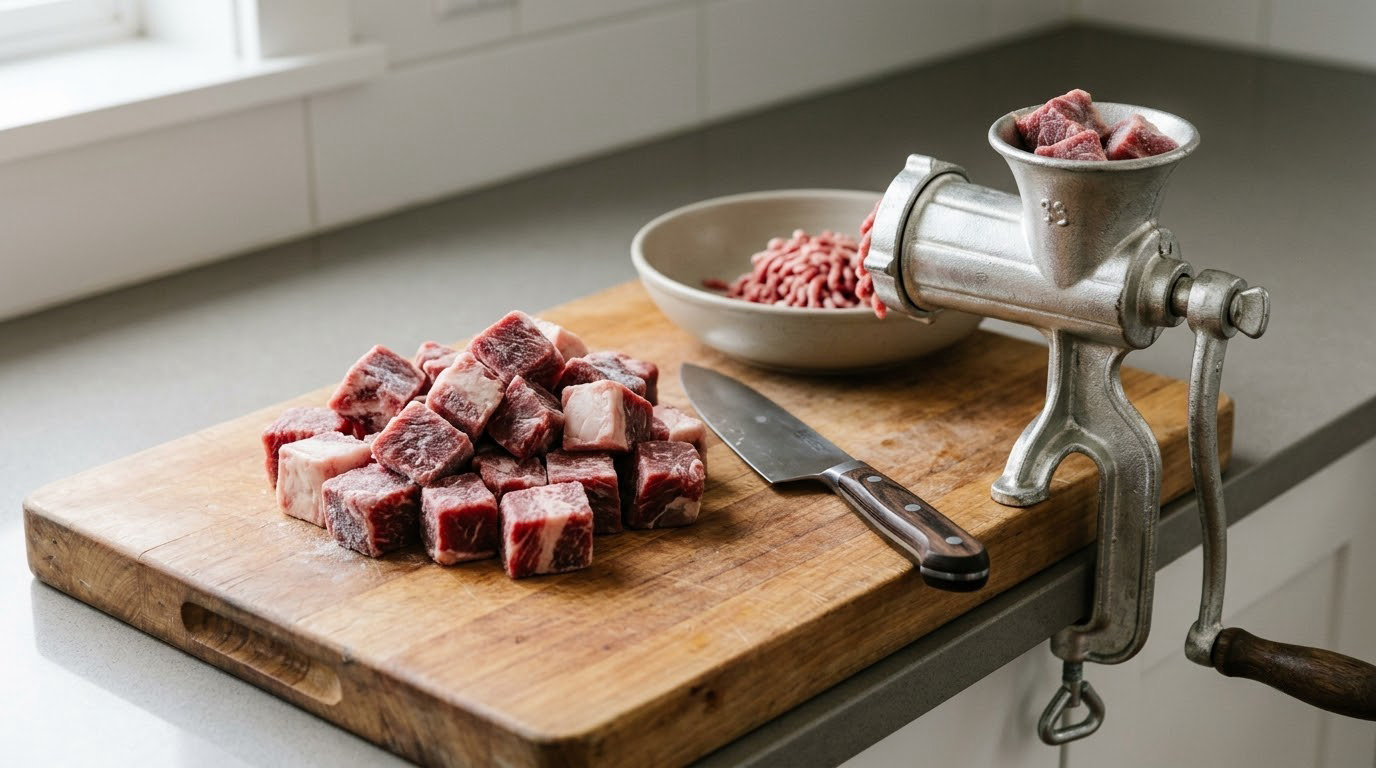
Cold meat grinds better because cold fat cuts cleanly and cold muscle protein holds its structure, while warm meat smears fat into a greasy film and turns the grind to paste. The most repeated advice on cooking forums is blunt about it: everything needs to be cold, because warm meat and fat will gum up a meat grinder.
That is the whole idea, but the useful part is knowing what is physically happening to the meat, what temperature numbers mean, and how to spot a grind that has gone wrong before you end up with a dense, greasy patty. I have pulled together what experienced grinders do and what the food science supports, because most of what circulates online stops at “keep it cold” without explaining the mechanism.
Table of Contents
- Why Cold Meat Grinds Better
- How Temperature Changes the Texture of Ground Meat
- Why Cold Meat Grinds Better for Burgers
- How Cold Should the Meat Be?
- The Role of Fat, Grind Size, and Chilling
- How to Grind Burger Meat Without Overworking It
- Does Cold Meat Make Burgers Safer or Healthier?
- Frequently Asked Questions
- Conclusion
Why Cold Meat Grinds Better
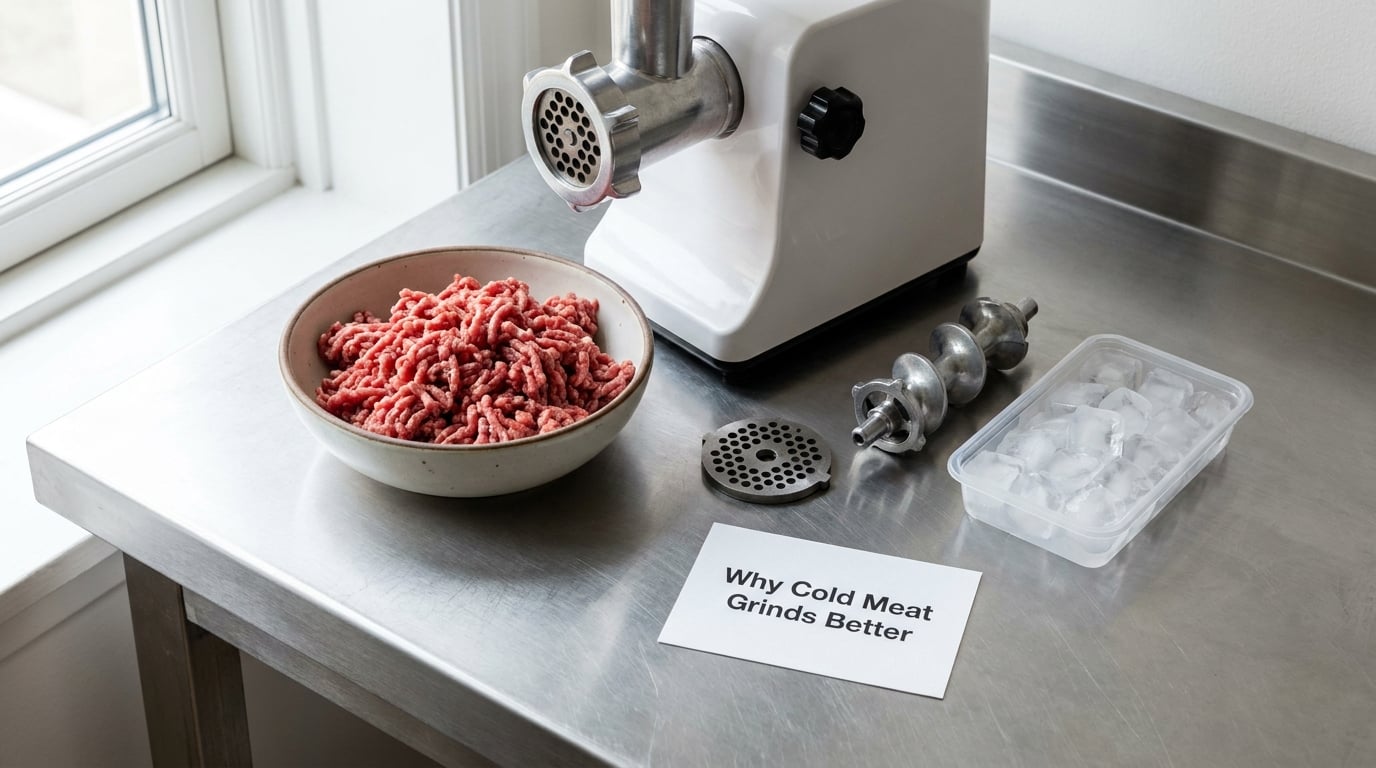
Here is the short version. Cold meat is firmer, so the plate cuts it into distinct particles instead of squashing it. Cold fat stays solid and breaks into pieces that stay separate from the lean. Cold protein keeps the ability to bind, which is what holds a patty together. As meat warms, all three of those things reverse, and warm meat also picks up heat from the auger and blade as it is being processed, so a grind that starts well can finish badly.
Temperature is not the only variable, but it is the one that changes the most, fastest. Grind size, fat content and how long the machine runs all push the same texture, which is why the same cut and the same plate can produce a loose, moist crumble in the morning and a dull, greasy block in a warm kitchen in the afternoon.
How Temperature Changes the Texture of Ground Meat
Muscle meat is a bundle of long protein fibres held in a tight lattice, with fat and connective tissue packed between them. Cutting that structure apart is a mechanical job, and the mechanics depend heavily on whether the fat and protein are firm or soft.
Warm fat smears instead of cutting cleanly
Fat smearing is what happens when the fat in meat warms past roughly 40°F, loses its firmness, and gets dragged across the lean by the auger and blade instead of being pushed through the plate holes as separate pieces. A cold fat particle meets the plate edge and snaps off. A warm one smears into a thin greasy film that coats everything around it.
That film is the whole problem. It coats the lean particles, so the myosin proteins cannot touch each other and bond. The result is a mixture that holds together mechanically but not chemically, and it behaves like paste when you pick it up.
Cold protein holds its structure
Myosin is the main protein in muscle and it does the binding work. Add salt and mix, and myosin extracts from the muscle fibres and links into a sticky network that traps water and fat. This is the same stickiness you get when you work salted meat into a sausage mixture, and it is temperature sensitive.
Protein denaturation is the term for proteins unfolding and losing their working shape. Heat is not the only thing that does it. Shear force, moisture, and time at an elevated temperature all contribute, which is why a slow warm grind smears while a quick cold one does not. A cold grind extracts myosin and links it. A warm grind cooks it in place, so the bind never forms.
Friction heat turns a slow grind into a warm grind
This is the part most guides leave out. The meat is not sitting in a fridge while it grinds. It is inside a machine, pressed between a spinning auger and a steel plate, generating real frictional heat. The last few pounds coming out of a warm grind are often pastier than the first few, because by then the metal is hot, the pile of waiting meat has warmed the air around it, and the motor has been running long enough to add to both.
That is why a large batch in a warm kitchen fails in a way the same batch does not fail on a cool morning. It is not random variation, it is accumulated heat.
Why Cold Meat Grinds Better for Burgers
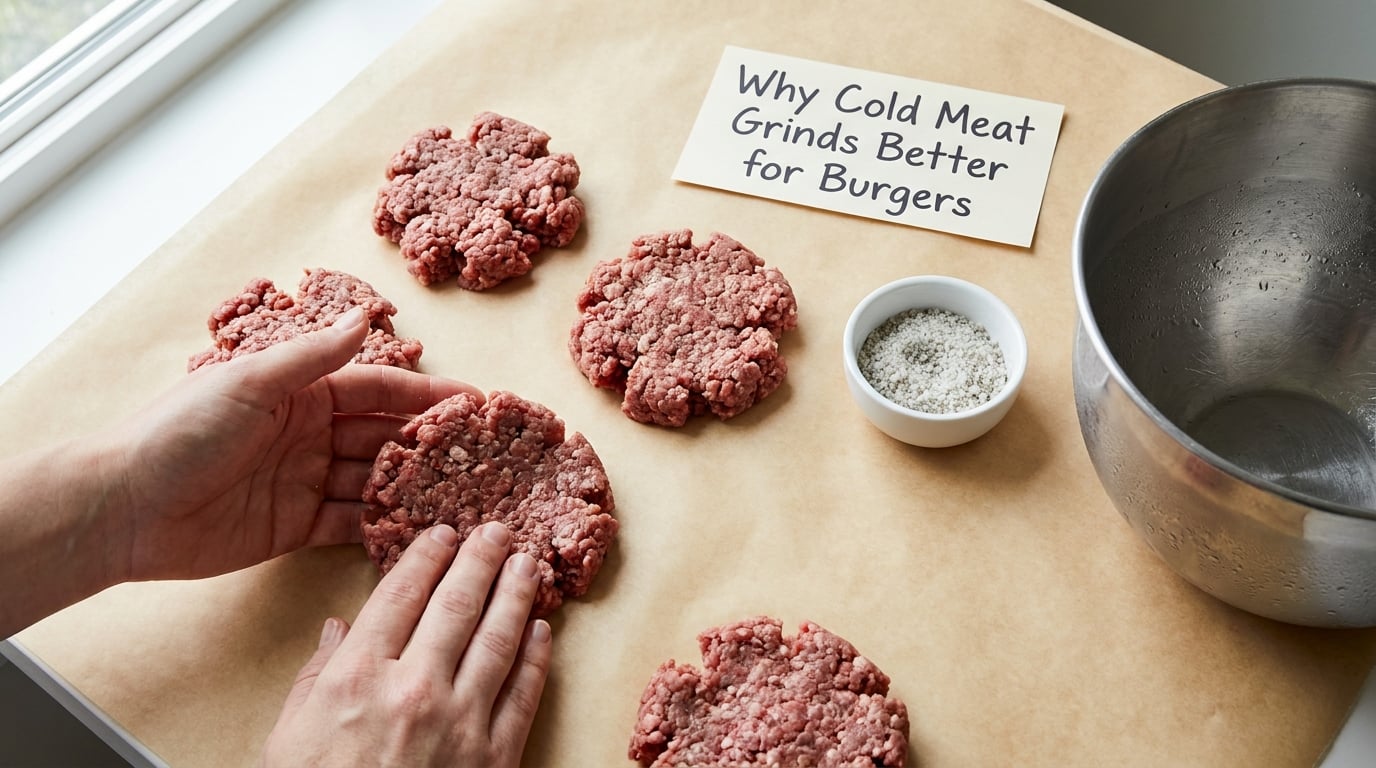
For burgers, cold grinding gives you three specific results. You get clean, craggy crumbles instead of a uniform paste. You get fat distributed as visible pieces that melt during cooking rather than a film that pools. And you get myosin extraction, which is what lets a loosely formed patty hold together on the grill instead of shedding chunks into the coals.
There is a second reason that matters for burger style specifically. Coarse crumbles have irregular surfaces and spaces between them. A smash burger needs that irregularity, because the flat contact points sear and the craggy edges stay moist. A paste-like grind has no craggy edges left. It compresses into a dense puck, renders out its fat in the pan, and ends up dry in the middle.
The goal is cold but workable meat. A hard, fully frozen block will not feed through a home auger cleanly, and forcing it just stalls the motor. Partially frozen is the sweet spot: firm enough that fat stays solid, soft enough that the auger can pull it. Hunters describe it well as half frozen, not hard like a rock, but slightly crystalline.
How Cold Should the Meat Be?
There are two temperature numbers in circulation and they are not competing with each other. 32°F is a quality target for the meat as it enters the grinder. 40°F is the food safety line, the point at which bacteria in the danger zone begin multiplying quickly. Aim for the first, respect the second, and the confusion disappears.
Working from practical experience, a 32°F starting point is realistic for home setups. Refrigerator meat straight from the case sits around 34°F to 38°F, and that is workable, especially in a cool room. Partially frozen meat gets you firmer fat and a more efficient feed. Chilling for 15 to 30 minutes in the freezer is the common recommendation, and 30 to 45 minutes makes sense for larger batches or for leaner, harder-to-grind meat such as venison.
How to tell the meat is cold enough without a thermometer
Press a cube with your thumb. Firm and slightly springy, with a surface that is dry rather than tacky, is about right. If the surface feels slick or the meat bends instead of pushing back, it is too warm. If it is rigid, frosted over, or gives off ice crystals, it is too hard to feed and needs 10 to 15 minutes at room temperature before you start.
The other check is on the machine. Touch the body of the grinder before you switch it on. If it feels like it has been standing in a warm kitchen, the parts need 20 minutes in the fridge or the freezer. Putting the plate, auger and blade in the freezer alongside the meat is the single most repeated tip across the forums, and it is the one most people skip.
If you grind with a hand crank, feed slowly and in small amounts. Manual work generates much less heat, which gives you a little more slack, but pushing too hard still compresses fat against the plate and starts the smearing early.
The Role of Fat, Grind Size, and Chilling
Temperature is one of four controls, and it only works well when the other three are set. Start with fat. A blend in the 15% to 20% fat range gives you moist burgers and gives the fat something to be. Cold grinding preserves that fat as pieces. Warm grinding turns it into a film, and a 20% blend that smears will behave more greasy than a leaner blend that does not.
Plate hole size is the second control. A 3/8 inch coarse plate gives you distinct strands and open texture, which suits smash burgers and coarse sausage. A 3/16 inch fine plate gives a finer grind that binds tighter, useful for emulsified styles and meatballs. Use the coarse plate first and only move finer deliberately, because a second pass over already-ground meat adds friction heat and pushes you toward paste.
The third control is equipment temperature, and the fourth is time. A cold bowl under the plate catches the grind immediately. Resting the meat between batches, with the unground portion back in the fridge, keeps the average temperature down. Both are cheap, and both matter more than most people expect.
How to Grind Burger Meat Without Overworking It
Chill everything first. Freeze the plate, auger and blade. Cube the meat into roughly 1-inch pieces, trim out silverskin and sinew, and freeze the cubes 15 to 30 minutes.
Then work in small batches of 2 to 5 pounds, with the rest of the meat staying cold. Use the coarse plate, let the auger pull the meat rather than pushing it down the feed tube, and keep the hand on the feed tube loose. When the batch is done, put it straight into the cold bowl and return the grinder head to the freezer while you load the next one.
Do not knead the ground meat, and do not run it through twice for no reason. Over-working is the most common way a good grind is ruined at the last step.
What to do when the output turns pasty
Paste output means stop. The meat has warmed or been over-processed, and continuing makes it worse. Put the batch back, spread it thin on a tray, and chill it until firm, or refreeze it for 15 to 20 minutes, then run it through again.
Other symptoms map to the same root cause. A plate that keeps clogging with lean meat often has the blade wrapped in silverskin rather than a dull blade, so cut connective tissue out before grinding and make sure the blade is actually seated on its square drive. A motor that strains, hums loudly or stalls on larger pieces is usually a sign the cubes are too big for the machine, so cut them closer to the size of the feed tube opening. A greasy film on the meat before cooking means the grind was warm.
Once the grind is finished and shaped into patties, get them back in the cold before they go anywhere near a grill. Cold patties sear faster and lose less moisture during the first minute of contact.
Does Cold Meat Make Burgers Safer or Healthier?
Cold grinding is about handling and texture, not nutrition. The number of calories, protein and fat in your burger is set by the blend you chose, not by the temperature of the meat going into the grinder. What cold handling does buy you is time.
Grinding creates a large amount of new surface area, and bacteria spread onto that surface every time meat is handled. Keeping meat below 40°F slows how fast they multiply, which extends the window between the butcher case and the pan. Trimmed meat waiting in the fridge is still on the same clock, so keep it cold and grind it the same day you bought it.
For cooking, follow the USDA minimum internal temperature of 160°F, or 71°C, for ground meat. Use a thermometer in the thickest part of the patty, not just against the edge. Ground meat cooks unevenly because of the craggy grind, so colour on the surface is not a reliable signal.
For storage, refrigerate ground meat at or below 40°F and use it within one to two days, or freeze it for three to four months for best quality. Thaw it in the refrigerator, not on the counter, and thaw it before grinding rather than grinding it frozen solid.
Frequently Asked Questions
Does meat need to be frozen before grinding?
No, and freezing it solid is actually counterproductive. Refrigerator-cold meat grinds acceptably, and 15 to 30 minutes in the freezer is enough to firm the fat for a noticeably cleaner cut. A hard frozen block will not feed through a home auger, and forcing it stalls the motor. Aim for firm and slightly crystalline, not rigid.
What are some tips for grinding meat?
Freeze the plate, auger and blade alongside the meat. Cube to roughly 1 inch and trim out silverskin. Work in batches of 2 to 5 pounds with the rest staying cold. Use the coarse plate, let the auger pull rather than pushing, and skip a second pass unless you specifically want a finer texture.
Why is my ground meat greasy and mushy?
Fat smearing is the usual cause, and it happens when meat or machine parts are above roughly 40u0026deg;F. The fat stops cutting cleanly and drags across the lean as a greasy film, which also blocks the myosin bind. Chill the meat and grinder parts, cut smaller pieces, slow the feed down, and grind smaller batches.
Can I add ice cubes to meat before grinding?
It is not worth doing. Ice dilutes the meat, does not chill the inside of the cube, and the water it releases works against the bind. The same effect is achieved properly by chilling the meat itself for 15 to 30 minutes and putting the metal grinder parts in the freezer.
Is ground beef safe at 50 degrees?
50u0026deg;F is above the 40u0026deg;F danger zone threshold and is not a safe holding temperature for ground meat, because grinding creates new surface area where bacteria multiply. That temperature is a texture problem first and a safety problem second. Keep meat below 40u0026deg;F while it waits and while it grinds, and cook finished ground meat to 160u0026deg;F internal.
How long can ground meat stay in the fridge?
Refrigerate ground meat at or below 40u0026deg;F and use it within one to two days. Freeze it instead if you cannot get to it, and use it within three to four months for the best quality. If it has been sitting at room temperature for more than two hours, or one hour in a hot kitchen, discard it rather than relying on smell.
Conclusion
Start with the parts, not just the meat. Put the plate, auger and blade in the freezer, chill 1-inch cubes of trimmed meat for 15 to 30 minutes, and grind in small batches while the rest stays cold.
Grind while the meat is cold but not rock-hard, stop the moment the output turns pasty, and cook ground meat to 160°F internal. That is the routine behind the loose, craggy, juicy burgers that make people wonder what changed, and it takes about twenty minutes of preparation.