
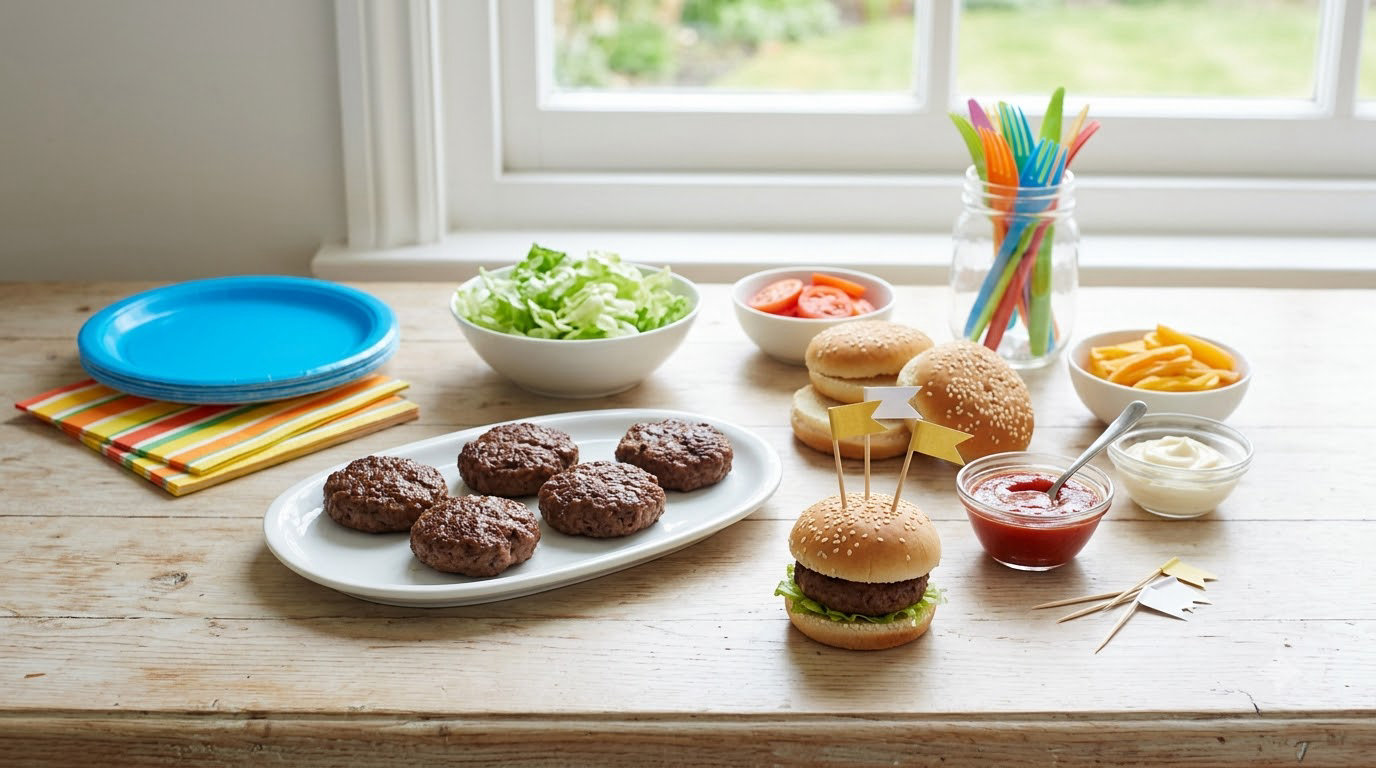
Learning how to make burgers for a kids party comes down to three things: make the patties small enough for small hands, cook the whole batch early, and keep it warm without drying it out. Plan on about two mini sliders per child plus a 20% buffer, and you will not run out halfway through the party.
The part that catches most parents is timing. By the time fifteen kids are lining up at the table, nobody wants to be standing over a hot pan. Cook the patties about an hour before serving, hold them at 140F or above, and set the buns and toppings out separately so the whole thing runs itself.
Table of Contents
- What You Need
- Step-by-Step
- How to make burgers for a kids party: Set up a simple workstation
- How to make burgers for a kids party: Mix and shape the patties
- How to make burgers for a kids party: Cook the burgers safely
- How to make burgers for a kids party: Choose toppings and assemble
- How to make burgers for a kids party: Make ahead and serve
- Common Mistakes
- Frequently Asked Questions
- Conclusion
What You Need
The equipment list for this is short, and most of it is already in your kitchen. A wide skillet or griddle, two spatulas, a baking sheet lined with parchment, an instant-read thermometer, and something to hold the finished patties warm is genuinely all you need.
On ingredients, buy 80% lean ground beef for a good balance of flavour and juiciness. Very lean meat dries out faster during a long hold, and extra-fatty meat greases the plate. One pound of beef makes roughly eight to ten sliders once you have portioned them.
- Ground beef, or ground turkey and a blend of beef and turkey for a lighter version
- Salt, plain black pepper, and a little garlic powder for mild flavour
- Small dinner rolls or slider buns, cut side open
- A mild cheddar slice cut into small squares, plus American-style slices for older kids who want bigger pieces
- Lettuce leaves, thin tomato rounds, and cucumber slices, all chopped small
- Ketchup and yellow mustard in squeeze bottles rather than bowls
- Paper plates, napkins, and wet wipes, in a stack within reach
How many burgers to make depends almost entirely on head count. Count the children you expect, not the invitations you sent, because birthday parties rarely run at full attendance.
| Number of kids | Mini patties to make | Plus 20% buffer | Buns to buy |
|---|---|---|---|
| 10 | 20 | 24 | 24 |
| 15 | 30 | 36 | 36 |
| 20 | 40 | 48 | 48 |
| 30 | 60 | 72 | 72 |
That buffer covers the toddler who eats three, the birthday child who wants seconds, and the one guest who arrives late and very hungry. Underestimating by a few patties is normal, and leftover cooked patties reheat fine the next day.
Adjust the size of the patty for the age of the group, because a four-year-old and a twelve-year-old have very different appetites and very different hands.
| Age band | Slider size | Pieces per child | Notes</ |
|---|---|---|---|
| 2 to 3 years | 1.5 inch patty | 2 small ones | Cut into quarters or thirds before serving and sit an adult nearby |
| 4 to 6 years | 2 inch patty | 2 | One-handed eating, minimal toppings |
| 7 to 12 years | 2 inch patty | 2 to 3 | Let them build their own |
| Teens | 3 inch patty or full-size | 2 to 3 | Offer a bun bar alongside for anyone who wants a real burger |
Skip round choking hazards for the under-three crowd. Cherry tomatoes, whole grapes, and thick raw carrot rounds are the usual culprits, so quarter the tomatoes and use soft cucumber sticks instead of carrot. Peanut butter belongs nowhere near this table unless you have confirmed no one present has a nut allergy, and even then it is not worth the risk at a mixed-age party.
For dietary needs, keep a small separate batch. Black bean or vegetable patties cooked the same way work for vegetarian guests, and gluten-free buns are now easy to find in most supermarkets. Put allergy-friendly items in a separate covered container with a label, because a mixed tray means nobody can tell.
Step-by-Step
How to make burgers for a kids party: Set up a simple workstation
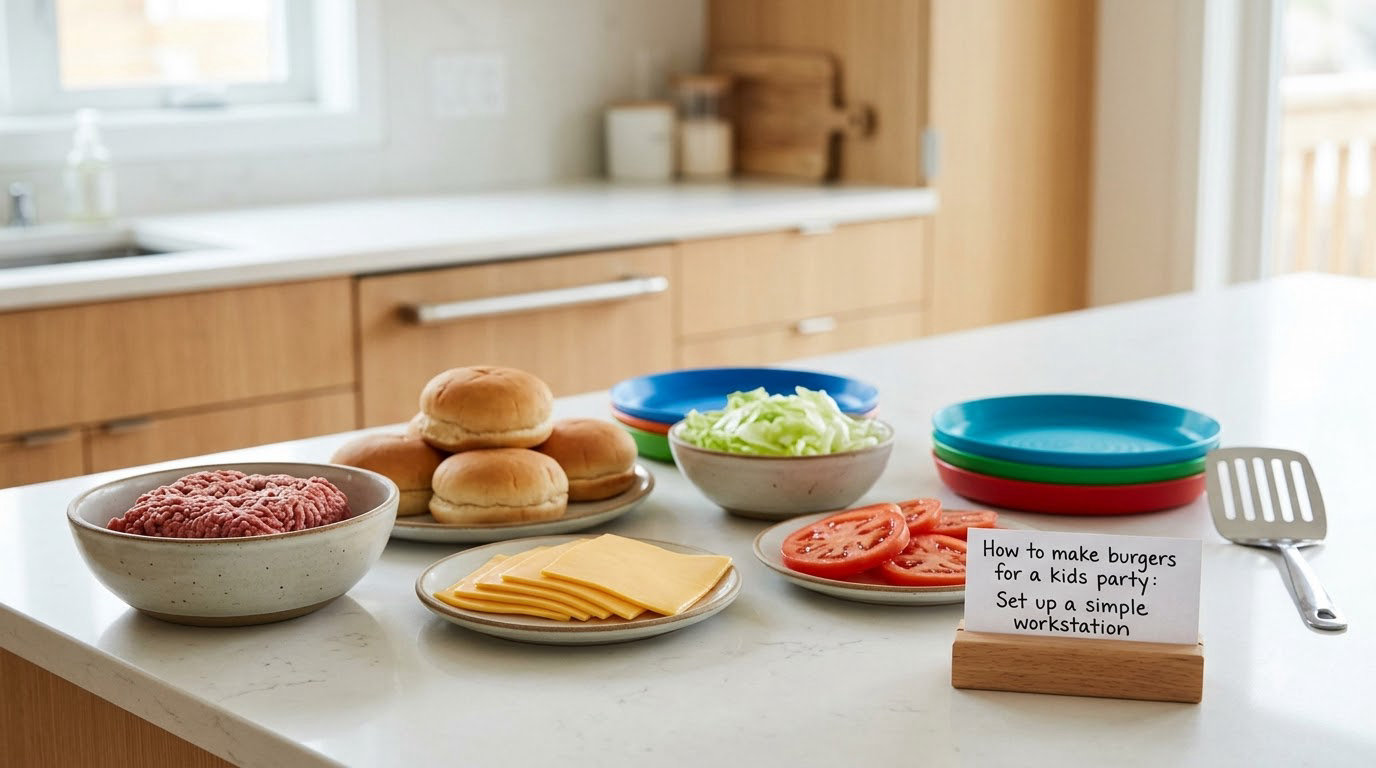
Set everything up before you touch the meat. Lining up the whole workflow on one counter means the cooking never becomes a scramble, and the calm is the entire reason this approach works for a party.
Start with the raw meat on a cold plate, far from the finished food. Put your mixing bowl, a small bowl of salt and pepper, and the parchment-lined tray next to it. Then move to a second area with the skillet, buns in a basket, toppings in small bowls, and squeeze bottles standing upright.
Two rules make the rest easier. Keep raw meat and cooked patties on separate surfaces, and wash your hands and any board that touched raw beef before you reach for the lettuce. With twenty kids in a kitchen that gets skipped easily.
How to make burgers for a kids party: Mix and shape the patties
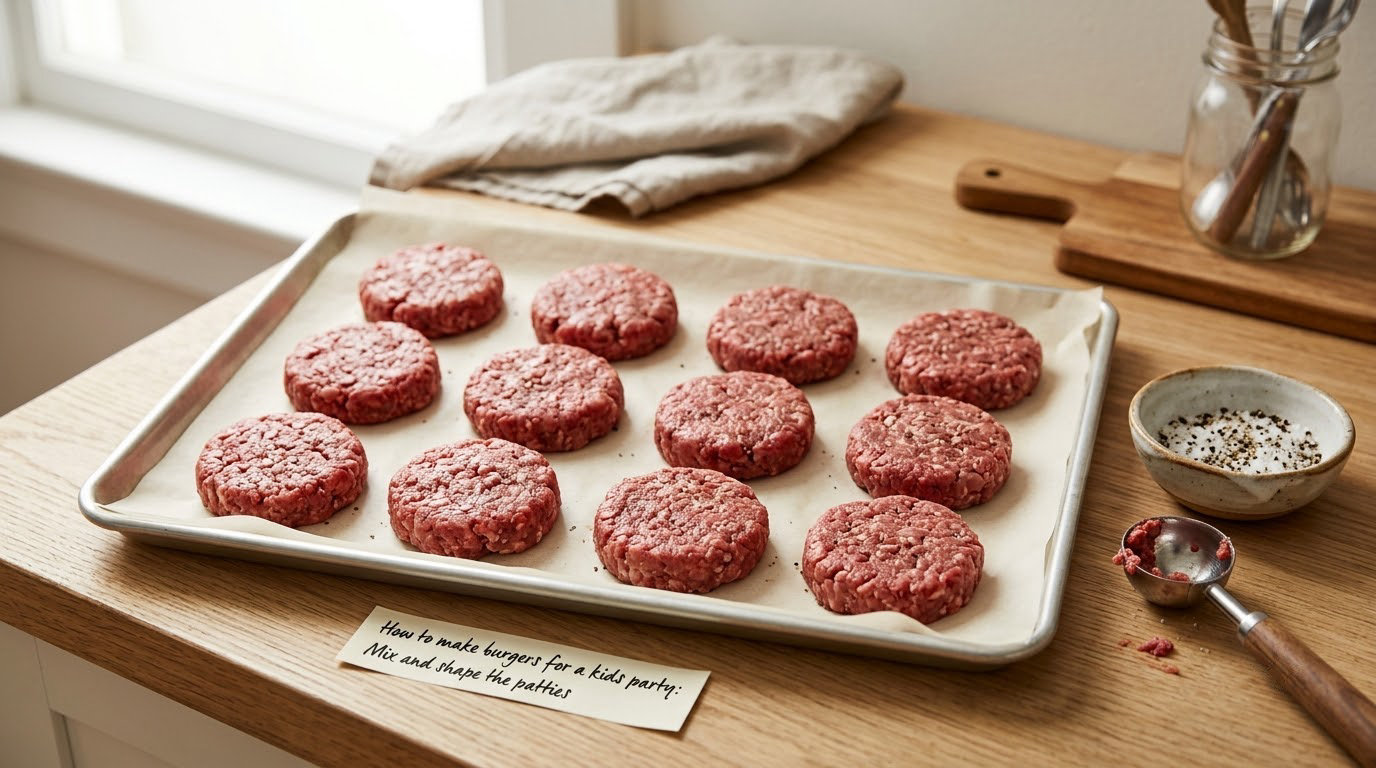
Mix the meat gently with your fingertips and barely season it. Overworking ground beef is what turns a juicy slider into a dense, bouncy one, and heavy seasoning is a bad idea with children who are still learning what a burger is supposed to taste like.
For about a pound of beef, use roughly one teaspoon of salt and a few grinds of pepper. A light dusting of garlic powder is fine. Nothing spicy, nothing smoky, no adult shortcuts.
Portion the meat with a small cup or an ice cream scoop so every patty comes out the same size. Even sizes cook evenly, and this is the step that most improves a batch made at 4pm for a 5pm party.
Press each portion into a flat patty about a quarter inch thick. Use the indent trick, a thumbprint in the centre of each patty, because the middle is what stops a slider from puffing up into a meatball as it cooks. Make patties no larger than a two-inch circle for kids under six, and a three-inch circle for older children.
Chill the shaped patties for 15 to 20 minutes if you have time. Cold patties hold their shape on the hot pan instead of falling apart, which matters when you are cooking four or five at a time.
How to make burgers for a kids party: Cook the burgers safely
Ground beef must reach 160F (71C) internally, and the only reliable way to know is an instant-read thermometer. Cook the patties in a single layer on a medium-hot skillet, working in batches so the pan stays hot and the meat sears rather than steams.
Give each side about two to three minutes for a small patty, longer for the three-inch version. Press each one once with the spatula to flatten it, flip, and cook the second side until the browned crust hides the pink. Check the thickest patty in the batch rather than the smallest, and aim for 160F.
Watch for the moisture that beads on the surface of the patty as it cooks. When the juices run clear instead of pink, the outside is well browned and the inside is close. Transfer finished patties to a warm platter with a foil tent over them and let them rest a few minutes before moving them to whatever is holding them warm.
Grill and oven baking both work, but pan-frying gives you the fastest turnaround and the most control over timing. A crowded sheet pan steams the patties, and steamed patties never brown.
How to make burgers for a kids party: Choose toppings and assemble
Keep the topping bar boring and familiar. Shredded lettuce, small tomato quarters, thin cucumber rounds, diced mild cheddar, and a single slice of American cheese per patty cover what most children will actually eat.
Serve sauces in squeeze bottles. A bowl of ketchup at a kids party ends with at least one child double-dipping, and a spill that size means a wiped table and a shorter serving line. Mustard is fine for older kids, and most four-year-olds consider it hilarious, so have a spare napkin supply ready.
Assemble in this order to protect the bun: sauce on the bottom bun, lettuce next as a moisture barrier, then the patty, then cheese, then tomato on top. That single layer of lettuce is the difference between a bun that holds together for ten minutes and one that dissolves in a child’s hands.
For toddlers, skip the bun entirely and serve the patty in quarters on a plate. It is messier by the numbers but far easier to eat, and it removes the main reason those age groups struggle with a slider.
Do not pre-assemble the whole batch. Sliders that sit stacked go soggy on the bottom and slide apart in the hand. You can pre-assemble for toddler guests who need one-handed eating, but keep the main supply in separate components until kids build their own.
How to make burgers for a kids party: Make ahead and serve
Cooked patties hold well for about an hour in a proper warmer. The single most common complaint from home hosts is dry patties, and that happens when cooked burgers sit on a platter with no heat and no moisture for two or three hours.
| Method | How it works | Good for | Watch out for |
|---|---|---|---|
| Chafing dish with fuel cans | Water pan below, food pan above, small cans of chafing fuel underneath | Long events, 2 hours or more | Dry air pulls moisture out, so add a splash of water to the water pan |
| Slow cooker on warm | Patties in the crock with a small amount of broth or water | Home hosts with no other equipment | Do not let the liquid boil, or patties will toughen |
| Foil pan in the oven | Covered foil pan on a rack at 200F (93C) | Convenience when the oven is free | Dry out faster than a covered pan, so keep the foil tent on |
| Insulated carrier or cooler | Preheated with hot water, patties in covered pans inside | Transport from another kitchen | Holds about an hour, and you must preheat the box |
Whichever method you pick, keep the patties at 140F (60C) or above. Food that sits in the danger zone between 40F and 140F for more than two hours should be discarded, and that window drops to one hour when the party is outside on a hot day.
A simple timeline keeps you out of the kitchen for most of the party:
- Two hours before: preheat the oven, take the patties out of the fridge, and set out the serving dishes
- Ninety minutes before: mix, shape, and season the patties, then chill them
- Forty-five minutes before: cook the patties in batches, working largest to smallest
- Thirty minutes before: move the finished patties into the warmer, arrange buns and toppings, and fill the squeeze bottles
- Fifteen minutes before: wipe the table, put out napkins and plates, and set out any toddler plates with cut patties
- Party time: stay out of the kitchen, refill the warmer in small amounts so you are not putting cold patties into a hot pan
For serving, stack plates at the very start of the line, napkins second, then patties, then buns, then toppings, then condiments at the end. Putting the condiments last slows the line down naturally, and a slow line beats a pile-up. Set the whole station on a low table for toddlers and a regular-height table for everyone else.
Common Mistakes
Overworking the meat is the first one. If the mixture feels sticky and dense in your hand, you mixed too long, and the patties will be tough no matter how short you cook them. Handle the beef only until it comes together.
Domed patties are the second. Forgetting the thumbprint in the centre makes a slider curl into a dome, which then rolls off the bun and onto the floor. Press the indent and keep patties an even quarter inch thick.
Crowding the pan is the third, and it is a party-specific problem because the instinct is to cook everything at once. A crowded skillet drops the temperature, the patties cook grey, and then you overcook them trying to hit 160F. Two or three batches of five is faster than one slow batch of twenty.
Soggy buns come from assembly order and from wet toppings sitting on bread. Lettuce between the sauce and the patty fixes most of it, and slicing tomatoes just before serving rather than an hour before helps too. So does buying buns that are a day or two old, since fresh ones are wetter to begin with.
Serving burgers that are too large is a quieter mistake. A four-year-old handed a full-size burger will push it around the plate for twenty minutes, and a toddler will eat nothing. Mini patties get finished, which is the entire point.
Heavy seasoning is the last one. This is not a chance to use the smoky hot stuff on the grill. Keep the seasoning mild and put the strong sauces on the table where the adults can reach them.
Frequently Asked Questions
How many burgers should I make for a kids party?
Plan on about two mini sliders per child, then add a 20% buffer. For 20 kids that means 40 patties and 48 buns. The buffer covers the hungry toddler, the birthday child taking seconds, and any late arrivals. Keep an eye on the age mix too, since toddlers often eat a half patty while tweens and teens will happily take three.
What are the best burger toppings for children?
Shredded lettuce, small tomato quarters, thin cucumber rounds, mild cheddar, and a slice of American cheese cover what most children actually eat. Keep sauces in squeeze bottles rather than bowls, and always put lettuce between the sauce and the patty so it forms a moisture barrier that keeps the bun from going soggy.
Can I make party burgers ahead of time?
Yes, and it is the better way to do it. Shape raw patties up to a day ahead and keep them covered in the fridge. Cook them 30 to 45 minutes before serving, then hold them at 140F (60C) or above in a slow cooker, a covered foil pan in a 200F oven, or a preheated insulated carrier. Cooked patties also freeze well for up to three months.
How do I keep cooked burgers from getting dry?
Keep them covered and keep them warm. A foil tent over the platter stops the surface drying out, and holding at 140F (60C) or above stops the moisture migrating out of the meat the way it does on a cold platter. Add a small splash of water or broth when they sit in a slow cooker, and avoid boiling, which is what makes reheated burgers leathery.
Should I use ground beef or turkey for a kids party?
Ground beef is the safe choice because kids recognise it, and an 80% lean blend stays juicy through a long hold. A beef and turkey blend is a good middle ground that is lighter without tasting unfamiliar. For vegetarian guests, black bean or vegetable patties cooked the same way work fine, but keep them separate and labelled rather than mixed into the main batch.
What temperature should ground beef burgers reach?
Ground beef should reach 160F (71C) internally, measured with an instant-read thermometer in the thickest patty of the batch. Colour is not a reliable guide, especially with smaller patties that sear before the centre cooks. Once they are done, keep them at 140F (60C) or above, and discard them if they sit in the danger zone for more than two hours.
Conclusion
Count your guests first, because every decision after that follows from the number. Two sliders per child plus a 20% buffer, patties pressed with a thumbprint, cooked to 160F (71C) in small batches, and held covered at 140F (60C) or above until the table calls.
Prep the toppings first and let the cooking be the last thing you do. Then put the whole station together, plates at the front and sauces at the back, and go enjoy the party.