
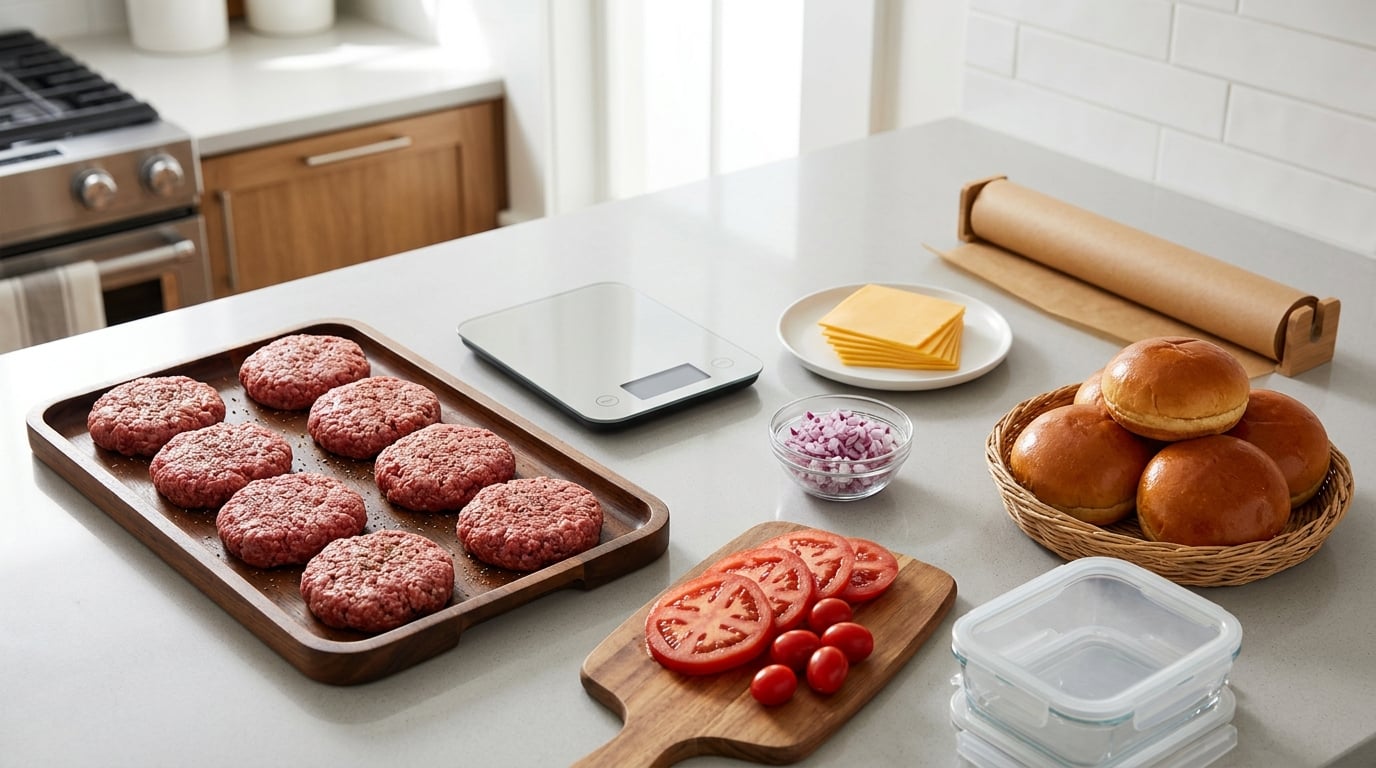
Learning how to make burgers for meal prep is mostly about what happens before the meat hits the pan: form even patties, season lightly, cook them to a safe internal temperature, cool them fast, and store every component on its own. A batch of 10 to 12 patties takes about 45 minutes and covers four or five weekday lunches.
The part most guides skip is storage. Burgers reheat beautifully and freeze well, but only when you control freezing times, container moisture, and the order you stack things. Get those three right and the weekday version tastes nearly identical to a fresh cook.
The short version: form 6-ounce patties about three-quarters of an inch thick, indent the center, season the outside rather than mixing, cook ground beef to 160°F (71°C) and poultry to 165°F (74°C), cool cooked patties before sealing, keep raw patties no more than 1 to 2 days in the fridge, and freeze them airtight for up to three or four months. Buns, sauces and crisp toppings travel separately.
What You Need for Burger Meal Prep
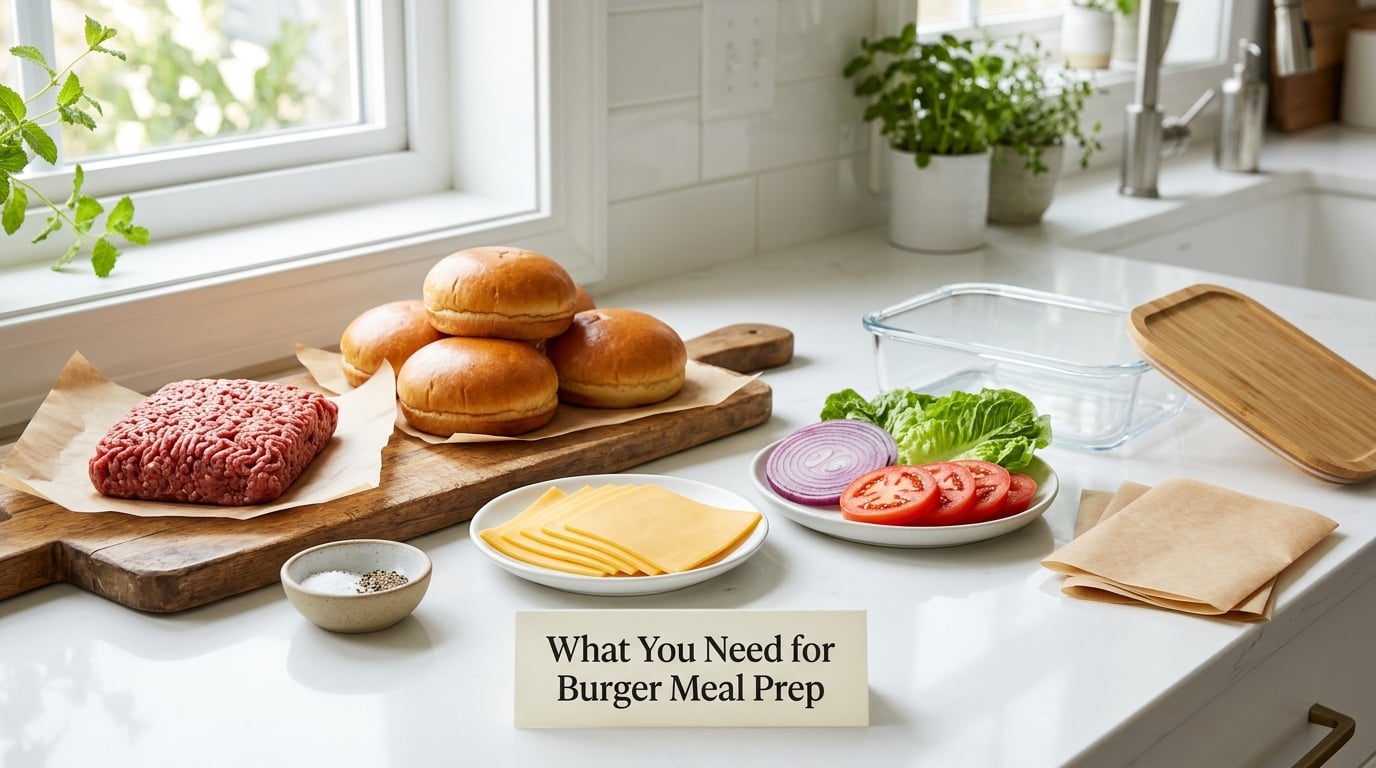
You need very little equipment, and most of it you already own. A digital scale is the one tool that changes the result most, because equal patties cook evenly instead of one drying out while the other stays pink.
The meat
- Ground beef: 80% lean for juicy patties that stay tender after reheating, 90% lean if you prefer a firmer texture.
- Ground turkey or chicken: 93% lean is the usual pick, since anything leaner dries out quickly once it is frozen and reheated.
- Ground pork: around 85% lean, mixed half with beef if you want the flavor to stay mild.
- Veggie or plant-based patties: these freeze acceptably but bind best when pressed firmly and frozen on a tray first.
- Frozen pre-formed patties: useful in a pinch, though they often contain less fat and need a sauce to stay moist.
The binders and seasonings
You do not need egg or breadcrumbs for a good burger. A pinch of salt, black pepper, garlic powder, and a splash of Worcestershire sauce is enough. Breadcrumbs add bulk that dries out after freezing, and egg softens texture over storage time.
If a lean base needs help holding together, a tablespoon of oat flour or almond flour per pound works better than egg. Mix it in lightly with the dry seasonings.
The storage gear
- Parchment or wax paper squares for separating patties
- A rimmed baking sheet for freezing patties individually
- Freezer bags or a rigid airtight container for portioned meals
- Shallow meal-prep containers for daily lunches
- A separate small container for sauces, sized so it fits in the lid
- A permanent marker for labeling bags with contents and the date frozen
How many patties to form
A simple formula works better than guessing: one patty per person per planned meal, plus one spare. Two people eating five days of lunches need 12 patties. One person prepping dinner five nights plus two spare lunches needs 7.
Size each patty at 5 to 6 ounces raw for a standard bun. A very lean base should go slightly heavier, around 7 ounces, because lean meat loses more moisture on reheating. That is roughly a 6-ounce cooked patty.
Step-by-Step: How to Make Burgers for Meal Prep
1. Choose the Right Burger Base
Choose the base by fat content, not by price or by what is on sale. For ground beef, 80% lean gives you a patty that stays juicy through freezing and reheating. Leaner beef is fine for people who like a firmer burger, but expect to add moisture with sauce.
Ground turkey and chicken are the safest all-around choices for a prep week because their flavor is neutral and they pick up whatever seasoning you use. Turkey and chicken are poultry, so they must reach 165°F (74°C) internally. Pork behaves like beef at the same 160°F (71°C) target.
For a batch of 10 patties at 6 ounces each you need about 3.75 pounds of meat. Round your number up and make the extra one, because a spare patty eaten straight from the pan saves you from a future rushed decision.
2. Mix and Season the Meat
Season in two stages. Mix the salt and pepper into the raw meat gently, with your fingertips, using a light touch. Overworking ground meat warms it and breaks down the fat into a paste, and that paste turns rubbery after reheating.
Push a thumb into the center of the lump and turn it over four or five times. The surface should stay slightly rough, not smeared. That rough surface is what gives you a crust in the skillet.
For a classic blend on 3.75 pounds of meat, use about 1 tablespoon of salt, 2 teaspoons of black pepper, 1 tablespoon of garlic powder, and 1 tablespoon of Worcestershire sauce. Taste a raw pinch before forming anything. If it tastes flat when raw, it will taste bland once cooked, since the fat absorbs seasoning during the sear.
Variations take one addition each: smoked paprika and a little brown sugar for a BBQ profile, cumin and chili powder for taco night, or oregano and garlic for an Italian style. Keep the salt level the same when you swap in a flavored blend.
3. Shape Uniform Patties for Meal Prep
Divide the seasoned meat into even balls and press each one into a patty about three-quarters of an inch thick and slightly wider than your bun. Thinner patties cook faster and reheat more evenly; patties over one inch thick cook unevenly and dry out at the edges before the center is done.
Press a shallow indentation into the center of every patty with your thumb. The middle of a burger contracts as it cooks, so the dimple keeps the patty flat instead of turning into a shallow bowl that holds grease.
Lightly wet your fingertips or dust the surface with a little flour before handling the meat. That small step stops the mixture sticking to your hands, which is how most people end up tearing patties instead of shaping them.
4. Chill or Freeze the Patties
Refrigerator storage and freezing are two different systems, and mixing them up is the most common prep mistake. It is also the step where how to make burgers for meal prep usually falls apart, because rushed freezing turns ten patties into one brick.
For next-day or next-two-day use, lay the patties in a single layer on a lined plate or tray, cover, and refrigerate. Use raw ground patties within 1 to 2 days. If you have cooked them first, cooked ground beef keeps 3 to 4 days in the fridge.
For longer storage, lay the raw patties on a parchment-lined tray, leave space between them, and put the tray in the freezer until they are solid, usually about an hour. Then transfer them to freezer bags or a rigid airtight container in meal-sized portions, and label with the contents and date.
Freezing patties flat on a tray first is what stops them bonding into one solid block. Skipping that step is why people find a single frozen brick at the back of the freezer.
5. Cook Burgers to a Safe Internal Temperature
Cook ground meat to 160°F (71°C) and ground poultry to 165°F (74°C), measured at the thickest part with an instant-read thermometer. Color is not a reliable guide, especially on turkey, which can look done well before it is.
For a batch cook, a heavy skillet is the most efficient route. Heat it until a drop of water skates, then sear the patties without crowding, about 3 to 4 minutes on the first side. Press once with a spatula to keep them flat, flip, and finish 3 to 4 minutes more until the thermometer reads target.
A wire rack over a rimmed sheet pan also works well for a large batch, since fat drains away instead of pooling under the patty and steaming the crust. An air fryer at 375°F (190°C) cooks 3 to 4 patties in about 8 to 10 minutes.
You may see a 5-6-7 rule referenced for doneness, which is really just a rough minutes-per-side guide by thickness. Treat it as a starting estimate, not a safety rule. The thermometer decides, every time.
After cooking, rest the patties 3 to 5 minutes, then move them to a rack so steam escapes. Cool them until they are no longer steaming before anything goes into a container. Sealing hot patties traps condensation, and that trapped moisture is what makes a reheated burger taste soggy.
6. Reheat and Assemble During the Week
Thaw frozen patties in the refrigerator overnight, in a bowl on the lowest shelf to catch drips. Cook or reheat straight from thawed, or place frozen patties in the skillet and add a splash of water, then cover until the steam cooks the top and the bottom re-crisps.
Most guides on how to make burgers for meal prep stop at the freezer door. Reheating is the other half, and the method changes the result more than the seasoning does. These are the timings for a thawed single patty:
- Skillet, 2 to 3 minutes per side: the best crust and the most control.
- Air fryer at 375°F (190°C), 5 to 7 minutes: even crispness, close to a fresh cook.
- Oven at 350°F (175°C), 10 to 12 minutes: hands off, and the best option for a whole batch.
- Microwave, 45 to 60 seconds: fastest, but rubbery and unevenly hot.
Warm your buns in the oven for the last 5 minutes of reheating, or toast them in a dry skillet. A cold bun next to a hot patty is the fastest way to get a disappointing meal.
Assemble in this order: bottom bun, sauce spread on the cut face, patty, cheese or crisp toppings, wet toppings like tomato and onion, then the top bun. Keep sauce on the bun rather than on the patty so it does not steam the meat, and add lettuce and tomato only at eating time.
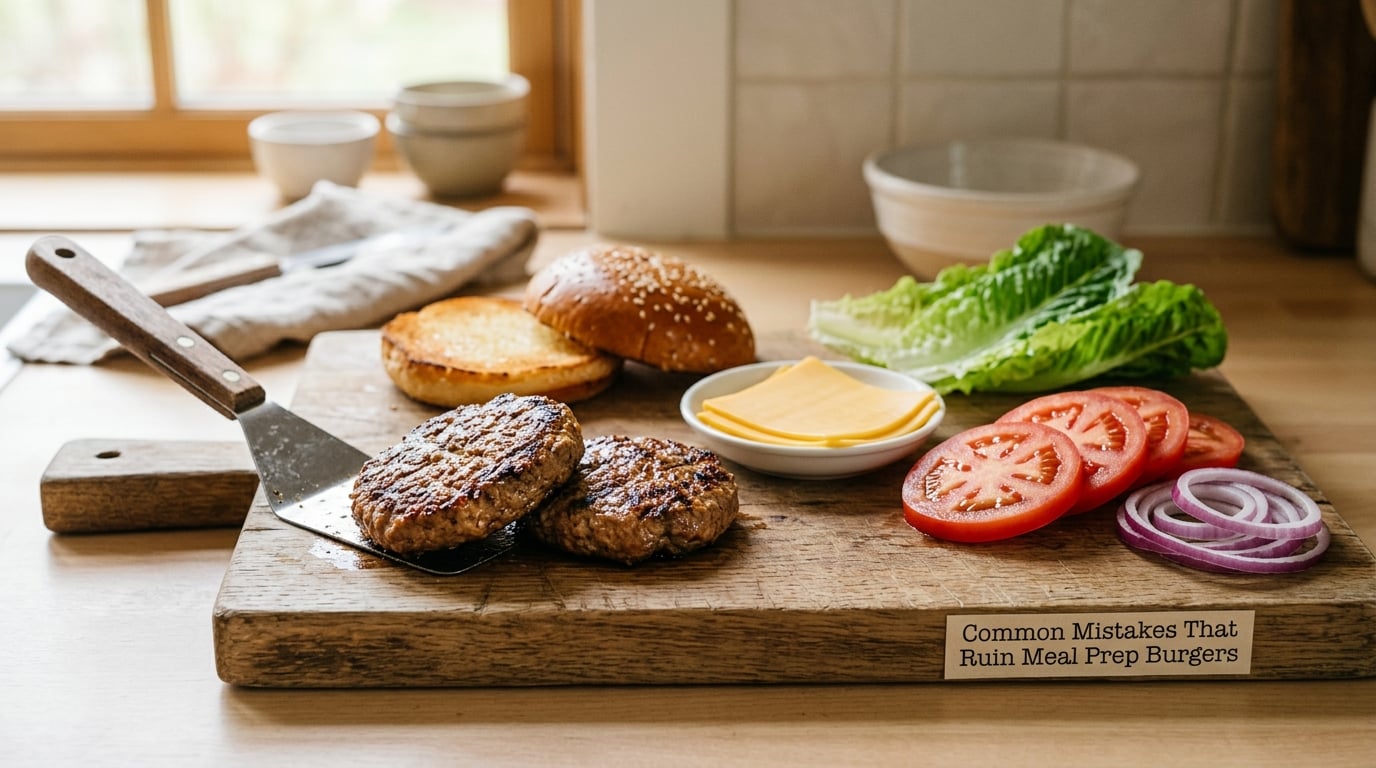
Common Mistakes That Ruin Meal Prep Burgers
Mixing the meat too much
Overworking ground meat warms it and turns the fat into an emulsified paste. Fix it by mixing with fingertips until the seasonings are evenly distributed, then stop while the meat still looks loose and granular.
Making patties that are too thick
A patty more than one inch thick dries at the rim before the middle reaches temperature. Press to about three-quarters of an inch and make them slightly wider than the bun so shrinkage keeps them contained.
Stacking patties before they are solid
Patties stacked warm stick together and tear when separated. Freeze them individually on a lined tray until solid, then bag or box them with parchment between each layer.
Reheating too hard or too long
Ten minutes on high heat turns a patty into a hockey puck. Reheat gently, in batches so a full tray does not cool unevenly, and stop as soon as the center is hot. Covering a skillet patty for the first two minutes keeps it moist.
Adding toppings too early
Sauce, tomato and pickles left on a patty overnight make it soggy by Tuesday. Store every topping separately in the fridge and add it in the minute before you eat, which takes about the same time as opening a container.
Sealing containers while the meat is hot
Warm patties sealed into a container release steam that condenses into water. Cool them uncovered on a rack first, then seal. This also keeps you within safe handling, since you are not trapping warm meat in a closed box for hours.
Storing buns in the fridge
Refrigerated buns turn stale and dry within a day or two, because the starch in bread retrogrades faster when chilled. Freeze buns in a sealed bag and warm them straight from frozen for 3 to 5 minutes at 350°F (175°C).
Cross-contamination during prep
Keep raw patties on their own tray, use a separate plate for cooked ones, and wash hands and surfaces after forming. This matters more in a batch session than in a single dinner, because you touch far more raw meat in one sitting.
Frequently Asked Questions
Can I freeze burger patties before cooking?
Yes, and raw patties freeze better than cooked ones. Raw ground meat keeps its texture for three to four months when frozen airtight, and cooking happens after thawing in the fridge overnight. Form the patties, freeze them individually on a lined tray until solid, then bag or box them with parchment between layers. Season at this stage, and hold off on cheese or other toppings until cooking time.
How many burger patties should I make for meal prep?
Plan one patty per person per meal, plus one spare. Two people covering five weekday lunches need 12 patties; one person prepping five dinners plus two spare lunches needs 7. At 6 ounces raw per patty, that is about 3.75 pounds of meat for 10 patties. Going a little leaner on fat content means going slightly heavier on size, around 7 ounces, to offset moisture loss.
Should I freeze burger patties raw or cooked?
Freeze them raw when you can. Raw patties reheated or cooked from thawed stay juicy, and you control the final sear. Cooked patties are more convenient on the day and keep three to four months, but they dry slightly faster. Either way, cool cooked patties to room temperature before sealing, use an airtight bag or container, remove all air, and label with the date.
How do I reheat frozen burgers without drying them out?
Thaw in the refrigerator overnight, then warm gently. A skillet for 2 to 3 minutes per side gives the best crust, an air fryer at 375u0026deg;F takes 5 to 7 minutes, and a 350u0026deg;F oven takes 10 to 12 minutes. Covering the patty for the first two minutes in a skillet traps steam and keeps moisture in. Save the microwave for last, since it heats unevenly and pushes moisture to the surface.
What toppings can I prep ahead for burger meals?
Prep the sturdy ones and portion the fragile ones. Cheese slices, caramelized onions, grilled peppers and pickles hold fine in the fridge for up to 4 days in separate containers. Keep lettuce, raw tomato slices and avocado out until eating time, since they go watery or brown in storage. Store sauces in a small lidded tub or a silicone cup that fits inside the container lid, and assemble in the order that keeps moisture off the bun.
Can I meal prep burger patties with cheese inside?
You can, but add the cheese during cooking or reheating rather than freezing it inside a raw patty. Cheese melted and refrozen turns grainy and can leak grease into the packaging. If you want a stuffed patty, seal the cheese inside the meat with the seam pinched firmly, skip the center indentation, and cook it slowly to keep the seal intact. Slice the cheese thin so it melts evenly through the center.
Conclusion
If you are new to how to make burgers for meal prep, start with ten 6-ounce patties from about 3.75 pounds of 80% lean ground beef. Freeze them on a lined tray until solid, bag them in meal-sized portions, and label the bags with the date.
Everything that makes a burger good happens at eating time, not prep time. Keep buns in the freezer, keep sauces in a separate small cup, keep lettuce and tomato out of the container, and give the patty a gentle skillet or air fryer reheat. That is the whole system, and it works for a week.