
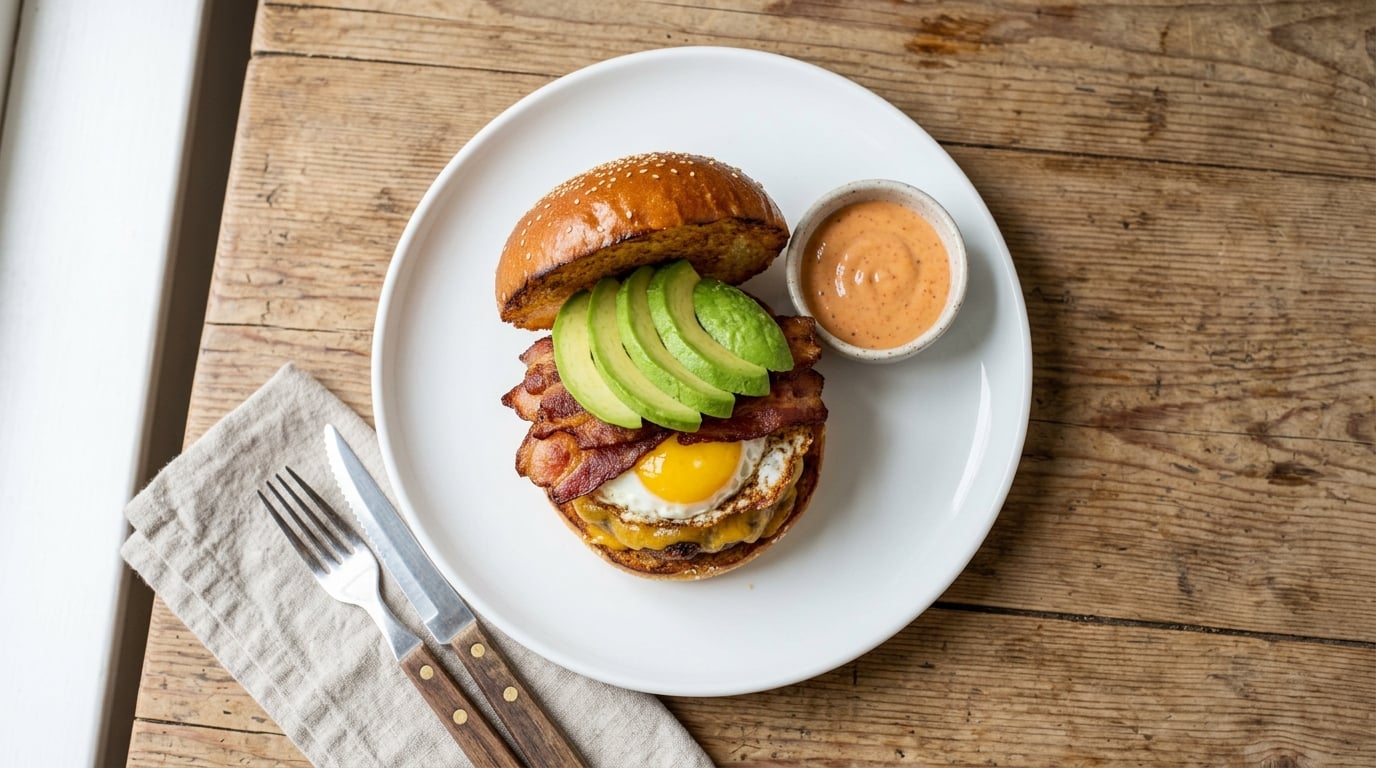
A brunch burger is a cheeseburger built for the weekend table: a beef patty seared hard on the outside, a fried egg on top with a runny yolk, a slice of cheddar or Swiss, and a toasted brioche or potato bun. To make brunch burgers with a fried egg that actually hold together, the egg is the part that decides everything — cook it at medium-low heat so the whites set and the edges go lacy-crisp while the yolk stays liquid, and transfer it onto the burger with a spatula instead of your fingers.
From there it is four jobs: form the beef loosely, sear the patties to 160°F (71°C) inside, toast the buns in butter, and assemble in an order that keeps the stack from sliding apart. Total time is about 30 minutes for two burgers, and the only real technique involved is controlling the egg.
Read on for the ingredient quantities, the timed method, and the fixes for the four failures that come up most — dry patties, cracked yolks, soggy buns, and a stack too tall for the bun. If you are new to this, start with the egg doneness table below; picking over easy or over medium before you heat the pan removes most of the guesswork.
Table of Contents
- What You Need
- Step-by-Step: How to Make Brunch Burgers with a Fried Egg
- Frequently Asked Questions
- Should the fried egg be sunny-side up or over easy for a brunch burger?
- What type of bun works best for a brunch burger with a fried egg?
- Can I prepare brunch burger patties ahead of time?
- How do I keep the egg from breaking when frying it for the burger?
- What cheese pairs best with a beef patty and fried egg?
- How long can I store a brunch burger with a fried egg?
- Conclusion
What You Need
This is the shopping and prep list for two burgers. Quantities are written in US measures with metric in brackets, since recipes get searched from both sides of the Atlantic.
For the patties
- 8 oz ground chuck or an 80/20 ground beef blend (225 g). Chuck gives you flavor and fat; an 80/20 blend is more forgiving if you are new to forming patties.
- 1 tsp kosher salt, plus more for the egg
- 1/2 tsp freshly ground black pepper
- 1 tbsp Worcestershire sauce or a splash of soy sauce (optional, for seasoning depth)
Do not add salt to the raw meat ahead of time. It draws moisture out and the patties turn out dense and gray when they hit the pan. Season them right before they cook, on both sides.
For the egg
- 2 large eggs, the freshest you can buy
- 1 tsp neutral oil such as avocado, canola, or vegetable
- Flaky salt for the top
Fresh eggs really do taste better here, and they hold their shape better in a hot pan because the whites are firmer. If you are serving a crowd and want six yolks still liquid at once, see the note on batch frying below.
For the bun and toppings
- 2 brioche or potato buns — potato buns hold up better under a tall stack
- Unsalted butter for the cut faces
- 2 slices aged white cheddar, Swiss, or American cheese
- 2 strips thick-cut bacon, cooked until crisp, optional
- 1/2 avocado, sliced; 2 tomato slices; a handful of baby spinach
- Two or three crispy hash brown patties, optional
- A sauce of your choice: burger sauce, roasted garlic aioli, salsa verde, hot sauce, or hollandaise
Equipment and the safety line
You need a 12-inch cast iron skillet, a flat-top griddle, or a nonstick skillet; a wide spatula with a thin edge; a wire rack set over a sheet pan; and an instant-read thermometer. That last one is not fussiness. Ground beef has to reach 160°F / 71°C internal and rest for three minutes before serving, and a thermometer is the only reliable way to know without cutting the patty open.
Step-by-Step: How to Make Brunch Burgers with a Fried Egg
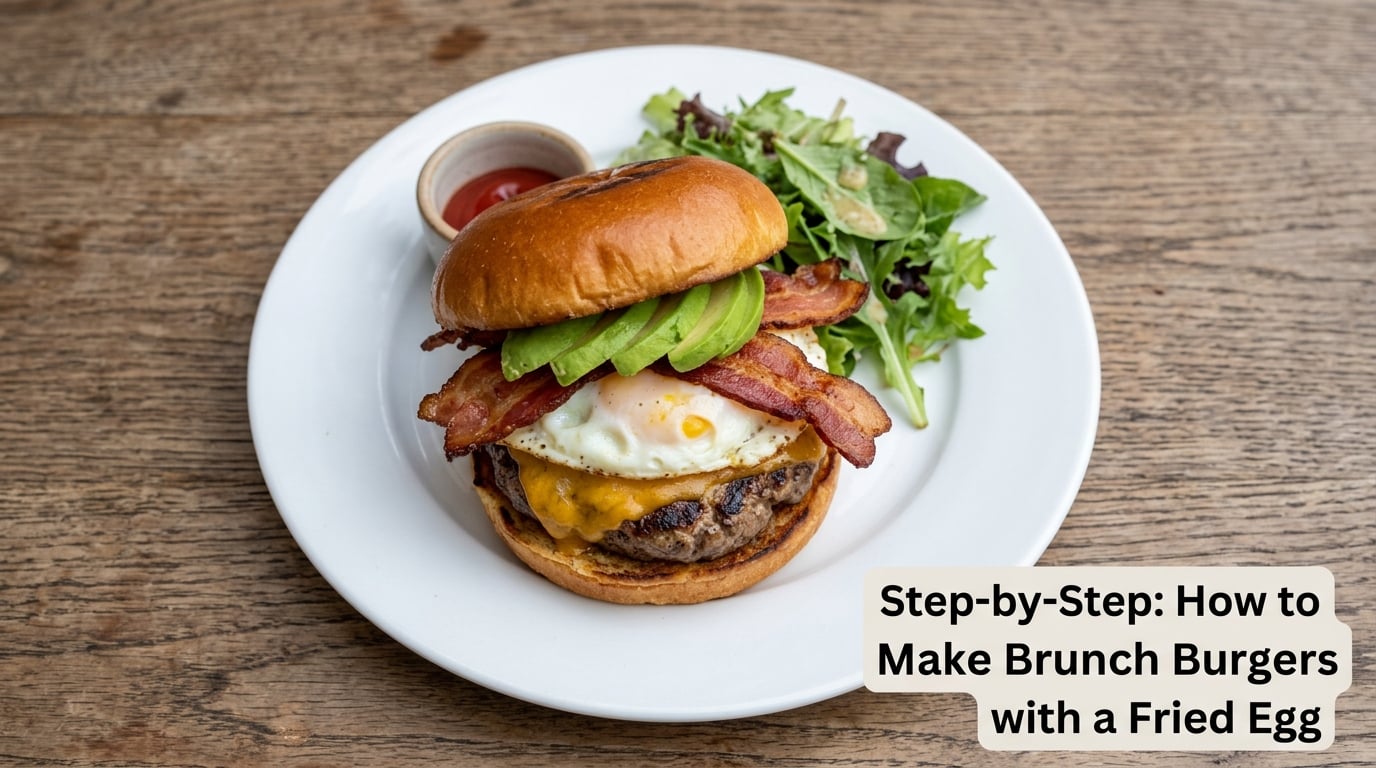
How to Make Brunch Burgers with a Fried Egg: The Method
1. Form the patties loosely and keep them cold. Divide the beef into two 4 oz balls and press each into a 3/4-inch-thick disc, about 4 inches wide so the edges stay inside the bun. Pack gently — the air is what keeps the inside juicy. Make a shallow dimple in the center of each with your thumb so the patty cooks evenly and doesn’t dome up into a hill. Refrigerate the patties while you prep everything else.
2. Sear the patties hard, finish gently. Heat the skillet or griddle over medium-high until a drop of water skitters and evaporates, about 2 minutes. Oil lightly, then lay the patties down and press each one flat for 15 seconds so the edges stay thin. Season with the salt and pepper. Cook undisturbed for 2 to 3 minutes, until the crust is dark brown and you can see rendered fat pooling. Flip and cook 2 to 3 minutes more to reach 160°F (71°C). Add the cheese in the last 30 seconds, laid flat on the patty so it drapes instead of sliding.
That first sear is where flavor comes from, and it is also where the texture comes from — the crust is the contrast to the tender center. On a medium or medium-low start the crust, and the inside cooks too fast and turns to bologna.
3. Fry the egg at medium-low, not high. This is the step people rush. Bring the skillet or a second pan to medium-low heat and add the oil. Crack each egg into a small bowl first and slide it into the pan — a cracked-in-place egg drags shell fragments into the white. Cook without moving it for 90 seconds, until the white is opaque and firm all the way to the edges and the edges have gone lacy and brown.
Slide the spatula fully under the egg, right to the far rim, and lift. For over easy, flip it in the pan, hold it with the spatula for 10 seconds to set the top, then lift it out. For over medium, flip and give it 30 to 45 seconds on the second side, which sets the white and firms the yolk enough to survive the trip. For sunny-side up, don’t flip; cover the pan with a lid for 30 seconds so the top sets without the yolk cooking.
The yolk should still move when you nudge the pan at the end. If it doesn’t, you went one stage too far.
Here is how the styles differ and what each one pairs with:
| Style | Heat | Time | Result | Best pairing |
|---|---|---|---|---|
| Sunny-side up | Medium-low | 2 to 3 min, no flip | Whites opaque with brown lacy edges, yolk liquid and uncovered | Something that cuts the richness: pickled onions, salsa verde, hot sauce, sharp cheddar |
| Over easy | Medium-low | 90 sec, flip, 10 sec | Yolk runs when cut | Sauces on the side; eat immediately |
| Over medium | Medium-low | 90 sec, flip, 30 to 45 sec | Yolk thick and jelly-like, barely moves | The safest choice for a stacked burger — it will not run down the plate |
| Over hard | Medium | 2 to 3 min each side | Fully set, firm yolk | Hearty stacks with bacon and hash browns, or anyone who prefers a dry burger |
4. Toast the buns in butter. Melt a thin film of butter in a second pan over medium heat. Lay the buns cut-side down and toast for 60 to 90 seconds until the cut face is golden and the whole bun smells buttery. Butter the cut faces and toast them while the patties rest — it takes under two minutes and it is the difference between a good burger and a great one.
5. Rest the beef, then assemble. Move the patties to a wire rack over a sheet pan and let them rest 3 minutes. Resting keeps the juice in the meat instead of on the board. Toast the buns last so everything lands on the plate at once.
Build in this order, and the burger keeps its shape:
| Order | Layer | Why it goes here |
|---|---|---|
| 1 | Bottom bun, sauce spread on | Sauce on the flat surface stops it sliding; a thick layer here is all the burger needs |
| 2 | Crispy hash brown patty (optional) | Adds a crisp layer and stops the soft bun from touching the patty |
| 3 | Beef patty with cheese | Cheese melting down the side acts as glue for everything above it |
| 4 | Fried egg, yolk up | Placed flat and centered so the yolk sits in the middle rather than off the edge |
| 5 | Avocado, bacon, spinach | Dry toppings go on above the egg; wet ones go below it |
| 6 | Top bun, sauce on the inside | Seals the stack and protects the egg from the buns above |
6. Serve immediately. A fried egg is at its best in the first few minutes. Pull the burger from the hot skillet to a board, let it sit for a minute — that sets the yolk enough to eat without it running down your hand — then slice it in half with a serrated knife so the cut face shows. Rest before eating, not after.
One honest warning: this is a messy burger. Cooks describe breakfast burgers as a little messy but very good, and they are right. Plate it with a knife and fork, add a stack of napkins, and accept that the first bite will ooze. A runnable yolk is the entire point.
Choosing Toppings and Sauces for a Fried Egg Burger
The egg does the heavy lifting, so the rest of the stack should do one job: add contrast. Here is what each addition actually contributes.
Cheese. Aged white cheddar gives you sharpness that cuts through the yolk. Swiss is milder and melts cleaner, which suits a burger with avocado. American is processed and melts best of all, draping over the patty in a single sheet that holds the egg in place — the practical pick if you are stacking tall.
Bacon. Thick-cut, cooked until the fat is crisp and the edges are hard. It adds salt and crunch, and two strips laid crosswise over the egg stop it shifting. Blot it dry with paper towel first, otherwise the grease soaks the bun.
Avocado. Adds cold, creamy fat that softens the heat of the egg. Slice it thick and press the slices onto the egg — it sticks far better than on a wet patty.
Hash browns. A crispy potato patty under the beef works better than on top, where it falls out on the first bite. Shop-bought frozen patties fried in a little bacon fat for 3 minutes a side are the fastest version.
Tomato and lettuce. Both add water. Put tomato on the bottom bun under the patty, where it will press into the bread rather than slide the egg, and use only a couple of leaves of lettuce. Skip raw onion if the burger is already tall; pickled onions are better because the acid cuts the yolk and they release no moisture.
Sauces. A simple burger sauce — mayo, ketchup, mustard, a splash of pickle brine — is the everyday pick. Roasted garlic aioli or spicy garlic aioli add richness without sweetness. Salsa verde cuts the fat better than anything sweet. Hollandaise is the weekend option; spoon it on the top bun rather than the patty so it does not soak through. If you want maple in there, a thin drizzle on the egg works better than mixing it into a sauce, because syrup poured on a hot patty burns.
The one rule on wet toppings: nothing watery goes between the bun and the patty. Mayo, tomato, and runny yolk all migrate downhill, and that is what turns a great burger into a plate of crumbs.
Common Mistakes and How to Fix Them
The patty comes out dry. Two causes. Overcooking is the first: pull it at 160°F (71°C), not at 165°F, and remember the residual heat keeps cooking it for three minutes on the rack. Overworking the beef is the second: kneading or pressing hard squeezes out the air and the fat. Shape with a light touch, and use 80/20 rather than lean beef, since lean has almost no internal fat to keep things moist.
The yolk breaks. It happens during the pan-to-burger transfer, almost never during cooking. Slide the spatula under the whole egg and lift rather than scooping from the front, keep the pan heat on low while you move, and put a dab of butter or sauce on the burger first so the egg lands on something soft rather than on a hot cheese crust. If you are nervous about it, cook over medium: the yolk firms up enough to survive the trip. Fresh eggs have firmer whites and are easier to flip whole.
The egg falls out of the burger. Structural, not culinary. An over-easy egg on a tall stack has nowhere to sit. Either cook it over medium, or cut the cooked egg in half and lay the halves cut-side up on the patty so two flat surfaces hold it in place. Adding cheese or bacon across the top pins it down.
The bun goes soggy. Toast the cut faces in butter before assembly, put the sauce on the bun rather than the patty, and keep wet toppings low. If the burger is going to sit more than five minutes, hold the components separately and build it at the table.
The burger is pink in the middle. Press a thumb into the thickest part: if it springs back fast, it needs more time. Ground beef needs 160°F (71°C) all the way through with no pink left. A second patty is not a substitute for a thermometer — it takes longer to come up to temperature and it is where thick burgers hide.
The white edges are rubbery instead of crispy. The pan was too hot. High heat coagulates the proteins in the white instantly and they tighten into a chewy sheet. Drop to medium-low, give the pan more time to warm, and use oil rather than butter for the egg — butter burns at the temperature needed for lacy edges. A splash of water into the oil before the egg goes in also slows the cooking and keeps the edges delicate.
The stack is taller than the bun. Count the layers against the bun height before you build. A thick 3/4-inch patty, a slice of cheese, and an egg add up fast. Smash the patty thinner for a breakfast-style burger, use a potato bun or a lettuce wrap instead, or drop one layer. A burger you have to reassemble halfway through eating is not worth the build.
Frequently Asked Questions
Should the fried egg be sunny-side up or over easy for a brunch burger?
Over medium is the safest choice for a stacked brunch burger, because the yolk firms up enough to stay on the patty. Over easy gives you a fully runny yolk and looks the most dramatic, but it runs the moment you cut into it, so serve that version with a knife and fork. Sunny-side up works well when something sharp cuts the richness, such as pickled onion, salsa verde, hot sauce, or aged cheddar.
What type of bun works best for a brunch burger with a fried egg?
A potato bun is the best all-round choice because its sturdier crumb survives the weight of a thick patty, cheese, and an egg. Brioche is softer and sweeter, which works nicely if you keep the stack to a single patty and one topping. For a low-carb version, use a lettuce cup or a keto bun, and skip the fried egg in favor of a single sunny-side-up portion so the stack stays short.
Can I prepare brunch burger patties ahead of time?
Yes. Form the patties up to two days ahead, press out any air pockets, and lay them on a parchment-lined tray with parchment between each one. Refrigerate for up to two days or freeze for up to three months. Cook them straight from the fridge on a hot griddle rather than letting them come to room temperature, which keeps the edges thin and crisp instead of steaming.
How do I keep the egg from breaking when frying it for the burger?
Crack the egg into a small bowl first and slide it into the pan, which keeps shell fragments out and avoids a broken yolk at the start. Slide a thin-edged spatula fully under the egg to the far rim of the pan and lift it straight up rather than scooping from the front. Cook over medium for a stiffer yolk if you are stacking a tall burger, and keep the pan on low while you move the egg to the bun.
What cheese pairs best with a beef patty and fried egg?
Aged white cheddar is the best overall match, since its sharpness cuts through the richness of the yolk. Swiss is milder and melts cleanly, which suits a burger topped with avocado. American cheese is the most forgiving option for a tall stack because it melts into one drape that holds the egg against the patty. Avoid strongly flavored blue or goat cheese, which competes with both the beef and the egg.
How long can I store a brunch burger with a fried egg?
Store the components separately and the fridge will keep them for three to four days, which matches the guidance for cooked ground beef. Keep the fried egg in a sealed container on its own, since its texture changes once it cools and reheating makes the white rubbery. Reheat the patty and bun in a dry pan, then add a fresh egg cooked to order, which is faster and better than reheating the whole assembled burger.
Conclusion
Start with the egg. Heat the pan to medium-low, give it 90 seconds without touching it, and choose over medium if you are stacking more than three layers. Everything else follows from that: the patties go on a hot griddle for 2 to 3 minutes a side until they hit 160°F (71°C), the buns toast in butter while the beef rests, and assembly happens in one minute at the table.
The single cue that tells you the burger is right is a yolk that wobbles when you nudge the pan but is still liquid at the center. Cook it one stage less than you think you should, put a fork in your hand, and eat it before the bun gives up.