
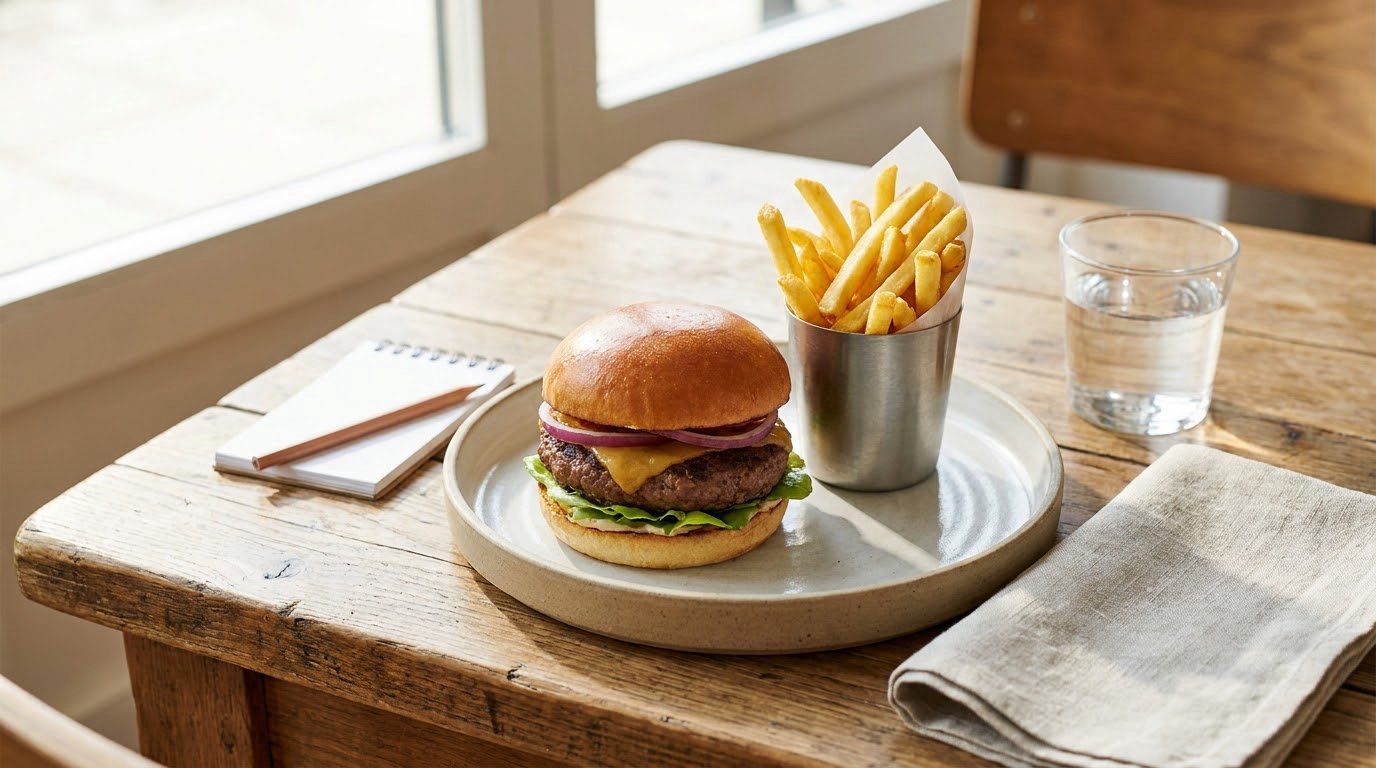
To order a burger at a restaurant like a pro, make your choices in a fixed sequence: patty style, doneness, cheese, toppings, bun, then sauce, and say the whole thing in one short order. It takes about fifteen seconds once you know the vocabulary, and it is the difference between a dry puck and a burger you think about afterward.
Most disappointing restaurant burgers are not badly cooked. They are undecided ones, where nobody specified a doneness, nobody asked for the cheese to go on while the patty was still hot, and the sauce went on the bun an hour before you took the first bite. Fix the order and the food usually follows.
What You Need
You need four decisions made before the server reaches you, plus the menu in front of you. Deciding them in advance is what turns a hesitant “uhh, I’ll just get the cheeseburger” into something that sounds deliberate.
1. The menu, read once, slowly. Look at three things before the toppings: what kind of patty they cook, how thick it is, and how the kitchen describes it. A menu that says smashed, griddled, thin, or double is telling you how the burger will behave on the plate.
2. Patty-style vocabulary. Smashed patties are thin, cooked fast on a hot flat top, and come out crisp-edged with a juicy middle. Thick diner patties are seared and finished slower, and they hold up to heavy toppings. Thin griddled patties sit between the two. Double means two patties, which usually means less bread per bite of beef, not twice the flavor.
3. A doneness decision. Decide this before you sit down, not while flipping through the menu. You are choosing a word and, behind it, a target temperature. The table in Step 3 maps both.
4. A toppings and sides plan. Pick at most one wet topping, one crisp topping, and one strong-flavored topping. Then decide whether you want a side that is fried, salad-style, or none at all, because adding a side late is how the meal turns into too much food.
Last updated October 2026.
Step-by-Step: How to Order a Burger at a Restaurant Like a Pro
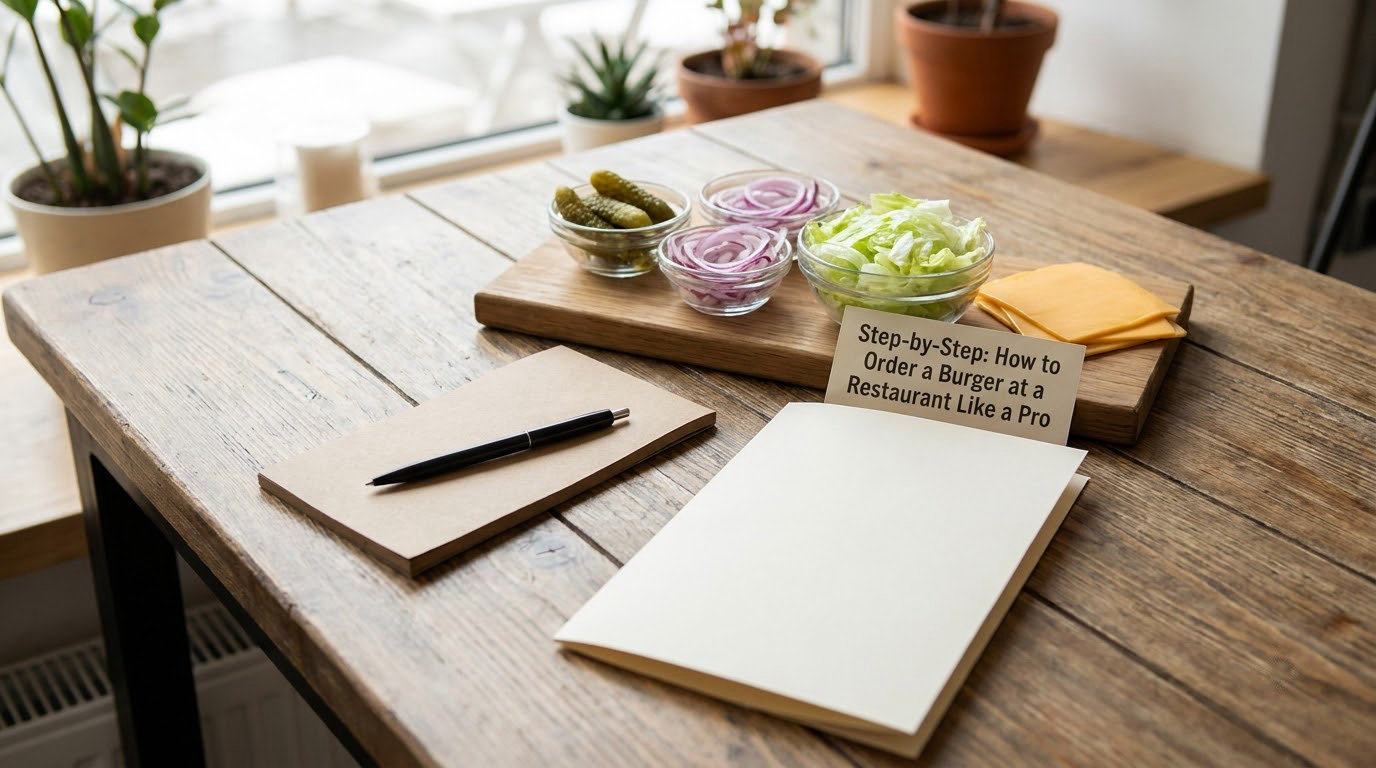
The sequence matters because the kitchen fires items in the order you give them. Say the patty first, then doneness, then cheese, then toppings, then bun, then sauce and sides, and finish by asking your one real question. Here is the full order, one step at a time.
Step 1: Read the Menu Before You Order
Read for patty type, patty weight, cooking method, cheese, sauces, sides, and substitutions before you open your mouth to the server. Menus tell you more than servers can, because a server repeats a list while a menu explains it.
Three phrases on a burger menu are worth slowing down for. Smashed means a thin ball pressed on a very hot flat top, usually for a short time, which produces lacy crisp edges and a soft center. Griddled means a thicker patty cooked on a flat top with more time, which gives you a denser, more substantial burger. Special or signature means a fixed recipe, so treat it as a starting point and ask what can change.
Also check whether the kitchen fries, grills, or both. A burger that travels from a grill has a deeper char; a griddled one has a broad browned crust and more rendered fat on the surface. Neither is better, but they are not the same experience.
Step 2: Choose the Burger and Patty
Choose the patty first, then the burger around it. A plain single patty is the cleanest place to taste what the kitchen actually does, and it is the safest choice if it is your first visit.
Go richer and heavier when you want the patty to carry the meal: a double, a thick diner patty, or a build-your-own with cheese and bacon. Go leaner when you want the toppings to lead, which usually means a single patty, lettuce and tomato, and a sauce you can taste through.
Ask the server one question if the menu is vague: is the patty smashed or thick? It is a normal question, it takes one second, and it tells you more about the burger than the name of the sandwich does.
Step 3: Choose the Right Doneness
State the doneness plainly, and expect to ask one step rarer than you actually want, because griddles and flat tops run hot and kitchens undercook against the request more often than they overcook.
Ask for it by name, one step rarer than your target, and expect the burger to land where you wanted it. For ground beef, the USDA food safety guidance puts the safe minimum internal temperature at 160°F, or 71°C, no matter which word you use.
| What you say | Internal temperature | What you get at a hot griddle |
|---|---|---|
| Rare | 130°F / 54°C | Still pink in the middle, which is below the safe minimum for ground beef |
| Medium-rare | 135°F / 57°C | Pink center with a cooked edge; not a real option on a thin smash patty |
| Medium | 145°F / 63°C | Pink, firm, and juicy. The most common request and the one most often overcooked |
| Medium-well | 155°F / 68°C | Mostly brown with a hint of pink, drier but dependable |
| Well-done | 160°F / 71°C | Fully brown, the safe minimum for ground beef, and drier on a thin patty |
The practical rule most experienced diners use: order one step rarer than the doneness you want. Ask for medium-rare and you will usually get a solid medium. Ask for medium and you will frequently get something close to raw, which is the complaint that shows up again and again in diner discussions online, and the reason so many people defensively order well-done and then wonder why the patty is dry.
Thin smash patties change the math. They cook in under a minute, so rare and medium-rare rarely survive the pan. Order those medium at most, or ask whether the kitchen can hold a smash patty rarer. Thick diner patties are more forgiving and can handle a request one step further.
Step 4: Add Toppings Without Overloading the Burger
Add toppings in three groups, and pick at most one from each: something wet, something crisp, and something with a strong flavor. Three well-chosen toppings beat six that fight each other.
Wet toppings are tomatoes, pickles, grilled onions, and sauces. Crisp toppings are lettuce, shredded cabbage, and raw onion. Strong flavors are bacon, jalapeños, blue cheese, and sharp cheddar. The reason for the limit is structural: every wet layer pushes moisture into the bun, and a bun that gives way halfway through the burger is worse than a burger with fewer toppings.
If you want the full load, ask for it packed separately. Hold the lettuce and tomato is standard shorthand, and servers read it instantly. Add toppings at the table yourself and the burger keeps its structure to the last bite.
Cheese is technically a topping and it deserves its own decision. American and cheddar melt cleanly and give you the melty patty-to-bun contact most people are after. Provolone and Swiss melt well and add sharpness. Blue cheese does not melt so much as soften, which is a different texture and an acquired taste. Ask for the cheese to go on while the patty is still hot, and ask for the bun toasted if the menu offers it.
Step 5: Order Sauces and Extras With Intention
Ask for sauce on the side whenever the sauce is thick or sweet, because a mayo-based special sauce on a toasted bun starts soaking the bread before the burger reaches the table. Ketchup and mustard are thin enough to go on the burger directly, and for most people that is where they belong.
Where to put the sauce matters as much as which sauce. Mayo and special sauce go on the bottom bun, directly on the meat. Ketchup goes on the patty. Mustard goes on the bun before the patty, so it seasons the meat instead of sliding off it.
Pick sides that add something rather than repeat starch. A burger with a rich patty and cheese wants something acidic or cold, which is why a side salad, slaw, or fried pickles works better than a second basket of fries. A plain single patty can carry fries. Add extras like bacon or an extra patty only when the base burger is deliberately plain, since they cover the flavor of what the kitchen does well.
The whole order, in one breath, sounds like this: single smashed patty, medium, American cheese, no pickles, lettuce and tomato on the side, sauce on the side, and fries. Fifteen seconds, no waffling, and the kitchen can fire it.
Step 6: Confirm the Order and Ask Relevant Questions
Say the order back to your server in the same sequence and ask one question that actually changes what arrives. Repeating it catches the one detail you rushed through, which is usually the doneness.
Useful questions: whether the patty is smashed or thick, whether the cheese is American or something else, whether the sauce is house-made, and whether the bun is toasted. If you have an allergy, ask a specific question about the bun, the sauce, and the fryer, because a shared griddle is a real risk with most burgers and only some kitchens handle it.
For allergies, say it plainly and early: I have a shellfish allergy, is there shellfish in the sauce or the fryer oil? Vague phrasing gets vague answers. Servers are not judging you; they need an accurate ticket and a fair warning, and the ones who work a dinner rush appreciate the direct version because it is faster than negotiating in the middle of a queue.
At a counter, ordering is faster and simpler: the person taking the order is often the one cooking it, so questions are easier and modifications are cheaper. At a table with table service, the same sequence works, and asking for sauce on the side or extra napkins costs nothing.
Common Mistakes
Ignoring what the menu says. If the menu says the patties are smashed thin patties, ordering medium-rare is a request the kitchen cannot honor. Read the specifications, then order within them.
Asking for doneness the kitchen will not deliver. Requesting rare on a griddled thin patty gets you a burger that is undercooked near the middle. The fix is to shift up one step, not to keep insisting.
Adding every topping. Six toppings means a soggy bun and a burger that falls apart. The fix is one wet, one crisp, one strong, and the rest on request.
Forgetting the sauce question entirely. The default sauce on a house burger is often sweet and heavy, which buries a good patty. The fix is to ask for it on the side and control the amount yourself.
Failing to mention allergies clearly. Saying I am sensitive to dairy when you need to avoid milk in the bun and the sauce leaves a gap. Name the specific allergen and name the items that matter: bun, cheese, sauce, fryer.
Not saying anything when the burger is wrong. Waiting until you have eaten half of it makes it harder, not easier. The fix is to say so as soon as you take a bite, calmly and specifically: this is well-done, I asked for medium.
Two smaller habits help more than they sound. Order your side at the same time as the burger instead of flagging the server down again, and if the kitchen offers a build-your-own counter where you assemble the burger yourself, use it, because that is the only situation where you control the stacking order.
Frequently Asked Questions
How do you order a burger at a restaurant?
Say your order in a fixed sequence: patty, doneness, cheese, toppings, bun, then sauce and sides. A complete order sounds like this: single smashed patty, medium, American cheese, no pickles, lettuce and tomato on the side, sauce on the side, and fries. Read the menu for patty type first, decide before the server arrives, and repeat the order back so any detail you rushed through gets caught.
What is the best burger doneness to request?
Medium, ordered as medium-rare. Flat tops and griddles run hot, and kitchens undercook against the request more often than they overcook, so asking one step rarer than you want lands on the doneness you actually prefer. For ground beef the USDA safe minimum internal temperature is 160u0026deg;F, or 71u0026deg;C. Thin smash patties cook so fast that medium-rare is rarely available, so ask for medium there.
Should I ask for burger sauces on the side?
Yes, if the sauce is thick or sweet, such as a mayonnaise-based special sauce. On a toasted bun it starts soaking the bread before you take the first bite. Ketchup and mustard are thin enough to go straight on. Mayo and special sauce belong on the bottom bun against the meat, ketchup on the patty, and mustard on the bun under it so the flavor stays with the burger.
How do you order a burger with specific toppings?
Name the changes as you order, not afterward: no pickles, no onion, add jalapeños. The shorthand most kitchens read instantly is hold the lettuce and tomato, which arrives packed on the side so you add it yourself and the bun stays intact. Ask for extra toppings packed separately too. Keep it to one wet, one crisp, and one strong flavor, since more than that turns a burger into a pile.
What should I ask about burger allergens?
Ask about the specific items that carry the risk: the bun, the cheese, the sauce, and the fryer oil. Dairy, egg, gluten, sesame, and shellfish appear in all four places, and most kitchens share one griddle. Phrase it as a direct question, such as asking whether there is shellfish in the sauce or in the fryer, rather than saying you are sensitive to something. Say it at the start of the order, before the ticket is fired.
What can I do if my burger order is wrong?
Say something the moment you notice, before you eat much of it, and keep it factual: this is well-done, I asked for medium. A missing or wrongly cooked item is an easy fix for a kitchen, and servers would rather hear it in the first two minutes than after half the burger is gone. Toppings and sauces are usually corrected instantly. A wrong doneness sometimes means a remake, and that is normal in a place that cares about its food.
Conclusion
Start with the burger style and the patty, since every other decision hangs off that: a thick diner patty takes heavy toppings, a thin smash patty wants a simple build. Then customize only what improves the flavor or the texture, like sauce on the side and toppings packed separately, and say it all in one short order. Master that and how to order a burger at a restaurant like a pro stops being a question.