
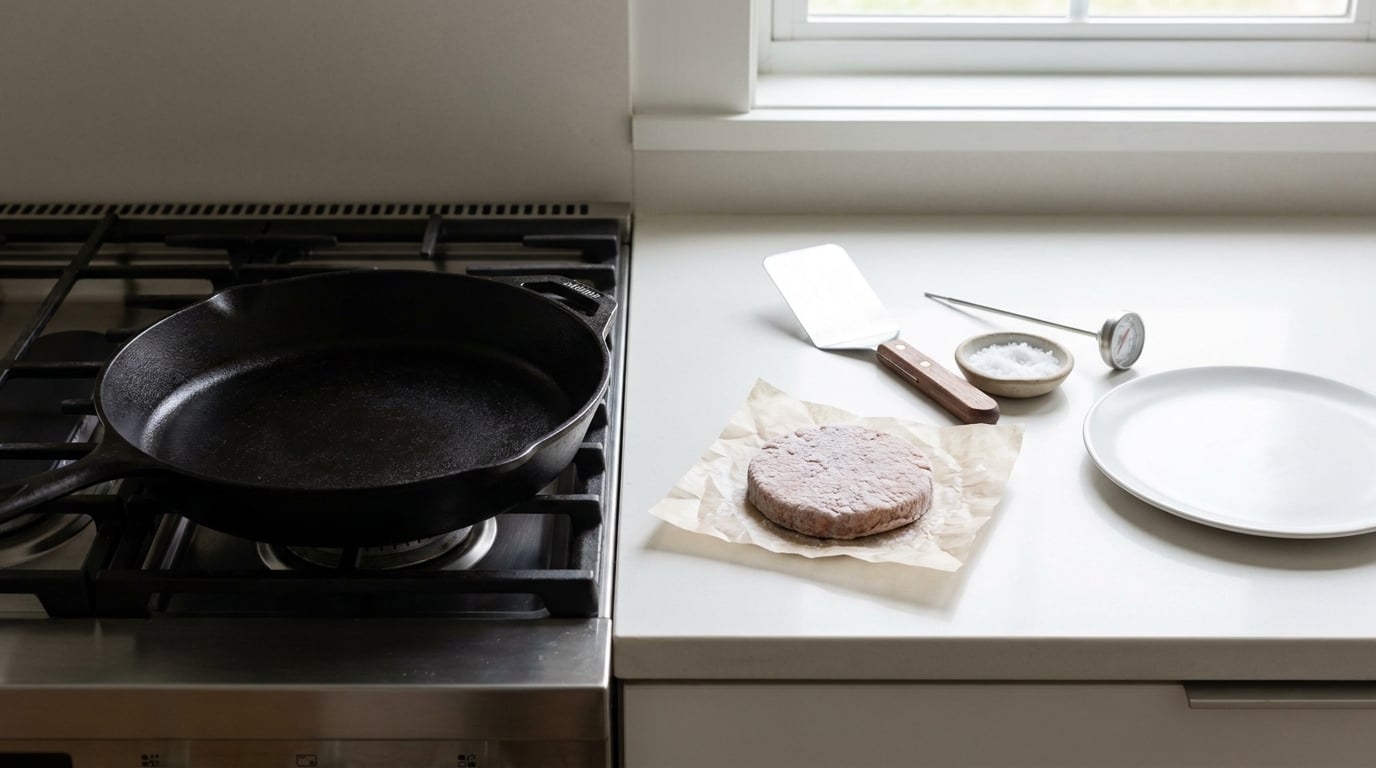
Yes, you can cook frozen burger patties straight from the freezer with no thawing at all, and the stovetop version takes about 10 to 15 minutes. How to cook frozen burger patties without thawing comes down to one move: put the patty on a hot pan and give it time, because a frozen center needs a gentle finish to reach a safe 160°F (71°C) before the crust burns.
Most of the “my burger was raw in the middle” disasters I have seen came from thawing patties on the counter for an hour and then slamming them into a screaming-hot skillet. From frozen, the math actually works in your favor. The outside sears first and forms a crust that slows moisture loss, while the inside has a built-in buffer of time before it can overcook.
Below is the full method, plus times for the grill, oven and air fryer, and the small set of mistakes that turn a good frozen patty into a hockey puck.
Table of Contents
- What You Need
- Step-by-Step
- Common Mistakes
- Frequently Asked Questions
- Can you cook a burger patty from frozen without thawing it first?
- How long does it take to cook frozen burger patties in a skillet?
- Should I season frozen burger patties before cooking them?
- Can I cook frozen burger patties on a grill?
- Can an air fryer cook frozen burger patties without thawing?
- How do I know frozen burger patties are fully cooked?
- Conclusion
What You Need
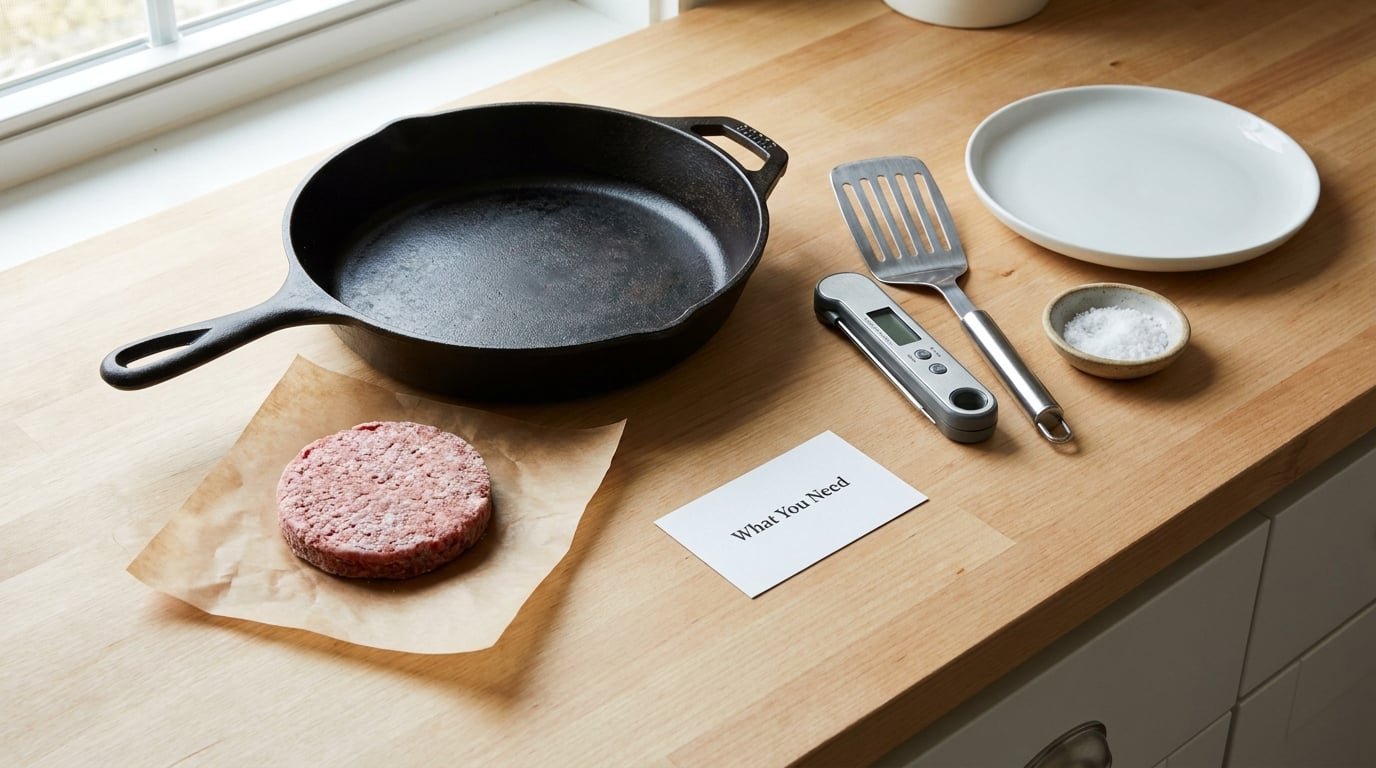
The list is short because nothing here is special equipment. You need a heavy pan, a working thermometer, and about 15 minutes of patience.
- The frozen patties. Straight from the freezer or the coldest part of the fridge, still solid or with a little ice at the edges.
- A heavy skillet. Cast iron or stainless steel gives more even heat than a thin nonstick pan, which matters for a thick frozen patty.
- A splash of oil. Neutral oil or a light coating of nonstick spray keeps the patty from welding itself to the surface in the first minute.
- Salt and pepper. More on when to add these than what to use.
- An instant-read thermometer. A cheap stick probe is the difference between a guess and a cooked patty.
- A metal spatula and a plate or rack for the finished burgers.
A lid is optional for the technique but genuinely useful, and it is the single change that turns a decent frozen burger into a good one. A glass lid lets you watch without lifting, which means less heat loss and less tearing.
Step-by-Step
Here is the master timing table first, so you can find your patty before you heat anything. Times are total cooking time from frozen, and the flip point is included for thick patties.
| Patty weight | Stovetop skillet | Grill | Oven at 425°F | Air fryer at 360°F |
|---|---|---|---|---|
| 1/4 lb (thin slider) | 8-10 min, no flip needed | 6-8 min, one flip | 16-18 min | 8-10 min, flip at 5 |
| 1/3 lb (standard) | 10-12 min, flip at 4-5 | 10-12 min, flip at 4 | 20-25 min, flip at 10 | 12-15 min, flip at 7 |
| 1/2 lb (thick) | 12-15 min, flip at 5, lid 3-4 min | 14-16 min, flip every 4-5 | 22-26 min, flip at 12 | 14-18 min, flip at 8 |
| 3/4 lb (jumbo) | 18-22 min, flip at 7, lid 5-6 min | 18-22 min, flip every 5 | 28-32 min, flip at 15 | 20-24 min, flip at 10 |
These are starting points, not gospel. A patty that is 90% meat behaves differently from one that is 80% meat and 20% soy protein, and a freezer that runs cold gives you a firmer patty than one at zero. The thermometer is how you resolve the difference in about ten seconds.
How to Cook Frozen Burger Patties Without Thawing in a Skillet
This is the default method, and it is the one that works in a dorm room, a hotel pan or a cast iron skillet that has not been fired in a decade. Cast iron heats evenly and holds it, which is exactly what a frozen center needs.
- Heat the pan to medium-high. Put a drizzle of oil in and let it shimmer. A properly hot pan is one where a drop of water skitters and then vanishes, not one that is smoking. You are looking for a fast, hard sear, not a frying fire.
- Place the patties down frozen and spaced apart. Leave about a finger of room between them. If they touch, they steam each other and the bottoms go pale and gray. Crowding is the most common reason a batch of frozen burgers looks sad on a plate.
- Do not touch them for the first 3 to 4 minutes. This is the part everybody gets wrong. A frozen patty is not going to fall apart the way thawed ground beef does, so it stays glued to the pan long enough to build a real crust. The crust is what keeps the inside juicy.
- Flip when it releases on its own. Slide the spatula under the edge and give a small nudge. If the patty moves freely and the underside is deep brown, turn it. If it is still sticking, it is not ready, and forcing it is how patties tear in half.
- Drop to medium-low and finish covered. Put the lid on and give it 3 to 4 more minutes for a 1/2 lb patty. The trapped steam cooks the center gently while the crust is protected from the burner. This is the step that separates a juicy burger from a dry one.
- Check the center before you serve. Probe the thickest part and read 160°F (71°C). USDA guidance for ground beef is 160°F as the safe minimum, and there is no substitute for measuring.
The whole sequence is about 10 to 15 minutes for a standard 1/3 lb patty. A home cook on the NoStupidQuestions thread described a longer, gentler version of the same idea: medium-low heat, a flip every six minutes, about 24 minutes total, and the pan covered for the first 12. It takes longer, but the numbers work the same way in reverse, more ambient heat and more time with the lid on.
Season at the flip, not at the start. Salt applied to a frozen, wet surface mostly slides into the melting ice and then into the pan, and you end up with salty drippings and a bland top. Flip, then salt and pepper the seared side while the patty is still hot and wet with rendered fat. Dry rubs and garlic powder, onion powder or paprika work best at the same moment, right after the turn.
How to Adapt Frozen Patties for a Grill or Oven
The same logic applies to both, only the heat comes from a different direction. You still want a hard sear first, then a gentler finish, and you still need space between patties.
On a grill
Set up two zones. Put the patties on the hot side over medium-high coals, a couple of inches from the direct flame, and leave them alone for 4 to 5 minutes. A frozen patty hitting a screaming-hot grill at close range is how you get a black crust wrapped around a frozen core, which is the exact complaint that keeps coming up on grilling forums.
Flip every 4 to 5 minutes on the first side, then move them to the cooler indirect side to finish. A cast iron grate or a sheet pan set on the indirect side does a great job here, since it turns the indirect side into a slow oven. Add cheese in the final minute, right before you pull them, so it melts without sliding off.
A long-running debate on BBQ Brethren settled on the same answer it usually does: yes, you can grill a frozen patty, as long as you give it a flip cadence and a two-zone finish instead of leaving it over direct heat until it is done.
In the oven
Heat the oven to 425°F and put a wire rack on a lined sheet pan. The rack is the whole trick. A patty sitting directly on the pan sits in rendered fat and stews on the bottom while the top dries out, and the rack lifts it into moving air so the underside cooks like the top does.
Bake a 1/3 lb patty for 20 to 25 minutes, flipping at the halfway mark so both sides brown. Thicker patties need closer to 30, and thin sliders are done well before that. The oven is the best method for feeding a crowd because you cook eight patties on one pan in a single layer and walk away.
Line the pan with parchment rather than bare foil if you have it, and expect some spatter from frozen patties because the ice on the surface flashes into steam on contact.
On a flat-top griddle, the same rules apply with more room: medium-high heat, a thin coat of oil, flip every 3 to 4 minutes, and finish on a lower or cooler section. A full Blackstone surface means crowding is your problem to manage, so cook in batches of four or six rather than laying out everything at once.
Common Mistakes
Every failure below has a straightforward cause, and once you know the cause the fix is boring and reliable.
Crowding the pan
Four patties touching in a 12-inch skillet is three patties and a steam oven. Leave a finger of width between each one, and cook in batches if the pan is small. An air fryer has the same rule, with the added note that shaking the basket mid-cook can send the cheese sliding off.
Using a cold or a smoking-hot pan
A cold pan slowly warms, the patty sits in its own meltwater, and you get a pale grey exterior. A smoking-hot pan burns the outside in two minutes while the center is still ice. Medium-high with shimmering oil is the window you want.
Flipping too early
Resist the urge to flip at two minutes. Every early flip costs you crust and risks tearing the patty, and frozen patties are far more forgiving than thawed ones. Wait until it releases on its own.
Pulling the patty before 160°F
Color is not doneness. Ground beef needs 160°F (71°C) at the center as the safe minimum, and a pink-looking patty can still be under while a brown one is not. Probe the thickest part, not the edge, where the temperature always runs higher.
Microwaving a frozen patty for dinner
A microwave will cook a frozen patty, and the texture comes out rubbery and uneven, with a cold ring near the center. It is fine as a last-minute melt-then-sear shortcut, but it is not a standalone method if you care about how the burger tastes.
Seasoning before cooking
Dry seasoning applied to a frosted surface will not stick. Season right after the flip, onto the hot seared side, where there is fat and moisture for it to grab onto.
Forgetting to let it rest
Carryover cooking keeps working in your favor off the heat. A two to three minute rest after you pull the patty lets the temperature even out, and the juices stop fleeing the moment you cut it.
On doneness, the general target is simple: rare is about 130°F, medium-rare around 140°F, medium 150°F, medium-well 155°F, and well-done at 160°F (71°C). For a frozen patty, well-done is the sensible target because the ice in the center gives you a much bigger gap between surface and interior temperature than a thawed patty ever will, and 145°F is a safe temperature for intact cuts of beef, not for ground meat that has been chopped up.
For serving, toast the bun in the rendered fat in the pan for the last 30 seconds, and add the cheese while the patty is still on the heat. For storage, cooked patties keep three to four days in the fridge in an airtight container, and reheating in a dry skillet over medium heat for three to four minutes per side brings back the crust that the fridge flattened out.
Frequently Asked Questions
Can you cook a burger patty from frozen without thawing it first?
Yes, and it is the better way to cook frozen patties in most cases. A hard sear forms a crust that holds moisture in, while the frozen center gives you extra time before the interior can overcook. Give it a medium-high pan, leave it alone for 3 to 4 minutes before the first flip, then check for 160°F (71°C) at the center.
How long does it take to cook frozen burger patties in a skillet?
Plan on 10 to 12 minutes for a standard 1/3 lb patty and 12 to 15 minutes for a thick 1/2 lb one. That covers roughly 4 minutes of sear on the first side, a flip, then 3 to 4 minutes covered on low to steam the center through. Thin 1/4 lb sliders finish in 8 to 10 minutes and usually need only one flip.
Should I season frozen burger patties before cooking them?
Not before. Salt and dry seasoning applied to a frosted surface slide into the meltwater and end up in the pan instead of on the burger. Season instead right after you flip the patty, while the seared side is still hot and wet with rendered fat. That is when garlic powder, onion powder, paprika or a coarse salt will actually adhere.
Can I cook frozen burger patties on a grill?
Yes. Set up two zones, cook on the hot side over medium-high heat for 4 to 5 minutes per side, then move the patties to the cooler indirect side to finish. Flip every 4 to 5 minutes rather than leaving them over direct heat, and expect 10 to 12 minutes total for a 1/3 lb patty. Add cheese in the final minute off direct heat.
Can an air fryer cook frozen burger patties without thawing?
Yes, and it is the fastest hands-off method. Air fryers vary, so start at 360°F with no preheat, cook 5 minutes, season the tops, flip, then cook 3 to 5 more minutes. Some recipes call for preheating to 370°F, which gives a darker crust but dries thin patties faster. Keep patties in a single layer with space between them.
How do I know frozen burger patties are fully cooked?
Use an instant-read thermometer in the thickest part of the patty, not the edge. Ground beef is safe at 160°F (71°C) internal temperature per USDA guidance. If you are cooking a turkey or chicken patty, the target is higher at 165°F (74°C). The center of a frozen patty is the last place to heat, so test the middle rather than judging by color.
Conclusion
Start here: get a heavy skillet to medium-high, add a little oil, and put the frozen patties down spaced apart. Leave them alone for 4 minutes, flip when they release on their own, then drop the heat, put the lid on and give it 3 to 4 more minutes.
That is the whole method behind how to cook frozen burger patties without thawing, and the same rules carry over to a grill, an oven or an air fryer. Sear hard first, finish gently, and probe the center for 160°F (71°C) before the patty goes anywhere near a bun.