
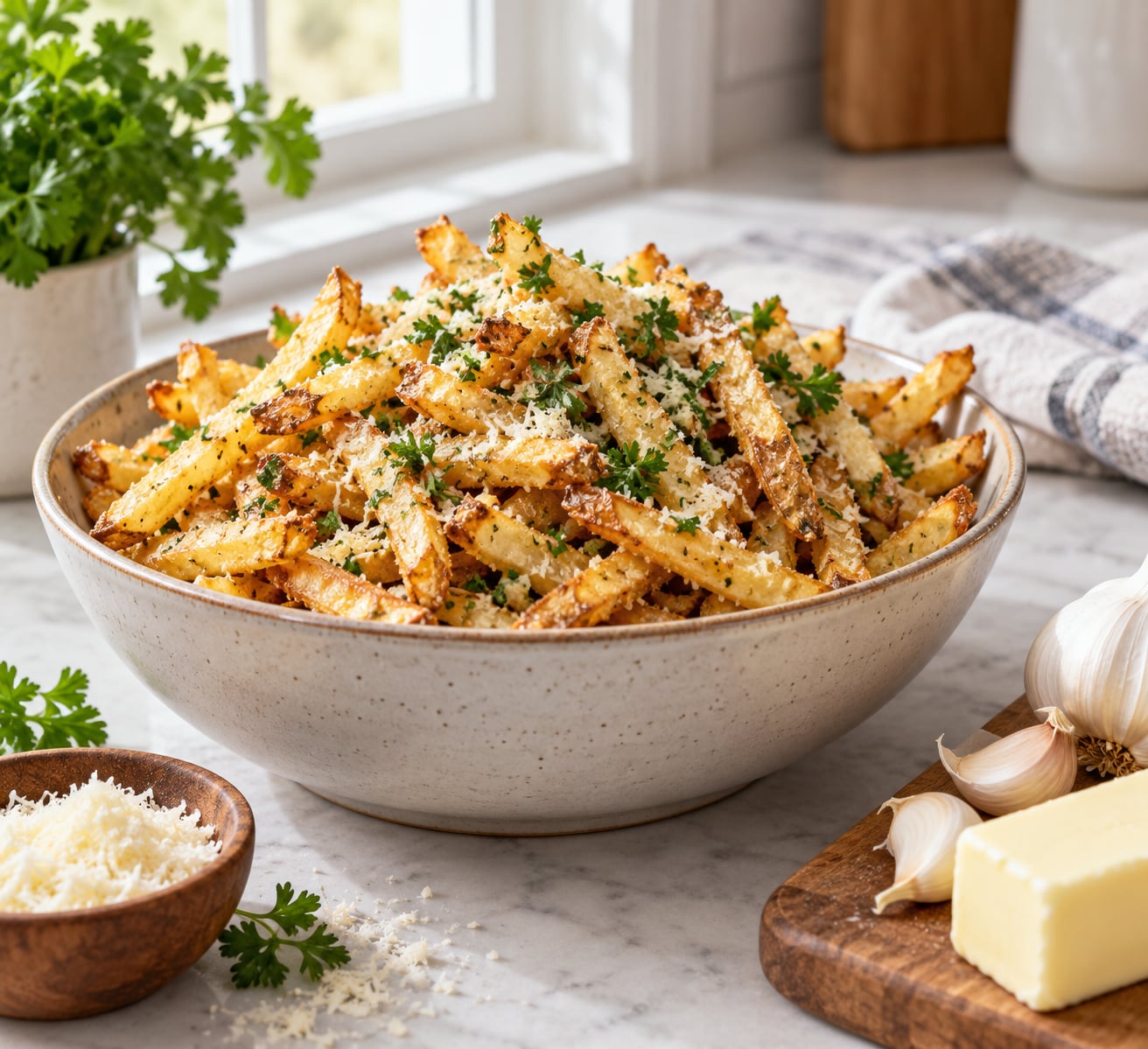
To make garlic parmesan fries with a shatteringly crisp shell and a fluffy center, cut russet potatoes into even batons, soak them in cold water to pull off surface starch, dry them completely, then cook them at high heat until golden before tossing with garlic butter, freshly grated Parmesan, and parsley in the last thirty seconds. Most of the work is front-loaded: once those fries come out of the oil or the oven, the coating takes about a minute.
The part that trips people up isn’t the frying. It’s the ten minutes after. Wet fries, cool fries, or a heavy hand with the butter will turn a crisp batch limp in your bowl before it ever reaches the table.
Garlic parmesan fries are french fries tossed in melted garlic butter and coated with freshly grated Parmesan and parsley, an Italian-American side dish that works as an appetizer, a burger companion, or the thing everyone fights over. Here’s the method that works, plus the three cooking options so you can use what you already own.
Table of Contents
- What You Need
- Step-by-Step: How to Make Garlic Parmesan Fries
- Common Mistakes
- Frequently Asked Questions
- Why do I need to soak potatoes before frying them?
- Why do my garlic parmesan fries turn soggy after I add the cheese?
- Can I make garlic parmesan fries with frozen fries?
- What cheese works best on garlic fries?
- How do I reheat garlic parmesan fries and keep them crisp?
- Can I make garlic parmesan fries ahead of time?
- Conclusion
What You Need
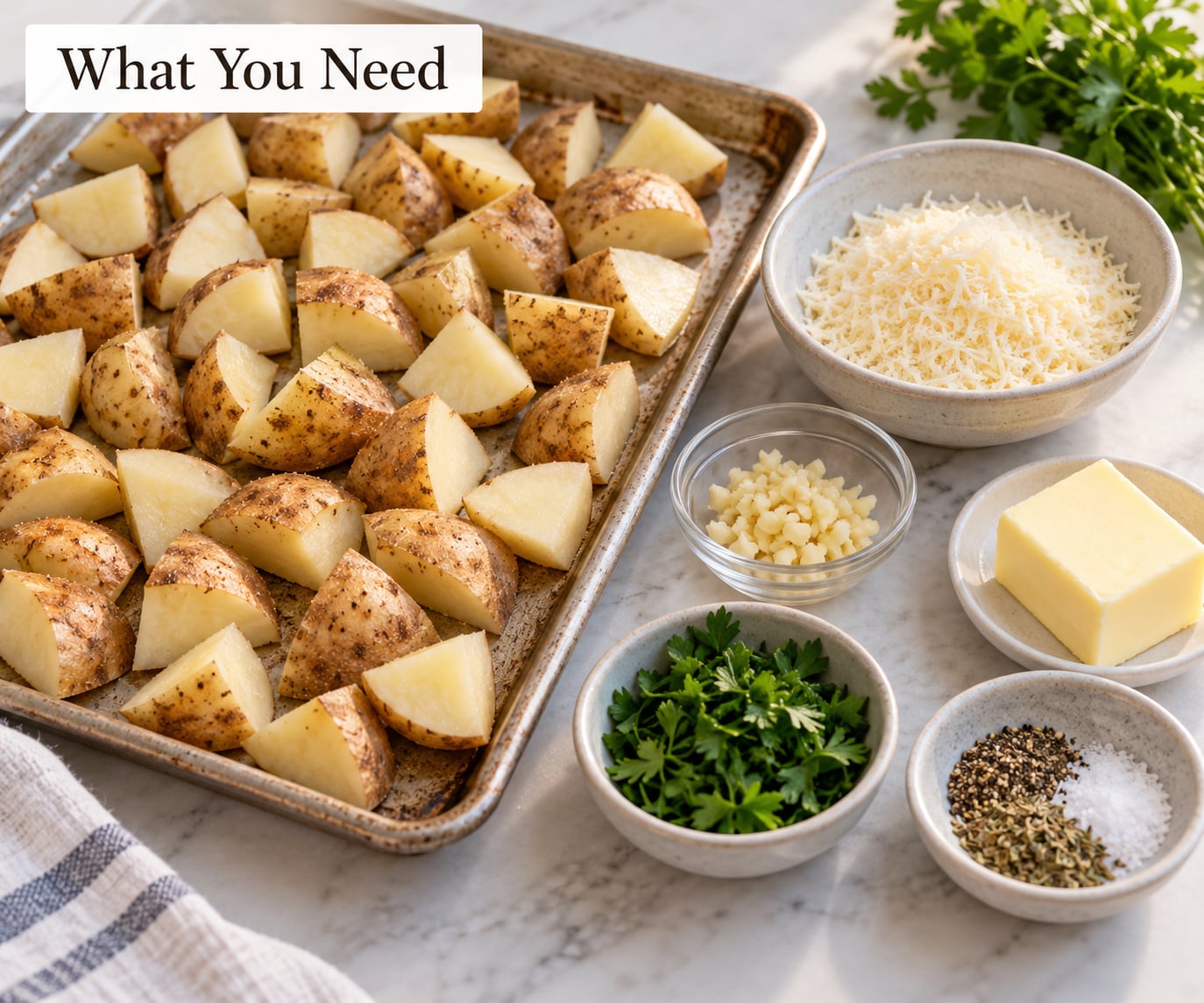
This makes roughly four servings as a side, or a generous snack for two. Double everything if you’re feeding a crowd — a full sheet pan in the oven is easier than two half batches, since crowding is what steams fries.
Ingredients
- 2 large russet potatoes (about 1 pound / 450 g), peeled
- 2 tablespoons avocado, canola, or peanut oil, divided
- 3 tablespoons unsalted butter
- 3 garlic cloves, minced or finely grated, about 1 tablespoon
- 3/4 cup freshly grated Parmesan (about 60 g), plus more to finish
- 1/4 cup chopped fresh flat-leaf parsley
- Kosher salt and freshly ground black pepper to taste
- Optional: 1/4 teaspoon red pepper flakes, 1/2 teaspoon garlic powder, 2 tablespoons finely grated Asiago or Pecorino Romano
Buy the block of Parmesan and grate it yourself. The pre-shredded stuff is anti-caking agents and starch, which melts into a dull film instead of forming those browned, nutty patches.
Roughly a third of a teaspoon of fine salt per pound of potato is a good starting point, and don’t skip it. Salt does two jobs here: it seasons the fry itself, and it helps the Parmesan stick.
Equipment
- A large pot with 2 to 3 inches of oil for the deep-fry method, plus a thermometer
- A wire rack set over a baking sheet for draining
- A large bowl for the cold water soak
- A peeler, a sharp knife, and a cutting board at least 9 by 13 inches
- Paper towels or a clean towel for drying
No deep fryer? The oven at 425°F (220°C) or an air fryer at 400°F (205°C) both produce a properly crisp fry, and my air fryer version is the one I make most weeks because cleanup takes ninety seconds. See how to make fries in an air fryer every time for the basket technique that keeps them from steaming against each other.
A wire rack matters more than people expect. Fries drain on a rack in the open air; fries on paper towel or on a plate trap steam underneath and go soft on the bottom within a few minutes.
Step-by-Step: How to Make Garlic Parmesan Fries
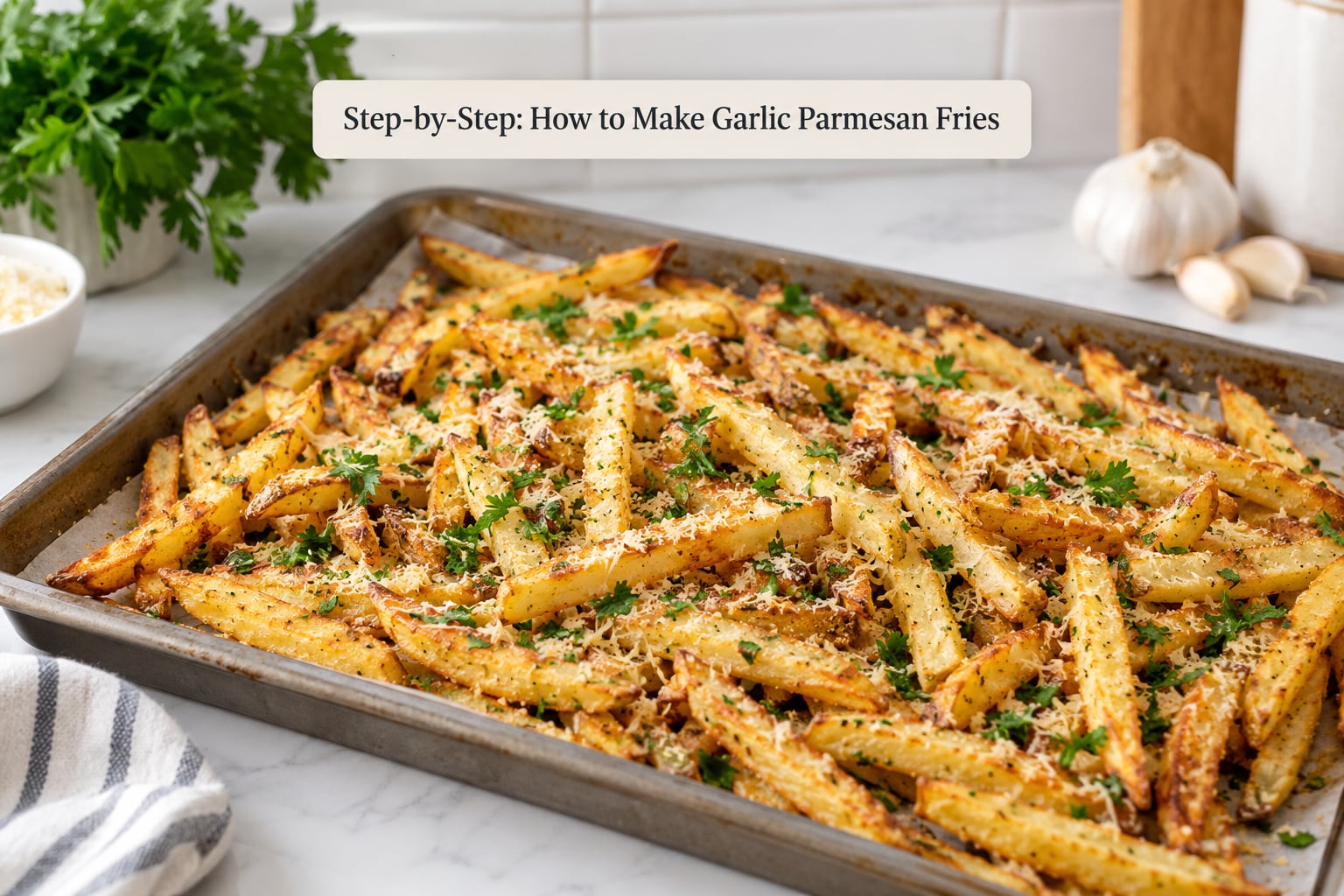
How to Cut and Prepare the Potatoes
Russets win here because of starch and moisture content. Their dry, fluffy flesh fries up crisp and their thick skins hold the shape of the cut. Yukon Gold works fine and looks prettier, but it fries paler and softer; a waxy new potato will not give you a crisp fry no matter how hot the oil is.
Cut the potatoes into batons about 1/4 inch thick, 1/4 inch wide, and 2 to 3 inches long. Uniformity is the whole game. A piece that’s half the thickness of its neighbor cooks in half the time, so the thin ones burn while the thick ones are still raw.
You can skip the peeling if you want, but scrub the skin well first. On a russet, the skin crisps and adds texture.
Now the soak. Put the cut potatoes in a bowl of cold water and leave them 30 minutes minimum, several hours if you have the time. Water draws starch off the cut surfaces, and starch is what turns a fry gummy and gluey when it hydrates and gelatinizes in the heat.
Drain, then rinse under cold water and toss the potatoes dry with paper towels. Keep patting until the pieces are visibly dry and squeak against each other. Residual surface water boils off into steam, and steam is the enemy of crust.
Toss the fries with 1 tablespoon of oil and the salt until every piece looks lightly glossy. That thin film is what makes the potatoes brown evenly and gives the oven and air fryer something to crisp. If you’re deep frying, skip the oil — the frying oil already does that job.
How to Crisp the Fries
Pick the method that matches your kitchen. All three land in the same place in about 25 to 30 minutes total.
Oven, 425°F (220°C): Heat a rimmed baking sheet in the oven while the oven preheats — a cold sheet is a soggy sheet. Spread the fries in a single layer with a finger’s width between them, and don’t use parchment. Oil on hot fries at high heat is what makes the underside crisp; parchment insulates it and you’ll get pale fries that bend rather than snap.
Bake 25 minutes. At the 15-minute mark, pull the sheet out and turn every fry with a spatula or your hands, then put it back for the last 10 minutes. They’re done when the color is a deep golden brown and a test fry is crunchy straight through the middle, with no bend or give. Pull them a minute early if they look right — carryover heat browns them further on the pan.
Air fryer, 400°F (205°C): Single layer, about half full at most. Air-fried fries cook by contact and moving air, so a full basket steams. Air fry 12 minutes, shake the basket, then 8 to 10 minutes more, checking after the second round. Many home fryers run hot, so start at the low end. For steak-cut or thicker batons, give them an extra 3 minutes. If you want a thicker fry, my notes on how to make steak fries at home cover the timing.
Double fry, deep: Heat 3 inches of oil to 320°F (160°C) with a thermometer — don’t guess, since oil temperature is the single biggest factor in the whole recipe. Fry the drained potatoes in batches for 4 to 5 minutes until pale and soft, not browned. Remove, drain on the rack, and let them rest while you heat the oil to 375°F (190°C).
Fry the second time for 2 to 3 minutes until the color is deep gold and the fry sounds like it’s frying. Move each batch to the rack and season immediately. The first fry cooks the starch and sets the interior; the second one drives off moisture and builds the crust. That two-stage process is why restaurant fries stay rigid when plain home fries bend.
How to Add Garlic and Parmesan Without Making Them Soggy
This is the step where a good batch gets ruined, and the fix is timing and restraint.
First, the garlic butter. Melt 3 tablespoons of butter in a small pan over medium-low heat. Add the minced garlic and cook it, stirring, for just 30 to 45 seconds, until it’s fragrant and pale gold. Pull it off the heat immediately. Butter and garlic go from perfect to burnt bitter in about fifteen seconds past that point, and once it’s bitter it ruins the whole bowl.
Stir in the parsley (about two-thirds of it), a pinch of salt, and the red pepper flakes if you’re using them. Set it aside.
Second, the Parmesan. Grate it while the potatoes cook so it’s ready, and keep it in your hand or a small bowl rather than dumping it into the pan early. Parmesan hits hot fat and heat fast: it melts in seconds and then goes from melted to rubbery to greasy as the fries cool.
Third, the toss. Put your hot, drained fries in a large roomy bowl. Pour the garlic butter over them and toss with your hands for 10 seconds. Add the Parmesan and toss again for 10 seconds. That’s it. Taste one, then add the rest of the Parmesan and a final pinch of salt as needed.
Serve right away, on a platter rather than in a pile, so steam escapes instead of collecting. If you’re making garlic butter for something else too, my garlic butter for burger buns uses the same butter-and-garlic base with a little more lemon.
Common Mistakes
The fries go soggy in the bowl. Almost always excess moisture, either from not drying the potatoes after soaking or from too much butter. Two tablespoons of melted butter for a pound of fries is plenty. Also toss in a wide bowl, not a small one — a cramped bowl sweats.
The underside is pale and soft while the top is brown. That’s parchment, a crowded sheet, or a cold pan. Preheat the sheet, leave space between pieces, and use oil instead of parchment. Two pans in the oven for a bigger batch beats one pan crammed full.
The garlic is bitter or blackened. Too hot, too long, and too late in the game. Cook the garlic in butter over medium-low for under a minute and take it off the heat. Fresh minced garlic is sharper and burns faster than garlic powder, so if you’re in a rush, a half teaspoon of garlic powder in the dry fries works and won’t turn bitter.
The cheese slides off and never browns. The fries were cool or dry when the cheese went on, or the Parmesan wasn’t fresh. Toss the coating onto fries that came straight off the heat and are still visibly steaming. Pre-shredded cheese won’t adhere well or melt properly — grate the real thing.
The whole batch tastes greasy and heavy. Two causes: oil temperature too low when the fries went in, which soaks them instead of frying them, and frying too many pieces at once, which drops the temperature further. Use a thermometer, work in batches, and if the oil falls below 320°F, let it come back up before adding more.
They’re crisp for five minutes, then soft. Steam trapped in a pile or an airtight container. Serve on a platter, not in a bowl with a lid. If you’re holding them, spread them on a rack in a single layer somewhere warm and dry.
One more that isn’t really a mistake: if you want them to hold for a while, leave the Parmesan off until the moment you serve. An un-coated fry reheats and re-crisps. A coated fry goes soft twice as fast.
Frequently Asked Questions
Why do I need to soak potatoes before frying them?
Soaking draws surface starch off cut potatoes into the water. Starch absorbs moisture when it heats and turns gummy, which is why soaked fries have a flaky crust and a fluffy center instead of a dense, chewy shell. Thirty minutes helps, a few hours helps more, and overnight is best. Rinse the potatoes after soaking and dry them thoroughly, since soaking also leaves water on the surface that steams instead of frying.
Why do my garlic parmesan fries turn soggy after I add the cheese?
Two things cause it: the fries were cool or wet when you coated them, or you used too much butter. Hot fat and Parmesan need seconds, not minutes, so toss immediately after draining. Keep the melted butter to about 2 tablespoons per pound of potatoes, toss in a wide bowl, and serve on a platter so steam escapes. Pre-shredded cheese also melts into a greasy film, so grate the real Parmesan.
Can I make garlic parmesan fries with frozen fries?
Yes, and it takes about 15 minutes. Air fry frozen fries at 400°F (205°C) without adding oil, working in a single layer, for 10 to 12 minutes, shaking the basket once. Bake them at 425°F (220°C) on a preheated sheet for 20 to 25 minutes, turning at the midpoint. Then skip the soak, dry the fries, and finish them with garlic butter, grated Parmesan, and parsley exactly like the from-scratch version.
What cheese works best on garlic fries?
Freshly grated Parmesan is the standard and it’s what gives the salty, nutty bite that holds up to garlic butter. Pecorino Romano is sharper and saltier, so use a little less of it, and Asiago melts slightly smoother if you want a milder, creamier coating. Avoid pre-shredded cheese entirely, since the anti-caking powder on it stops it from melting and browning properly.
How do I reheat garlic parmesan fries and keep them crisp?
Use an oven or air fryer, never a microwave, which steams the crust into softness. Spread the fries in a single layer at 375°F (190°C) for 8 to 10 minutes in the oven, or 5 to 6 minutes at 400°F (205°C) in the air fryer. Refrigerated fries need a few extra minutes. If they were stored with the Parmesan already on, expect them to crisp less well, which is another reason to hold the coating back until serving.
Can I make garlic parmesan fries ahead of time?
Partly. The fries themselves can be made ahead: par-cook them through the first fry, or bake them until nearly done, then refrigerate them uncovered on a rack for up to two days. The garlic butter can also be made three days ahead and kept in the fridge, though add the parsley at the last minute so it stays green. Toss the fries with the butter and Parmesan only when you are ready to serve, since that is the point where crispness starts to go.
Conclusion
Start with the potatoes: cut them the same thickness, soak them in cold water, and dry them until they’re visibly dry. Cook them until they’re deep golden and crisp on their own, before any butter or cheese is involved. Then drain them on a rack, and while they’re still hot enough to steam, toss with garlic butter, freshly grated Parmesan, and parsley. That last minute is the entire difference between restaurant garlic parmesan fries and a soggy bowl of coated potatoes.
Updated for 2026.