
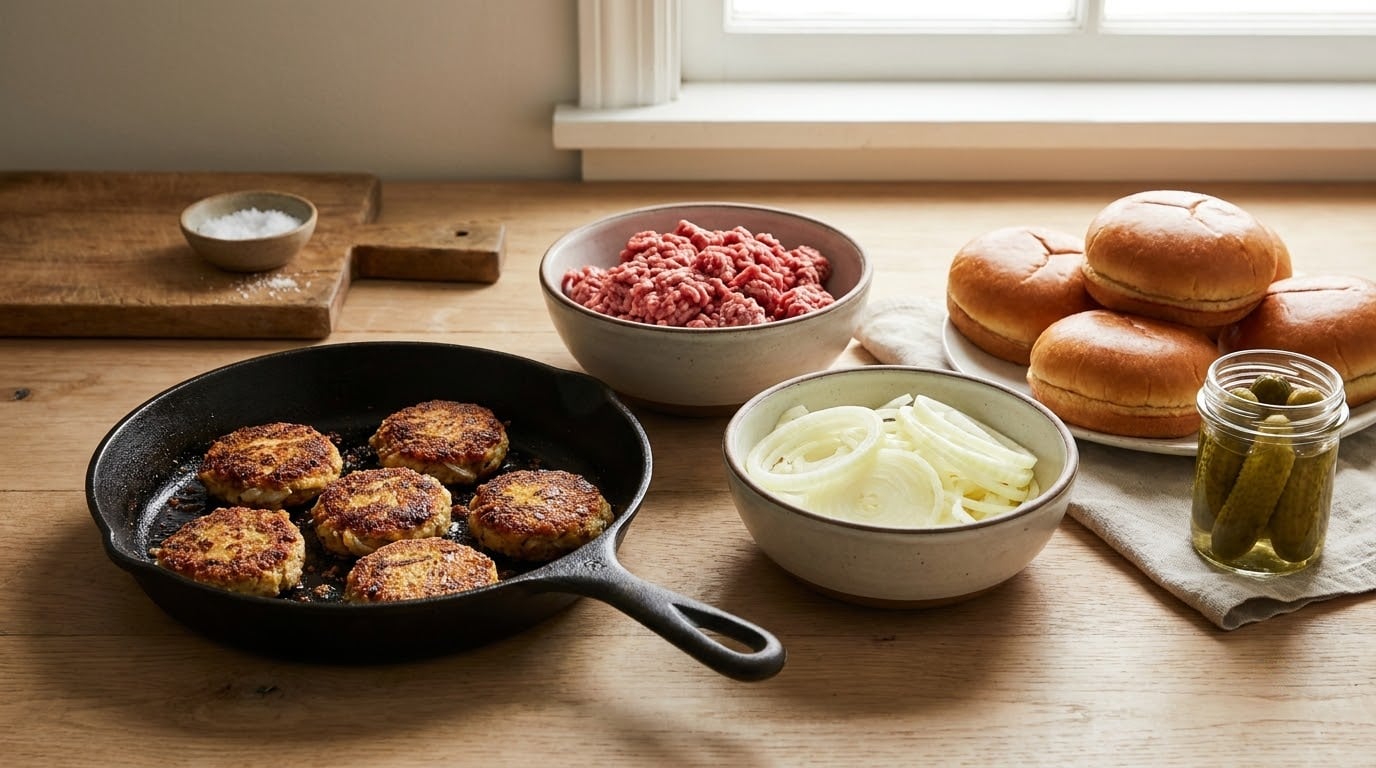
An Oklahoma fried onion burger is a super-thin beef patty with a heavy layer of paper-thin onions cooked straight into the meat until the edges caramelize and the whole thing crisps on a hot griddle. To make Oklahoma fried onion burgers at home, you salt and drain the onions, fold them gently into ground beef, smash the mixture into a thin round, coat it, and fry it onion-side down until deeply browned. The whole job takes about 35 minutes and needs nothing more than a heavy skillet.
This burger comes out of El Reno, Oklahoma, a town that built a festival around it, and the technique is worth learning on its own. Because the patty is pressed thin and covered in onions, there is far more browning surface than a thick restaurant burger gets, which is where nearly all the flavor comes from. Home cooks usually underestimate two things: how wet raw onions are, and how much pressure the patty needs.
Table of Contents
- What You Need
- Step-by-Step: How to Make Oklahoma Fried Onion Burgers
- Common Mistakes
- Frequently Asked Questions
- How much onion goes into an Oklahoma fried onion burger?
- Should I fry Oklahoma onion burgers or bake them?
- What bun works best for an Oklahoma onion burger?
- What cheese melts best on an onion burger?
- Can I make Oklahoma onion burgers ahead of time?
- Do I need egg or breadcrumbs to hold the patties together?
- Conclusion
What You Need
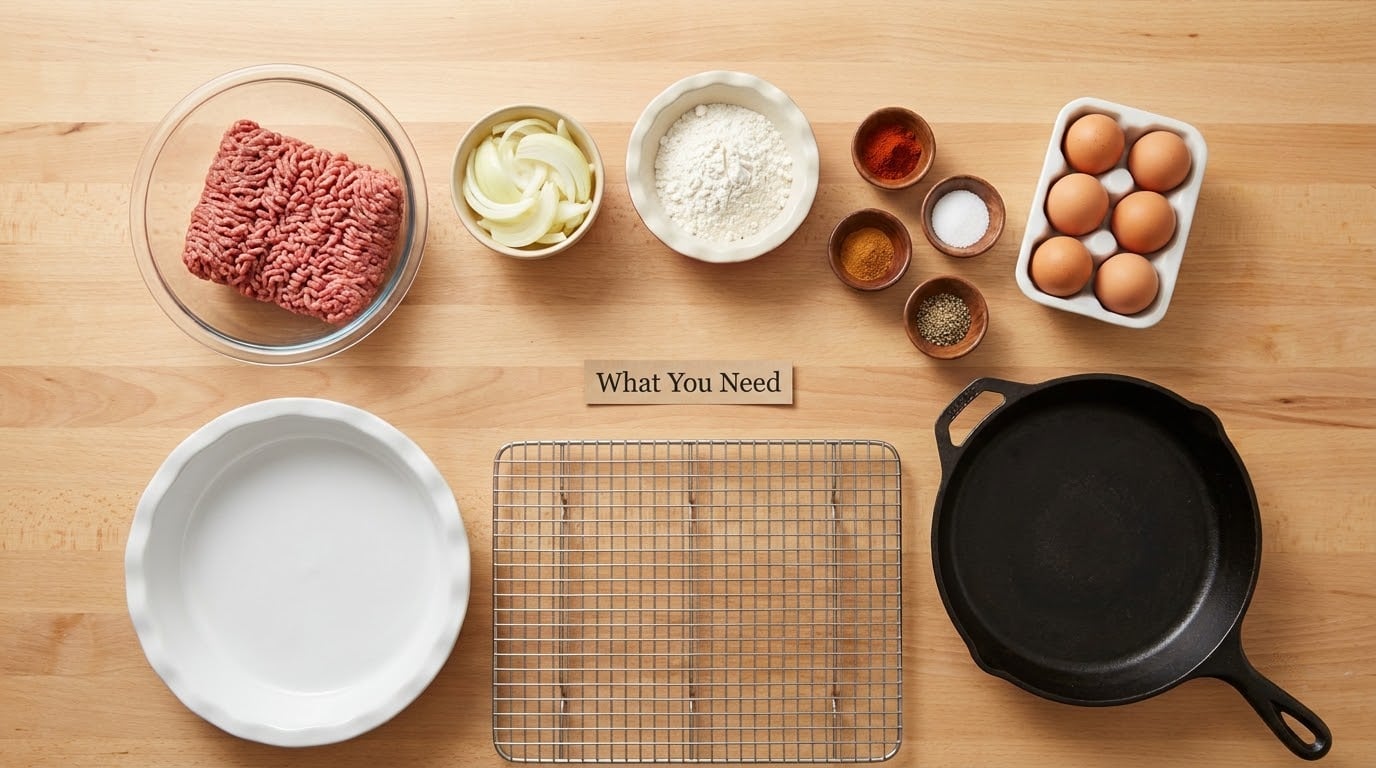
Most of the shopping list is short. The coating is optional, and almost everything else you probably have already.
For the patties
- Ground beef: 1 pound (450 g). An 80/20 blend gives the crispiest edge. Leaner 90/10 works, but expect a slightly softer crust because there is less fat to render and brown. Nothing here needs binder.
- Yellow onions: 2 medium, about 1 to 1.5 cups once sliced. White onions are sweeter and sharper, sweet onions go soft too fast, and red onions turn muddy in a hot pan. Yellow is the safe pick.
- Kosher salt: for salting the onions and seasoning the beef.
- Black pepper: a heavy grind, the coarse kind that cracks in the bite.
For the coating
- All-purpose flour, a shallow bowl
- One egg, beaten with a splash of water
- Breadcrumbs, panko or regular, for extra crunch
The coating is what makes this a fried onion burger rather than a griddled smash burger. Skip it and you get a great onion patty, just not the same dish. If you want to know how the flour and egg stages behave, and where breadcrumbs actually matter, read how to make burgers with breadcrumbs vs without before you start.
For the sauce and the build
- Mayonnaise, yellow mustard, pickle juice, plus a splash of hot sauce or a teaspoon of pickle relish
- American cheese or sharp cheddar, one or two slices
- Buns: standard hamburger buns or a brioche if you want a softer roll
- Dill pickles, butter, salt and pepper for the final build
You also need a cast iron skillet or a flat-top griddle, an offset spatula, a mandoline or a very sharp knife, and a wire strainer. The offset spatula is not optional in my kitchen. A thin spatula slides under a thin patty, and a regular one tears the onion layer in half every single time.
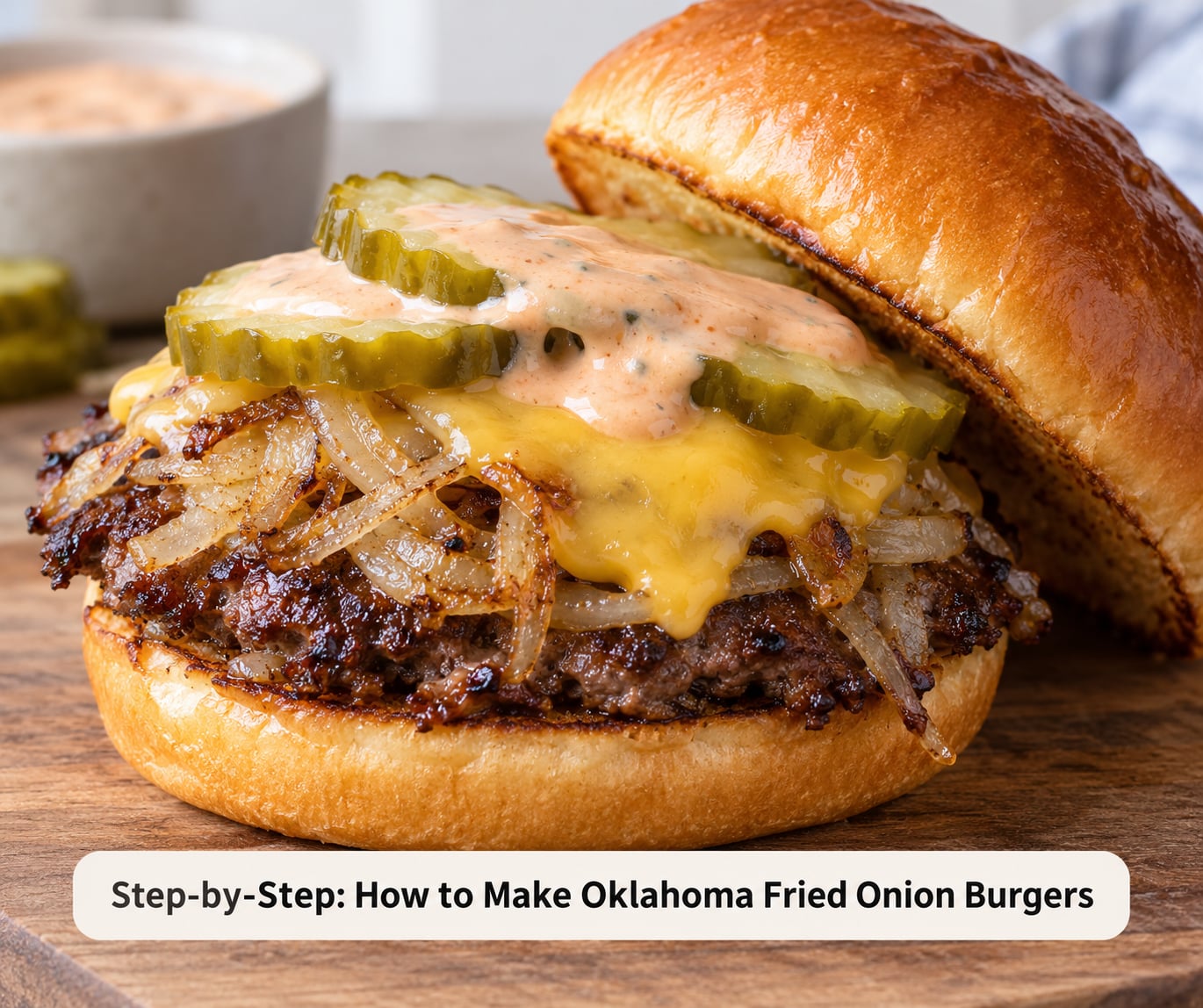
Step-by-Step: How to Make Oklahoma Fried Onion Burgers
1. Prepare the onions
Slice the onions as thin as you can manage, aiming for slices you can almost see light through. A mandoline does this in seconds and gives you the consistent thickness that matters here. If you do not own one, slice with a sharp knife across the grain, holding the onion steady with your fingertips curled inward.
Now salt them. Toss the sliced onion with about 1 teaspoon of kosher salt, spread it on a rimmed baking sheet, and wait 20 to 30 minutes. The salt pulls water out of the onion cells, and that water is the enemy of browning. A wet onion steams instead of caramelizes, and a steaming onion will not crisp no matter how hot your pan is.
Rinse the onions in a wire strainer, then dry them thoroughly in a clean dish towel. Squeeze small handfuls until almost nothing drips out. When they look limp and translucent with barely any liquid left in the bowl, they are ready.
Plan on roughly half a cup of drained onion per burger, so about 1 to 1.5 cups per pound of beef. Too few and you get a plain burger with onion flavor. Far too many and the mixture turns pasty and falls out of the pan.
2. Mix the beef and onion filling
Put the drained onion in a bowl with the raw beef, the remaining salt and the pepper. Use your hands and mix with a light touch, folding from the bottom until you can just barely see streaks of onion. Stop while it still looks slightly uneven.
This is where most home attempts go wrong. Overmixing works gluten and collagen into the meat and gives you a dense, bouncy, sausage-textured patty, which is the opposite of what you want here. A gentle mix keeps the meat loose enough to stay tender while still holding together.
If your mixture feels sticky and refuses to shape, chill it for 20 minutes. Cold beef firms up, the fat solidifies, and you get a much cleaner release from the pan later. If it feels loose and crumbly, that is fine, since compaction during shaping is what fixes it.
3. Form and coat the patties
Divide the mixture into four loose balls, about 4 ounces each. Do not pack them tightly. A ball that is already compressed will not spread, and you want the patty to spread under your palm, not be shaped by it.
Dip each ball in flour, then in the beaten egg, then in breadcrumbs. Press the coating on with dry fingers so it adheres. The egg is doing the work here, and the flour gives the egg something dry to grab. Look for full coverage with no bare patches, especially along the edges, because bare spots soak up oil and go soggy.
Heat about 1/2 inch of oil in a cast iron skillet over medium-high until it shimmers and a dropped crumb sizzles hard. Lay each patty in and press firmly with the flat side of the spatula until it is about 1/4 inch thick and roughly 4 inches wide, wider than the bun. That pressure is what fuses the onions into the meat and creates the lacy, crisp edge when it cooks.
4. Cook until browned and safe
Cook onion-side down, undisturbed, for 2 to 3 minutes. Resist flipping early even though the edges will look ready. The patty needs the full time to brown all the way through and for the onions to cook into it, and that color only shows up once the crust is well past golden.
Flip once and cook 1 to 2 minutes on the second side until the cheese would brown and the center is firm to the touch. Cook in batches so patties are not touching. A crowded pan drops the temperature, and that is exactly how you end up with pale, greasy burgers.
Ground beef needs to reach 160°F (71°C) internally. Use an instant-read thermometer in the thickest part, because color is not a reliable signal, especially with the cheese and breadcrumbs on top. Rest the patties 2 minutes before building so the juices settle back into the meat.
Oven option: set a rack in the upper third of the oven and broil for 6 to 8 minutes per side at 450°F (230°C), watching constantly. Broiling browns fast, so this only works if you are standing right there. If the smoke alarm is a concern, [how to make burgers on the stove without smoke](https://bqmburger.com/how-to-make-burgers-on-the-stove-without-smoke/) covers the pan setup that keeps cooking at a steady sizzle.
5. Assemble and serve
Melt a thin layer of butter in the pan and toast the buns cut-side down until golden. For extra softness, put the buns cut-side up over the patties during the final 30 seconds with a splash of water and cover the skillet, which steams them in the beef drippings.
Spoon the sauce on both bun halves while the patty is still hot, add the cheese so it melts immediately, then layer dill pickles, a pinch of salt and pepper and anything else you like. Lettuce and tomato are not traditional but they are not wrong.
Keep finished burgers on a wire rack rather than a plate. A plate traps steam, and a steamed bun turns to cardboard within a few minutes. Eat them fast.
What the special sauce is doing
Mix equal parts mayonnaise and yellow mustard with a tablespoon of pickle juice and a few drops of hot sauce. The pickle brine supplies the acid that cuts the fat, and the mustard gives the sharpness that plays against the sweet onion. Thin it with a teaspoon of water if it drags too thick across the bun.
Common Mistakes
The onions go soggy
Almost always skipped salting and drying. Thirty minutes in salt and a hard squeeze in a dish towel removes far more water than most people expect, and that missing water is the whole problem. Pat the onions dry again after mixing if your hands were wet.
The patty falls apart in the pan
Two causes: you flipped before the crust formed, or you pressed too hard and squeezed the onion layer out from under the meat. Lay it down and leave it alone for the full 2 to 3 minutes, then slide a thin offset spatula all the way under and lift rather than scooping. A gentle mix in step two also helps, since an overworked mixture tears instead of releasing.
The onions burn before the beef cooks through
The patty was too thick or the heat was too high. Press to about 1/4 inch and drop to medium. Thin patties transfer heat to the center fast, and the thin onions on the surface burn long before the middle of a thick puck ever cooks.
The coating is pale and greasy
The oil was not hot enough when the patties went in, or the pan was crowded. Heat until a crumb sizzles immediately and cook no more than two patties per skillet. A too-cool oil absorbs into the breadcrumbs before they can set into a crust.
The burgers are dense and bouncy
Overmixed. The first thirty seconds of mixing is enough. If you already have a bowl of paste-like mixture, chill it hard and work it gently, because you cannot undo the damage entirely.
Everything is uneven
Check the onions are the same thickness and measure the oil depth before each batch. Adding oil between batches cools the pan, so top it back up and give it a minute to come back to temperature.
For a group of four to six, work in batches and let everyone build their own at the end. Toast buns in the last batch only, since they go stale fast sitting out. And keep the fried onions for a side dish in mind, because [crispy fried onions for burgers](https://bqmburger.com/how-to-make-crispy-fried-onions-for-burgers/) are worth making extra on purpose.
Frequently Asked Questions
How much onion goes into an Oklahoma fried onion burger?
About half a cup of drained onion per burger, so 1 to 1.5 cups for a full pound of ground beef. Slice them paper-thin, salt for 20 to 30 minutes, then rinse and squeeze dry before mixing. Measure the onions after they are drained and squeezed, since wet onions shrink the real volume of what goes in the patty.
Should I fry Oklahoma onion burgers or bake them?
Frying gives you the crispest, most authentic result. A shallow layer of oil in a cast iron skillet over medium-high heat is what creates the lacy fried edge on the onions. Baking or broiling at 450°F (230°C) works in a pinch and uses less oil, but the coating stays paler and the patty cooks a little unevenly near the center.
What bun works best for an Oklahoma onion burger?
A sturdy hamburger bun. The patty is wide and floppy when hot, so a thin hot dog-style roll or a very soft enriched bun collapses under it. Brioche works well if you toast it well, since it has enough fat and sugar to stand up to the sauce. Toast cut-side down in butter for the best bite.
What cheese melts best on an onion burger?
American cheese melts the smoothest and hugs the irregular edges of a thin onion patty, which is why it is the most common choice. Sharp cheddar adds more flavor and browns better, but it needs the patty to be a little hotter to melt through. One slice is usually right, two makes a very tall burger.
Can I make Oklahoma onion burgers ahead of time?
Yes. Salted onions can be prepped and refrigerated in an airtight container for up to two days, and the sauce keeps about a week refrigerated. Form patties and coat them the same way, then cook from cold with a few extra seconds per side. Keep the buns and the final toast out of the make-ahead plan, since they are best done fresh.
Do I need egg or breadcrumbs to hold the patties together?
For the patty itself, no. Gentle mixing and firm pressing during shaping are what hold it together, and an overworked mixture will break apart faster than one with no binder at all. Egg and breadcrumbs belong to the coating, where they give the burger its fried crust. Raw beef patties keep one to two days refrigerated at 40°F (4°C) or below, and cook only to 160°F (71°C).
Conclusion
Start with the onions. Salt them for 30 minutes, squeeze them dry, and the rest of the burger takes care of itself. Mix them into 80/20 beef with a light hand, press the balls to about 1/4 inch thick, coat them in flour, egg and breadcrumbs, then fry onion-side down until the crust is genuinely brown and the center hits 160°F (71°C).
One tip above the rest: do not move the patty for the first couple of minutes. The crust that forms in that window is the whole burger. Once it sticks together, spread it with mustard-mayo and pickles and change whatever you like about the rest.