
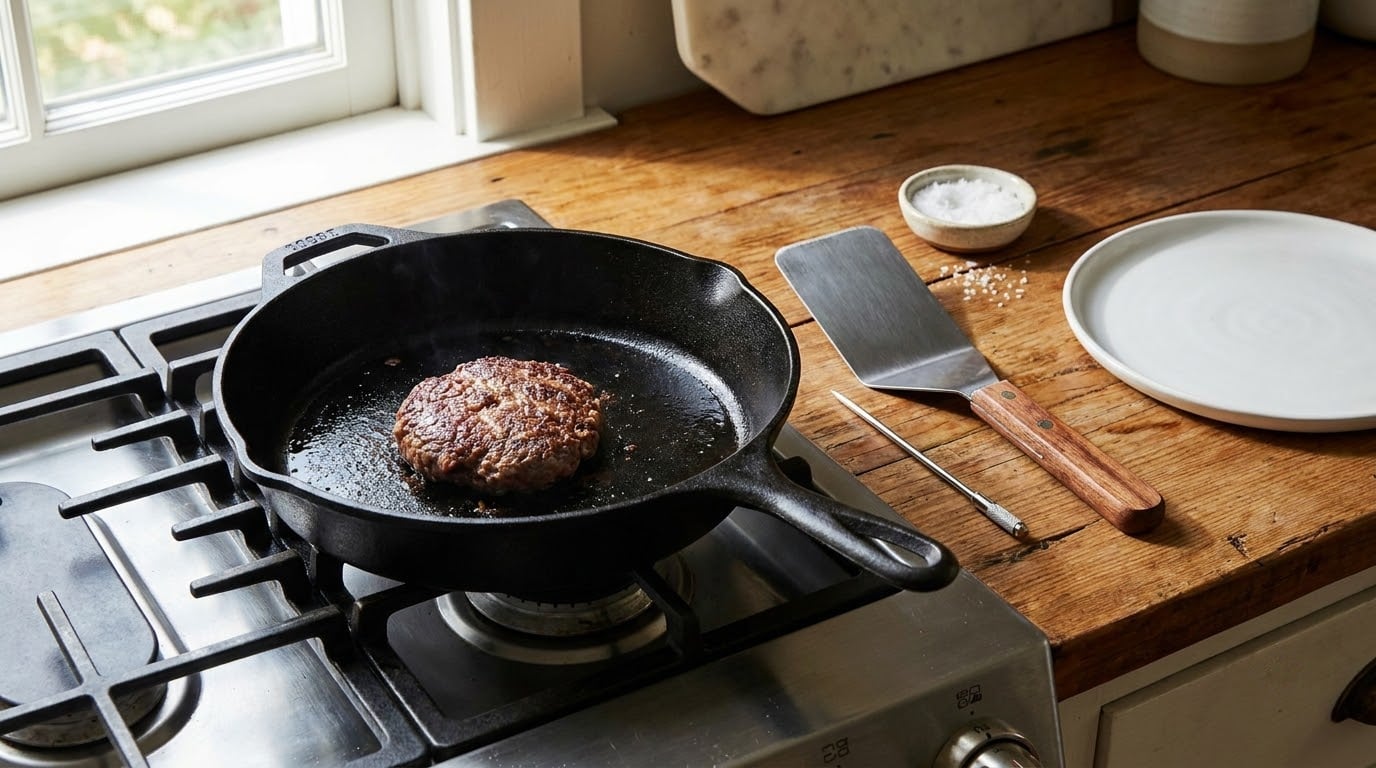
How often to flip a burger comes down to how thick the patty is. Thin smash patties get exactly one flip, usually 60 to 90 seconds in, while patties half an inch or thicker cook more evenly when you turn them every 15 to 30 seconds until the center reaches 160°F.
That is the whole answer, but the details matter more than the number. Time alone tells you very little, because a 400°F gas grill, a screaming-hot cast iron griddle and a cold patty from the fridge all behave differently. Cues tell you everything: browning, juices, and whether the patty peels off the surface cleanly.
What You Need
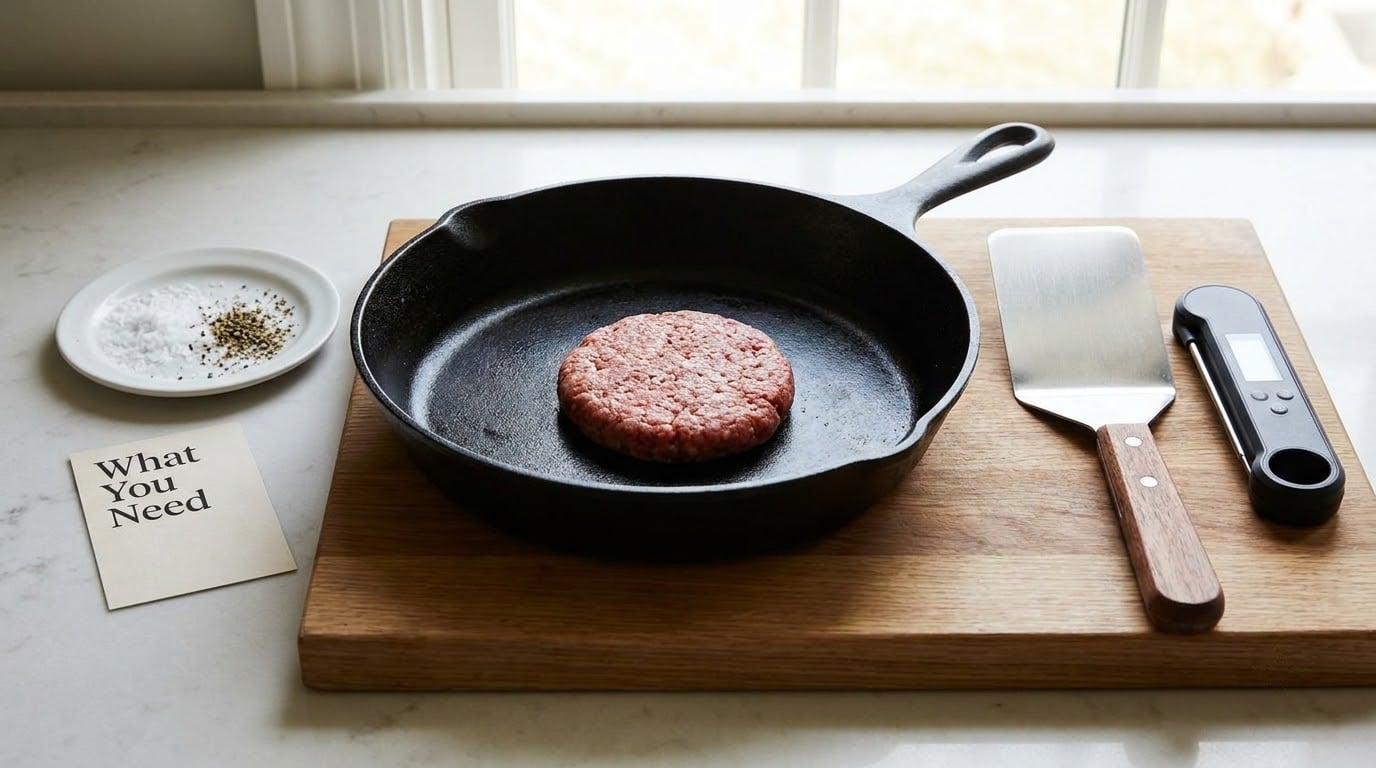
You do not need a bag of gadgets. You need one tool that slides under a patty without tearing it, one way to check temperature, and a hot surface that is already hot when the meat lands.
- A sturdy, thin-edged spatula. A squared-off metal spatula gets under a patty and lifts it. A thin plastic one flexes and dumps the burger back onto the grate. Tongs work for a second flip on thin patties, not for the first one.
- An instant-read thermometer. This is the single thing that fixes the “is it done” argument. Appearance lies; a probe does not.
- A grill, griddle or cast iron skillet, preheated. Ten minutes on medium-high, or five on high for a griddle, before the patties go on.
- A light coat of oil or spray. A dry patty sticks to a dry grate. Waxy factory pre-formed patties need nothing at all.
- Coarse salt and pepper, plus a plate for resting. Season the patty when you flip it, not before, so the salt does not pull moisture out of the surface too early.
Shape the patties evenly before they hit the heat. A patty that is thick in the middle and thin at the edges will never cook evenly no matter how many times you flip it. If you are rolling your own, keep everything within about a quarter inch of the same thickness.
Step-by-Step
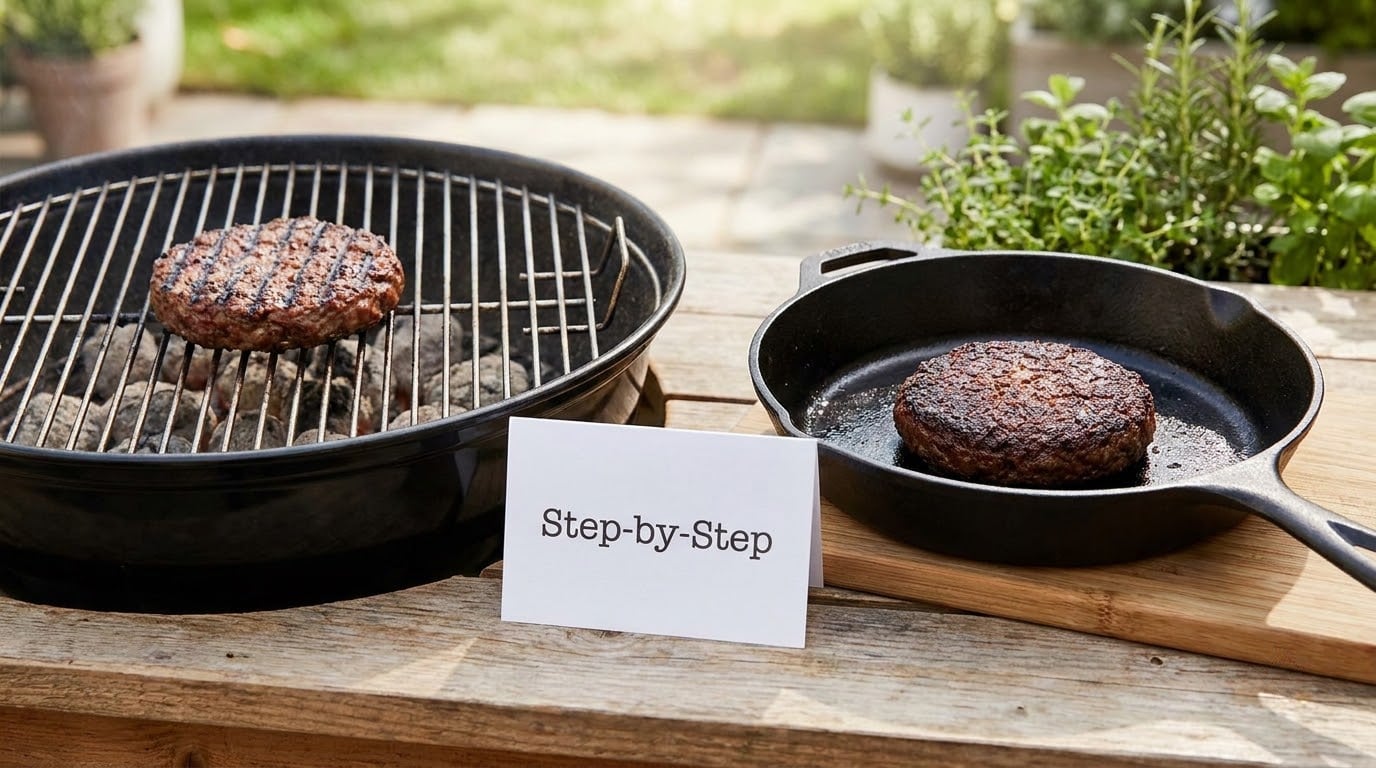
Here is the quick version before the detail:
- Thin smash patty, under 1/4 inch: one flip, 60 to 90 seconds on a very hot griddle or skillet, done in 2 to 3 minutes total.
- Thick patty, 1/2 to 3/4 inch: turn every 15 to 30 seconds and judge by release rather than the clock, medium-high heat around 400°F, 6 to 8 minutes total.
- Thick patty, one-flip method: one flip at the halfway point, 3 to 4 minutes a side, medium heat around 350 to 375°F, 6 to 8 minutes total.
- Frozen store-bought patty: one or two flips, 3 to 4 minutes a side, medium heat at 350 to 375°F, 8 to 12 minutes total.
How Often to Flip a Burger on a Grill or Skillet
The short answer to how often to flip a burger: once or twice, not every thirty seconds by reflex. Most home cooks do best with a single flip for thin patties and one or two flips for thicker ones, letting browning and release decide the timing rather than the clock.
Thin patties cook in two to three minutes total. They land on a hot surface, brown on the bottom, and release as soon as the crust has set, usually somewhere between 60 and 90 seconds. Flip once, finish the other side, and pull.
Patties half an inch or thicker have a different problem. Left alone on one side, the outside burns and dries long before heat reaches the middle, which is where the gray overcooked ring comes from. Turning them every 15 to 30 seconds keeps the two faces closer to the same color and shrinks that band. Serious Eats tested this frequent-flip approach and reported the gray ring shrank by up to 40 percent compared with a single flip on thick patties.
The one-flip method is not wrong. It just trades evenness for convenience: cook on medium heat, flip once at the halfway point, and accept a slightly wider gray ring in exchange for a calm cook and a deep crust. On a charcoal grill with the lid down, plenty of cooks never flip at all beyond a single turn, and they are right about it.
How to Know When a Burger Is Ready
Three cues tell you when to flip, and all three together are more reliable than any one of them. First, the patty releases from the grate or pan without tearing when you lift an edge with the spatula. Second, the top surface changes from wet and glossy to matte, with clear beads of juice sitting on it. Third, the edges firm up and brown.
For doneness, the USDA guideline for ground beef is 160°F measured in the thickest part. Aim the probe in from the side rather than straight down through the top, so you do not punch all the way through and let the juice run out on your board.
Pull at 160°F and expect carryover cooking to carry it a few degrees higher while it rests. That is the window people miss: pull too early and you end up undercooked at the table, pull too late and the patty is dry in the middle. For anything past medium, err toward pulling a touch early.
The thumb test, pressing the patty to gauge give, tells you almost nothing about internal temperature. Use it for feel if you like, but pull the thermometer out when the answer matters.
Common Mistakes
Flipping before the crust sets. This is the number one cause of torn patties and the reason people think flipping is risky. A patty releases when a browned, slightly firm layer has formed underneath. Flip earlier and you rip that layer off along with the meat, and the juices that were about to baste the patty end up on the grate instead.
Flipping on a timer with no cues. If you flip at exactly three minutes whether or not the patty has browned, you are cooking to the clock instead of the meat. Watch the surface instead.
Turning the patty over and over. Constant flipping cools the surface each time and costs you crust. Getting how often to flip a burger right on a thick patty, and knowing when to stop, matters more than the count itself. The useful range is every 15 to 30 seconds, not every ten.
Pressing with the spatula. Smash burgers get one press in the first seconds, before any crust exists. After that the press only flattens the patty, squeezes out juice and glues the crust to the iron.
Grilling a thin patty to thick-patty times. A 1/4-inch patty on a hot griddle is done in minutes. Giving it the same time as a thick charcoal-grilled patty means serving something that is well past the 160°F mark and dry all the way through.
Skipping the rest. Cutting into a patty the second it leaves the heat lets every drop of juice run onto the board. Two to five minutes changes the texture more than any flip decision.
Tips for the Best Burger Results
Preheat properly and leave room between patties. A cold grate stalls the sear, and patties touching each other cook in their own steam instead of forming a crust. Preheat on high, then drop to medium-high before the meat goes down.
Start patties from the fridge. A room-temperature patty has soft fat on the surface that tears more easily and drips more fat onto the fire. Straight-from-the-fridge patties hold together better and shrink less.
Watch the fat ratio when flare-ups start. An 80/20 blend burns far more than an 85/15, and each flare-up dries the outside of the patty. Move the meat to a cooler zone to finish rather than fighting the fire, and keep the lid on when you want to cook through with less attention. If you are curious about how a line handles eight patties at once, I wrote about how restaurant kitchens organize a burger line recently.
Add cheese in the last 20 to 40 seconds, right after the final flip, so it melts without the patty overcooking. Toast the bun while the meat rests, and add onions late as well. A raw onion cooked alongside a thick patty needs extra minutes that the patty cannot spare.
Beyond beef, the same cues apply to any ground patty. How to cook plant based burger patties covers the differences in moisture and browning, and why milk makes some burger patties tender explains a preparation trick that changes how a thick patty holds up mid-cook.
Frequently Asked Questions
Do you flip a burger more than once?
Sometimes, and it depends on thickness. Thin smash patties get exactly one flip at about 60 to 90 seconds. Patties half an inch or thicker can be turned every 15 to 30 seconds until the center hits 160 degrees Fahrenheit, which cooks both sides more evenly and shrinks the gray overcooked ring. Either way, flip on browning and release rather than on the clock.
How long should I cook a burger before flipping it?
For a thin patty on a very hot griddle, 60 to 90 seconds. For a patty half an inch or thicker, wait until it releases from the grate without sticking and the top goes matte with beads of juice on the surface, usually 3 to 4 minutes at medium-high heat. If it still grips the spatula when you lift an edge, the crust has not set yet and flipping will tear it.
Should I press a burger while cooking?
Press once and only in the first few seconds, while the patty is still raw on top, if you are making a smash burger. That is what welds the meat to the griddle and builds the crust. After that layer forms, never press again. Pressing flattens the patty, squeezes juice into the fire, and glues the browned crust onto the griddle so it tears off when you turn it.
Can I use a thermometer without ruining the burger?
Yes, and it is the least damaging option available. Slide the probe in from the side of the patty, aiming at the thickest part, and stop before you push through the far edge. That keeps the juices inside where a straight-down poke would release them. Pull the probe, note the reading, and keep cooking until the center reaches 160 degrees Fahrenheit for ground beef.
When should I add cheese to a burger?
In the last 20 to 40 seconds of cooking, right after the final flip, so it melts without pushing the patty past done. On a thick patty that means during the last turn rather than at the start. Cheese added early traps steam under the lid and softens the crust you spent the whole cook building. Slice or grate it thin so it melts evenly across the surface.
How long should a cooked burger rest before serving?
Two to five minutes on a warm plate or a wire rack. The rest lets the muscle fibers relax and reabsorb the juice that pushed to the surface during cooking, and it lets carryover heat finish the patty. Cutting straight in sends that juice onto the board. Rest on a rack rather than a flat plate if you want the underside to stay crisp.
Conclusion
Heat your grill, griddle or skillet first, then put the patty down and leave it alone. When the underside browns and the patty releases from the surface without sticking, flip once for a thin burger or start turning every 15 to 30 seconds for a thick one, and stop guessing about doneness when the center reads 160°F.
Rest it two to five minutes, toast the bun while you wait, and add the cheese in the last half minute of cook time. That sequence, not the flip count alone, is what separates a juicy burger from a dry one. Good luck on your 2026 cookout.