
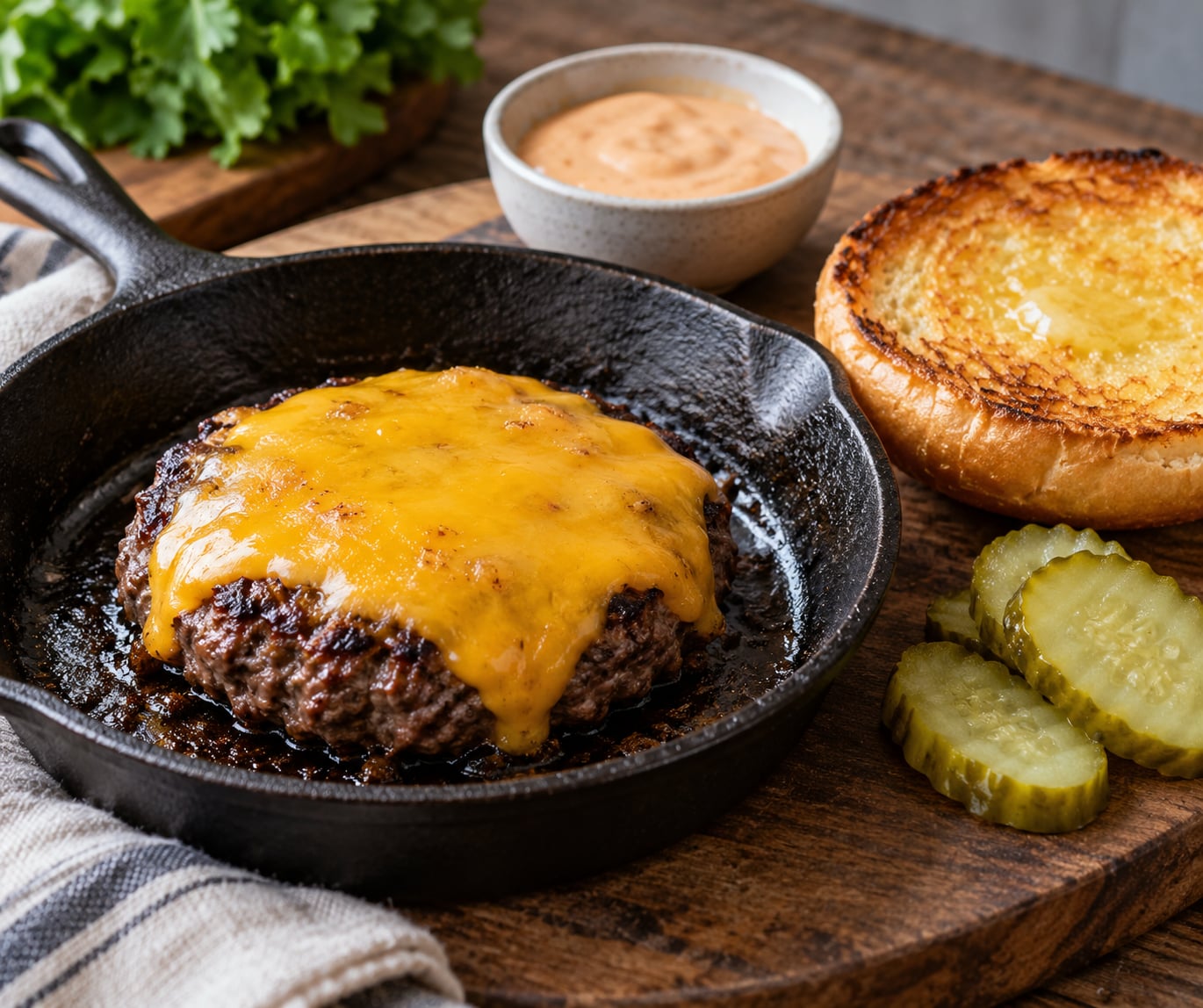
A pub style burger is a thick, hand-formed beef patty — usually 6 to 8 oz (170 to 200 g) of coarse-ground 80/20 chuck — seared for 3 to 4 minutes per side in a very hot cast iron skillet or griddle, then finished with cheese on a toasted bun. If you have wondered how to make pub style burgers at home without a commercial flat top, the gap is narrower than it looks: patty weight, gentle hands, a properly preheated pan and fast assembly.
From cold beef to a dressed burger in your hands takes about 35 minutes, most of it waiting. Shape a few patties once and the method is repeatable enough that you will stop reaching for the recipe.
Updated for 2026.
One thing worth saying up front. A thick pub burger is heavier to flip than a thin smashed one, and it fills you up the way a thin patty never does. A single 6 to 8 oz patty is a full meal, which is why I save this style for a weekend rather than a Wednesday.
What You Need
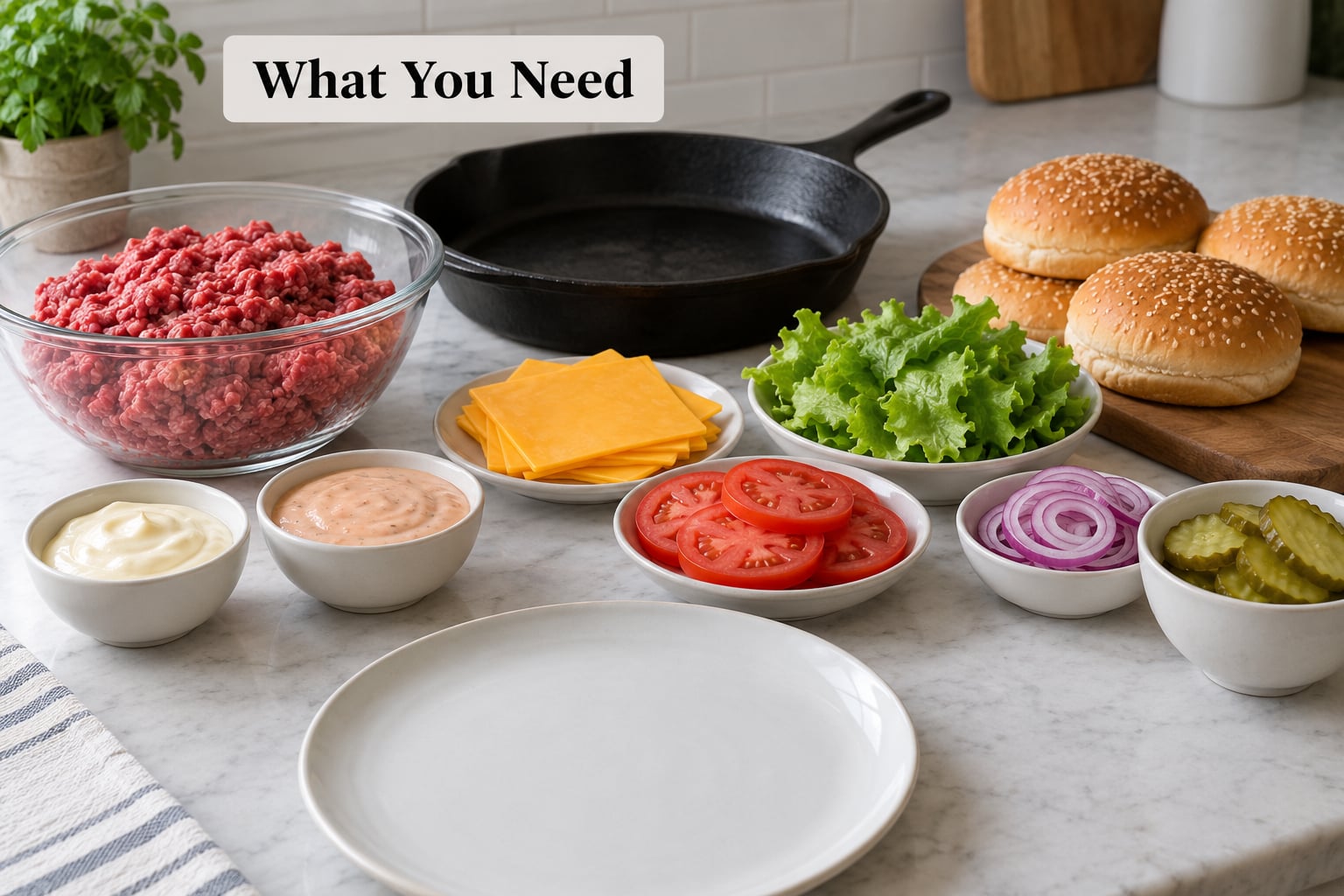
The ingredient list is short. What matters is fat, grind and heat, not a long shopping list of special items.
- Beef. Ground chuck at 80/20 — 80% lean, 20% fat — is the working answer for pub style burgers. Fine-ground supermarket mince tends to give a springy, rubbery bite, so a butcher who will grind a chuck roast to order is worth the detour. A pound (450 g) gives you four 7 oz patties with no leftovers.
- Buns. Potato buns or a plain brioche roll. Avoid anything heavily sugared or seeded; the sweetness competes with the beef and the seeds crack when the sauce goes on.
- Cheese. Mature cheddar for the classic version, or Stilton, Gouda, Brie or Taleggio if you want something stronger. American cheese belongs on a smash burger, where it melts into a flat sheet — on a thick patty it just drapes.
- Toppings. Shredded lettuce, thick tomato slices, thinly sliced red onion, and pickles cut lengthways rather than in rounds so they sit flat.
- Sauce. A mayonnaise-and-ketchup burger sauce, a sharp brown sauce, or a homemade Thousand Island dressing if you want the sweet-sharp pub version.
- Equipment. A cast iron skillet or carbon steel griddle, an instant-read thermometer, a wide metal spatula with enough rigidity to lift a half-pound patty, and a plate for the toasted buns.
Portion size is the piece most home cooks get wrong. Budget 6 to 8 oz of raw beef per person for a proper pub burger, which means roughly 1.5 lb (680 g) of beef for four people. That is more than a standard burger night, and it is the reason the finished sandwich overhangs the bun.
If you only have lean beef, 85/15 will still work — just cook it a shade faster and skip the long rest, because lean patties have less internal fat to keep them moist. If you have coarse pre-formed patties from a supermarket tray, cook them as they are; re-forming them is optional, not a rule.
Cooking for a crowd is a simple multiplication. One 7 oz patty per person plus a spare or two means about 1.5 lb of beef for four, 3 lb for eight, and roughly 6.5 lb for a group of twenty. Most home skillets take two patties at a time, so a big cookout means batches, not a crowded pan.
One more piece of equipment, if you do this often: a flat top griddle gives you a wide even surface and drains grease to the side instead of letting it pool under the meat. A carbon steel griddle does the same job for less money and takes just as long to heat. A heavy skillet is the only one of the three I would bother buying first.
Step-by-Step: How to Make Pub Style Burgers at Home
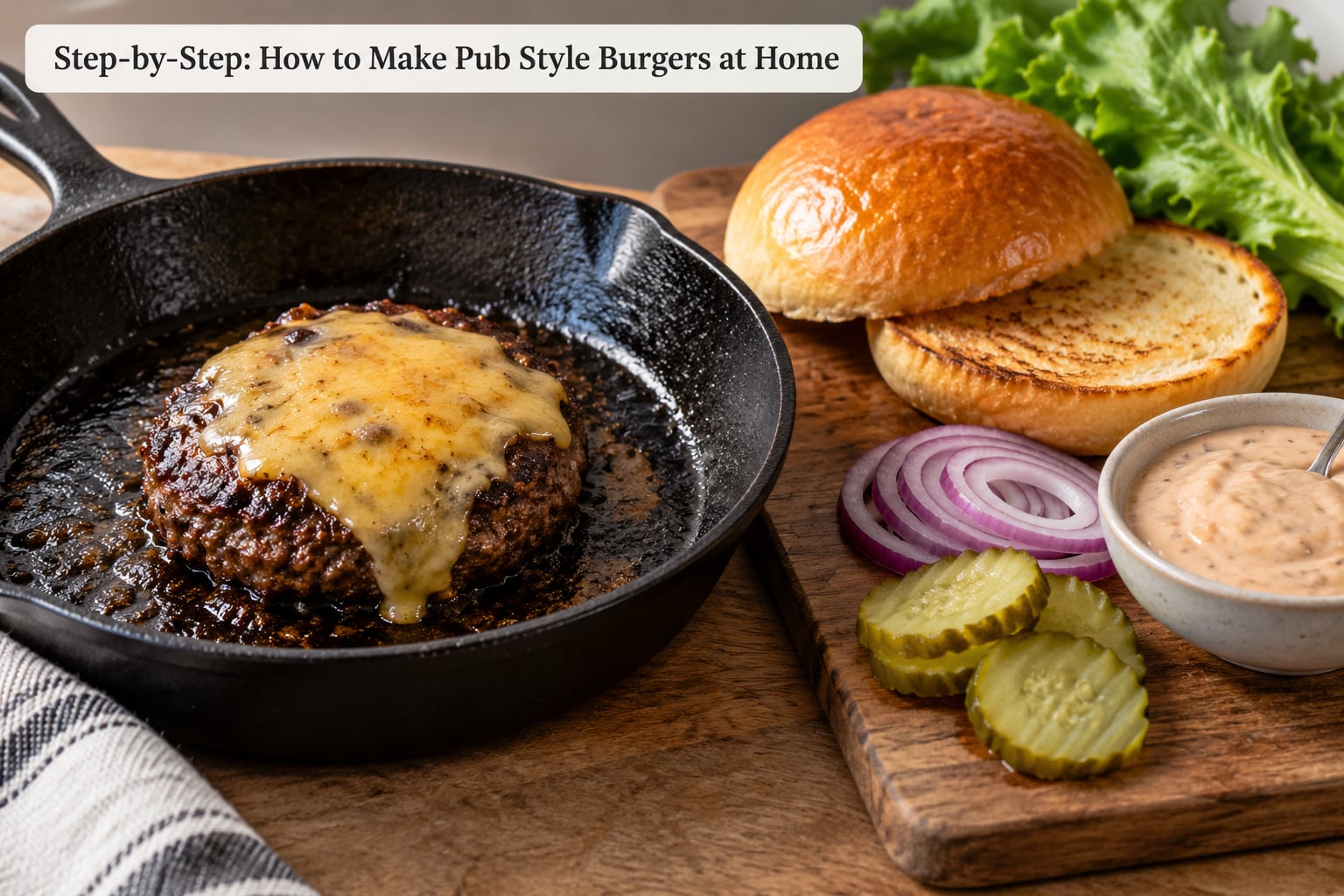
The whole method runs in one direction: cold meat, hot pan, seasoned outside, rested, assembled fast. Here is the sequence in brief before the detail.
- Bring the beef to room temperature for 15 to 20 minutes if it came straight from the fridge.
- Divide it into loose 6 to 8 oz balls and shape them gently, wider than the bun, with a shallow dimple in the centre.
- Heat the cast iron until a drop of water skates across it, then add a thin film of neutral oil.
- Press the patties down once, season the outside only with salt and pepper, and lay them down away from you.
- Leave the first side alone for 3 to 4 minutes until the edges look set and brown, then flip once.
- Check for 160°F / 71°C in the thickest part, add cheese, and rest the patty for 2 minutes.
- Butter the buns, toast them cut side down for 30 seconds, and build the burger immediately.
How to Form Juicy Burger Patties
Shape the beef with as few hands as possible, and never squeeze it. Working the meat too long activates the proteins, tightens the mixture and gives you a dense, bouncy patty — the single biggest reason home burgers taste different from pub ones.
Divide the beef into loose balls with your cupped hand, then flatten each one to about 1.5 cm (5/8 inch) thick, roughly 1 cm wider all round than the bun it will sit on. The extra width is your insurance: a 7 oz patty loses a meaningful amount of weight to rendered fat and shrinks noticeably in a hot pan, and the overhang is what a pub burger is supposed to look like.
Press a shallow dimple into the centre with your thumb. As the outside cooks, proteins contract and the patty domes upward in the middle; a thumb-sized hollow keeps the heat path even and stops the centre cooking slower than the edge. Make the dimple, then stop touching it.
Keep the meat cold while you work. If you have a sheet pan, form the patties early, chill them for 15 minutes, then season and cook straight from the fridge — cold fat gives you a cleaner sear and firmer edges.
How to Get a Crisp Burger Crust
A deep brown crust comes from heat, contact and time, not from pressing harder. The browned layer is the Maillard reaction, and it needs a surface hot enough to drive off surface moisture quickly.
Heat the cast iron over high heat for a full 5 minutes before the beef goes near it. A drop of water should skate and vanish rather than sit and bubble. Wipe it, add a thin film of neutral oil, and let the oil shimmer before the first patty lands.
Season the outside only, and season late. Salt mixed into raw meat pulls moisture out of the meat itself and dries the centre, which is the opposite of what you want from an 8 oz patty that needs eight minutes to cook through. Coarse salt and cracked black pepper on the outside give you the same seasoning with none of the drying.
Press each patty down once with the spatula as it hits the pan to guarantee full contact, then leave it alone. No flipping early, no nudging, no pressing. When the edges look dark brown and slightly set, the juices that were running pink across the surface have turned to gravy and you can flip. Lift from underneath with a wide spatula rather than a thin turner, and give it one confident motion.
If you are cooking indoors and the smoke is a problem, there are ways around it — I have covered cooking burgers on the stove without smoke separately. The short version: a preheated pan burns less fat than a timid one, and an exhaust fan close to the burner handles most of the rest.
How to Cook Ground Beef Safely in Pub Style Burgers
Ground beef should reach an internal temperature of 160°F (71°C). Because a pub patty is thick enough to taste raw in the middle long after the outside is done, colour is not a reliable guide — use a thermometer.
Push the tip of an instant-read thermometer into the side of the patty, aiming for the thickest part without touching the pan, and read it without the probe staying in for more than a second or two. Leaving a thermometer in a hot patty keeps cooking it from the inside, so take the reading and pull.
| Stage | Internal temperature | Approx. total cook time |
|---|---|---|
| Early, still raw outside | Below 130°F / 54°C | 3–4 minutes total |
| Getting close, pink centre | 140–150°F / 60–66°C | 5–7 minutes total |
| Safe minimum for ground beef (USDA) | 160°F / 71°C | 8–10 minutes total |
One caveat on that table. The lower stages are there to show how a thick patty moves through temperature, not as an instruction to serve it early. Ground beef is the one cut where USDA guidance is 160°F (71°C) with no lower stage recommended, and that is the number to cook to and serve from. Colour, the press test and how juicy it looks are not safety signals for ground meat.
Carryover cooking does the rest. A patty that reads 155°F when you pull it will sit up past 160°F within a couple of minutes, so pull a shade early if you are chasing a specific texture. Rest the patty for 2 minutes on a warm plate or on the side of the skillet with the heat off, and the juices stop running out onto the board and redistribute through the meat.
Add cheese only after the safe temperature is reached, and let it sit on the patty for 30 to 60 seconds so it melts from the residual heat rather than from a hard sear. Sauces, pickles and raw toppings go on at assembly, never before the meat is safely cooked.
For anyone feeding a mixed table, a practical compromise is to cook most patties straight through to 160°F and pull one or two early only if someone wants less well-done texture, resting them on the side until the thermometer confirms the safe temperature. It is the same reason smash burgers settle the doneness argument in two minutes — pub patties ask for a little more planning.
How to Build a Pub-Style Burger
Build in this order and the burger holds together: toasted bun, sauce, patty, cheese, dry toppings, wet toppings, top bun. Put the sauce on the bottom bun as a thin spread rather than a pool, and keep raw tomato and pickles above the patty rather than under it, so the juice runs down into the meat instead of straight into the bread.
The classic combination is cheddar, shredded lettuce, a thick tomato slice, thin red onion and two lengthways pickle slices. Toast the buns in the same skillet with a little butter for 30 seconds a side, and put them cut side up on the board while you rest the patties — a bun left face down traps steam and goes soft.
If you want a fuller plate, caramelise the onion in the pan fat after the patties come out and pile it on top. It takes six extra minutes and it is the difference between a decent burger and the one your friends ask about afterwards. For a thinner, more American build, the layering in our diner style cheeseburger guide works just as well on a thick patty.
Assemble and eat fast. A pub burger waits for nobody, and the bun starts going soft within a minute of the sauce landing.
Pub Style vs Smash Burger: Which Should You Make?
The difference is thickness and heat, not ingredients. A smash burger is a 3 to 3.5 oz ball pressed flat on a very hot surface and cooked in well under two minutes per side, which gives you a wide lacy crust of crisp edges and a thin middle. A pub style burger is a 6 to 8 oz patty cooked gently for 3 to 4 minutes a side, which gives you a thick, even, juicy centre and a crust that wraps the whole surface.
Most home cooks split on this one. They reach for a smash burger on an ordinary weeknight because it is fast and forgiving, and save the thick pub patty for when they actually want a meal. That is the honest answer — the two styles solve different problems.
| Factor | Pub style burger | Smash burger |
|---|---|---|
| Raw patty weight | 6–8 oz (170–200 g) | 3–3.5 oz (85–100 g), often doubled |
| Thickness | About 1.5 cm, domed if un-dimpled | Under 5 mm, pressed thin |
| Cooking surface | Hot cast iron or griddle, medium-high to high | Very hot griddle, almost smoking |
| Cook time per side | 3–4 minutes | Under 2 minutes |
| Crust character | Even brown crust all over | Lacy, crisp, ragged edges |
| Texture | Juicy throughout, substantial | Thin, chewy, edge-crisp |
| Best cheese | Cheddar, Stilton, Gouda, Brie, Taleggio | American or thin provolone |
| Best bun | Potato or plain brioche, holds up to overhang | Small brioche or potato bun |
| Suits | A proper sit-down meal, cookouts, feeding a crowd | Quick lunches, two people, mixed doneness |
One trap worth naming. Applying smash technique to a half-pound patty backfires: the patty spreads to something absurd, is impossible to flip with an ordinary spatula, and cannot be dressed. If you own a burger press and are tempted to use it on a pub patty, leave it in the drawer. Press only when you want a smash burger.
For reference, the thin, edge-crisp, stacked style most people picture when they hear the word burger is a smash burger. A hand-formed thick patty is a different animal: it needs more heat, more time, and a bun sturdy enough to take the overhang.
How to Make Home Burgers Taste Like Restaurants
Six things separate a restaurant burger from a decent home one, and none of them are secret. They are process decisions you can copy on a weeknight.
- Buy fattier beef. 80/20 ground chuck is the baseline. Lean 90/10 griddles into a dry puck, and no amount of sauce fixes it.
- Handle the meat as little as possible. Loose balls shaped with a cupped hand stay tender. Mixed or kneaded meat compacts and tightens.
- Season the outside only. Salt on the surface in the last minute before cooking seasons properly. Salt mixed through raw beef draws water out of the muscle and dries the middle of an already slow-cooking patty.
- Give the pan real heat. A properly preheated cast iron skillet browns in seconds. A lukewarm pan steams the meat grey and drops the fat straight through the crust instead of browning it.
- Leave the first side alone. Every early flip, press or wiggle resets the crust. Three to four minutes of stillness does more for flavour than any ingredient.
- Rest and assemble fast. Two minutes off the heat, then build and eat immediately. Restaurants have a line of tickets between cooking and serving; the home equivalent is not letting the burger sit on the board while you finish everything else.
If you do only three of those six, take the fattier beef, the preheated pan and the patience to leave the patty alone. Those three do most of the work.
Common Mistakes
Almost every disappointing home pub burger traces back to one of these eight things. Each fix is small; doing all of them is the difference.
Dense, bouncy patties
You kneaded the beef. Mix it no more than it takes to combine, and shape with a light cupped hand. A few seconds of pressing is plenty — no kneading, no rolling.
Patties shrink to fit the bun
Size every patty at least 1 cm wider than the bun and accept the overhang. Also press a dimple in the centre so the middle does not pull inward as it cooks. Expect to lose roughly 20% of raw weight to rendered fat and moisture — that is normal, not a mistake.
No browning
The pan was not hot enough or the patties were crowded. Give cast iron a full 5 minutes over high heat, cook two patties at a time in a home skillet, and let the surface moisture cook off before the patty goes down.
Dry, overcooked patties
Use 80/20 beef, stop seasoning the raw interior, and pull the patty at temperature rather than on the clock. A 2-minute rest is not optional on an 8 oz patty.
Soggy buns
Toast them. Butter the cut face and give it 30 seconds a side in the hot pan, then keep them cut side up while everything else finishes. Also spread sauce thinly rather than heavily — a quarter teaspoon per bun is usually plenty.
Cheese that slides off or melts unevenly
Put the cheese on immediately after the flip while the patty surface is still hot, then leave it alone. Moving the patty while the cheese is setting drags it sideways, and double-stacking slices on the off heat melts them unevenly.
Too many wet toppings
Pickles and tomato drain onto the bun and the whole thing collapses by the second bite. Drain the pickles, slice the tomato thick, and keep fried onions to a spoonful rather than a layer.
Everything gone cold and flat by the time you serve it
For a group, cook in batches of two and stack the bare patties in a folded foil parcel in the toasted bun — the bun traps the heat, and the last patty lands hot with the first. If you want them to wait longer than that, hold them on a rack in a 170°F / 75°C oven rather than in a covered dish, which steams the crust away.
Frequently Asked Questions
How big should a pub style burger patty be?
Six to eight ounces (170 to 200 g) of raw beef per person is the pub style range. Weigh it rather than eyeballing, and shape the patty about 1 cm wider than the bun because it will shrink as the fat renders and the proteins contract. One 7 oz patty is a full meal, which is why this style suits a weekend cookout more than a quick Tuesday dinner.
What is the best cheese for a pub style burger?
Mature cheddar is the classic choice because its sharpness holds up against an 80/20 patty without disappearing into the fat. Stilton, Gouda, Brie and Taleggio all work well if you want more character. Skip American cheese here — it is engineered to melt flat for thin smashed patties, so on a thick burger it just drapes over the edge.
Is a cast iron skillet better than a grill for pub style burgers?
For a thick pub burger, cast iron or a carbon steel griddle is the easier choice. It holds a steady high heat and the whole surface stays hot, so a 7 oz patty cooks evenly without a hot spot under the middle. A gas grill works too, but keep the patty over medium-high indirect heat rather than straight over a flame, or the outside burns before the centre reaches 160°F.
How do I stop the bottom bun going soggy?
Toast the buns cut side down in butter for about 30 seconds a side, then spread only a thin layer of sauce on the cut face — roughly a quarter teaspoon per bun. Put the patty on top of the sauce, and keep wet toppings like tomato and pickles above the meat so the juice runs down the patty rather than into the bread. Never build the burger more than a minute or two before eating.
Can I form the patties the night before?
Yes. Form loose balls and patties from cold beef, lay them on a parchment-lined tray, cover and refrigerate for up to 2 days. Season them only just before cooking, because salt on the surface pulls moisture out of the patty during storage. Raw formed patties also freeze well for 3 to 4 months on a tray first, then loosely bagged, with parchment between each one.
Start with the beef and the pan, because everything after that is straightforward. Buy 80/20 chuck, weigh it into 6 to 8 oz portions, and get the cast iron properly hot before anything else. Shape the patties gently, dimple the centre, season the outside, and give it 3 to 4 minutes a side untouched — that is the whole technique behind how to make pub style burgers at home that taste worth the drive-thru.