
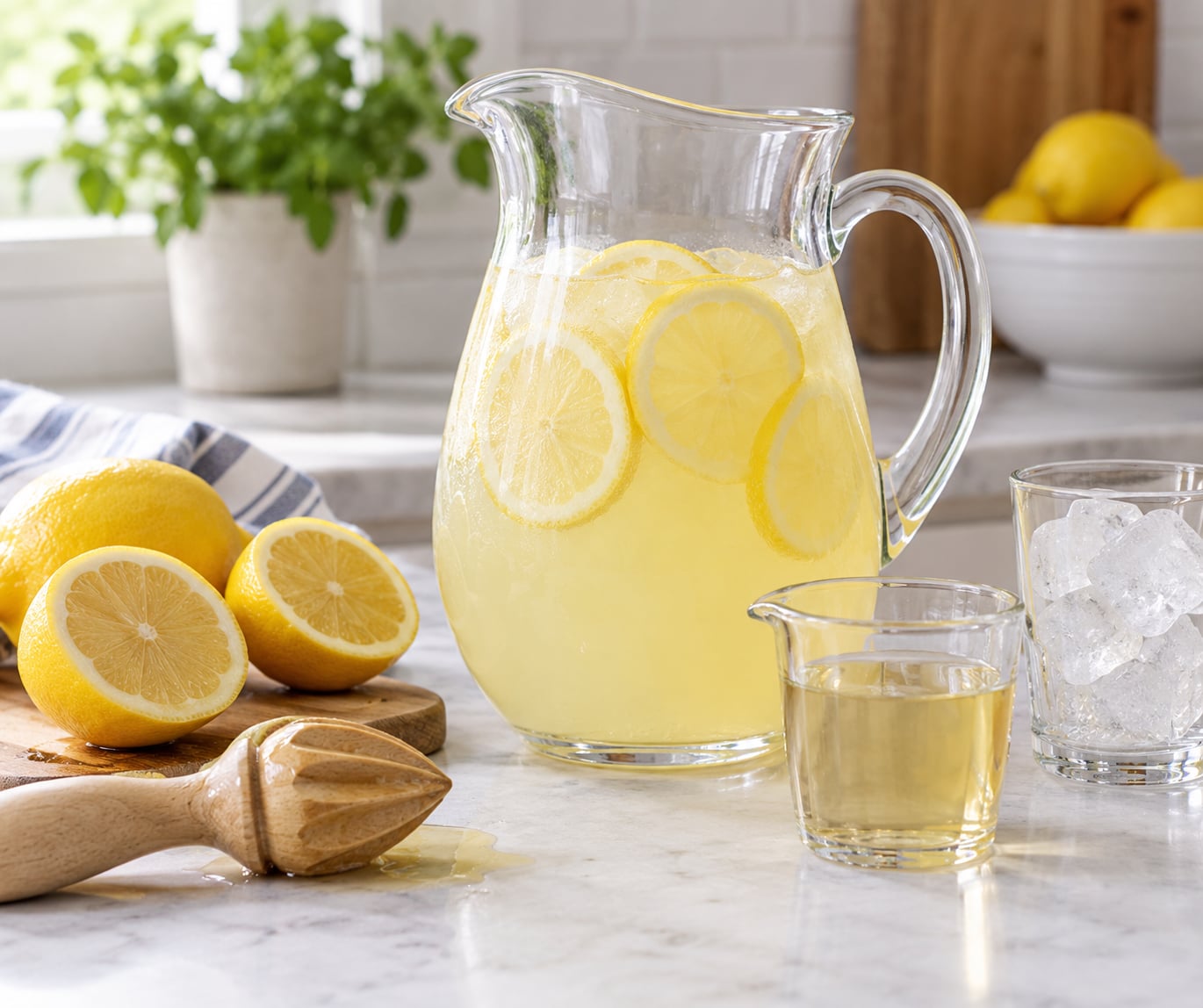
How to make lemonade from scratch takes about 15 minutes and three real ingredients: fresh-squeezed lemon juice, a 1:1 simple syrup made from sugar and water, and cold water. Squeeze 6 to 8 medium lemons, dissolve the sugar in a hot cup of water, stir everything together, and chill.
That syrup step is the whole trick. Sugar dumped straight into cold juice and water sinks to the bottom and stays gritty, so you end up over-sweetening the top layer to fix the bottom one. Dissolving the sugar first gives you a drink you can adjust by taste instead of by guesswork.
This is a beginner-friendly method, and the hardest part is remembering to roll the lemons on the counter before you cut them.
What You Need
The base recipe makes about half a gallon, roughly eight one-cup servings. Everything below is measured by volume, so a standard measuring cup gets you there without a scale.
Ingredients
- 6 to 8 medium lemons, about 1 1/2 cups of juice once squeezed and strained
- 1 cup granulated sugar
- 1 cup water for the simple syrup
- 5 cups cold water
- Ice for serving
Tools
- A citrus juicer, lemon press, or the flat side of a butter knife
- A small saucepan
- A whisk or long spoon for the syrup
- A fine mesh strainer
- A glass pitcher or gallon jar
- A measuring cup and a sharp knife
One medium lemon gives roughly 3 to 4 tablespoons of juice, and how many you buy depends entirely on size and seediness. That is why the recipe measures juice by cup after straining rather than telling you to count lemons.
If your tap water is heavily chlorinated or very hard, swap the 5 cups of cold water for filtered water. The drink picks up an off flavor from the water far more easily than most people expect, and it has nothing to do with the lemons.
Scaling the batch
| Batch | Fresh lemon juice | Lemons to buy | Sugar | Syrup water | Cold water |
|---|---|---|---|---|---|
| 1 cup drink | 3 tablespoons | 1 small | 1 tablespoon | 1 tablespoon | 2/3 cup |
| Half gallon (8 cups) | 1 1/2 cups | 6 to 8 medium | 1 cup | 1 cup | 5 cups |
| 1 gallon (16 cups) | 3 cups | 12 to 16 medium | 2 cups | 2 cups | 10 cups |
| 5 gallons | 15 cups | 60 to 80 medium | 10 cups | 10 cups | 50 cups |
For a lemonade stand or a big barbecue, make the syrup in a stockpotted double or triple and juice the lemons the day before, storing the juice covered in the fridge.
How to Make Lemonade from Scratch: Step-by-Step
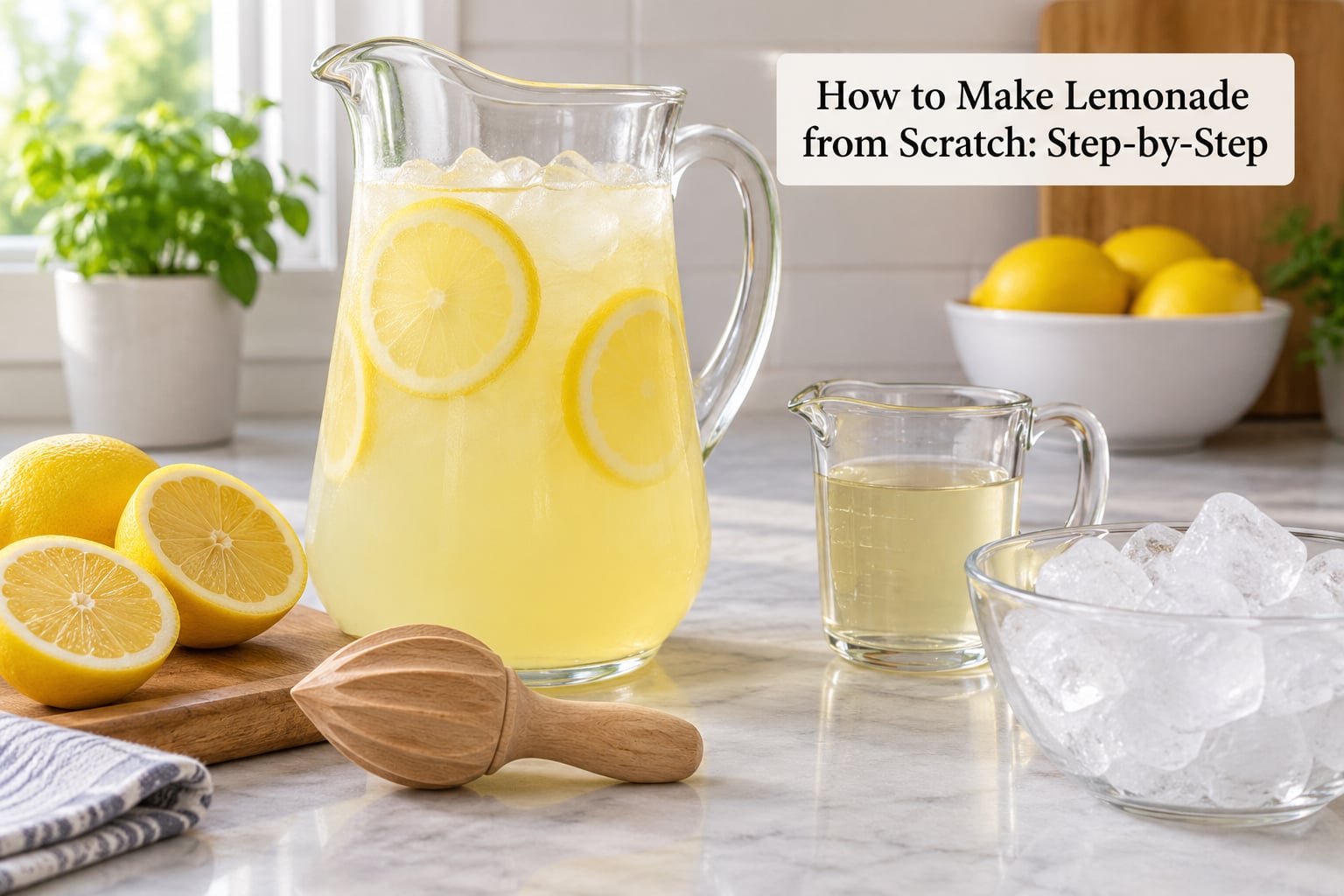
Set everything out before you start, because the syrup, the juice, and the mixing all happen within about 15 minutes of each other. Keep the juice in the fridge while the syrup cools so nothing sits warm for long.
Make the Simple Syrup
Pour 1 cup of water into a small saucepan and set it over medium heat. When it starts to steam and you see tiny bubbles along the bottom, add the 1 cup of granulated sugar and stir with a whisk or spoon.
Keep it at a gentle simmer for about 3 to 5 minutes and keep stirring until the liquid runs clear. That is the cue that it is done: no cloudiness, no sugar crystals catching the light, and no grainy texture when you drag a finger along the back of the spoon.
Do not boil it hard. A rolling boil takes longer and can concentrate the syrup enough to taste scorched once it hits the lemon juice.
If you want a deeper lemon aroma, add the zest of 2 lemons to the saucepan before the water heats, then strain the syrup through a fine sieve when it is cool. Only the colored outer layer goes in. The white pith underneath is the bitter part, and it is the same culprit behind most bitter batches.
Turn the heat off and let the syrup cool for about 10 minutes. It thickens as it cools, so a warm drizzle will thin right out once the cold water goes in.
For larger batches or a different sweetener entirely, I use the same 1:1 approach I write about in how to make homemade soda syrup.
Juice and Strain the Lemons
Roll 6 to 8 medium lemons on the counter under the flat of your palm for 30 to 60 seconds, pressing firmly. You are breaking the juice sacs inside so more liquid comes out with less squeezing, and that also reduces how much bitter white pith gets torn loose.
Cut each lemon in half crosswise, cut side down on the board, and squeeze with a citrus reamer or a lemon press. Steady pressure is plenty. If a seed comes along, fish it out or let it fall into the strainer.
Pour the juice through a fine mesh strainer set over a bowl or measuring cup. Skip the straining and you will get a cloudier, slightly pulpy drink; keep the seeds in and you risk seeds floating in the glass.
Measure what you collected. You are aiming for 1 1/2 cups. A heavy Meyer or Eureka lemon can give you nearly half a cup, so a big fruit count is not always a high yield.
Mix and Chill the Lemonade
Pour the cooled simple syrup into the bottom of your pitcher. Add the fresh juice and stir once so they combine, then add the 5 cups of cold water and stir again until the whole pitcher looks the same shade from top to bottom.
Now taste it. Squeeze in more juice by the tablespoon if it is flat, or add simple syrup by the tablespoon if it is sharp. Taste again. Sweetness reads differently when a drink is cold, so chill first and do your final adjusting cold.
Refrigerate for at least 30 minutes, and up to 2 hours if you can wait. Cold water and cold fruit go in first, so the drink chills faster and tastes brighter than lemonade made with room temperature ingredients and ice added at the end.
Serve It Cold
Fill tall glasses with ice first, then pour the lemonade over. That keeps the drink cold without watering it down as fast as ice melted directly in the pitcher would.
Garnish options: thin lemon wheels or half-moons, a few torn mint leaves, or a sprig of rosemary. Citrus wheel cutters make the wheels look even, but a sharp paring knife and a steady hand do the same job.
For sparkling lemonade, chill everything first, then top each glass with chilled sparkling water at the table rather than mixing it into the pitcher. The bubbles last about ten minutes this way instead of going flat in five.
For a mixed drink that reads more adult, pour the lemonade over iced tea in equal parts. If you do it at home, get the tea right first with how to make sweet tea properly.
Store the lemonade covered in the refrigerator and drink it within 3 to 4 days. Because it is made with cut fruit and no preservatives, treat it like any other fresh juice: keep it cold, and if it has been sitting out longer than 2 hours on a table, or longer than 1 hour in heat above 90°F, throw it away.
Common Mistakes
Almost every bad pitcher of lemonade comes down to one of five things.
- It tastes bitter. White pith got dragged into the juice, or the lemons themselves were under-ripe. Roll the lemons before cutting, press gently, cut side down, and strain through a fine sieve. To rescue an existing batch, add cold water and a tablespoon of syrup at a time until the bitterness fades.
- It tastes thin or watery. Too much dilution, usually from eyeballing the water instead of measuring it. Add lemon juice a tablespoon at a time and taste until the edge comes back.
- It tastes cloyingly sweet. The sugar went in before anyone tasted. Dilute with cold water and let it chill fully; cold mutes sweetness, so a batch that tastes too sweet at room temperature often lands right once it is cold.
- There is gritty sugar at the bottom. The drink was mixed cold and served immediately. Simple syrup exists to prevent this. If you already have a gritty pitcher, stir for 30 minutes and most of it will dissolve; for stubborn patches, warm the pitcher gently and cool it fast.
- It is dull or flat, not sour. That is usually chlorinated or very hard tap water rather than a lemon problem. Use filtered water next time.
Two more variations worth trying: steep a handful of mint or lavender in the syrup while it simmers for a light herbal note, or muddle a cup of strawberries at the bottom of the pitcher for fresh strawberry lemonade. Both keep the same 1:1 syrup ratio, so nothing else changes.
Frequently Asked Questions
Do I need fresh lemons to make lemonade from scratch?
Fresh lemons give you the strongest aroma and the brightest acidity, and this recipe is built around them. Bottled lemon juice does work if that is what you have on hand, but it is usually more acidic and less fragrant, so start with about three quarters of the juice volume and taste before adding more.
Can I make lemonade without simple syrup?
Yes. Stir the sugar straight into the pitcher with the cold water and juice, then let it sit for 30 minutes, stirring once or twice, until the sugar dissolves. The overnight version people use for large batches works too: sugar in the bottom of a gallon jar, lemon juice and cold water on top, and let it stand overnight.
How do I make lemonade less bitter?
Bitterness comes from white pith and the white membrane beneath the peel being torn into the juice, or from lemons that were picked before they ripened. Roll the lemons for a minute before cutting, squeeze with steady pressure instead of force, and strain through a fine sieve. To fix a batch already made, dilute with cold water and add syrup a spoonful at a time.
Can I make this recipe into sparkling lemonade?
Yes, and the method is easier than you would expect. Make the lemonade as written without any bubbles, chill it thoroughly, then top each glass with chilled sparkling water at the moment of pouring. Adding the sparkling water to the whole pitcher works too, but the bubbles start leaving the glass within a few minutes.
How much lemonade does this recipe make, and how long does it last?
The base recipe uses 6 to 8 lemons, 1 cup sugar, 1 cup water and 5 cups cold water, which comes to about half a gallon or eight one-cup servings. Covered and refrigerated it stays good for 3 to 4 days. If it has sat out over 2 hours on a table, or an hour above 90°F, discard it.
Conclusion
Start with the syrup. One cup of sugar in one cup of water, simmered until clear and cooled for ten minutes, is the part that turns three ingredients into a drink worth serving.
Then roll and squeeze 6 to 8 lemons, strain the juice, combine it with the syrup and 5 cups of cold water, taste while it chills, and adjust sweetness and sharpness to your liking. Get that right and the rest is pouring it over ice.