
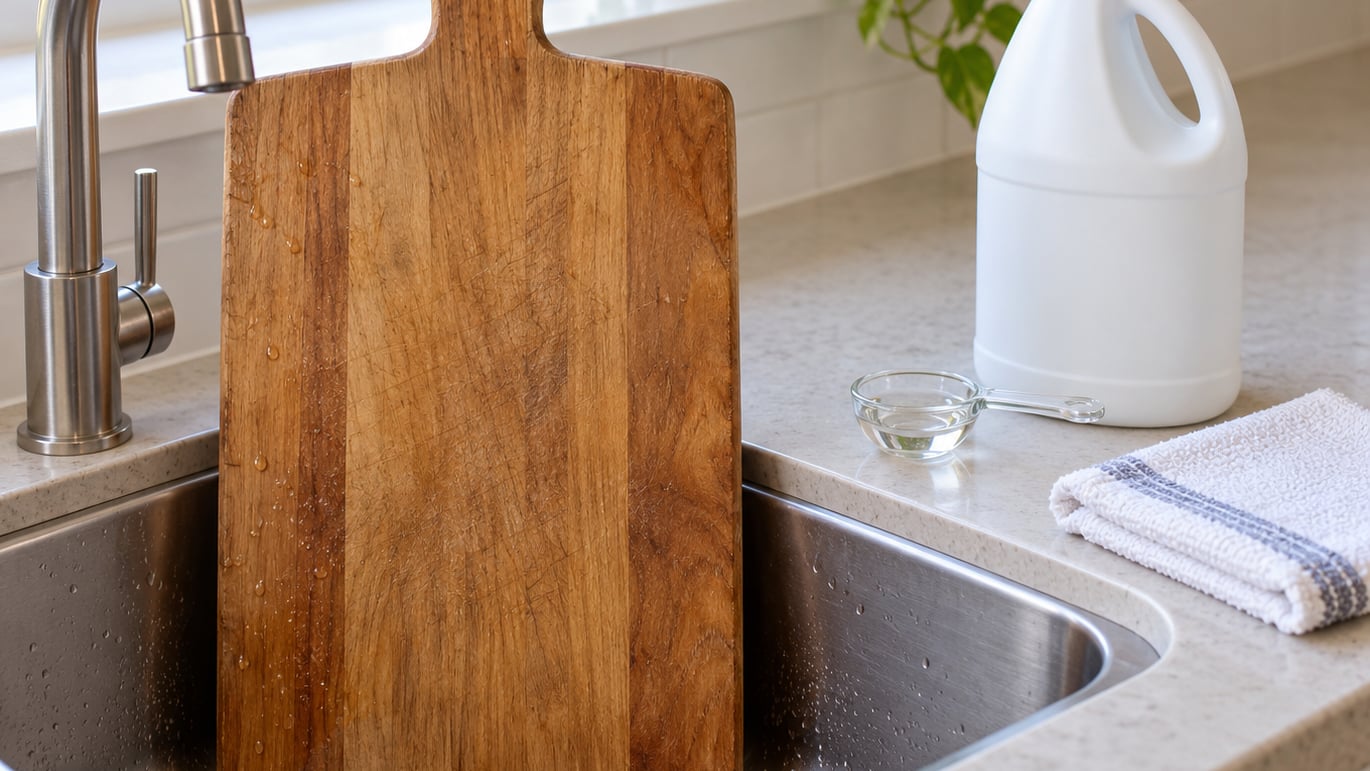
To sanitize a wooden cutting board, wash it with hot water and dish soap first, flood the surface with a measured diluted bleach solution, let it stay wet for a minute, then rinse and stand the board upright until it air-dries completely. The whole job takes about ten minutes plus drying time, and the order matters more than the products you use.
Most home kitchens do not need anything more elaborate than soap, water, and air. But raw poultry, fish, and beef leave behind bacteria that a quick rinse will not shift, and the grooves in an older board hold residue that a sponge cannot reach. That is the moment a sanitizer earns its place.
This guide walks through exactly how to sanitize a wooden cutting board, how long each step takes, how to spot a board that has stopped being cleanable, and what mistakes cause warping or cracking. Nothing here requires gear beyond a sink and a measuring spoon.
Table of Contents
- What You Need to Sanitize a Wooden Cutting Board
- Step-by-Step
- Common Mistakes
- Frequently Asked Questions
- Can you sanitize a wooden cutting board with vinegar?
- Is hydrogen peroxide safe for a wooden cutting board?
- Can you put a wooden cutting board in the dishwasher?
- How often should I sanitize a wooden cutting board?
- What smells mean a wooden cutting board should be thrown out?
- Does washing a wooden cutting board with dish soap sanitize it?
- Conclusion
What You Need to Sanitize a Wooden Cutting Board
Gather these before you start, because the sanitizing step is useless on a board that still has food on it. Everything takes about five minutes to lay out.
- Hot running water. Hot enough to comfortably hold your hand for a few seconds. You are not boiling anything, you are helping grease melt.
- Dish soap. Standard liquid detergent. Degreasing soap is not required, and heavy degreasers leave a film that wood absorbs.
- A stiff brush or a plastic scraper. A dish brush works on the end grain; a scraper gets up tomato and beet stains.
- Unscented, liquid chlorine bleach. The label must say it is suitable for food-contact surfaces. Colored or scented varieties are the wrong choice.
- Cool clean water for mixing. Hot water weakens bleach, so mix in cold or cool water.
- A measuring spoon and a large bowl or the sink basin. You need volume big enough to flood the whole board face.
- A food-contact surface sanitizer, optional. This is the labeled-product route for anyone who prefers not to use bleach at home.
- A drying rack or an open space on the counter. The board needs to stand on edge with air moving around it.
Step-by-Step
Run these steps in order every time. Cleaning, then sanitizing, then drying are three different jobs, and skipping the first one makes the second one weaker.
Wash away food and grease
Scrape loose debris into the trash with the back of your knife or a scraper. Then scrub every part of the board with hot soapy water: the top face, the bottom face, all four edges, the handle, and any groove or joint you can see.
Pay attention to the parts people skip. End-grain blocks and the seam where a handle meets the board trap the most food and hold the most moisture, so give them an extra scrub with the stiff brush.
Dish soap is fine here. The idea that soap strips wood of protective oils does not hold up in practice; the oils that matter are the ones you reapply yourself, and rinsing well removes the detergent film anyway. Wash with soap every single time you use the board.
Skip the dishwasher. The heat, the standing water, and the drying cycle will warp, split, or loosen the glue joints on almost any wood board. If a board has gone through the washer once, treat drying and warping as a countdown.
Rinse and dry the board
Rinse under hot running water until the water runs clear and you cannot feel slickness on the surface. Trapped detergent is what causes a musty smell later, and it also dulls any oil you add afterward.
Stand the board upright on its edge so air reaches both faces. Lay it flat and the underside stays damp for hours, which is the single most common reason boards smell.
You do not need the board bone dry to sanitize it. You need it damp enough that the solution spreads instead of beading, and free of loose water so the sanitizer does not get diluted on contact.
How to sanitize a wooden cutting board with diluted bleach
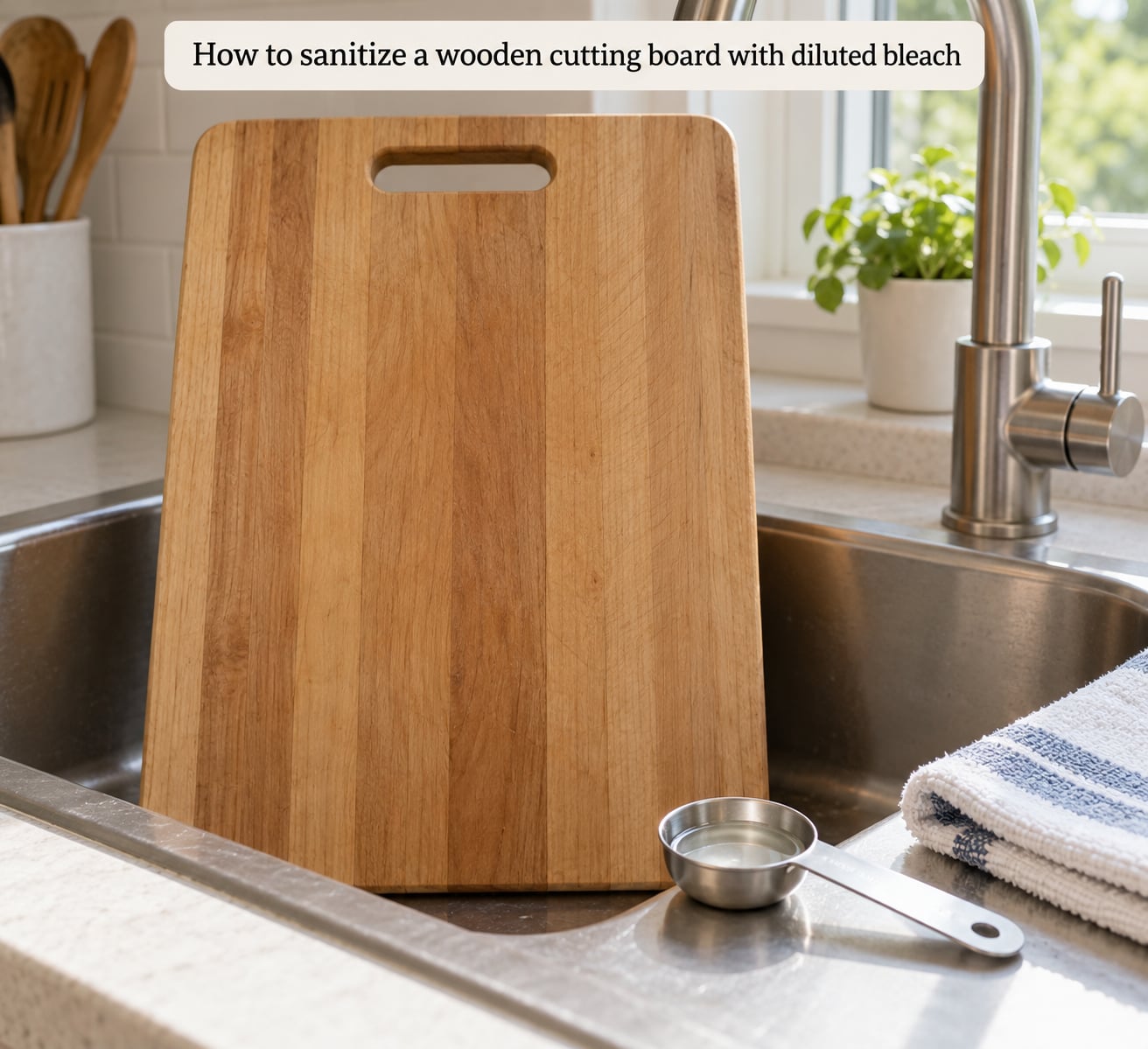
Mix one tablespoon of unscented, liquid chlorine bleach per gallon of cool water. Use a spoon to measure it rather than eyeballing a pour, and pour the solution into a bowl or the sink basin.
Flood the board. Both faces, all four edges, the handle, the grooves. You want every surface visibly wet with no dry patches, because a dry patch is a surface the bleach never touched.
Leave the solution sitting on the wood for at least one minute. That wet dwell period is the part people rush. A quick swipe of undiluted bleach across a wet board does almost nothing compared with a thin, correctly diluted solution held in contact for a full minute.
Never mix bleach with vinegar, ammonia, or any other cleaner, and never pour bleach into a sink that still holds dish soap. Vinegar plus bleach releases chlorine gas, and bleach plus ammonia makes chloramine. Pick one product per cleaning session.
Check the bottle before you measure. Standard unscented chlorine bleach in roughly the five to nine percent range, labelled for food-contact surfaces, works at that one-tablespoon-per-gallon measurement. Concentrated commercial bleach needs a different dilution, so follow the label on whatever is in your cupboard rather than assuming.
Sanitize with a labeled product instead
Commercial kitchens rarely use bleach at the counter. Most use a quaternary ammonium sanitizer sold for food-contact surfaces, applied from a spray bottle or a cloth, with a test strip to confirm the solution is still at strength.
If you go this route at home, follow the label exactly. That means covering every surface, holding it wet for the stated contact time, rinsing if the label says to rinse, and then air-drying. Labels differ on dilution and timing, and the label always beats any general advice, including this article.
The restaurant version of the same routine is a three-compound sink method: wash, rinse, then sanitize in a separate labelled bucket kept at the correct concentration. The reason it exists is that busy kitchens sanitize dozens of boards an hour and need a system that scales. At home you have one board and time to get it right, which is the easier version of the same principle.
Check that the board is clean and fully dry
Look at the board in good light and ask two questions. Can I see any food or discoloration that did not come from the wood itself, and does it smell clean once you are close to it? A faint bleach smell is normal and fades as it dries. A sour or oniony smell that survives a full wash means residue is still lodged somewhere.
Then let it dry fully. Stand it upright with space on both sides, and do not lay a towel over the top or push it into a corner of the cabinet. Check it again before you put it away.
Some boards should not be cleaned at all, only replaced. Discard the board if you find deep splits or cracks you can catch a fingernail in, a soft or spongy area, black or green speckling that looks like mildew, a glue joint that has started to open, or an odor that survives washing and drying twice.
Common Mistakes
Almost every problem with a sanitized wooden board traces back to one of these. They are worth a quick scan before you start.
- Undiluted or over-strength bleach. Concentrated bleach burns and darkens wood and leaves a residue you cannot rinse out of the grain.
- Skipping the contact time. Dumping the solution on and immediately rinsing it off gives you a wet board, not a sanitized one.
- Leaving food in the grooves. Sanitizer cannot kill what is buried under dried residue, so wash first and scrub the grooves.
- Mixing cleaners. Bleach with vinegar, ammonia, or leftover dish soap is genuinely dangerous, not just a bad idea.
- Soaking or running the dishwasher. Standing water and heat open splits and glue joints faster than anything else on this list.
- Wiping the board dry with a towel. Towels trap moisture against the wood and push it into the grain. Stand it up and let the air do the work.
- Repairing a board that should be replaced. A deep split or a persistent smell is not a maintenance problem.
- Spending money on a board cream and skipping the wash. Cream conditions wood. It does not sanitize it.
How to fix a deeply cut or damaged board
Light knife marks are not a food-safety problem. The board is still cleanable, and many cooks just live with the patina.
If the cuts bother you cosmetically and the board is otherwise sound, sand it smooth with medium and then fine grit, wash off the dust, and re-oil it with food-grade mineral oil. Sanding flattens the fibers a little and makes the surface less able to hold liquid, so follow it with a fresh coat of oil.
Do not try to repair deep splits, a joint that has opened, or a board that smells no matter how you wash it. Once water is getting into the cracks and staying there, you are sealing moisture into the board with every soak. Replacing it is the safer and honestly easier fix.
Sanitizing tips for long-lasting wooden boards
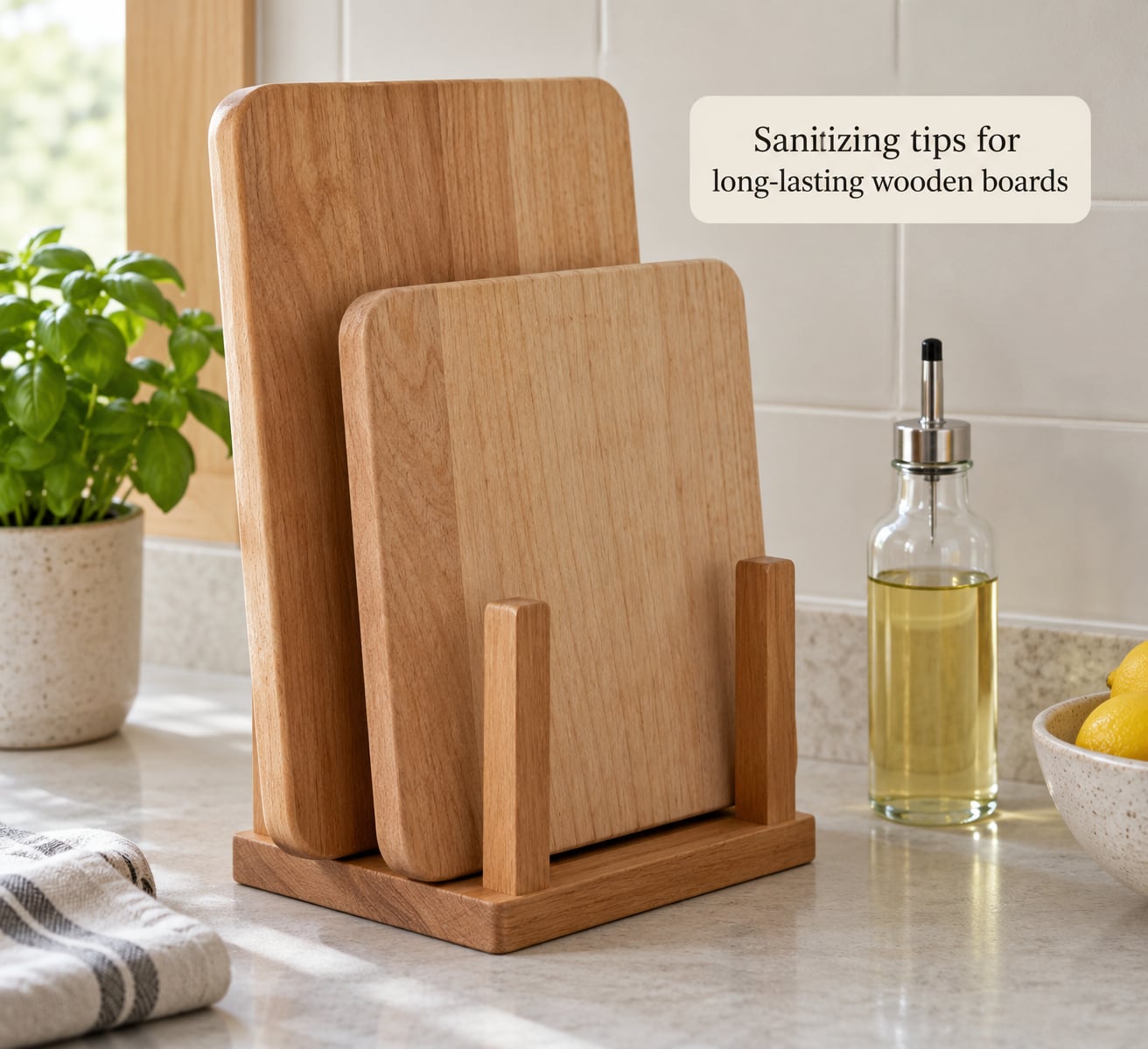
Use two boards if you cook often. Keep one for raw meat, poultry, and fish, and a second for bread, vegetables, and ready-to-eat foods. This is the same color-coded logic restaurants use, and it removes most of the reason to sanitize aggressively in the first place.
Wash after every use and dry upright, every time. Food left sitting on a wooden board for an hour soaks in, and that is where the odor and the bacteria come from. The habit matters far more than any treatment you do later.
Oil the board when the surface looks pale or dry, usually every few weeks in a busy kitchen and every couple of months in a quiet one. Use food-grade mineral oil or a board cream made with mineral oil and beeswax. Avoid olive oil, corn oil, and other vegetable oils; they oxidize and go rancid, and a rancid board smells worse than the onion you were trying to remove.
Store boards upright or on their side so air circulates. Laying a damp board flat under the sink or in a stacked pile is what turns a good board into a replacement.
Replace the board once it is too porous to clean. Test it by washing it thoroughly, drying it completely, and looking at it under a light. If the surface stays blotchy and darkened no matter what you do, the grooves are now deeper than the wash.
Frequently Asked Questions
Can you sanitize a wooden cutting board with vinegar?
White vinegar is a decent everyday disinfectant, not a sterilizer. Mixing equal parts of plain white vinegar and water and flooding the board works well for routine sanitizing between foods, and it also handles garlic and onion odor. Pour it off and rinse with plain water after a few minutes so the smell does not linger. After raw poultry or fish, the diluted bleach method is the stronger choice.
Is hydrogen peroxide safe for a wooden cutting board?
Three percent hydrogen peroxide is safe on wood and breaks down into water and oxygen, so it leaves no residue behind. Flood the board with undiluted three percent solution, leave it wet for about ten minutes, rinse, and stand the board up to dry. Never combine peroxide with vinegar; the two together form peracetic acid, which irritates lungs and eyes and is a common kitchen accident.
Can you put a wooden cutting board in the dishwasher?
No. The dishwasher heat, prolonged moisture, and drying cycle will warp the board, split the wood, and loosen glued joints, usually within a few cycles. Wash by hand with hot soapy water, rinse well, and stand the board upright. If it has already gone through the machine, check for a curve or an opening seam and expect to replace it sooner rather than later.
How often should I sanitize a wooden cutting board?
Wash with hot soapy water after every use, and sanitize with a disinfectant after raw meat, poultry, fish, or after any illness in the household. A vinegar or bleach treatment once or twice a week is plenty for everyday vegetable and bread prep. If you use one board for everything, weekly sanitizing becomes the minimum rather than the option.
What smells mean a wooden cutting board should be thrown out?
A faint bleach smell right after sanitizing is normal and fades as the board dries. A sour, sour-sweet, or oniony smell that is still there after a full wash and dry cycle means residue is living in the grooves. Mildew, mustiness, or a smell that returns within hours of cleaning all point the same way, and in those cases replacing the board is the safe call.
Does washing a wooden cutting board with dish soap sanitize it?
No, it cleans. Dish soap and hot water lift grease and food residue off the surface, which removes most of what you are trying to get rid of, but soap alone does not reliably kill bacteria. Sanitizing is the extra step that kills what washing leaves behind, and it only works on a surface that has already been cleaned.
Conclusion
Start with the habit, not the chemicals. Wash the board with hot soapy water the moment you finish using it, rinse away every bit of detergent, and stand it upright so both faces dry in moving air. That alone handles most of what a sanitizer would.
When you are cutting raw meat, poultry, or fish, add the second step: one tablespoon of unscented chlorine bleach per gallon of cool water, flooded over every surface, left wet for at least a minute, rinsed, and air-dried fully. And if the board has deep splits, mildew, or an odor that keeps coming back, replacing it protects you more than any amount of scrubbing will.