
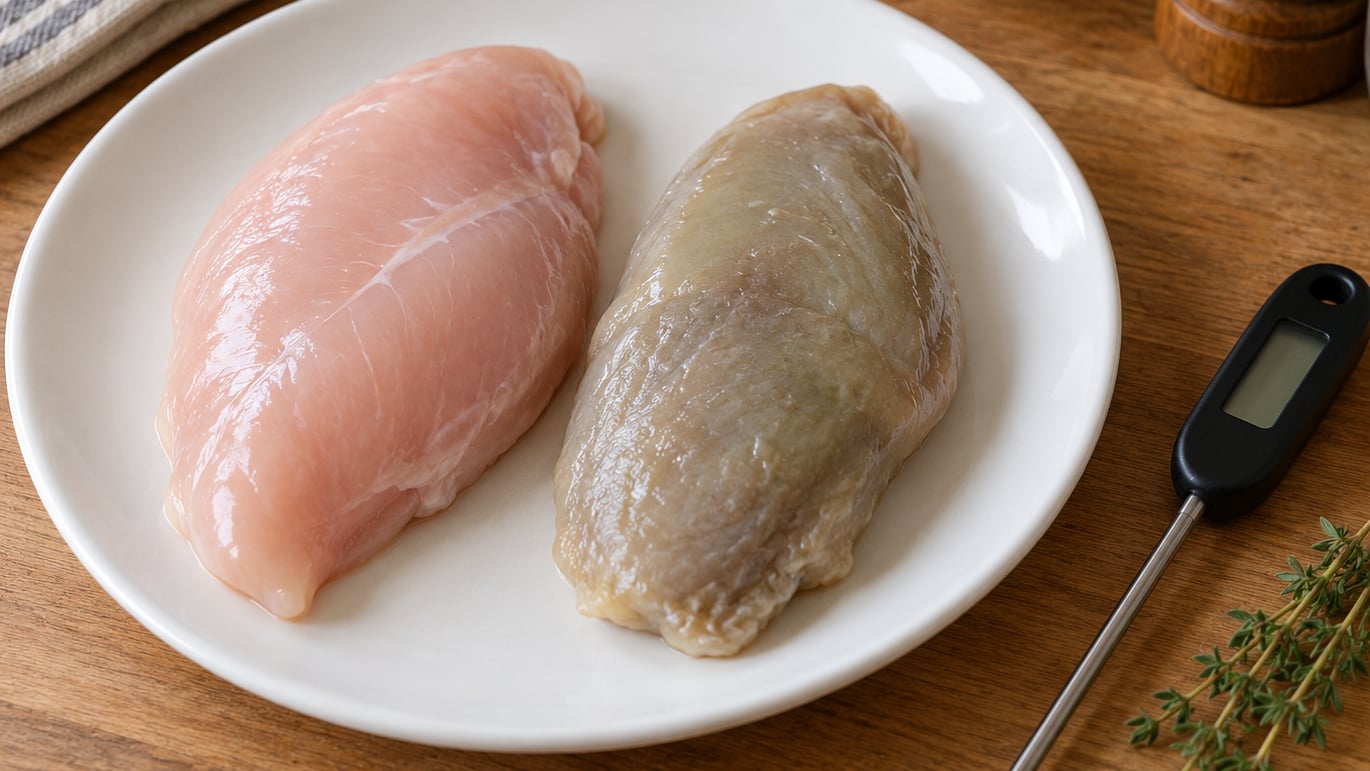
Smell it, then touch it, then look at it. Chicken that has gone bad gives off a sour, ammonia-like or rotten-egg odor, feels slimy or sticky, and turns dull gray-green or shows fuzzy mold. If you know how to tell if chicken has gone bad, you can make that call in under a minute without tasting anything.
Never taste chicken to check it. That rule is the whole reason this guide exists.
Most people get this wrong in one of two directions. Some cook chicken that has been sitting on the counter since morning and take their chances, then feel unwell that night. Others throw away perfectly good chicken because fresh raw meat is naturally a bit slick and they read that as spoilage.
Both mistakes come from checking in the wrong order. Here is the order I use: storage history, then packaging, then appearance, then smell, then texture, and a thermometer for anything already cooked. Follow it top to bottom and you will have a defensible answer every time.
What You Need to Check Before Judging Chicken
You need very little, but you do need all of it. Half a check is how people get sick.
- The chicken and its packaging. Keep the tray, the absorbent pad and the bag until you finish. Liquid color, package inflation and leakage all tell a story that the meat alone does not.
- The storage history. When did it come out of the fridge, when did it go in, and did anyone else touch it? An unanswered question here can override a clean smell.
- A clean plate, tongs or a fork, and paper towels. You do not squeeze-test chicken on the cutting board you are about to chop on.
- An instant-read thermometer. Optional for raw chicken, close to mandatory for cooked chicken and refrigerated cooked chicken you are unsure about.
Wash your hands with soap and water before you start and again after, and give yourself a clear counter. If the chicken is going in the bin, you want to know that before you have handled the rest of the groceries.
How to Tell If Chicken Has Gone Bad: Step-by-Step
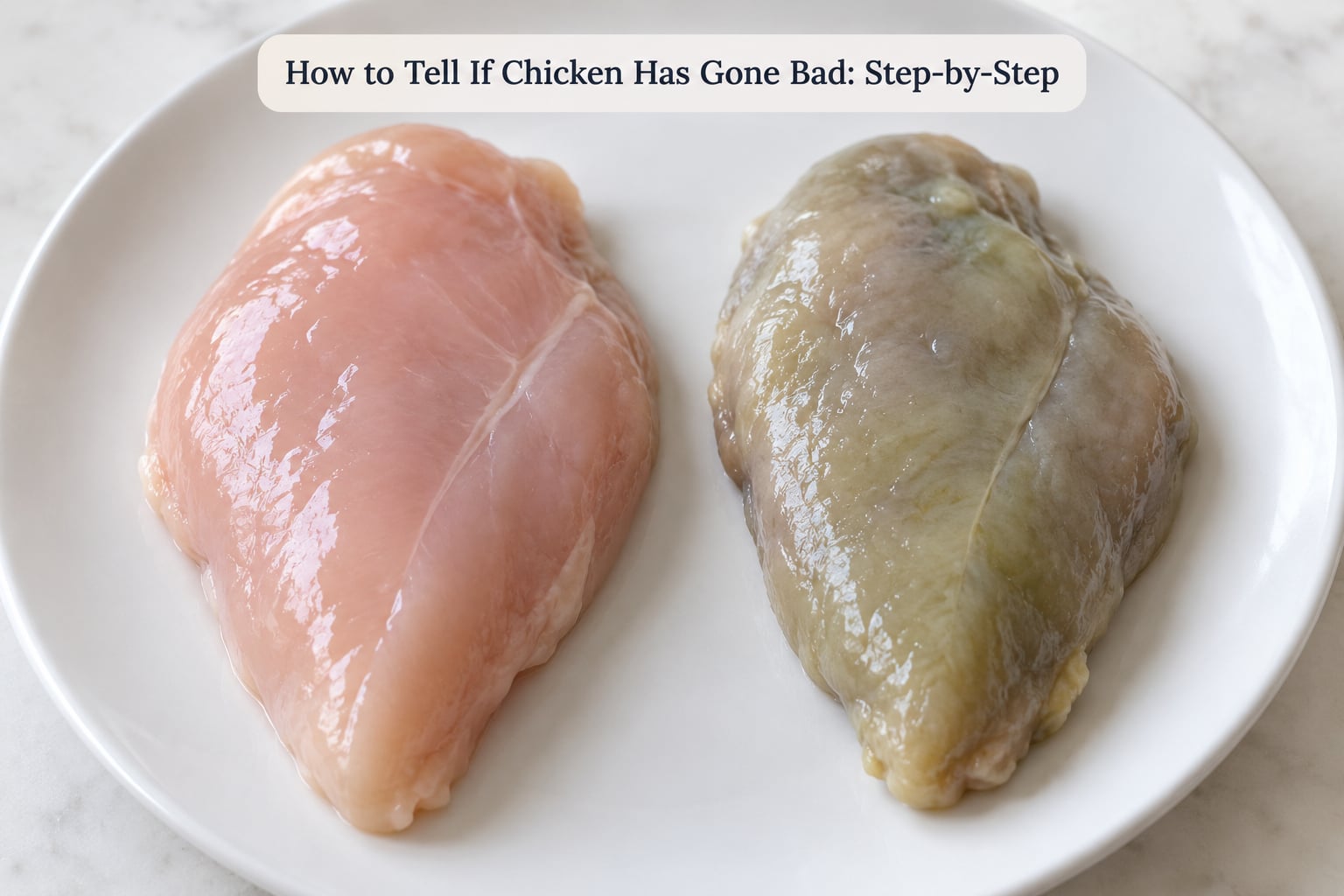
Run these five checks in order and stop at the first clear failure.
- Check the clock first. Raw chicken keeps 1 to 2 days in a refrigerator at 40°F (4°C) or below. Cooked chicken and refrigerated cooked chicken keep 3 to 4 days. Beaten by the calendar, everything else on this list is academic.
- Inspect the packaging. A swollen or ballooning tray, a broken seal, dried or darkened liquid, or cloudy grey fluid that does not smell like clean meat all point one direction.
- Look at the color. Fresh raw chicken is pale pink to beige with white fat. Notice dull grey-yellow patches, a green cast, or mold. A small spot of fat that has yellowed is normal; the muscle underneath should not.
- Smell it, and smell it properly. Open the package away from your face and let the air reach you. Fresh chicken has almost no smell. Sour, acidic, ammonia-like or rotten-egg odors are the single most reliable warning.
- Press it, and verify cooked chicken with heat. Natural raw chicken is slightly slick and springs back. Spoiled chicken feels slimy, tacky or mushy. Cooked chicken must reach 165°F (74°C) internally before you eat it, though heat does not rescue spoiled meat.
How to Tell If Raw Chicken Has Gone Bad
Raw chicken trips people up more than cooked chicken does, mostly because of texture. Fresh raw chicken is coated in a natural protective film, so it feels glossy and a little slimy straight from the tray. That is normal and it is not a spoilage sign.
Here is the test that separates the two, and it is the one people on cooking forums keep coming back to. Put the piece in a bowl of cold water and swish it rather than holding it under the tap, pat it dry with paper towels, then press it. If the slippery film washes away and the flesh underneath feels firm and matte, the chicken is fine. If the tackiness stays, or the surface feels gummy, that is bacterial growth. Toss it.
One more touch test costs nothing: press a fingertip firmly into the thickest part for a few seconds. If the meat is so soft that your finger leaves a lasting imprint and the flesh stays dented, discard it.
Color is the weakest signal here. Chicken can be bright pink, pale pink or slightly purple depending on the cut, the feed and the oxygen exposure, and none of that means spoiled. Yellow fat, dark patches near the bone and a slight purple cast in vacuum-packed breast all have innocent explanations.
What does mean trouble: gray-green or olive coloring, purple-gray areas that persist after the chicken has been out of the package, fuzzy white, green or black growth, or a surface that looks dull and dried rather than wet and glossy.
How to Check Cooked Chicken and Leftovers
Cooked chicken is easier to judge. It has no protective film, so spoilage shows up faster and the smell is sharper because the fat has broken down.
Set a baseline the day you cook it. While the chicken is still fresh, look at it and smell it, then put it in the fridge. The next morning, check the same way. That comparison catches a slow change you would otherwise talk yourself out of, and it takes ten seconds.
Cooked chicken stored in the fridge is a TCS food, meaning time and temperature control for safety. Fresh cooked chicken should be white with a faint sheen, or beige if you seasoned it. Watch for a slick film on the surface, dry leathery edges, gray or olive patches, or any visible mold, even a small dot, because mold on soft moist food means the whole portion goes.
When a piece from a larger batch looks questionable, separate a small portion rather than handling the rest. If you already cut into the batch, keep the pieces together and decide once.
Reheat refrigerated cooked chicken to 165°F (74°C) and eat it within two hours. If it has been on the counter longer than two hours, that is the two-hour rule and the food goes in the bin regardless of how it smells.
Raw and Cooked Chicken Spoilage Signs Side by Side
| What you notice | Raw chicken | Cooked chicken and refrigerated cooked chicken |
|---|---|---|
| Normal smell and color | Pale pink to beige with white fat; almost no odor | White or beige with a faint sheen; low aroma |
| Normal texture | Glossy, slightly slick, springs back | Firm, moist, not rubbery-dry |
| Watch for: smell | Sour, acidic, ammonia-like, rotten egg | Pungent, sour, sharper than when raw |
| Watch for: texture | Sliminess that stays after rinsing and patting dry, tacky or mushy | Slick surface film, leathery dry edges |
| Watch for: color | Gray-green or olive cast, dull gray-yellow muscle, mold | Gray or olive patches, fuzzy white or green mold |
| Watch for: packaging | Swollen tray, broken seal, cloudy grey liquid | Not applicable, but check the container for leaks or odor |
| Time limit at 40°F or below | 1 to 2 days | 3 to 4 days |
| Safe final step | Cook to 165°F (74°C) | Reheat to 165°F (74°C) within 2 hours of cooking |
The last row is the one people misread. Reaching 165°F kills most live bacteria, but toxins some bacteria have already produced survive the heat. Cooking questionable chicken does not make it safe, and the USDA Food Safety and Inspection Service says plainly that food with an off odor, discoloration or slimy texture should be discarded rather than cooked.
Common Mistakes When Checking Chicken
Treating pink chicken as proof it is undercooked. Color is not a doneness test in either direction. Raw chicken can be very pale and fully cooked chicken can stay pinkish in a spot. Measure the thickest part with a thermometer. If you would rather not fuss with a probe, our guide to telling when meat is done without a thermometer covers the cues that hold up better than color.
Assuming every discoloration means spoilage. Yellow fat, purple patches, and dark meat near the bone are ordinary. What matters is gray-green, olive, or fuzzy mold. Overcalling normal variation is how people end up throwing out a whole bag of good thighs.
Tasting suspicious chicken. There is no version of this that is a good idea. You are not detecting toxins that way, you are just adding a dose of whatever is growing to the list of things you do not want.
Trusting the date label more than your nose. A best-by date is a quality guideline about flavor and texture, not a safety guarantee. Chicken can spoil before the date, especially if the cold chain broke in transport, and it can sit past the date and still be fine if it stayed at or below 40°F the whole time. The FDA FoodKeeper database gives storage times by food, and the label never overrides smell, texture or appearance.
Thinking a good cook fixes suspicious meat. This is the most expensive myth in the category. Heat kills bacteria but not the toxins they have already shed, so a well-done piece of bad chicken can still put you in the bathroom at 2 a.m. Salmonella and Campylobacter are the two names that come up most in poultry-related foodborne illness, and the CDC estimates tens of millions of people get sick from contaminated food each year.
Rinsing raw chicken over the sink. Washing it splashes raw bacteria across your sink, counter, and stovetop. The Food Safety and Inspection Service advises against washing raw poultry for that reason. If you want to rinse, put the piece in a container and pour water over it instead.
Two more habits close most of the risk. Store raw chicken on the bottom shelf in a leak-proof container so nothing can drip onto produce or cooked food, and freeze what you will not eat inside two days. If you are batch cooking, freezing portions as you go beats discovering a dull-smelling tray on Thursday.
Frequently Asked Questions
Is chicken bad if it is still pink?
No, not on its own. Raw chicken ranges from pale pink to beige and can be slightly purple, and cooked chicken can keep a pinkish tint in spots without being undercooked or bad. Pink tells you about pigment and oxygen, not freshness. Use smell, texture and appearance to judge spoilage, and use a 165F thermometer to judge doneness.
How can you tell if raw chicken has gone bad?
Use three checks. Smell it after opening the package away from your face: fresh raw chicken has almost no odor, while spoiled chicken smells sour, acidic, ammonia-like or like rotten eggs. Rinse the piece in a bowl of water and pat it dry, because natural sliminess washes off while spoilage sliminess stays tacky. Finally, look for gray-green coloring, mold, or cloudy liquid in the tray.
How long can cooked chicken stay in the refrigerator?
Three to four days at 40F or below, counted from the day you cooked it. Reheat refrigerated cooked chicken to 165F and serve it within two hours of heating. If it has sat out longer than two hours, the two-hour rule applies and it should be discarded no matter how it looks or smells. Freeze it on day two if you will not finish the batch in time.
Can frozen chicken go bad?
Yes, slowly, and usually for reasons you cannot see. Chicken stays safe indefinitely at 0F or below, so frozen meat does not spoil the way refrigerated meat does. What degrades is quality: white ice crystals, dry patches or grayish skin are freezer burn, which is harmless. Discard frozen chicken that has thawed, been refrozen, or has no packaging left and an off smell.
Does cooking chicken make it safe if it smells bad?
No. Heat kills most live bacteria at 165F, but toxins that certain bacteria have already produced are not neutralized by cooking. So a piece of chicken with a foul odor, sliminess or mold can make you sick even when it is thoroughly cooked. The USDA Food Safety and Inspection Service recommends discarding food with an off odor rather than cooking it.
What does slime on chicken mean?
It depends on whether it washes off. Fresh raw chicken has a natural glossy film that feels slightly slick, and that film lifts away in a bowl of cold water. Spoilage slime is bacterial growth: it stays tacky after you rinse and pat the piece dry, and it often comes with a sour odor, dull color or mold. Raw chicken that is slimy but smells clean and rinses clean is generally fine.
So start with the clock and the packaging, because those settle most cases before you touch the meat. Then smell, press and look, in that order. If you still cannot tell, toss it: a package of chicken is cheaper than a night of vomiting, and that is the only call in this guide I will not hedge on. If you want the cooking side of the basics, we have guides on grilling chicken breasts without drying them out and baking wings so they stay crispy, both of which start from chicken you already trust.