
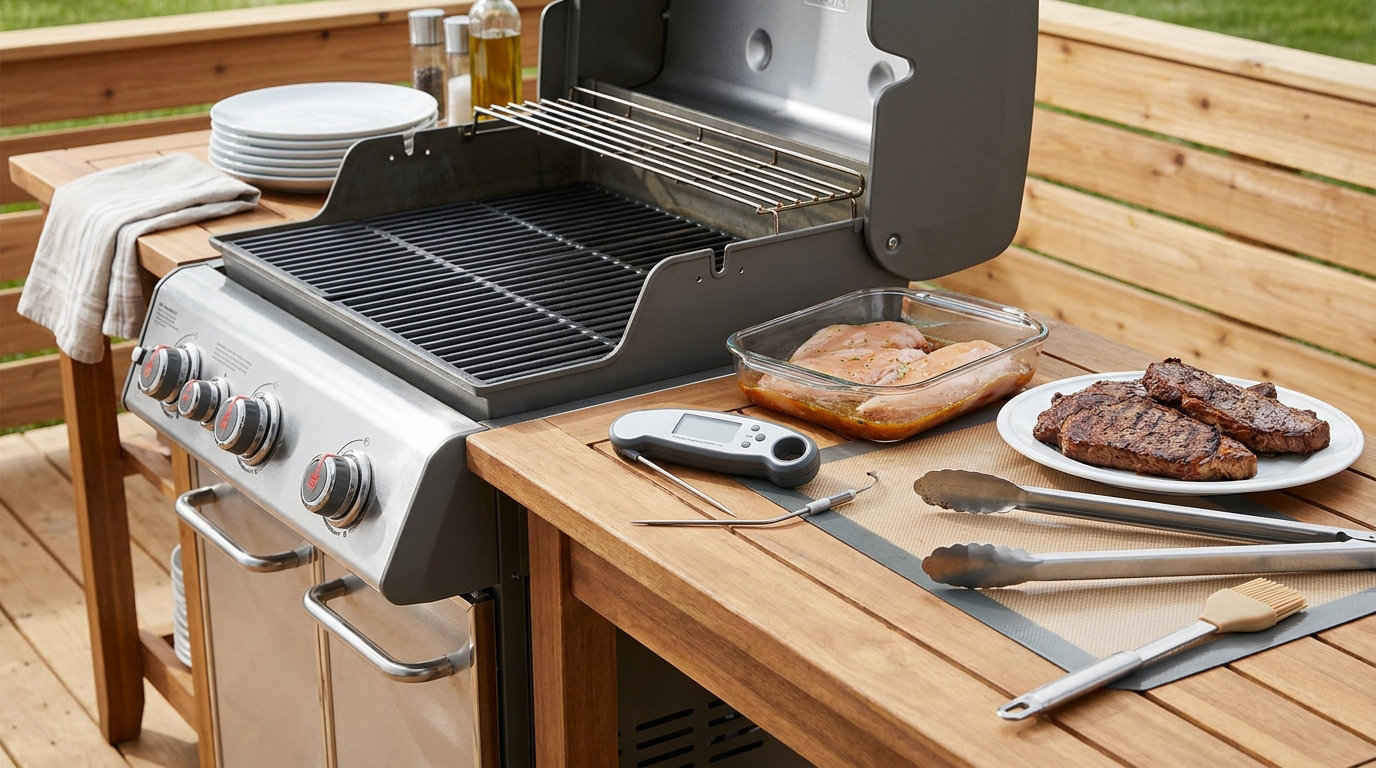
The food safety rules for grilling meat come down to four habits: keep raw meat cold, keep raw and cooked food apart, cook every cut to its USDA minimum safe internal temperature verified with a food thermometer, and refrigerate leftovers within two hours. Grilling sears only the outside, so a thick steak can look finished while the center is still in the bacterial danger zone of 40°F to 140°F.
Grills also bring a second set of problems that have nothing to do with food. A grease fire, a propane hose leak or a lighter left on a picnic table can ruin a weekend faster than any undercooked burger. I keep the two sets of rules separate in this guide: food handling first, then fire and heat safety.
Everything below follows USDA Food Safety and Inspection Service guidance and CDC recommendations. If you want to check a specific question with a person, the USDA Meat and Poultry Hotline answers at 1-888-674-6854, and there is a live chat at ask.usda.gov. Last reviewed for 2026 grilling season.
Table of Contents
- Food Safety Rules for Grilling Meat at a Glance
- How to Prepare Meat Safely Before Grilling
- How to Prevent Cross-Contamination While Grilling
- Safe Internal Temperatures for Meat on the Grill
- Food Safety Rules for Grilling Meat by Type
- How to Grill Without Leaving the Safe Zone
- How to Rest, Store and Reheat Grilled Meat
- Common Grilling Safety Mistakes and How to Fix Them
- Frequently Asked Questions
Food Safety Rules for Grilling Meat at a Glance
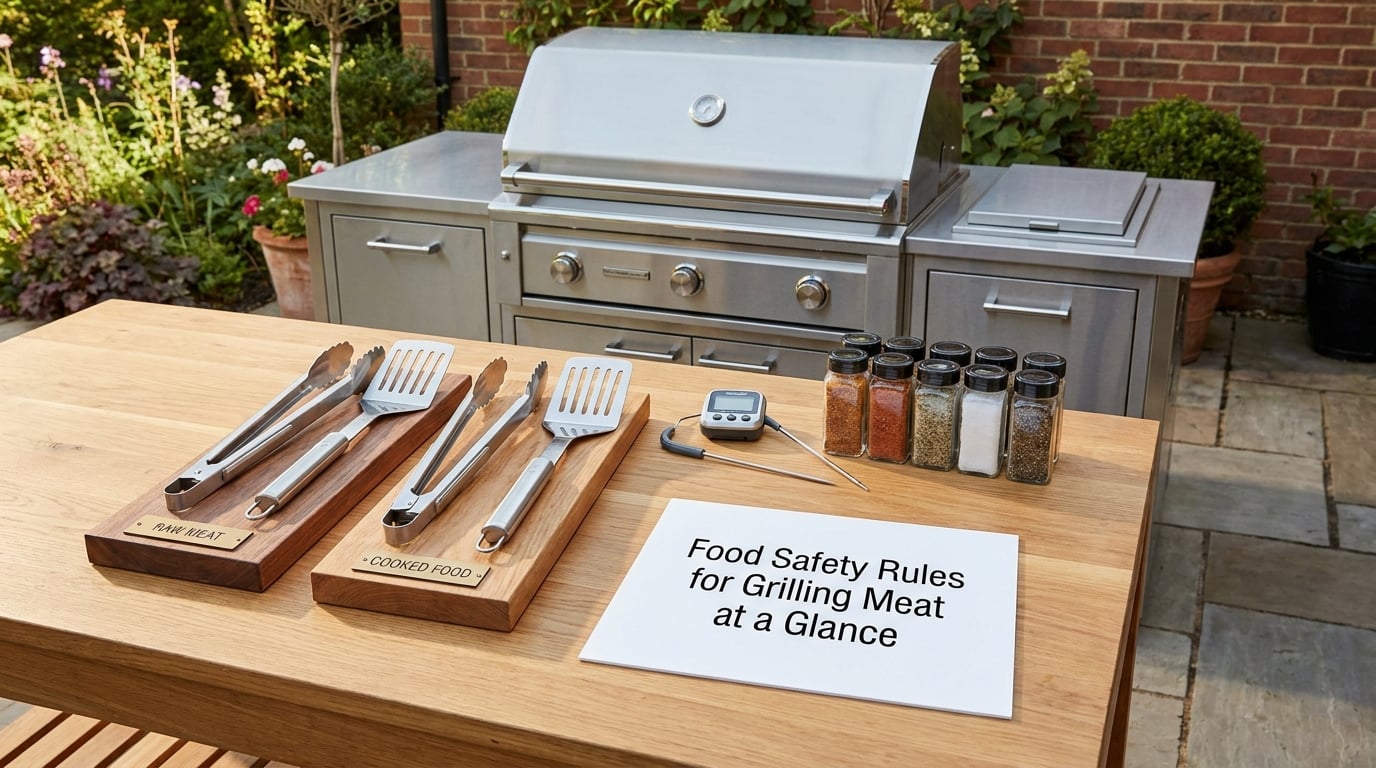
These eight rules cover nearly every foodborne illness risk at a backyard cookout. If a neighbor asks me the short version, this is the list I give them.
- Keep meat cold until it goes on the grill. Thaw in the refrigerator, in cold water, or in the microwave, and put raw meat back under 40°F right away. The counter is not a thawing method.
- Wash your hands for 20 seconds with soap and water after touching raw meat, after handling the cooler, and after petting the dog. If there is no sink, use a hand sanitizer of at least 60% alcohol.
- Keep raw and cooked food separate. Separate cutting boards, separate tongs and spatulas, and a clean plate for everything that leaves the grill. Never put cooked meat back on the plate that held it raw.
- Cook to the safe minimum internal temperature and confirm it with a food thermometer in the thickest part. Color, firmness and clear juices are not doneness tests.
- Marinate in the refrigerator, never on the counter. If you want to use marinade that touched raw meat, boil it first, then use it only for cooking.
- Watch the clock, not the crowd. Perishable food should not sit in the danger zone for more than two hours, and only one hour when the outdoor temperature is above 90°F.
- Rest the meat before you slice it. Whole cuts of beef, pork, lamb and veal need at least a 3-minute rest after reaching 145°F. Resting also limits carryover cooking, so the center finishes at a safe temperature.
- Get leftovers into the fridge fast and clean up the grill. Move cooked meat into shallow containers within the two-hour window, and fully cool charcoal or shut off propane and disconnect the cylinder before you walk away.
How to Prepare Meat Safely Before Grilling
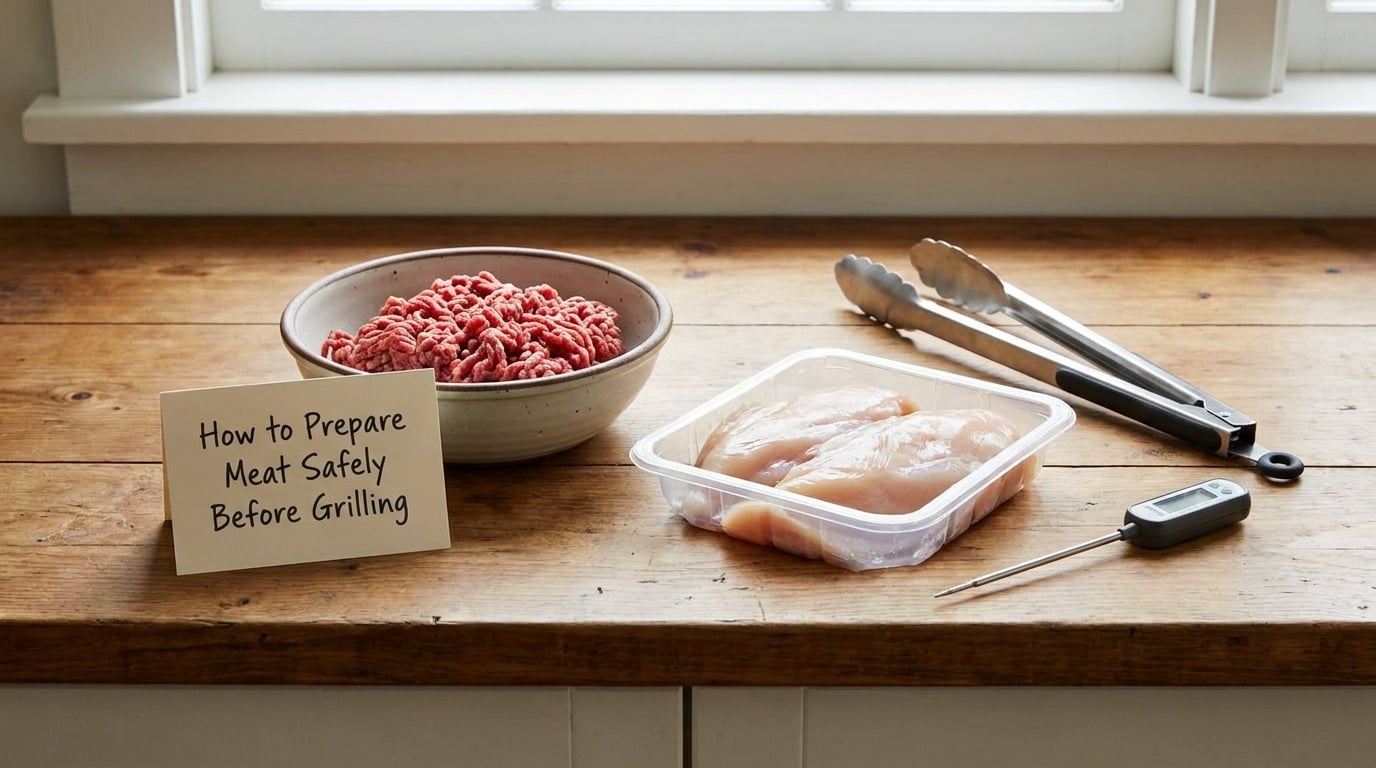
Most of the work happens before the grill is even lit. Raw meat that has warmed to room temperature, or sat in a marinade bowl on the counter, picks up bacteria fast and carries them straight to the grate.
Thaw meat in one of three safe ways
- In the refrigerator: the most reliable option, at roughly 24 hours per 4 to 5 pounds. Put the tray on the lowest shelf so it cannot drip onto anything else.
- In cold water: keep the meat sealed in a leakproof bag submerged in cold tap water, change the water every 30 minutes, and allow about 30 minutes per pound. Cooking has to start right after.
- In the microwave: fastest of the three, and only works if you cook the meat immediately after it finishes thawing.
Thawing on the counter is the one to drop. The outside of a large cut warms into the danger zone long before the center softens, and the juices that drip off carry bacteria across the counter.
Once thawed, keep meat in the fridge until you are ready to cook, and transport it in an insulated cooler with plenty of ice if you are heading to a park or a tailgate. Leave the cooler in the shade and open it as little as possible.
Trim meat in the kitchen, not at the grill, and wash your hands and the cutting board afterward. When you marinate, cover the bowl and refrigerate it. A marinade you touched raw meat with can be boiled and reused for cooking, or thrown out. It should never be poured back over finished meat as a sauce.
How to Prevent Cross-Contamination While Grilling
Cross-contamination is how bacteria move from raw meat to food that is already cooked and ready to eat. At a grill, the paths are obvious once you know them: shared tongs, shared plates, the cutting board, and your hands.
Start at the sink before you handle anything, and go back the same way after handling raw meat, the cooler, the charcoal bag, or a lighter. Twenty seconds of soap and water is the standard, and warm water alone is not enough. If you cannot get to a sink, a sanitizer with at least 60% alcohol will do.
Set up your station so the flow of food only goes one way: raw in, cooked out. Use one cutting board for raw meat and a different one for produce and bread. Give raw burgers their own tongs and a second pair for everything that is finished cooking, because the tongs that sat in raw chicken carry juices onto every steak that touches them after.
Bring more plates than you think you need. The single most common mistake at a cookout is loading a plate of finished burgers at the same spot where raw patties were sitting. If you must use one plate, wash it before the cooked food goes down.
Watch the order on the grate too. Grill vegetables first on a clean section, or on a separate grate, because vegetables are ready to eat the moment they char. Raw meat goes on last, and it replaces the vegetable section unless you moved the food around.
Keep a bucket of soapy water and a brush for the grate, and remember that drippings running off raw meat and hitting coals can flare. That flare is the moment to move the food back to the cooler side of the grill.
Safe Internal Temperatures for Meat on the Grill
This is the table I keep taped inside the grill lid. It gives every temperature in both Fahrenheit and Celsius, with the rest time that goes with whole cuts.
| Meat, seafood or egg dish | Minimum internal temperature (°F) | Minimum internal temperature (°C) | Rest before serving | Notes |
|---|---|---|---|---|
| Chicken and turkey, whole or ground | 165 | 74 | Not required | Check the thickest part of the breast and the innermost thigh joint |
| Ground beef, pork, lamb and veal | 160 | 71 | Not required | Burgers, sausages, meatballs, and meat crumbles |
| Whole cuts of beef, pork, lamb and veal | 145 | 63 | At least 3 minutes | Steaks, chops, roasts. Probe away from bone and fat |
| Fish and shellfish | 145 | 63 | Not required | Shrimp turn opaque and firm; fish flesh flakes |
| Eggs and egg dishes cooked on the grill | 160 | 71 | Not required | Applies to frittatas and cooked-in-foil eggs |
| Pre-cooked ham being reheated | 140 | 60 | Not required | Only for ham labeled ready to eat |
| Leftovers and casseroles | 165 | 74 | Not required | Reheat only until steaming hot throughout |
| Home-dried jerky | 160 | 71 | Not required | Follow a tested dried-meat recipe |
The 145°F figure is a minimum, not a finished recipe. Most people who grill steaks and chops like them slightly firmer than that, which is a preference choice rather than a safety one.
Where to put the probe
Insert an instant-read thermometer into the thickest part of the meat, away from bone, fat pockets and the grate itself. A probe that touches bone reads high, one that rests against the grill grate picks up radiant heat, and a fatty seam reads low. Those three errors are the usual reason a thermometer disagrees with a recipe.
For thin cuts such as a flank steak or a chicken breast, insert the probe sideways through the side rather than straight down from the top. A leave-in probe with a cable to the outside of the grill is fine to leave in the meat for the whole cook, which is how you get a reading without opening the lid and losing heat.
Pull temperature vs. final temperature
You do not have to leave the meat on the grill for the full three minutes after the thermometer hits the number. Thick cuts keep cooking after they come off the heat, so many cooks pull a few degrees early and let carryover cooking finish the job. Pulling early and resting is exactly the technique described on r/cookingforbeginners, where the advice is to pull chicken at about 68°C to 70°C and let it finish under foil during the rest.
That only works with a real rest, and it does not apply to ground meat or thin cuts that lose heat almost immediately. Beginners on r/grilling report better results with longer rests, not worse, and that matches the guidance: rest whole cuts at least 3 minutes, longer for large roasts.
Why color and clear juices are not a doneness test
Pink beef can be safe and brown beef can be undercooked. Myoglobin, the pigment in red meat, stays red after cooking, and the color of the meat has nothing to do with the temperature inside. Juices run clear as the muscle proteins set, but timing varies with the cut and the same steak can behave differently on consecutive cooks.
Press test, poke test and cut-and-peek all have the same problem: they estimate, and an estimate is not a measurement. The thermometer is the only tool that tells you the center reached 165°F for poultry or 160°F for ground meat.
Food Safety Rules for Grilling Meat by Type
Different meats need different numbers, and the difference comes from where bacteria live. Muscle tissue on a whole steak is mostly clean on the surface, while ground meat is mixed through the whole patty, and poultry carries Salmonella both on the surface and throughout.
Poultry. Chicken, turkey and duck need 165°F, checked in the thickest part of the breast and near the bone of the thigh, and that temperature is the line. Drumsticks and thighs will hit it long before the breast, which is why a single reading on the breast is the one that matters. A stuffed or injected turkey needs a longer cook and a check in the center of the stuffing.
Ground meat. Burgers, meatballs, sausages and meat crumbles need 160°F. Ground meat cooks unevenly, so do not cut into a raw patty to peek, and do not press a thick burger flat to speed things up, since that creates a raw center and can drip juices onto the coals.
Pork. Whole chops, tenderloin and ham from fresh pork need 145°F with a 3-minute rest. Ground pork sausage and sausage made from ground pork are a different category at 160°F. Read the label, because the mix decides the number.
Beef and lamb. Steaks, roasts and chops from beef and lamb need 145°F with a 3-minute rest. Lamb offal and ground lamb fall under the 160°F ground-meat rule.
Fish and shellfish. Cook fish and shellfish to 145°F, or until the flesh is opaque, firm and flakes easily with a fork. Shrimp and scallops turn pearly white and firm, and they cook in minutes, so they are the easiest item on the grill to leave sitting in the danger zone while everyone talks.
If anyone at your table is pregnant, under five, over 65 or immunocompromised, treat these numbers as firm. Those guests are the ones for whom foodborne illness is most dangerous, and well-done poultry and well-done ground meat are the safest serving for them.
How to Grill Without Leaving the Safe Zone
Food safety and fire safety overlap in one place: the flare-up. Raw meat drips hit coals, flame jumps to the food, and a burst of grease can turn into a fire you cannot control in thirty seconds.
Build a two-zone fire. Push all the coals to one side and cook on the direct side for searing, then move food to the indirect side, away from the coals, for finishing. Indirect heat is also what makes a thick steak or a whole chicken cook evenly, and it lets you take a temperature reading without the flare-up that comes with searing every time you check.
Keep a three-foot safe zone around the grill in every direction, with nothing combustible in it: fence boards, siding, dry grass, paper towels, and the awning above you. Keep kids and pets outside that zone and never leave a lit grill unattended, even for a minute.
For propane, check the hose and connections with a soapy water solution before the first connection and any time you store the grill. Bubbles mean a leak; shut the valve and reconnect before lighting. Do not light a gas grill with the lid closed, and close the tank valve and disconnect the cylinder when you are done.
For charcoal, use a long-handled lighter, keep starter fluid away from an already-lit pile, and never pour lighter fluid onto hot coals. When you finish, spread the coals out, cover them with a metal lid, and douse with water until hissing stops. Ash can hold heat for hours.
If you are grilling somewhere other than your own yard, check the local fire code first. Many apartment buildings and HOAs ban grills on balconies, in courtyards, or within a set distance of a wall, and most park rules restrict open flame to designated areas. A grill with a lid and a working cover is the kind most properties actually allow.
How to Rest, Store and Reheat Grilled Meat
Resting is a safety step for whole cuts, not just a quality habit. After beef, pork, lamb or veal reaches 145°F, leave it on the board for at least 3 minutes. A large roast gets 10 to 15 minutes, and poultry cooks on from residual heat even though the USDA lists no required rest.
Loosely tent the meat with foil if you want to hold the surface crust, but the interior keeps cooking either way. Put large roasts on a wire rack set in a pan if juice running off matters to you.
Start the two-hour clock when the food leaves the grill, not when you start loading the car. Get cooked meat into shallow containers, since a deep pile cools too slowly, and put it in the refrigerator at 40°F or below within two hours, or within one hour when it is above 90°F outside. If you are still grilling, stage the containers in the ice so finished food goes straight in.
Cooked meat and poultry keep three to four days in the refrigerator, and cooked seafood keeps about three days. Reheat to 165°F and only until steaming hot, checking the thickest part. Any sauce or gravy that touched raw meat on the plate needs to come to a full boil before it can be reused.
A microwave works on leftovers, but heat is uneven, so stir or rotate the food partway through and let it stand before serving. Reheating brings the center back up through the danger zone before it comes out, so move the leftovers rather than parking them on the cooler side of the grill for a while and then tossing them back on the hot side.
Common Grilling Safety Mistakes and How to Fix Them
- Same plate for raw and cooked. Fix: bring a separate clean plate for every batch that comes off the grill, and never reuse the dish the raw meat sat on.
- Taking the temperature too early and then leaving it. Fix: check in the last few minutes, and close the lid between readings so the fire does not climb or drop.
- Thawing on the counter. Fix: move it to cold water or the refrigerator, and cook meat thawed in the microwave immediately.
- Pouring the marinade tray over cooked meat. Fix: boil the used marinade and use it for cooking only, or discard it. Cook fresh meat in it if you want the flavor.
- Treating char marks as proof of doneness. Fix: check the temperature. Heavy charring burns the surface without cooking the middle, and burnt surface compounds are a reason to keep char light.
- Washing raw chicken or beef before grilling. Fix: do not rinse it. Splashing spreads raw bacteria across the sink, and heat is what kills the pathogens, not the rinse.
- Partially grilling now and finishing later. Fix: cook it through, then refrigerate it. Meat sitting in the danger zone in a car or cooler is not on a safe track to finishing.
- Relying on the recipe’s cook time with a cheap thermometer. Fix: test a new thermometer in ice water, and replace any unit that reads more than 2°F off. Accurate equipment is what makes the numbers above worth following.
Frequently Asked Questions
Is grill smoke a sign that meat is unsafe to eat?
Smoke flavor comes from incomplete combustion, mostly from fat dripping onto coals, and it is a flavor issue rather than a safety warning. A light haze is normal on a charcoal grill. Heavy black smoke means the fire is starved of oxygen, so open the vents or move food away from flare-ups. Meat that is charred black and bitter is worth cutting off before serving, but smoke alone does not make food unsafe.
How long should I cook ground beef on a grill?
Time is a poor guide for ground beef because patty thickness and grill temperature vary widely, but the target number is clear: cook ground beef to 160°F (71°C) and verify it with a food thermometer. A thin burger on a hot grate usually takes about 3 to 4 minutes per side, while a thick patty on indirect heat needs 8 to 10 minutes total. Check the thickest part rather than the edge.
Do I need to flip meat while grilling to cook it evenly?
Not always. A two-zone fire lets you sear on the direct side, then move the meat to the indirect side and leave it alone until the thermometer reads the safe internal temperature. Frequent flipping adds no safety benefit and can dry the surface. Flip burgers and thin steaks for grill marks if you want them, and flip larger cuts only when the seared side has finished browning.
Can I use a barbecue sauce that has touched raw meat?
No, not unless you boil it first. A sauce that has touched raw meat can carry bacteria, and putting it back on finished meat transfers them. If you want to reuse it, bring it to a rolling boil in a saucepan, then use it only for cooking or for basting meat that still has to reach its safe internal temperature. Grazing on basted meat during the cook is a separate risk, so avoid that too.
How should I check whether grilled chicken is fully cooked?
Insert an instant-read thermometer into the thickest part of the breast, away from bone, and into the innermost part of the thigh near the joint. Both should read 165°F (74°C), and that is the only test that counts. Cutting into the breast to look for clear juices is unreliable, and the color of the meat can stay pale after it has reached a safe temperature.
If you change one habit after reading this, make it the thermometer. Keep one in the cooler, take the reading in the thickest part before the meat comes off, and let the rest do the rest. Those food safety rules for grilling meat cover the majority of the risk at any cookout, and the numbers never change no matter how good the steak looks.