
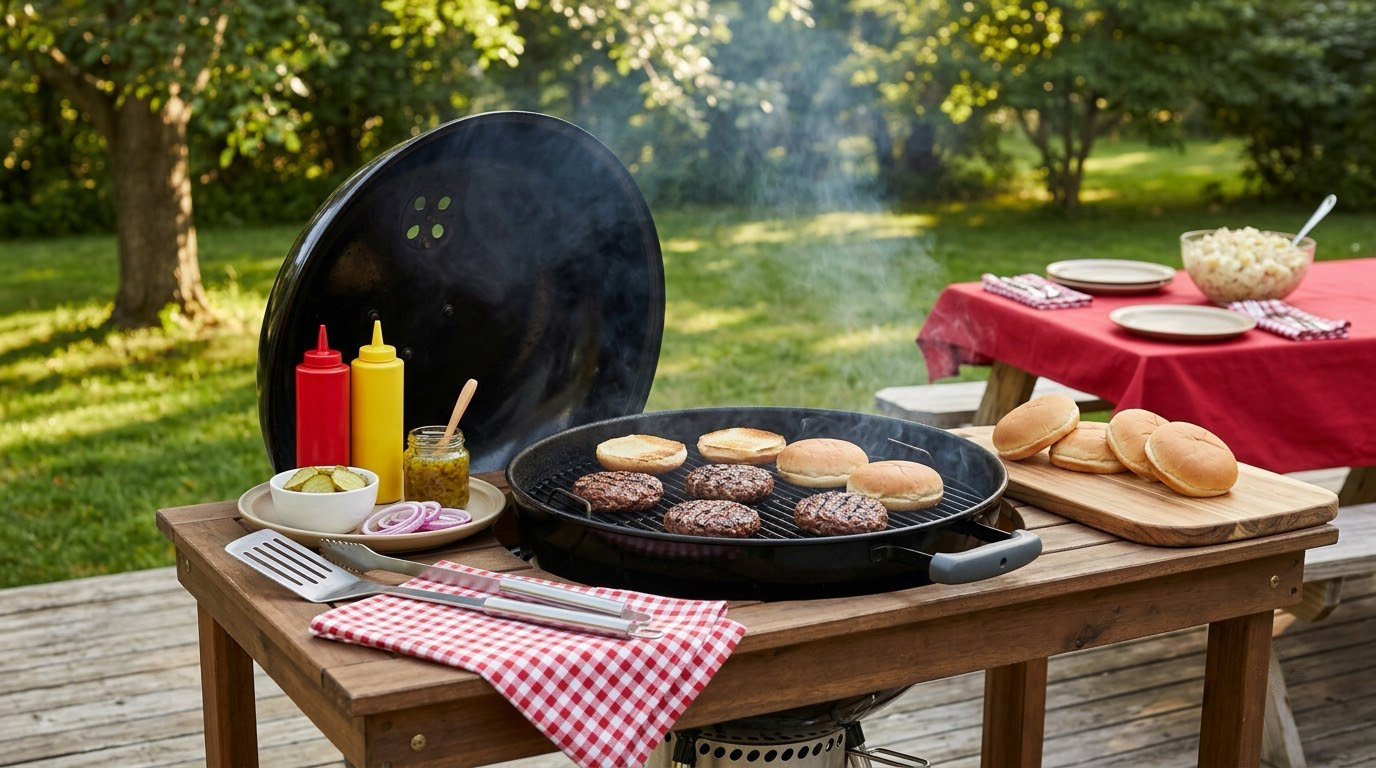
Burgers are tied to summer cookouts for three practical reasons that stack on top of each other: grilling works best in warm weather, a ground beef patty cooks fast enough to feed a crowd in batches, and the build-your-own format lets every guest assemble a burger they actually want. Add the fact that cookouts became informal social gatherings rather than formal meals, and the hamburger ends up holding the center of the season.
There is also a story in how that happened. The burger arrived as an immigrant food, spent decades as a lunch-counter item, then walked out onto the patio when American families bought their first backyard grills after World War II. The holiday calendar finished the job.
Worth noting that the grill does not really get used the other nine months. People buy grills in spring, learn on them in June, and then find a cover over them in September. The season shapes the whole ritual.
Table of Contents
- Why Burgers Became a Summer Cookout Staple
- How Grilling Helped Create the Burger-Summer Connection
- What Makes Burgers Ideal for Feeding a Crowd
- How Toppings and Regional Styles Shape the Summer Tradition
- How to Make Burgers for a Reliable Summer Cookout
- Frequently Asked Questions
- Conclusion: Make the Burger the Center of the Cookout
Why Burgers Became a Summer Cookout Staple
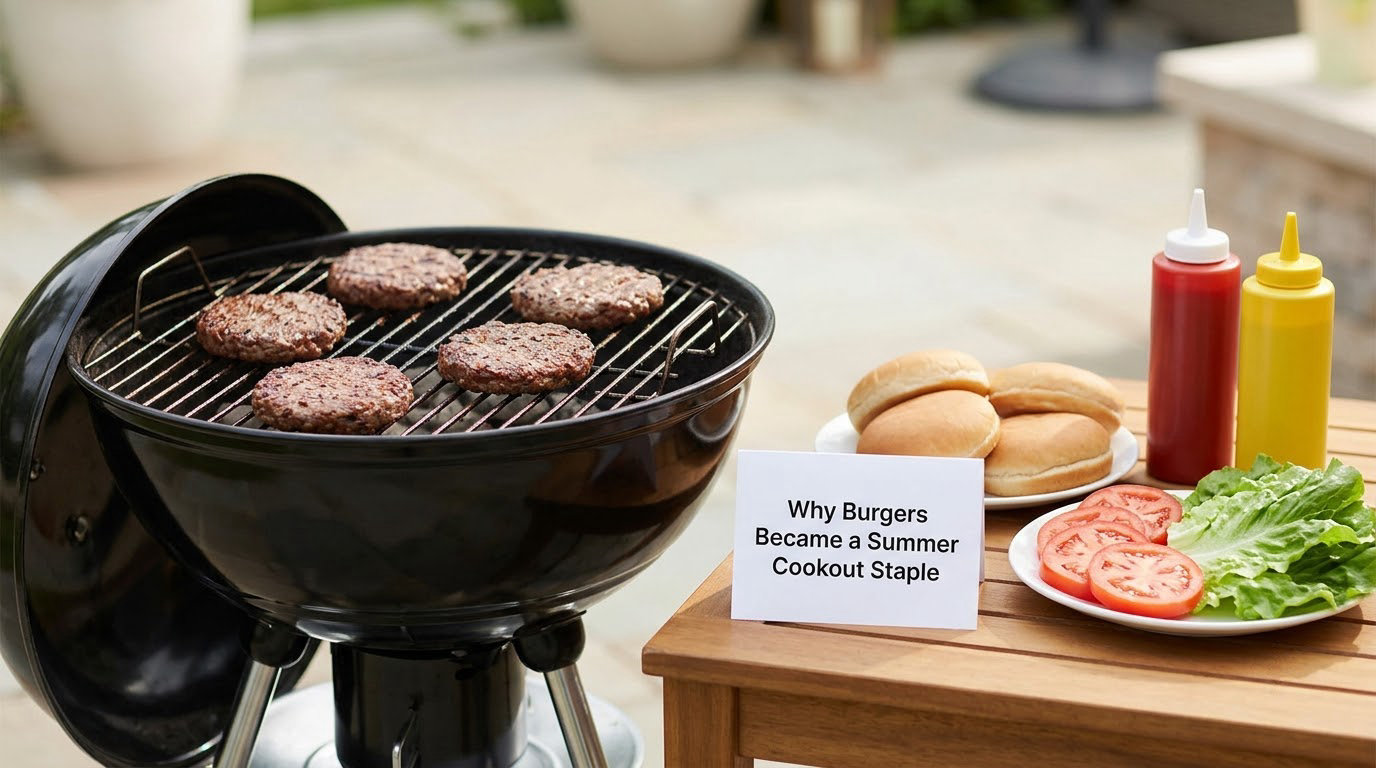
The short version: the burger is the rare food that suits the grill, the crowd, and the calendar at the same time. Everything else on a cookout menu is either harder to cook outdoors or harder to hand out in bulk.
One thing to clear up first. Burgers were not invented for the Fourth of July, and they were not invented for the backyard. The modern hamburger was assembled out of several separate threads, and the timeline is messier than most retellings suggest.
German immigrants brought Hamburg steak, a dish of chopped or ground beef cooked on a flat griddle, through ports in the 1840s and 1850s. Newspaper ads for “Hamburg Beef” appear in American papers in that period. Around 1900, loose ground beef sandwiches called Beef Olives showed up in New York street carts and were eaten standing up, with onion and mustard.
Between 1885 and 1904, several American cities passed rules requiring restaurants to serve ground beef in a bun with lettuce and pickle, so diners would not be served a slab of steak off a plate. Hamburg steak became hamburger in the legal sense. That is the actual moment the sandwich format was born, and it was a rulebook decision rather than a marketing one.
Then White Castle, opened in Wichita in 1921, built an entire company around a small, thin, bland patty cooked on a vertical griddle. Josh Ozersky’s The Hamburger: A History and Andrew F. Smith’s Hamburger: A Global History both treat this era as the point where the burger stopped being a regional street food and started being a national product. By the 1920s, burgers were well established in America, and the sandwich that people eat on a patio today is a direct descendant of that griddle patty.
Why Burgers Are Tied to Summer Cookouts
What moved the burger from the lunch counter to the backyard is mostly a change in how Americans lived after the war. Suburbs, backyards, and family cars arrived together, and so did affordable charcoal and gas grills. Suddenly there was a cooking appliance in the yard and a surface for it to sit on.
Grilling is a summer activity in a way oven cooking is not. Nobody wants to stand in a hot kitchen in July. On a patio, the heat is where you were going anyway, and the cooking smells drift toward the neighbors instead of into the ceiling of the house.
The food part of the link is simple too. A burger is bread plus meat plus whatever is in the refrigerator. It is the cheapest possible way to feed ten people well: a pound and a half of ground beef, ten buns, and a table of condiments. Nothing else on the cookout list scales that cleanly, and nothing else gives each person final authority over the meal.
As the cookout became the default summer gathering, the burger became its fixed center. Corn on the cob is seasonal and only good for a few weeks. Potato salad has to be made in advance. Watermelon needs a knife and a plate. A burger needs a grill and ten minutes.
How Grilling Helped Create the Burger-Summer Connection
Grilling suits summer for three separate reasons, and the burger happens to need all three.
Cooking outside keeps the heat out of the house
A charcoal fire puts several hundred degrees of heat into a yard instead of a kitchen. In July that difference decides whether a person feels like cooking or feels like being punished for cooking. Grill owners also report the seasonal swing honestly: a grill that sits unused through fall and winter gets started twice in spring, and the first few cookouts are practice.
Smoke and searing are part of the occasion
Under a hot lid, a patty picks up browning, char marks, and smoke flavor that an oven skillet or a pan rarely gives it. That browning is the Maillard reaction, the same chemistry that turns bread crust golden and roasts coffee, and it is the flavor people are actually chasing. The smell of it is part of why people come to a backyard from three blocks away, which is the social point of the whole afternoon.
A patty cooks in minutes, not an hour
A thin beef patty on a hot grill goes from raw to done in a few minutes a side. That speed is the single most practical fact about the burger, because it is what makes a cookout possible at all. Roasts, whole chickens, and casseroles are real cookout food, but they are committed to a start time well before anyone wants to eat.
For gas grills specifically, the learning curve is mostly about heat zones and timing rather than technique, which is why a short guide to how long to cook burgers on a gas grill is usually enough to fix most problems.
The counterfactual matters here. The hot dog was on the grill before the burger, and it has a better case as a summer food in some ways: faster, cheaper, no browning required. But the hot dog has nowhere to go. There is no meaningful difference between a plain hot dog and a dressed one, so it stays a side item. The burger won the grill by being a meal on its own.
What Makes Burgers Ideal for Feeding a Crowd
Crowd feeding is where the burger separates itself from almost every other barbecue food, and the difference comes down to five practical advantages.
Batch cooking. Patties cook at the same rate, need the same heat, and go on the grill together. A cook for twelve puts six patties down, turns them, and takes them off, and nobody at the table is waiting on a timer that started an hour before they arrived.
One hand. A burger is eaten standing up, walking, sitting on a blanket, or leaning over a lawn chair. No plate, no cutlery, no napkin pyramid. Nothing else at the cookout is as easy to eat while moving around, which matters at exactly the kind of gathering where people drift in and out for three hours.
Customization. The patty is the same for everyone, and everything else is the guest’s decision. This is the trick that lets one cook satisfy a picky kid, a strict vegetarian guest with a bun and a grilled vegetable, a cheeseburger regular, and someone who wants bacon jam and an egg on top.
Familiar ingredients. Ground beef, bread, butter, cheese, onion, tomato, lettuce, pickles, ketchup, mustard. Nothing on a burger requires a special shop or a plan, which is what you want when eight people show up and the menu needs to work.
Sides that do the work. Burgers pair automatically with the other cookout staples. Corn on the cob, potato salad, coleslaw, baked beans, watermelon, chips, and cold drinks all work, and most can be made ahead and served cold while the grill stays on.
| Compare this | Burgers | Hot dogs |
|---|---|---|
| Time on the grill | 3 to 5 minutes a side for a thin patty | 2 to 3 minutes total |
| Customization | Unlimited: cheese, bacon, sauces, toppings, bun swaps | Mostly condiments |
| Feels like a meal | Yes, on its own | Usually a side |
| Cooks in a large batch | Yes, all patties at the same rate | Yes, but they hold poorly once done |
| Kid appeal | High, because each one is different | High |
| What it needs besides the grill | Bread and a toppings table | Bread and condiments |
The honest weakness of all this is that a burger does not wait. Cookers complain about it constantly, and it is worth naming since it undercuts the whole crowd-feeding claim: patties held cooked shrink, dry out, and go rubbery at the edges, and a bun sitting under steam goes soggy before anyone gets to it. More on that below.
How Toppings and Regional Styles Shape the Summer Tradition
The topping bar is what makes a cookout inclusive without any argument. A plain patty with salt and pepper is a legitimate burger, so a guest with strong preferences is not a problem to solve. They build it themselves and nobody notices.
Basic toppings do the seasonal work: American cheese or cheddar, raw onion, dill pickles, lettuce, tomato, ketchup, yellow mustard, mayo, and bacon jam for the people who treat condiments as a hobby. Caramelized onions and a sharp patty with enough fat to stay juicy is a common house style, and pickles with brine in them cut the fat and the heat both.
Regional styles show how flexible the format is, and most of them are still served outdoors in hot weather.
A Carolina burger is a chopped, heavily seasoned patty served with slaw and a peppery vinegar sauce. A hamburger in a midwestern backyard barbecue comes with a pile of the cook’s own chili. Los Angeles orders add a spread of raw onion and pickle relishes. Tokyo has a fast-food chain built almost entirely on a single seared beef patty, and a Sao Paulo version layers bacon, egg and chopped meat into a tall bun. Australia has its own bun and barbecue traditions. None of these borrow the cookout calendar, and all of them keep the same structure: seared ground beef, starch, fixings.
That flexibility is also the strongest answer to the idea that the burger cookout is purely an American habit. The format travels because it is a blank canvas with a consistent center.
How to Make Burgers for a Reliable Summer Cookout
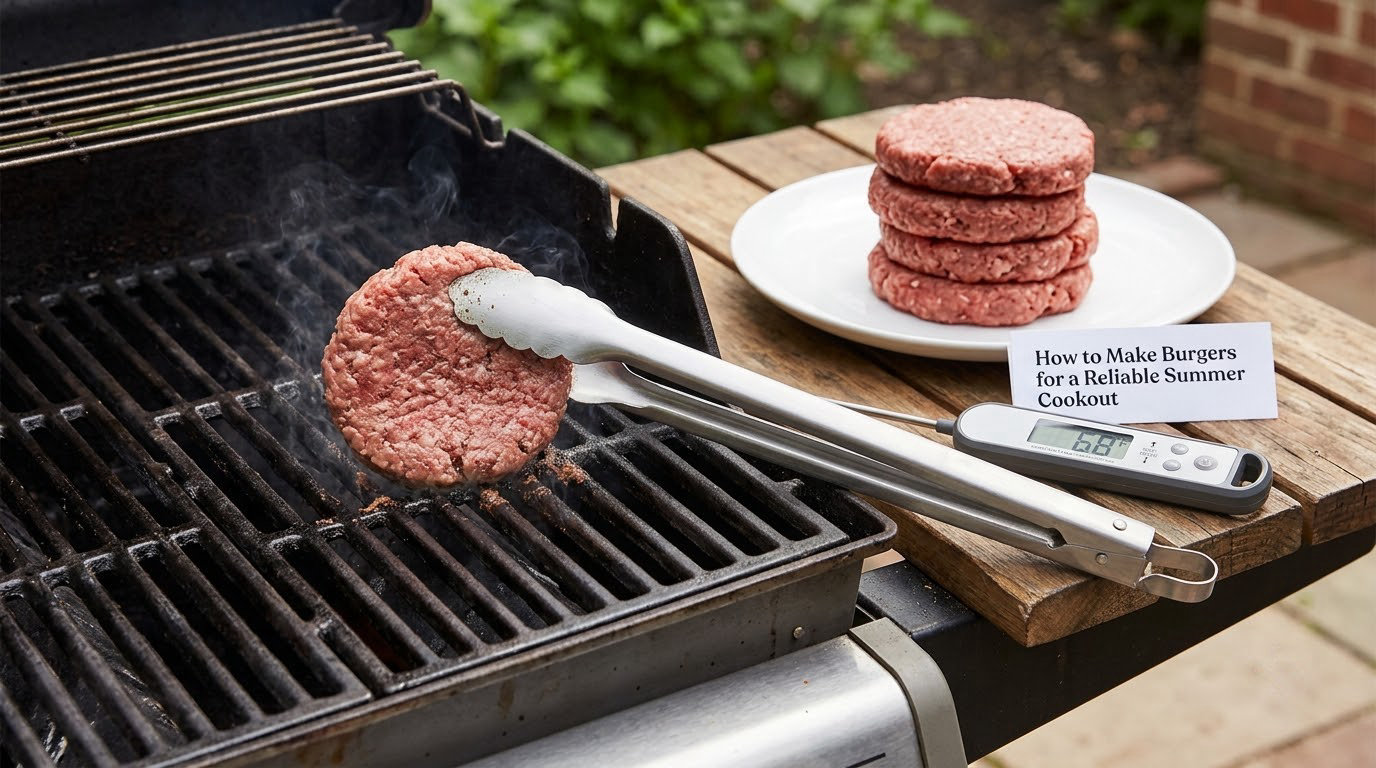
Understanding why burgers work for summer is only half of it. The crowd-serving claims hold up better when the cooking method matches them, and a few habits fix the two problems people complain about most: dry patties and soggy buns.
Preheat the grill fully before the first patty goes down, and give it at least 10 to 15 minutes on gas or until the coals are ashed over on charcoal. A grill that is not hot enough gives you gray, steamed patties instead of a crust, and that is the single biggest reason people decide their burgers are disappointing.
Shape patties to the same thickness and the same diameter every time, and make them slightly wider than the bun. Consistent thickness means consistent cook time, which is what makes batch cooking work. A rough 3/4-inch patty hits 160°F in roughly 4 to 5 minutes a side on a hot grill.
Handle ground beef as little as possible. Mix it, press it, and stop. Every extra squeeze squeezes out the fat that keeps a burger juicy, and there is a decent chance you are trading a good burger for a hockey puck.
Cook in batches based on the grill’s usable surface, not on guest count. Six patties on a home grill cook far better than ten crammed together, so expect to run a second round. That round is where overcooking starts: resist the urge to hold cooked patties for a late guest.
Watch the temperature, not the clock. The USDA safe minimum internal temperature for ground beef is 160°F, and an instant-read thermometer in the thickest part of the patty is the only reliable check. For more on the cook itself, the guide to gas grill cooking times is a good second reference.
Fix the bun problem by toasting buns on the grill cut-side down in the last few minutes, and by only cutting a few buns at a time. If you must hold a batch, put the patties on a wire rack over a tray rather than on a plate, and cover loosely, because trapped steam is what turns a bun to cardboard.
For food safety outdoors, cookouts run hot and food sits out long. Refrigerate leftovers within two hours, or one hour if the day is above 90°F, and use refrigerated leftovers within three to four days, reheating them to 165°F.
The seasonal thread closes neatly here. The grill is the most-used appliance in the house for about ten weeks a year, which is exactly why the burger became a warm-weather ritual rather than an everyday meal.
Frequently Asked Questions
Did burgers exist in the 1920s?
Yes, and by then they were a chain, not a novelty. White Castle opened in 1921, and beef patties were a standard lunch-counter item across the country through the decade. That is also the era when cookbooks began printing ground beef patty recipes with bun and topping instructions, which is how the burger reached home kitchens before grilling became widespread.
How did hamburgers become American?
Through three steps: an immigrant base dish, a legal format, and mass distribution. Hamburg steak arrived from German immigrants, city regulations from 1885 to 1904 defined the ground beef sandwich, and chains like White Castle and the postwar fast food business made it cheap and standardized everywhere. The cookout tradition built on that foundation after home grills became affordable.
Are burgers just an American thing?
No. The burger is now a global format, and every country has adapted the center while keeping the structure of seared ground beef in starch with fixings. Japan has its own patty-focused fast food chains, Australia has a different bun and barbecue tradition, and Brazil has versions built with bacon and chopped meat. The cookout calendar does not travel as well as the food does.
What country loves hamburgers the most?
Americans consume more ground beef in burgers than any other country, so by volume the answer is usually the United States. Per capita comparisons get messier because many countries eat less beef overall but eat a lot of burgers as a share of what they do eat. Ranking by total burger sales or by burger-shaped meals both lead to the same general conclusion.
What food is traditionally eaten on the 4th of July?
Burgers and hot dogs lead the list, usually with corn on the cob, potato salad, baked beans, coleslaw, sliced watermelon, chips, and deviled eggs on the side. Beer usually accompanies them. The grill is the centerpiece of nearly every July 4 cookout, which is why the burger outranks the hot dog even though the hot dog arrived first.
Why do Americans love burgers so much?
Burgers are a food that encodes memory. The same patty and bun get eaten at a child’s birthday, a family holiday, a ball game, and a Labor Day cookout, so the food carries the occasion with it. Customization helps, since everyone can build their own, and the format stays recognizable no matter how the topping list changes from one year to the next.
Conclusion: Make the Burger the Center of the Cookout
Why burgers are tied to summer cookouts comes down to timing and practicality more than sentiment. Grilling only makes sense in warm weather, a patty cooks fast enough to feed a crowd in batches, and the bun-and-topping format hands final authority to every guest. Everything the burger is today grew out of that fit.
If you are running one this year, start with the grill: preheat it fully, patties the same thickness and size, batches sized to your grate, and a 160°F check before they come off. Then set out the toppings and let people build their own.