
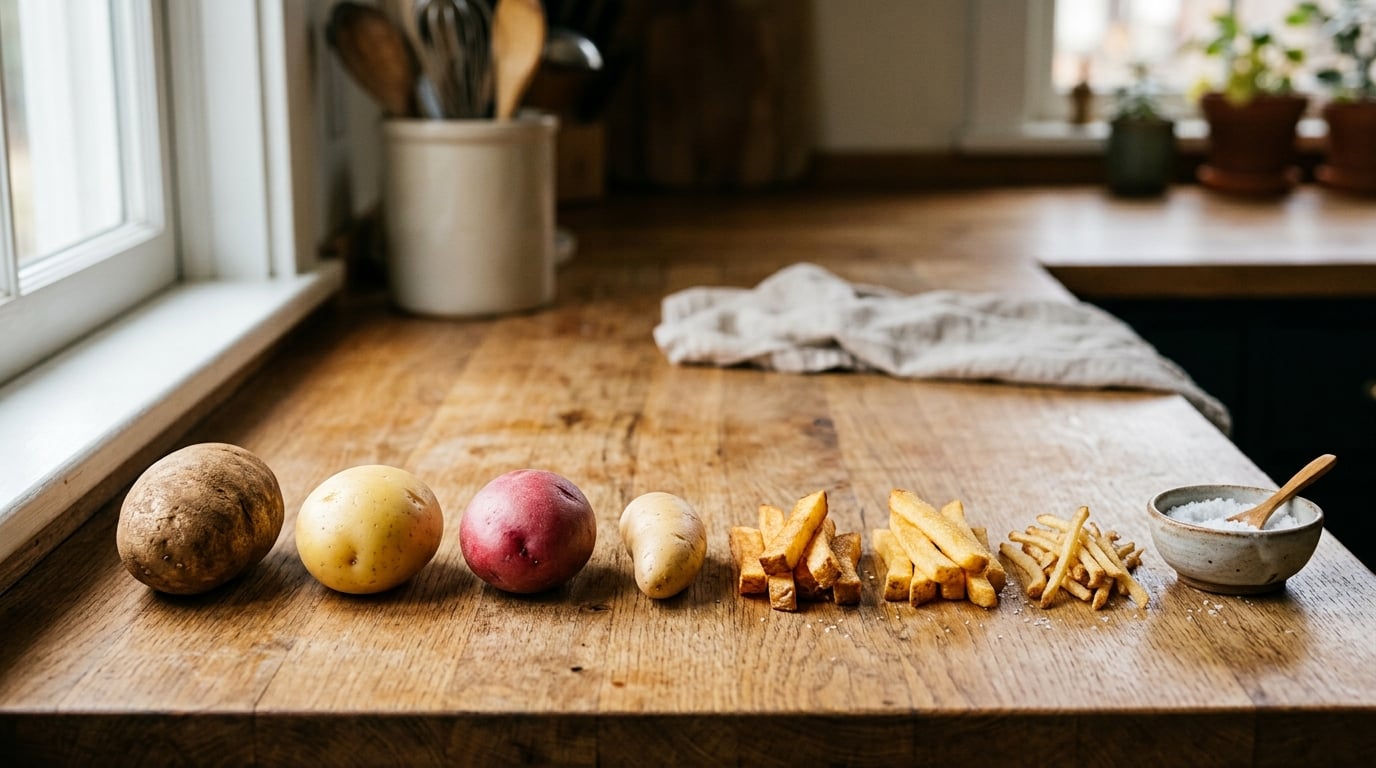
Russets, sold as Idaho potatoes, are the best potatoes for french fries because their high starch and low moisture cook into a crisp shell with a fluffy centre. Yukon Golds, Kennebecs and Maris Pipers also work well, and red or waxy potatoes suit thicker cuts. Here is how each one behaves in hot oil, and how to get the crispest fry from whatever you buy.
Starch is the whole story, and it is easier to fix a starchy potato than a waxy one. Cook it right and an ordinary russet beats a better knife or a pricier pan. Cook it wrong and no potato saves you.
Table of Contents
- Best Potatoes for French Fries at a Glance
- What Makes the Best Potatoes for French Fries?
- Which Potato Type Should You Choose?
- How to Cut Potatoes for the Crispiest Fries
- How to Keep Potatoes from Turning Brown or Mushy
- Which Potato Variety Is Best for Restaurant-Style Fries?
- Are Yukon Gold Potatoes Good for French Fries?
- Are Waxy Potatoes Bad for French Fries?
- Tips for Choosing and Storing Potatoes for Frying
- Frequently Asked Questions
- Conclusion
Best Potatoes for French Fries at a Glance
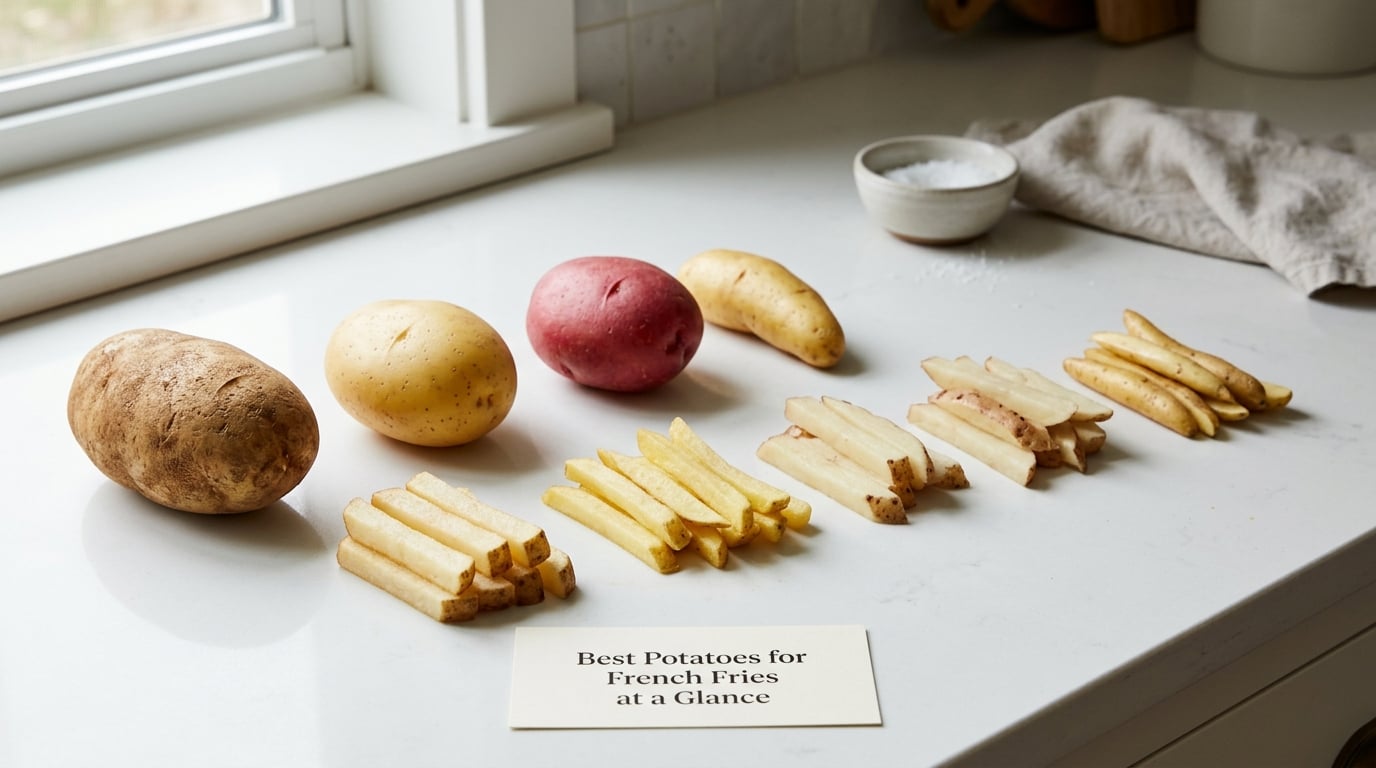
Starch and moisture move in opposite directions, so a variety that scores well on one usually ranks low on the other. The figures below are typical ranges, not lab measurements, and they shift with the season and the source.
| Potato | Type | Starch | Moisture | What it does in the fryer | Verdict |
|---|---|---|---|---|---|
| Russet / Idaho | Starchy, floury | Very high | Low | Crisp shell, dry and fluffy inside, big shatters | Best all-round pick |
| Kennebec | Starchy white | High | Low to medium | Clean crispness, holds shape well at thick cuts | Excellent, chef favourite |
| Maris Piper | Starchy white | High | Medium | Good crust, creamier middle than a russet | Strong, UK chip shops agree |
| Agria | Starchy white | High | Medium | Holds up to a long fry without falling apart | Very good across Europe |
| Sebago | Floury white | High | Low to medium | Classic thick-cut chip texture | Very good in Australia |
| Yukon Gold | All-purpose, waxy-leaning | Medium | Medium | Golden colour, creamy and moist centre, softer crust | Good, not the max-crisp choice |
| Red (red-skinned) | Waxy | Low | High | Softens quickly, edges brown before the centre cooks | Skip for classic fries |
| Fingerling, petite | Waxy | Low | High | Wet, limp interiors; burns at the tips | Avoid |
Red potatoes and fingerlings are not bad potatoes. They are simply built for boiling and roasting, where water stays welcome. For a fry, the water fights you at every step.
What Makes the Best Potatoes for French Fries?
Frying is a water-removal job. The moisture in a potato turns to steam on the surface, and the starch in it softens and then sets into a rigid shell. Get the balance right and you get a hard, brittle crust around a tender middle.
| Quality | What it does in hot oil | What you get |
|---|---|---|
| High starch | Starch granules swell and gelatinise, then set into a firm shell | Thick, crisp crust that resists softening |
| Low moisture | Less water to boil off before the surface dries | Drier, flakier interior and faster browning |
| Low sugar | Less caramelising and burning at the tips | Even golden colour across the whole fry |
| Solid, dense flesh | Holds together instead of breaking in the basket | Fries that keep their shape in a heavy batch |
| Freshness | Less stored sugar, steadier starch | Consistent results batch to batch |
That is the whole mechanism, and it explains every failure people report. Waxy potatoes hold so much water that the steam keeps softening the crust from inside while the thin edges brown and blacken. Russets go the other way: little water, lots of starch, so the surface can dry out and set before the sugars get a chance to burn it.
Sugar is the sneaky one. Potatoes that have been stored for months convert starch into sugar, and a cook with more sugar in it means a fry that colours fast and tastes bitter before the middle is done. That is why the same bag of potatoes can behave differently in March than in July, and why one cook’s success story becomes another cook’s soggy pan.
Density matters too. A dense potato survives the drop into hot oil and the weight of a full basket. A soft, spongy one breaks apart, and broken pieces turn into dark crumbs floating in your oil.
Which Potato Type Should You Choose?
Start with the texture you want. Maximum crisp and maximum fluff means the most starchy option you can find, which in North America is a russet. Creamy and golden with a softer shell points to a Yukon Gold or an all-purpose white.
Outside the US, the same rule produces different names. Sebago in Australia, Maris Piper and King Edward in the UK, Agria and Fontane across much of northern Europe. Ask whoever is closest to you which local floury variety is going into the fryer this week.
Sweet potatoes make decent fries, and the logic is the same: they are starchy, so they crisp. They brown faster because their sugar content is much higher, which is a feature for anyone who wants caramelisation and a nuisance for anyone who wants a pale chip.
Best Potatoes for French Fries Explained by Cooking Method
The same potato does not win every job. Dry heat behaves differently from submerged frying, and an air fryer behaves differently again.
| Method | Best potato | Why | Key settings |
|---|---|---|---|
| Deep fryer or heavy pot | Russet, Kennebec, Maris Piper | Starch sets into a shell before the interior overcooks | Blanch at 300-325F, cool, finish at 360-375F |
| Oven, deep tin | Russet | Stays dry on the sheet instead of steaming in its own moisture | 425-450F, preheated sheet, single layer |
| Oven, on parchment | Yukon Gold | Parchment traps steam under the fries, so a wetter flesh holds up better | 425F, turn at 20 minutes, dry before adding |
| Air fryer | Russet or Kennebec | Small batches and moving air need a starchy fry to stand up | 380F, 18-25 minutes, shake the basket twice |
| Oven-roasted, skin on | Any waxy or fingerling | Roasting concentrates flavour instead of competing with water | 425F, cut side down, no oil pooling |
The oven result is not a myth, it is parchment physics. Paper is fine, but it does nothing to move moisture off the surface, and readers who blamed the pan for soggy fries were usually looking at a crowded sheet. Use a bare preheated steel pan when you want maximum crunch and parchment when you want a more forgiving, creamier fry.
How to Cut Potatoes for the Crispiest Fries
Cut to the fry you want, and cut every piece the same size. Even thickness matters more than width, because a mismatched batch leaves thin strips burnt before thick ones finish.
Six millimetres, roughly a quarter-inch, gives you a steak fry with a craggy face and enough interior to stay tender. Three to four millimetres gives a thin, fast-cooking fry that goes crisp easily. Anything much thinner than that needs almost no cooking time, and the risk of burning rises fast.
Use a serrated knife. The teeth tear the surface as you cut, and those rough edges brown faster and grab oil, which is exactly the texture you want. A wire crinkle cutter does the same job for ridges, and the flat valleys between them crisp faster than a smooth wall.
Skin-on cuts hold together and cook slightly faster. Leave the skin if you want the sturdier fry, and peel if the dish is one where you want soft, potato-flavoured centres such as loaded fries with sauce.
How to Keep Potatoes from Turning Brown or Mushy
Cut potatoes brown because enzymes react with oxygen at the cut face, and they turn mushy because water is still in there when the fry ends. Both have fixes, and one of them is often done wrong.
Hold cut potatoes under cold water. Water excludes oxygen, so the browning slows to almost nothing while you work. A spoonful of vinegar or lemon juice per quart buys you extra hours in the fridge, a trick borrowed from restaurant prep kitchens.
Do not salt the soak. Readers assumed it would help the flavour, and it did the opposite: salt water draws moisture out of the surface, weakens the cell walls, and the fry comes back limp.
Drying is the step people skip. Every bit of water left on the potato has to boil before the surface can set into a crust, and while it boils it cools the oil and extends the cook. A salad spinner plus a clean towel takes a minute and changes the result more than anything else on this list.
For make-ahead work, cut and hold the potatoes submerged in cold water in the fridge for up to two days. Drain and dry them the same day you cook, and they will behave like freshly cut pieces.
Which Potato Variety Is Best for Restaurant-Style Fries?
For restaurant-style fries, russet is the dependable answer, and Kennebec is the one serious rival. Kennebec is a high-starch white potato that holds its shape through a long fry, which is what a fryer full of orders actually needs.
Russet wins on the dry, fully fluffy interior that people call shatter-crisp. Kennebec wins on structural strength and a slightly creamier middle. Both are starchy, both work, and the choice between them matters less than three things that happen after you get them home.
Cut consistently, dry completely, and keep a stable oil temperature. A fryer that sits at 350F and drops to 320F when you add the basket gives you greasy, limp fries no matter which variety you chose. Large fast-food chains work with potatoes from a contracted supply that grows a starchy, consistent crop, which is why the fries arrive uniformly pale golden and stay crisp in the bag longer than yours do.
The standard restaurant method is a double fry. Blanch at 300-325F for about four minutes, drain, rest while the starch sets and the surface steams dry, then finish at 360-375F for one to two minutes. The low first pass cooks the interior without colouring it. The hot second pass sets the crust and browns it in a couple of minutes.
Are Yukon Gold Potatoes Good for French Fries?
Yes, Yukon Golds are good for french fries, just not the crispest possible outcome. They carry a moderate amount of starch rather than an abundance of it, which gives a fry with a softer shell and a golden colour that russets do not reach in the same time.
The payoff is a creamy, buttery interior, and that is why they are my pick for oven fries on parchment. Plenty of readers swapped in russets and reported success anyway, which tells you both varieties are forgiving.
Reach for a russet when you want a hard shell and a dry, crumbly centre. Stay with the Yukon Gold when you want a softer bite, a more even colour, or a fry that sits under a heavy sauce without falling apart.
Are Waxy Potatoes Bad for French Fries?
Waxy potatoes are not bad for french fries. They are a different tool, and using them for classic thin fries asks them to do something their flesh was not built for.
A waxy potato holds roughly two percentage points more water than a floury one and noticeably less starch. That water turns to steam inside the fry, keeps the interior soft, and pushes moisture back out to the surface, where it fights the crust you are trying to build. The thin edges brown and burn while the thick middle is still cool and wet.
They earn their place in a few jobs. Thick, skin-on cuts such as steak fries or chunky chips hold their shape, and the firm flesh gives you a clean bite. Waxy roast potatoes are excellent. For thin shoestring fries cooked in a hot fryer, pick a starchy potato instead.
Tips for Choosing and Storing Potatoes for Frying
Buy firm, heavy potatoes with dry, unwrinkled skin. Size matters at the cutting board rather than in the bag: a bag of similar-sized spuds gives you one cook time instead of four.
Check for sprouts and green patches. Both signal older tubers, and the green part in particular tastes bitter. Cut those away, or put the potato somewhere else.
Skip the fridge for long storage. Household cold sits around 40F, which converts starch into sugar and makes the fries darker and sweeter. A cool, dark, well-ventilated cupboard or cellar at about 45-50F keeps the starch behaving. Paper bags or baskets are better than sealed plastic.
Plan for the season, not the week. Freshly harvested potatoes in autumn are starchier than the same variety in spring, so fries from a freshly lifted russet and one that has been in storage since winter are not identical even when the recipe is.
Frequently Asked Questions
What is the best potato for homemade french fries?
A high-starch, low-moisture variety such as a russet is the best starting point. Its dry, floury flesh sets into a rigid crust in hot oil and leaves a fluffy centre, which is the combination most people picture when they describe good fries. Kennebec, Maris Piper and Agria behave the same way. Yukon Gold works well too, with a softer shell and a creamier middle.
Do I need to soak potatoes before making french fries?
Soaking is not mandatory, but it makes results more consistent. Holding cut potatoes in cold water keeps them from browning while you work, and rinsing off the loose surface starch leaves a drier face that browns better. Skip the salt. Salt in the soak pulls moisture from the surface and leaves you with limp fries, which is the most common soak mistake readers report.
Which is better for french fries, russet or Yukon Gold?
Choose russet for maximum crispness. Its higher starch and lower moisture produce the hard shell and dry, fluffy interior that most people want from a classic fry. Choose Yukon Gold for a softer, more golden fry with a creamy centre, especially in the oven or under a heavy sauce. Both work, and the difference is a matter of taste rather than a rule.
Can I make crispy french fries in an air fryer?
Yes. Use a starchy potato such as a russet or Kennebec, cut to about six millimetres, and keep the batch small enough to lie in a single layer. Cook at 380F for 18-25 minutes, shaking the basket twice so the pieces turn. A crowded basket steams instead of fries, which is the usual reason air-fried potatoes come out soft.
Should I fry potatoes twice?
Twice is the restaurant method and it is the most reliable route to a crisp fry that holds. Blanch at 300-325F for about four minutes, drain and rest while the surface steams dry, then finish at 360-375F for one to two minutes. The first pass cooks the interior without colouring it, and the second sets the crust. A single hot fry works too, but it is less forgiving.
Can I freeze cut potatoes for french fries?
You can, and it is a good shortcut. Cut and dry the potatoes, blanch them at 300-325F until barely tender, drain, cool, and spread in a single layer before freezing so they do not clump. Fry or bake from frozen at 425F without thawing, giving them a few extra minutes. Freezing raw cut potatoes without the blanch leaves them limp and grey.
Conclusion
Pick a firm russet, cut it into even six-millimetre batons, hold the pieces in cold water while you work, and dry them properly before they see oil. Blanch at 300-325F, rest, then finish at 360-375F. Those five decisions matter more than which bag the potato came from, and they turn an ordinary potato into a genuinely good fry.