
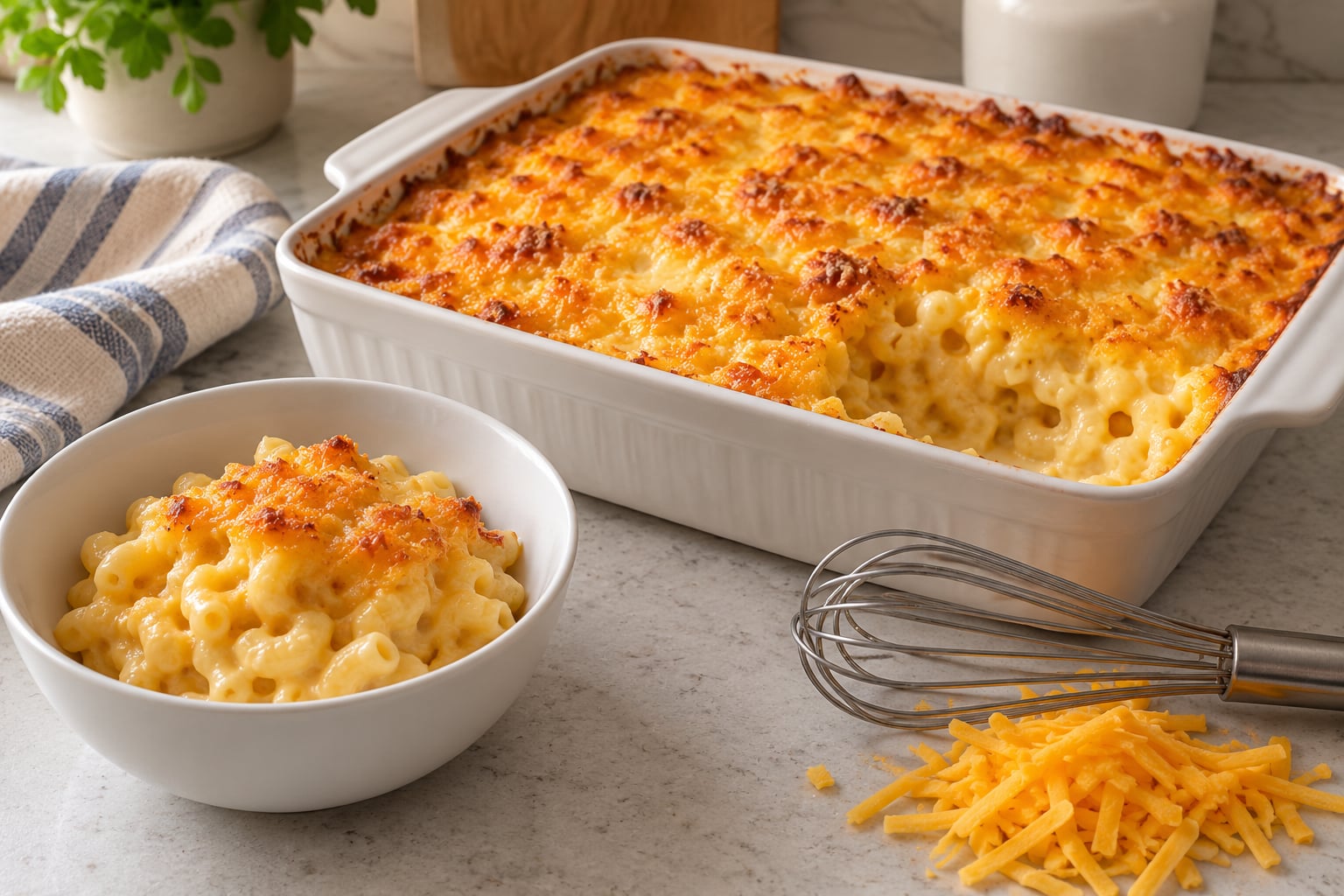
To make baked mac and cheese, boil 1 lb of elbow macaroni until it is one minute shy of al dente, toss it in a homemade béchamel cheese sauce made from butter, flour, milk and shredded cheddar, then bake at 375°F for 20 to 25 minutes until the top is golden and the center is bubbling.
Three things do the work: a smooth cheese sauce made before the oven goes on, pasta that still has a little bite left in it, and a topping that browns while the inside finishes setting. Get those right and the result is what people picture when they think of baked macaroni and cheese, not the dry, grainy version that ends up in too many pans.
This version takes about 20 minutes of hands-on work and 25 minutes in the oven, and it feeds 6 to 8 as a side dish or 4 to 6 as a main. The two checks that matter never change: does the sauce coat the back of a spoon before it goes in the oven, and does the top hit golden while the middle is still hot.
Table of Contents
- What You Need
- Step-by-Step: How to Make Baked Mac and Cheese
- Common Mistakes and How to Fix Them
- Frequently Asked Questions
- What ingredients make baked mac and cheese taste more flavorful?
- Can I use cheddar, Swiss, or American cheese in baked mac and cheese?
- Can baked mac and cheese be made ahead of time?
- How do I keep baked mac and cheese from getting dry?
- Can I freeze baked mac and cheese, and how should I reheat it?
- Should I cover baked mac and cheese while baking it?
- Conclusion
What You Need
Everything splits into three groups: macaroni, cheese sauce, topping. The sauce is a standard béchamel, a butter-and-flour roux loosened with milk, with the cheese whisked in off the heat so it never tightens and goes rubbery.
Macaroni
- 1 lb (450 g) elbow macaroni, or cavatappi, shells or penne
- Kosher salt, about 1 tablespoon for the pot
Cheese sauce
- 6 tbsp (85 g) unsalted butter
- 1/3 cup (40 g) all-purpose flour
- 3 cups (710 ml) whole milk, plus more if needed
- 1 cup (240 ml) heavy cream, or substitute half-and-half
- 3 cups (340 g) shredded sharp cheddar, divided
- 1 cup (110 g) shredded Gruyere or Swiss
- 1 cup (110 g) shredded mozzarella, optional, for pull
- 1 cup (100 g) shredded Parmesan, optional
- 1 teaspoon smoked paprika, 1/2 teaspoon ground mustard, 1/2 teaspoon garlic powder, 1/4 teaspoon nutmeg
- 1/2 teaspoon salt and several grinds of black pepper
Topping
- 1 cup (60 g) panko breadcrumbs
- 2 tbsp (28 g) butter, melted
- 1/2 teaspoon smoked paprika or garlic powder
Equipment, temperature and timing
A 9×13-inch (33 x 23 cm) ceramic or glass dish, or a 2.5-quart (2.4 L) casserole, a large pot, a whisk and a box grater are all you need. Heat the oven to 375°F (190°C). Most recipes say 350°F, and it works, but the hotter oven browns the crumb topping before the cheese sauce has set, which is why so many pans end up with a dark crust over a cold center. At 375°F you get the same set time, about 20 to 25 minutes, with a better top.
Prep is 20 minutes, cooking 10, bake 20 to 25, rest 10. Yield is 6 to 8 servings. Scaling up is easy for a holiday crowd, but a single 9×13 is the deepest dish that browns properly. For 20 servings, use two dishes rather than one enormous pan.
Which cheeses melt best for baked mac and cheese
No two cheeses behave the same in a hot sauce. This is the table I keep next to the grater.
| Cheese | Melt quality | Flavor | Best role |
|---|---|---|---|
| Sharp cheddar | Very good | Bold, tangy | The base of the sauce |
| Gruyere or Swiss | Excellent | Nutty, mild | Melts smoothest, keeps sauce flowing |
| Mozzarella | Excellent | Mild, stretchy | Cheese pull, dilutes sharpness |
| Monterey Jack | Excellent | Mild, buttery | Kid-friendly version |
| Colby | Good | Mild, creamy | Cheaper substitute for half the cheddar |
| American | Very good | Glossy, processed | Smoothest texture, least character |
| Swiss-style Swiss cheese | Good | Tangy, holes | Swap for Gruyere, not ideal alone |
| Fresh mozzarella or ricotta | Poor | Watery | Skip in the sauce |
| Pre-shredded bagged cheese | Poor | Flattened by coating | Grate your own, always |
Two details matter more than the list. Grate blocks yourself, because bagged shredded cheese carries anti-caking agents that keep the strands separate and that powdery coating turns a warm sauce grainy. And keep the heat low, since cheese proteins tighten and seize when they hit a hard boil.
Step-by-Step: How to Make Baked Mac and Cheese
Six steps, and the order matters. The sauce is smooth before baking, the pasta keeps some shape, and the dish is finished when the center bubbles and the top is brown.
1. Boil the macaroni until just underdone
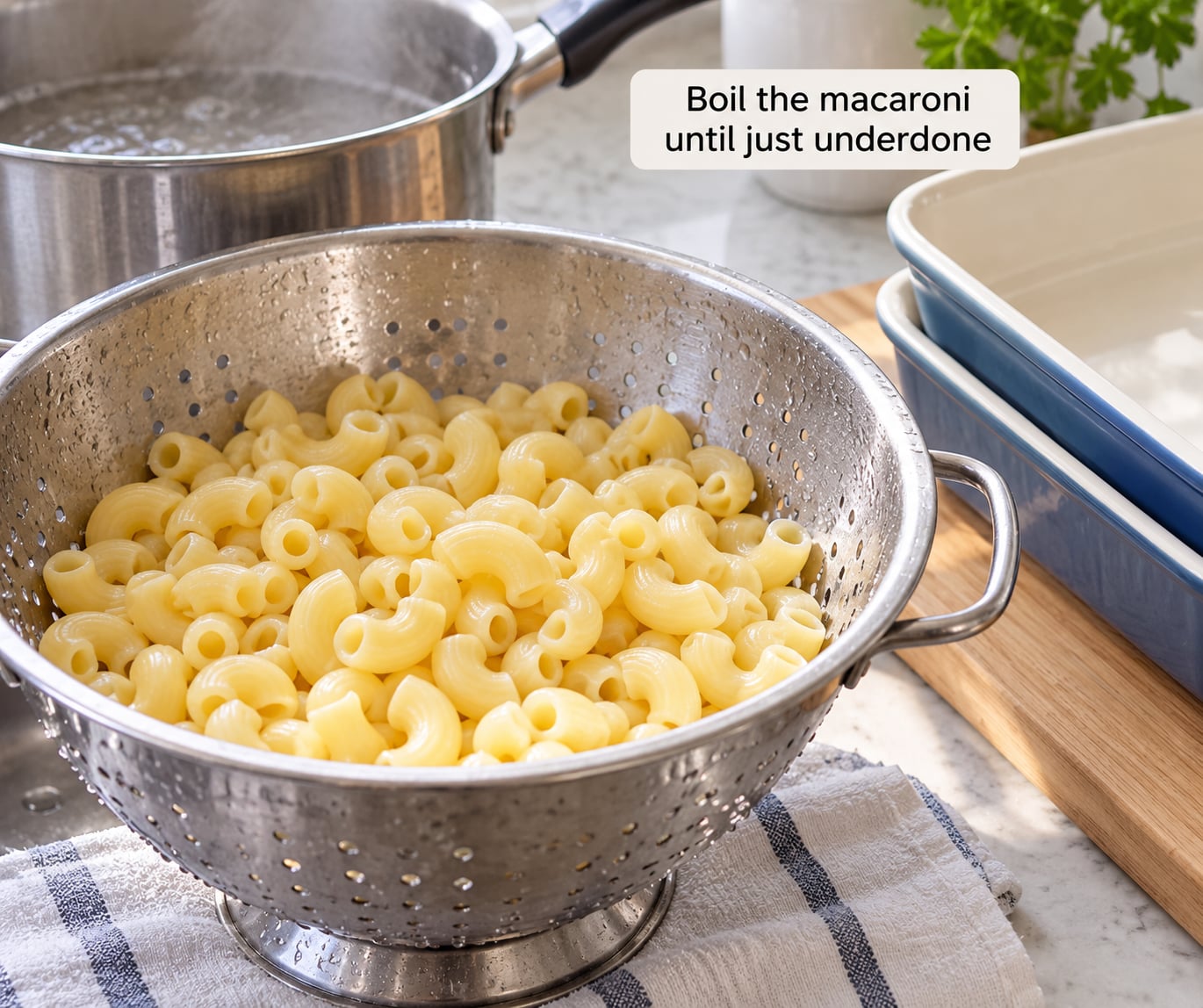
Bring a large pot of well-salted water to a rolling boil, then cook the macaroni one minute less than the package time. Start at 7 minutes for a standard 8-minute box. The pasta should bend easily but still push back when you squeeze it, because it finishes cooking in the oven.
Before you drain, scoop out a cup of the cloudy pasta water. That starchy water is the emergency repair kit for a sauce that tightens up later. Drain the pasta and let it sit in the colander for two or three minutes so it stops drinking water and swelling, which is what turns baked macaroni into paste.
2. Make the buttery roux
Melt 6 tablespoons of butter in the same pot over medium heat. Whisk in the flour and keep whisking for about 2 minutes, until the mixture bubbles, smells faintly nutty and coats the whisk. That nutty stage is flavor, not a warning sign, and it is the point where a raw-flour taste disappears.
Stay at medium heat and keep moving. Flour scorches fast once it browns past golden, and a scorched roux tints the whole dish. If the butter browns before the flour goes in, start over. It takes seconds.
3. Add milk and make the cheese sauce
Turn the heat down to low. Pour in 3 cups of milk and 1 cup of cream in 4 or 5 additions, whisking constantly between each one. Add a splash of that reserved pasta water whenever the sauce thickens faster than you expect, since the temperature of your pot changes how fast the starch cooks.
Simmer 3 to 4 minutes until the sauce is thick enough to coat the back of a wooden spoon and leaves a clean trail when you drag it. Take the pot completely off the heat, then stir in the shredded cheddar and Gruyere a handful at a time until each batch vanishes. Stir in the paprika, ground mustard, garlic powder, nutmeg, salt and pepper, and taste it. It should taste slightly under-seasoned, because the pasta water and the oven will dull it further.
Stirring the cheese off the heat is the whole trick. Boiling cheese sauce pushes the fat and protein apart, and no amount of whisking brings them back together smoothly.
4. Toss the pasta with the sauce
Return the drained pasta to the pot and pour the sauce over it. Fold gently with a spatula until every piece is coated, about 30 seconds, then stop. Vigorous mixing turns the surface of the pasta into paste, and that is the most common reason a homemade bake seems to have more body than a restaurant one.
Taste one piece. Under-salted sauce is the usual culprit when a finished dish tastes flat, and the fix is a pinch of salt now rather than a whole batch of adjustments later.
5. Add the topping and bake
Transfer to the dish and spread it into an even layer, about 2 inches deep. Toss the panko with melted butter and the extra paprika, then scatter it over the top and press it down lightly so it stays put. A topping that slides off is nearly always a topping nobody pressed on.
Bake at 375°F for 20 to 25 minutes, uncovered. Leave it uncovered so moisture can escape and the crumb can crisp. It is done when the top is deep golden and sauce is bubbling slowly at the edges, and the center reaches 165°F on an instant-read thermometer if you have one. A thermometer is a nice confirmation, not a requirement, and the visual cues work fine on their own.
If the crust browns while the middle is still cold, tent the dish loosely with foil and give it another 5 to 10 minutes. A hot oven with a shallow dish can brown in 12 minutes while the center is still at room temperature.
6. Rest, portion, and serve
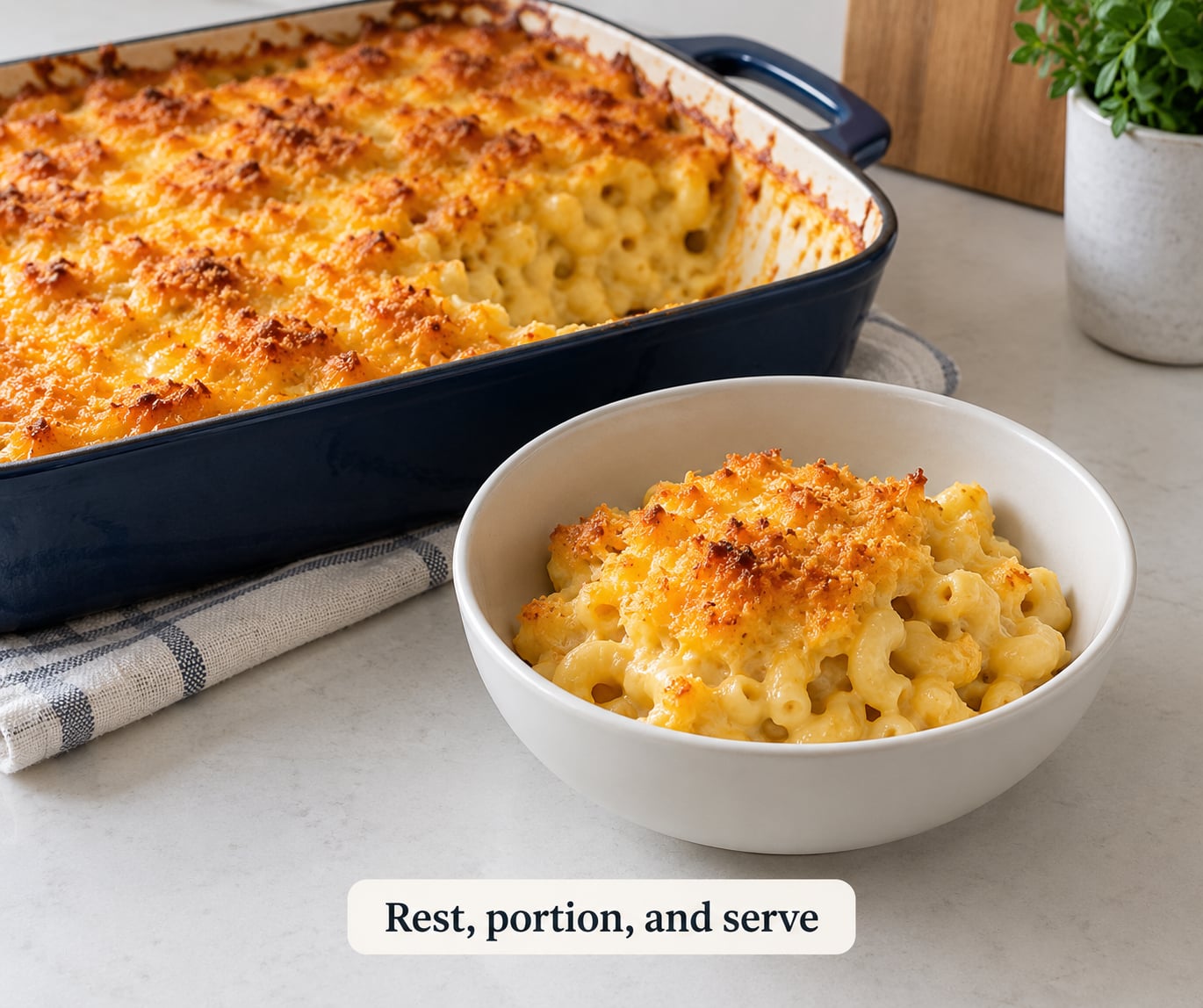
Rest 10 minutes before serving. The sauce is still setting as it cools, and slicing straight out of the oven gives you loose, soupy portions that run onto the plate. The finished dish should hold its shape on the spatula with a creamy, slightly stretchy center and a set, browned edge.
It is a side dish as often as it is a main. On a burger night it goes right next to how to make a burger without a bun, and it holds up next to veggie burgers made from scratch just as well as it does next to roast turkey. Serve it at 165°F or warmer; a cold dish of macaroni and cheese tastes of nothing.
Common Mistakes and How to Fix Them
Nearly every disappointing baked mac and cheese traces back to one of a handful of causes. Find the row that matches what you see and fix that, rather than adding more cheese to a dish that was never short on cheese.
| Problem | Cause | Fix |
|---|---|---|
| Grainy or gritty sauce | Cheese added over high heat, or bagged pre-shredded cheese with anti-caking agents | Grate your own blocks and stir the cheese in off the heat, a handful at a time |
| Sauce breaks or turns oily | Cheese boiled hard, or the sauce went over 180°F | Take it off the heat, whisk in a tablespoon of cold milk or reserved pasta water until it comes back together |
| Mushy, bloated pasta | Pasta boiled to full al dente, then sat in the colander | Drain one minute early and let it sit only two minutes before saucing |
| Dish comes out dry and stodgy | Too little sauce for the amount of pasta, or an overlong bake | Use about 1.5 cups of sauce per pound of pasta and pull it the moment the edges bubble |
| Bland flavor | Seasoned before the sauce went into the oven, so heat dulled it | Taste after saucing and after baking; add salt, a splash of Worcestershire sauce or more mustard powder |
| Grainy already baked dish | Sauce seared during the bake | Warm it gently with a splash of milk on low heat and stir until the fat re-emulsifies, then broil 2 minutes |
| Topping slides off or burns first | Not pressed on, or dish too deep | Press the crumbs down and keep depth to about 2 inches |
| Custard sets into a solid block | Too much egg or an overbake | One egg per pound of pasta is plenty; pull the dish at 165°F |
On the grainy question specifically, which comes up more than anything else on cooking forums: yes, you can rescue it. Warm the dish over low heat with a splash of milk, stir slowly until the loose fat recombines with the sauce, and the graininess usually goes with it. If it stays broken, pull it off the heat, add a tablespoon of cold milk and whisk hard for thirty seconds. Cooks on r/Cooking and r/AskCulinary report the same cold-milk fix for a seized sauce, and it works far more often than starting over.
Tips for the Best Baked Mac and Cheese
Sharper and richer. Add 1/2 teaspoon of Worcestershire sauce and a teaspoon of Dijon with the seasonings. A tablespoon of sour cream stirred in off the heat adds body without thinning anything.
A different crust. Panko gives the crunchiest top. Plain breadcrumbs work fine, and for a saltier crust people often crush Ritz crackers, Cheez-It or Goldfish and mix them with the same melted butter. Buttered bread crumbs with a little garlic powder are a close second for a Thanksgiving table.
Lighter dairy. Whole milk, 2%, half-and-half, evaporated milk or heavy cream all work. Evaporated milk is the most forgiving because it is already concentrated and does not curdle easily. Avoid skim milk, which lacks the fat that keeps the emulsion together.
Gluten-free. Use a gluten-free pasta and skip the flour. Make the roux with 2 tablespoons of cornstarch instead, and cook it a minute longer. Expect a slightly looser sauce, since gluten-free pasta gives up less starch to the pot.
The Southern custard style. This is a different technique, not a shortcut. Beat 2 eggs with 12 ounces of evaporated milk and 2 cups of cubed cheese, stir that into the cooked pasta, and refrigerate it overnight before baking. The eggs set into a sliceable custard, so it never goes grainy and it holds its shape far better. Treat it as a project that starts the night before.
No roux at all. For a first attempt, layer uncooked elbow macaroni, sliced cheese and a can of condensed soup or evaporated milk in the dish, cover with foil, and bake at 375°F for 35 minutes. It is a decent dish. It just is not the same one.
Make ahead. Assemble the dish up to two days ahead without the topping, cover, and refrigerate. Bake cold at 325°F for 25 minutes covered with foil, then remove the foil, add the topping, and bake 15 to 20 more minutes until golden. This is the version to make for Thanksgiving dinner, where oven space is contested.
Freeze it. Assemble unbaked and without the topping, wrap tightly in plastic and foil, and freeze up to 2 months. Thaw overnight in the refrigerator, then bake at 350°F covered for 15 minutes, followed by 25 minutes uncovered. Thawing in the fridge rather than on the counter is what keeps the texture close to fresh.
Storage and reheating. Keep refrigerated, tightly covered, for 3 to 4 days. Reheat a portion in the microwave with a tablespoon of milk for 60 to 90 seconds, stir, and finish under the broiler for a minute to bring the crust back. A skillet over low heat works even better.
Frequently Asked Questions
What ingredients make baked mac and cheese taste more flavorful?
Smoked paprika, ground mustard powder, garlic powder and a pinch of nutmeg build the most flavor for the least effort. A tablespoon of Worcestershire sauce added off the heat adds depth, and a splash of Dijon sharpens it. Season the sauce and the pasta separately, and taste again after the bake, because the oven dulls seasoning more than most people expect.
Can I use cheddar, Swiss, or American cheese in baked mac and cheese?
All three work. Sharp cheddar gives the most flavor, Swiss or Gruyere melts the smoothest, and American delivers the glossiest texture with the least fuss. A blend of two beats any one of them alone: try 3 cups cheddar with 1 cup Gruyere, or swap in Monterey Jack for a milder, kid-friendly version. Always grate blocks yourself.
Can baked mac and cheese be made ahead of time?
Yes, and holiday dinners depend on it. Assemble the dish up to two days ahead without the topping, cover it, and refrigerate. Bake cold at 325°F for 25 minutes with foil on top, then remove the foil, scatter the topping, and bake 15 to 20 minutes more until golden and bubbling at the edges. Do not put the topping on until the day you bake.
How do I keep baked mac and cheese from getting dry?
Three things prevent a dry bake. Use about 1.5 cups of sauce per pound of pasta, cook the pasta one minute short of al dente so there is still moisture in it, and pull the dish out of the oven as soon as the edges bubble and the top is golden. Baking past that point keeps drying the pasta even though the sauce is already set.
Can I freeze baked mac and cheese, and how should I reheat it?
Freeze it unbaked and without the topping, wrapped tightly in plastic and foil, for up to 2 months. Thaw it overnight in the refrigerator, then bake at 350°F covered in foil for 15 minutes and uncovered for 25 minutes. Already-baked portions reheat with a tablespoon of milk in the microwave, stirred halfway, then a minute under the broiler to re-crisp.
Should I cover baked mac and cheese while baking it?
Leave it uncovered so the crumb topping can brown and moisture can escape. Covering traps steam and the top stays pale. The exception is a dish going into the oven cold from the refrigerator, or baked from frozen: cover that with foil for the first 15 minutes, then uncover for the remainder so the top can crisp.
Conclusion
Start with the sauce. Melt butter, whisk in flour until it smells nutty, loosen with milk slowly over low heat, and stir in grated cheese off the heat until it is smooth enough to coat a spoon. Boil the pasta one minute less than al dente, fold it through gently, and bake at 375°F uncovered for 20 to 25 minutes until the top is deep golden and the center is bubbling. Rest it 10 minutes before serving, and it will come out creamy in the middle every time.