
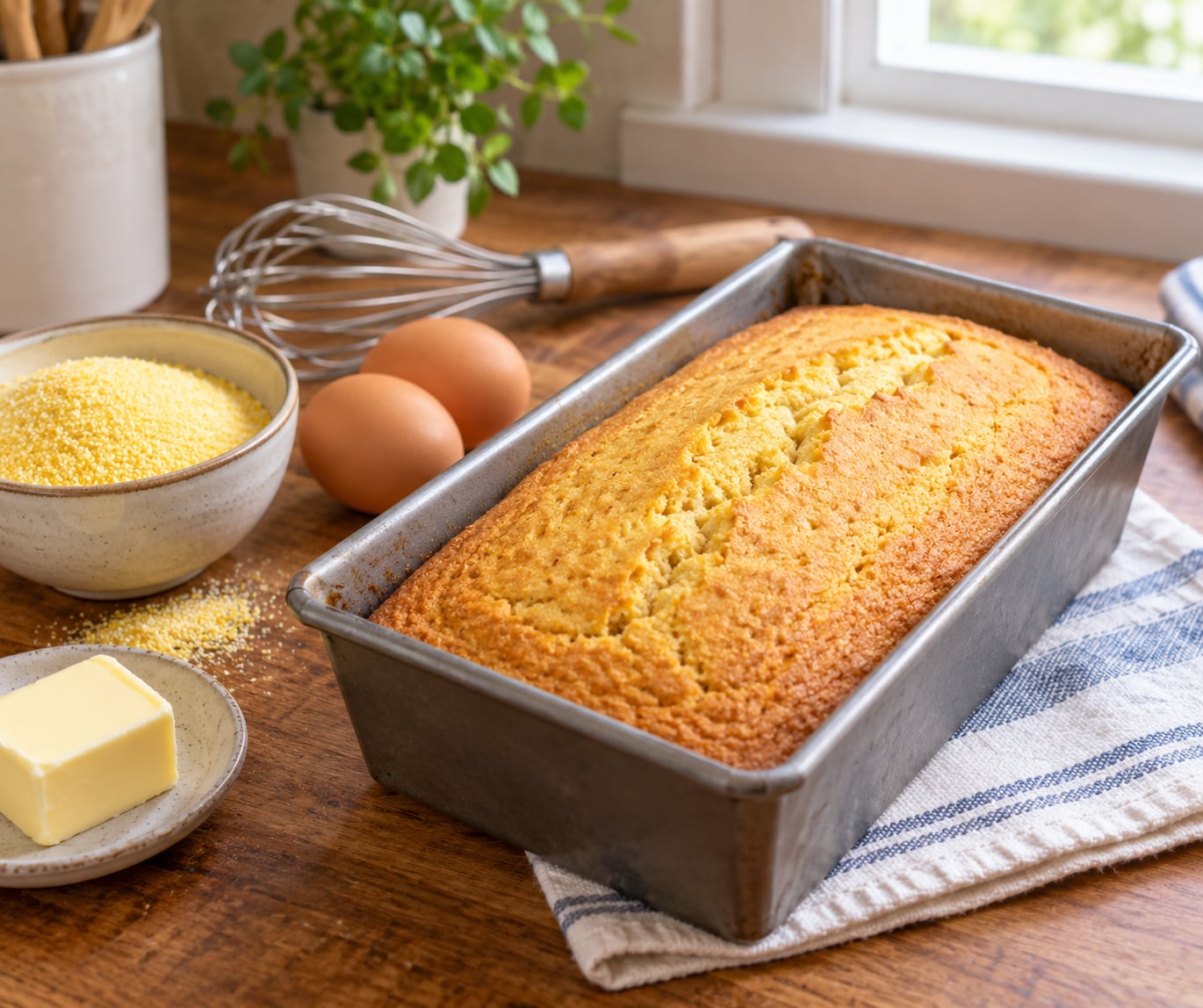
Knowing how to make cornbread from scratch takes one bowl, one pan, and about 30 minutes from a cold start to a sliced loaf. Cornbread is a quick bread: you whisk cornmeal and a little flour together with milk, eggs, and leavener, then bake at high heat until the top is golden and the center just sets.
Most dry, crumbly cornbread is not a bad recipe. It is a heavy hand in the mixing bowl or a pan sitting in the oven too long. Get those two things right and you will have a tender crumb with a crisp edge, no boxed mix required.
Here is the method I use, with the temperatures and times spelled out for each kind of pan so you can see exactly what worked. I have baked it as a skillet bread, a 9×13 slab, and as muffin-pan cakes, and the batter barely changes between them.
What You Need to Make Cornbread From Scratch
The ingredient list is short. What matters is that you know what each one is doing, because that is how you fix a bad loaf instead of guessing.
- 1 cup yellow cornmeal (about 140g). Medium-grind works best for a tender crumb with some texture. Stone-ground is coarser and more fragrant, and it makes a slightly grittier loaf.
- 1 cup all-purpose flour (about 125g). This is the binder. Skip it entirely and the loaf crumbles when you cut it, and you risk a gummy center.
- 1 tablespoon sugar for a savory-leaning loaf, up to 1/4 cup for a sweet one. Sugar is the main dial between Northern sweet cornbread and Southern cornbread.
- 1 tablespoon baking powder for lift on its own.
- 1 teaspoon baking soda, which reacts with the acid in the buttermilk. Use it only if you have buttermilk or an acid substitute.
- 1 teaspoon fine salt.
- 2 large eggs, which set the crumb and bind the batter.
- 1 cup buttermilk (about 240ml).
- 6 tablespoons melted butter or a neutral oil. Butter adds flavor, oil keeps the crumb moist longer.
Substitutions worth knowing
No buttermilk? Stir 1 tablespoon of white vinegar or lemon juice into 1 cup of whole milk, let it stand 5 minutes until it looks slightly curdled, and use that. The acid does the same job baking soda needs.
Dairy-free works too: use unsweetened plant milk with a tablespoon of vinegar added the same way. Just expect a slightly tighter crumb, since dairy proteins help with tenderness.
Equipment
You need a 9-inch cast iron skillet, a 9×13 metal or glass baking dish, an 8-inch square pan, a muffin tin, or a 5×9 loaf pan. A whisk, a medium bowl, and a wooden spoon finish the list. No stand mixer, and no kneading, ever. If you enjoy the process of building other quick breads from the pantry, how to make veggie burgers from scratch is the same kind of hands-on approach.
Step-by-Step: How to Make Cornbread From Scratch
Read through the whole sequence once before you start. It moves fast from the moment the wet ingredients hit the dry ones, and baking powder begins losing its lift the second it gets wet.
Step 1: Prepare the Pan and Oven
Set the oven to 400°F (205°C) for a 9×13 or 8-inch pan, or 425°F (220°C) if you are using a cast iron skillet. Let it preheat fully; a cold pan is the reason many home bakers end up with a pale, under-baked bottom.
Set the empty skillet in the oven for 10 minutes with 2 tablespoons of butter or oil inside it, so the fat heats up and smokes faintly before the batter goes in. That hot fat is what gives skillet cornbread its crisp, craggy crust. For a baking dish, coat the bottom and sides with butter or oil and use parchment if you plan to serve the cornbread straight from the pan.
Step 2: Combine the Dry Ingredients for Cornbread From Scratch
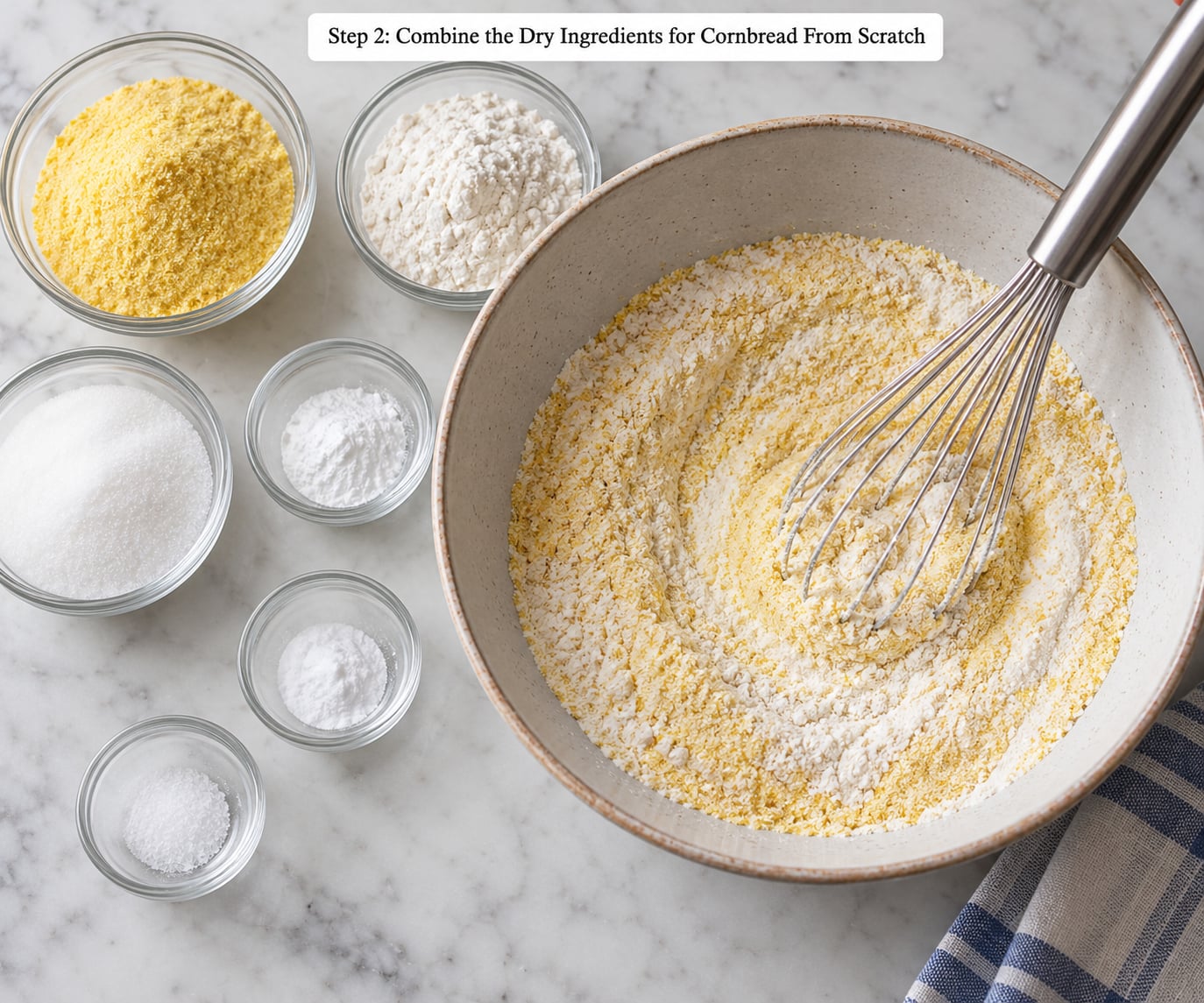
Whisk 1 cup cornmeal, 1 cup flour, the sugar, 1 tablespoon baking powder, 1 teaspoon baking soda, and 1 teaspoon salt in a large bowl until there are no streaks of flour left in the corners.
Spoon and level the flour rather than scooping it. A packed cup of flour is close to a quarter cup too much, and that surplus is the single most common reason homemade cornbread comes out dry and crumbly.
Step 3: Mix the Wet Ingredients
In a second bowl or measuring jug, whisk 2 eggs, 1 cup buttermilk, and 6 tablespoons melted butter or oil until the yolks break and everything looks evenly yellow.
Let the butter cool for a minute before it goes in. Very hot butter scrambling the eggs gives you scrambled egg ribbons baked into your bread, and there is no way to stir that out later.
Step 4: Make the Batter
Pour the wet mixture into the dry and stir with a wooden spoon just until the flour disappears. Ten or fifteen strokes, no more. You will still see a few streaks and that is correct.
Cornbread is a quick bread, and the flour in it is all-purpose, which means gluten. Beating air into gluten makes it link into long strands, and long strands are what you chew on in a tough, dense, chewy slice. Stop while the batter still looks under-mixed and it bakes into something tender.
Lump the batter a few times with the back of the spoon so the cornmeal clumps break up, then let it sit for 5 minutes. That rest hydrates the cornmeal and gives you a better crumb than rushing straight to the oven.
Frozen corn kernels blended into the batter work in place of some of the flour and cornmeal if you want more corn flavor. If you have never compared a cooked grain side against a crumb-based one, burgers with breadcrumbs vs without makes the same kind of texture case in a different dish.
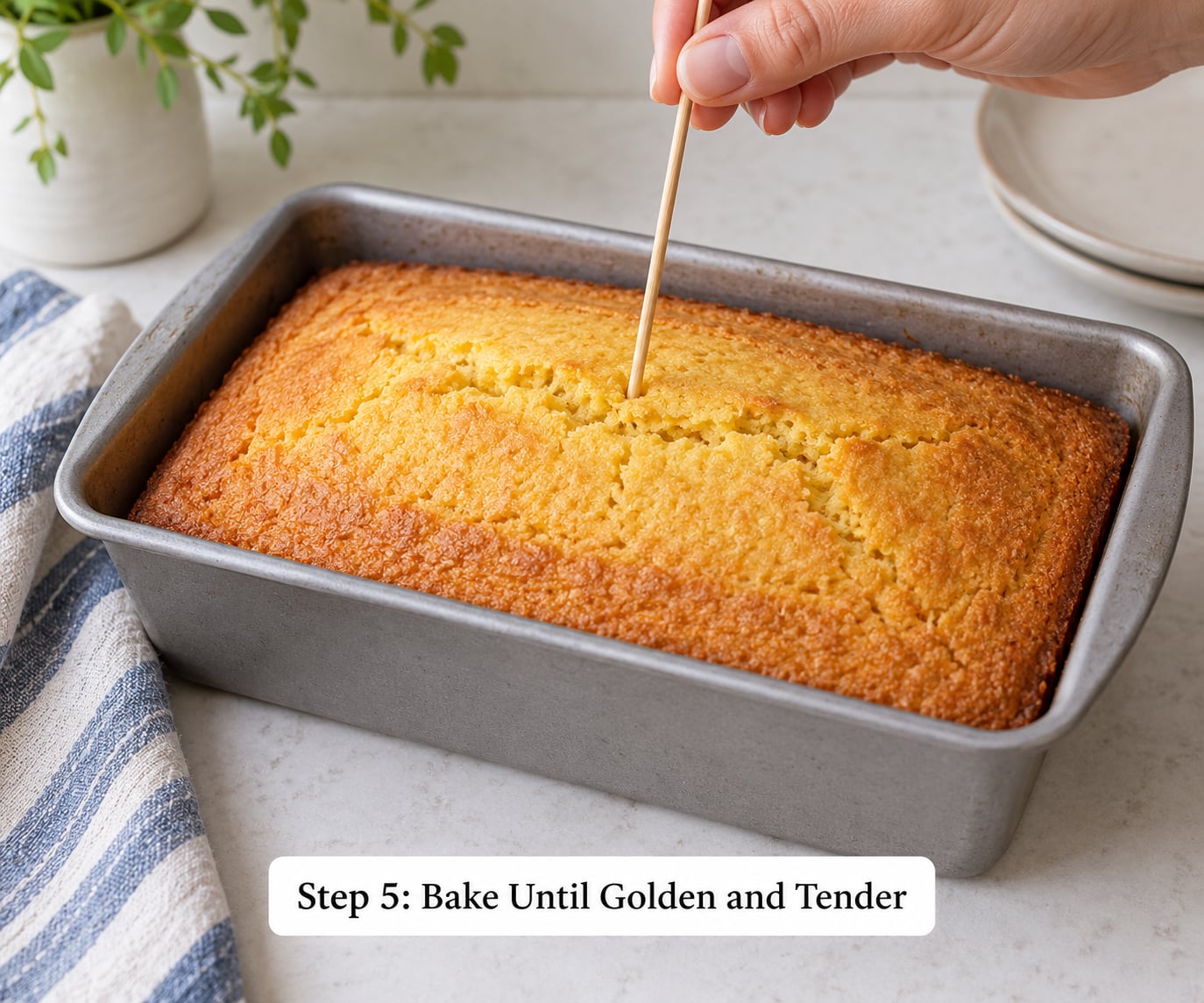
Step 5: Bake Until Golden and Tender
Pour the batter into the hot pan and spread it into the corners, where it will pull away from the sides as it bakes. Put it in the oven immediately.
Bake a skillet loaf at 425°F for 22 to 25 minutes, then turn the heat down to 375°F for the last 8 to 10 minutes. That two-temperature method gives you a dark, caramelized top first, then enough time to set the thick middle. Bakes in a 9×13 dish need 30 to 35 minutes at 400°F, an 8-inch square needs 25 to 30, a 5×9 loaf pan needs 30 to 35, and muffin-pan cakes bake in 12 to 15 minutes.
Check with a toothpick or a thin wooden skewer in the deepest part of the center. It should come out clean or with one or two moist crumbs clinging to it. If there are wet, sticky crumbs, give it three or four more minutes. The top should be golden brown and the edges pulled slightly from the pan.
Step 6: Cool, Slice, and Serve
Wait 15 minutes before the first cut. Cornbread keeps baking from residual heat as it cools, and cutting it early leaves the crumb gummy and tacky, with crumbs stuck to the knife.
Cut it with a serrated knife in one confident motion rather than sawing back and forth, and serve it warm with butter and honey. It also works as a base for chili, bean soup, beef stew, or fried eggs at breakfast.
Bake Time and Temperature by Pan Type
Here is the reference at a glance. Thinner batter means shorter time, and cast iron needs the most heat because it holds and pushes heat into the crust.
| Pan | Oven temperature | Bake time | What you get |
|---|---|---|---|
| 10-inch cast iron skillet | 425°F then 375°F | 22-25 min, then 8-10 min | Crisp, craggy edges and the deepest corn flavor |
| 9×13 baking dish | 400°F | 30-35 min | Even slab, best for chili cornbread casserole |
| 8-inch square pan | 400°F | 25-30 min | Thick center, cut into squares |
| 5×9 loaf pan | 400°F | 30-35 min | Sliceable loaf, good for toast and sandwiches |
| Muffin tin | 400°F | 12-15 min | Individual cakes, freeze well for meal prep |
If you do not own a cast iron skillet, the recipe works perfectly well in the 9×13. You trade the dramatic crust for a more even, softly golden bake, which is a fair trade for beginners. Skillet cornbread also rewards a little patience, since cast iron holds so much heat that the loaf can scorch on the bottom before the middle sets.
Common Mistakes and How to Fix Them
Nearly every cornbread complaint has one of five causes. Find yours before the next bake.
The crumb is dry and crumbly
Two causes: too much flour and too long in the oven. Spoon and level your flour, and pull the loaf the moment the toothpick comes back with only a couple of crumbs. A third cause is cutting it too early, which lets steam escape as the crumb still sets.
The center sinks or collapses
The batter was under-mixed or the pan was not hot enough, so the structure could not hold the rise. Whisk the dry ingredients thoroughly, stir just until the flour disappears, and make sure your baking powder is fresh. Old baking powder has lost most of its lift and cannot be revived.
The edges look done but the middle is raw
This is a pan-shape problem. A 9×13 dish spreads the batter thin, so if you filled it past the middle third of the dish you have baked a deep cake in a shallow pan. Use 8×8 or a skillet for thick batter, and test with a skewer in the center rather than at the edge.
The bottom is soggy or pale
A glass dish that went into a cold oven never got hot enough to sear the base. Preheat the oven, then heat the empty pan with butter for several minutes before pouring the batter in. That investment is what makes the bottom golden and crisp.
The texture is gummy and dense
Overmixing developed gluten. Stir with a spoon in broad, slow strokes, and stop as soon as the flour disappears. Also check your oven temperature with an oven thermometer; a dial oven running 25 degrees hot bakes off moisture and dries the loaf out.
The loaf bakes unevenly or one side browns first
Rotate the pan halfway through the bake, once it has set enough to move safely. If you bake from a hot oven and a cold front step, an insulated oven mitt wrapped around the back of the pan will level out the radiant side.
How to keep cornbread moist overnight
Cool it completely before storing, then wrap the whole loaf, not the cut slices, in plastic wrap or a sealed container. Airtight is the goal, since cornbread loses moisture through its crumb within hours. If you must refrigerate it for more than a day, wrap it in a damp towel inside the container.
Frequently Asked Questions
What are the four basic ingredients in cornbread?
The four base ingredients are cornmeal, flour, milk or buttermilk, and eggs. Everything else in a from-scratch recipe is a supporting player: baking powder for lift, salt for flavor, and fat for tenderness. Some very old-fashioned versions are just cornmeal, water, salt, and fat, baked like a pone rather than a loaf.
What are the ingredients for making Southern cornbread?
Southern cornbread leans savory: 1 cup yellow cornmeal, 1 cup all-purpose flour, 1/2 teaspoon salt, 1 teaspoon baking powder, 1 teaspoon baking soda, 1 cup buttermilk, 2 eggs, and 4 tablespoons melted butter or bacon drippings. Sugar is often left out or cut to a tablespoon. Add-ins like chopped jalapeno, shredded cheddar, or corn kernels are traditional.
What is the origin of cornbread?
Cornbread grew out of Native American nixtamal, where field corn was soaked in an alkaline solution, ground, and cooked into pones. When settlers arrived, they replaced the alkaline process with alkali leavening and alkaline water, which is why baking soda and buttermilk became the backbone of Southern cornbread. Frying in pork fat became widespread in the 19th century.
What kind of flour is best for cornbread?
All-purpose flour is the right choice in the standard ratio. It has just enough gluten to give the loaf structure without making it tough, and it keeps the crumb tender. Bread flour develops more gluten and produces a heavier, chewier crumb. For a gluten-free loaf, use a 1-to-1 gluten-free baking flour in place of the wheat flour and make sure your cornmeal is certified gluten-free.
What is a substitute for buttermilk in cornbread?
Mix 1 tablespoon of white vinegar or fresh lemon juice into 1 cup of whole milk and let it stand for 5 minutes until slightly curdled, then use it exactly as you would buttermilk. The acid is what activates the baking soda, so plain milk alone will rise less and taste flatter. Plain milk works too if you add 1/2 teaspoon extra baking powder and omit the soda.
Can I freeze cornbread or make cornbread mix from scratch?
Yes to both. Cool the loaf completely, cut it into wedges, wrap each one individually in plastic wrap, and freeze for up to three months. Reheat straight from the freezer in a toaster oven at 350°F for 8 to 10 minutes. For a mix, combine 2 cups cornmeal, 2 cups flour, 1 cup sugar, 3 tablespoons baking powder, and 1 teaspoon salt and store it airtight; add the wet ingredients fresh each time.
Conclusion
How to make cornbread from scratch comes down to three things: measure the flour by spooning it, stir the batter until the flour disappears and not one stroke more, and take the loaf out when the toothpick comes back with only a couple of moist crumbs. Start with the 9×13 dish at 400°F for 30 to 35 minutes, and once you have a feel for the crumb, move on to a hot skillet for the crisp-edged version. If you are still building out a home bread repertoire, how to make burger buns from scratch is the next step up in difficulty.