
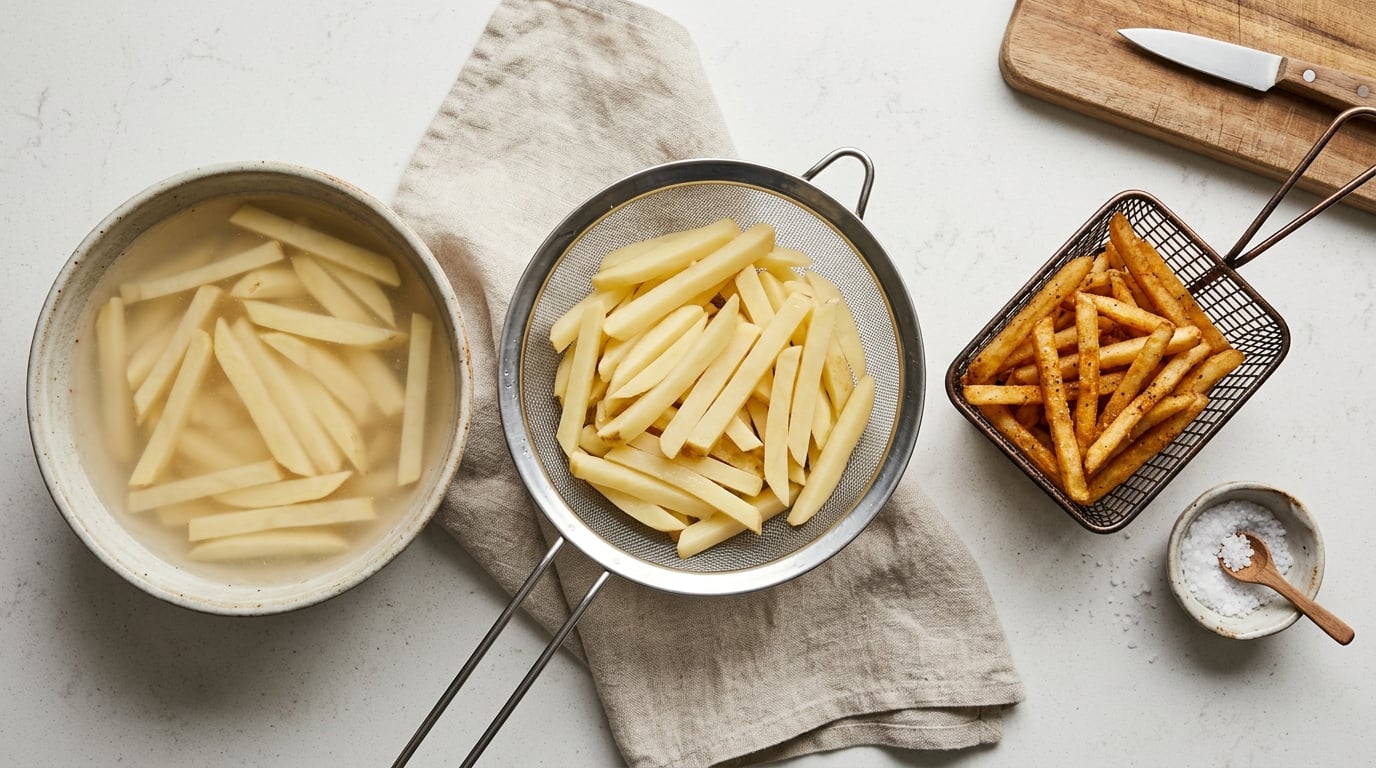
Soaking cut potatoes in cold water before frying fries washes the loose starch off the freshly cut faces, and that starch is the main reason home fries come out limp, greasy, and welded into one clump. Cut a potato and you rupture thousands of tiny cells, exposing starch granules to water. Thirty minutes in that water pulls them off the surface, so the pieces brown faster, drink less oil, and cook more evenly.
It takes almost no effort and it is the single highest-payoff step in the whole process. The catch is that the soak only does half the job. If you drain those potatoes and drop them straight into the oil with the water still clinging to them, you trade one problem for a worse one.
Below is what soaking actually does to a potato, how long to do it, what to do about the water, and the exact method to get crisp fries in a home kitchen.
Table of Contents
- What Does Soaking Potatoes Do Before Frying?
- How Does Starch Affect Crispy French Fries?
- Why Soak Potatoes Before Frying Fries for Better Texture
- How Long Should You Soak Potato Sticks Before Frying?
- Should You Change the Water While Soaking Potatoes?
- How to Soak and Fry Crispy Fries at Home
- Does Soaking Potatoes Make Fries Healthier?
- Common Soaking and Frying Mistakes to Avoid
- Frequently Asked Questions
- What to Do First
What Does Soaking Potatoes Do Before Frying?
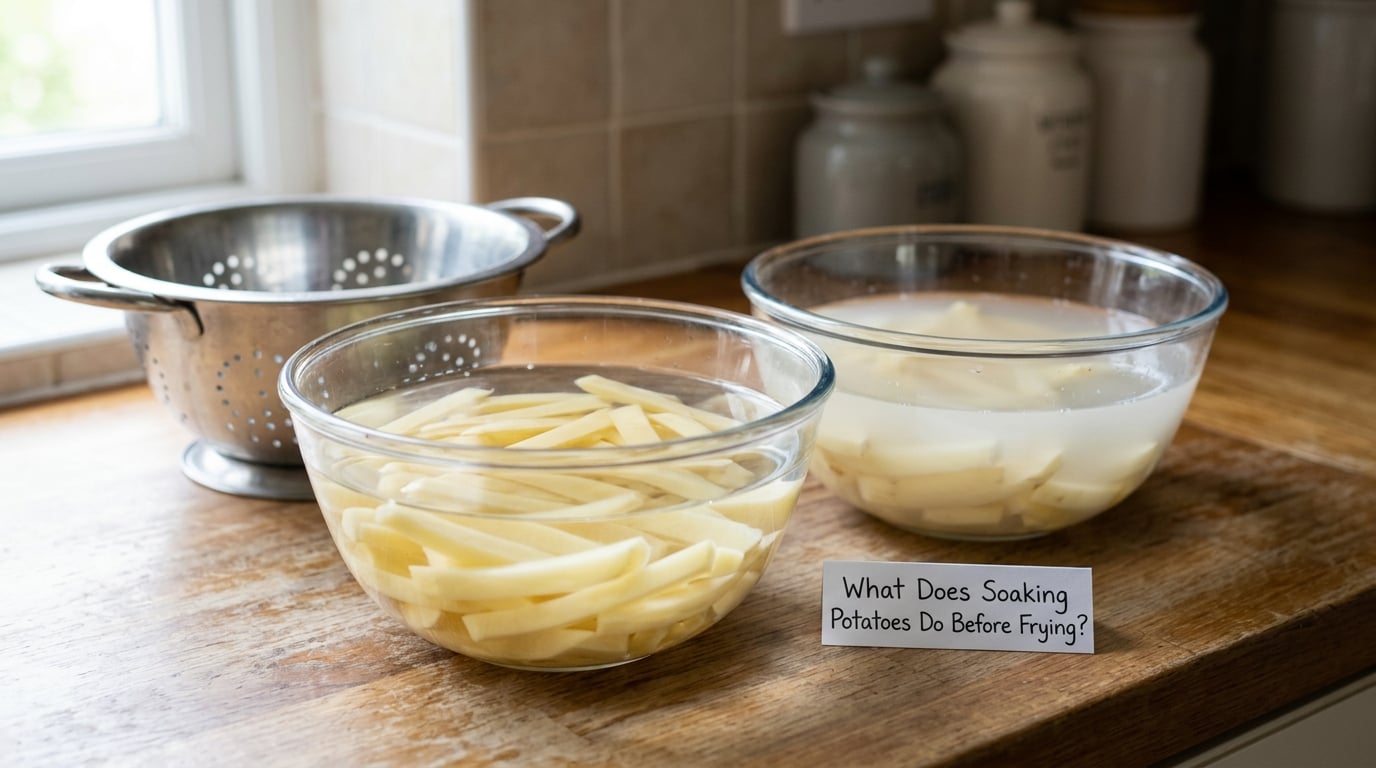
Soaking draws loose surface starch off the cut faces of the potato and carries it into the water. With less free starch on the outside, the pieces brown faster, take on less oil, and stay separate in the fryer instead of fusing into a soft, greasy mass.
Cutting is what makes the step necessary. A whole potato has an intact skin and cell structure, so nothing escapes. Once you slice or chop it, the cut faces expose starch that was never meant to be washed away, and that exposed starch is exactly what ruins crispness.
Rinse the cut pieces under running water first, then soak them in cold water until they are fully submerged. You will see the water turn milky within a few minutes. That cloudiness is starch you have just removed from the surface of your future fries, and it is the clearest sign the soak is working.
Three things happen during the soak, and they matter in different ways:
- Loose surface starch lifts off into the water, so it can no longer form a gummy film when the pieces hit hot oil.
- The pieces stop sticking together. Starch-coated fries clump together in the fryer, and a clump cooks unevenly and steamy.
- The outer layer rehydrates, so the outside and the center finish cooking at closer to the same time rather than the outside overcooking first.
How Does Starch Affect Crispy French Fries?
Potatoes contain two very different kinds of starch, and confusing them is the most common misunderstanding about this step. Only one of them is a problem.
Surface starch is the problem, internal starch is not
When you cut a potato, you rupture cells and free individual starch granules from the ones you do not rupture. That free surface starch is a loose powder sitting on the cut face, and water rinses it away in minutes. It is entirely removable.
Starch locked inside intact cells is a different story. Soaking cannot reach it, and it is not trying to. That internal starch is what swells and gelatinizes during cooking, and it is the reason the inside of a good fry is fluffy and tender rather than gluey. A potato with no internal starch would be a disappointing fry. The claim that soaking removes all the starch from a potato is simply wrong.
What happens in the oil, in three stages
Once the pieces are in hot oil, three processes compete for the same heat, and the order matters.
First, water boils off. That steam is the enemy of crust formation, and it is why any surface moisture on your potatoes produces sputtering and a soft exterior.
Second, starch gelatinizes. Potato starch absorbs water and swells at roughly 140 to 150 F, which is the point where loose surface starch turns into a soft, gluey paste. A film of gelatinized starch on the outside of a fry is soft, it holds moisture in, and it drinks oil. That is the texture people mean when they describe soggy or greasy fries.
Third, the surface dries enough to brown. Above roughly 300 F the dry exterior heats past the point where sugars and amino acids react, producing the color and roasted flavor you want. Free surface starch works against this because it holds water at the surface and blocks that browning. A properly soaked fry develops a thin, rigid, golden shell. An unsoaked fry rarely gets there.
Why Soak Potatoes Before Frying Fries for Better Texture
After soaking, fries brown more evenly and take up noticeably less oil. The crust stays rigid while the inside stays soft, and the pieces cook through without the outside turning leathery before the center is done.
The difference is easy to see side by side, and it is the reason so many recipes repeat the step even when nobody explains it.
| Outcome | Soaked potatoes | Not soaked |
|---|---|---|
| Color | Even golden brown | Patchy, pale, sometimes scorched spots |
| Exterior | Thin, rigid, crisp shell | Soft, limp, slightly rubbery |
| Interior | Fluffy and moist | Waxy, or gummy if the outside was overdone |
| Oil uptake | Noticeably lower | Higher, and the fries taste oily |
| In the fryer | Stays separate | Sticks together in clumps |
| How long it stays crisp | Holds its crunch longer on the plate | Goes soft within minutes |
Do you need to soak potatoes before frying fries every time?
For a deep fry, a proper soak is close to essential. For air fryer, oven, and pan-fried potatoes it still helps, though the margin is smaller, because those methods brown with dry convection or contact rather than by fully surrounding the food in hot oil.
Soaking also matters less for the wrong potato. Waxy varieties such as red potatoes hold their shape and have far less loose surface starch to remove, so the improvement is real but modest. Floury russets release the most starch, which makes them both the best candidate for the soak and the ones that benefit most from it.
One honest caveat: soaking is not a guarantee. If you cut, soak, dry, and deep fry correctly and still get limp fries with an off taste, the likely culprit is old or poorly stored potatoes rather than technique. No step fixes bad produce.
How Long Should You Soak Potato Sticks Before Frying?
Thirty minutes in cold water is the standard that works for almost everyone, and it is the number most professional and home methods settle on. Below that you get partial benefit, and far beyond it you start trading crispness for a waterlogged interior.
| Soak time | What you get | The tradeoff |
|---|---|---|
| 10 minutes | Noticeably cleaner surfaces, less sticking | Only partial starch removal, so results vary by potato |
| 30 minutes | The reliable default, good browning and a crisp shell | None worth worrying about |
| 2 hours | Very clean surfaces, extra even cooking | Mild flavor loss from longer water exposure |
| Overnight | Maximum surface starch removal | Waterlogged, mushy centers and a noticeably flatter taste |
So is longer better? No. Most of the removable starch comes off in the first 20 to 30 minutes, and the returns fade fast after that. Somewhere in the second hour you start pulling flavor out of the potato along with the starch, and overnight soaking is a real technique only in restaurants that fry the same cut every single day.
Use cold or cool water, and keep the potatoes fully submerged. Cold water slows the swelling of the starch granules on the surface, so they stay loose enough to wash away instead of setting into a paste during the soak itself. Warm water works against you twice: it speeds up starch swelling and it softens the surface of the potato before the fry even starts.
Adding ice is closer to folklore than it is to necessity. Cold tap water handles it. If your tap runs warm in summer, add a few ice cubes and let the water sit for five minutes first, since ice-cold water can firm the outsides unevenly.
Should You Change the Water While Soaking Potatoes?
Yes, if the water turns visibly cloudy. Cloudy water means starch has come off the potatoes and is now sitting in the bowl, where it can redeposit onto the cut faces if you leave the pieces sitting in it.
Rinse the pieces under cold running water, dump the cloudy water, cover them with fresh cold water, and push them back under the surface. A second rinse right before you drain is worth doing even if you only soaked for 30 minutes.
There is one more move that costs you nothing and helps more than most people expect: after draining, spread the pieces on a towel or a wire rack rather than piling them in a colander. A single layer lets them release water instead of steaming each other.
How to Soak and Fry Crispy Fries at Home
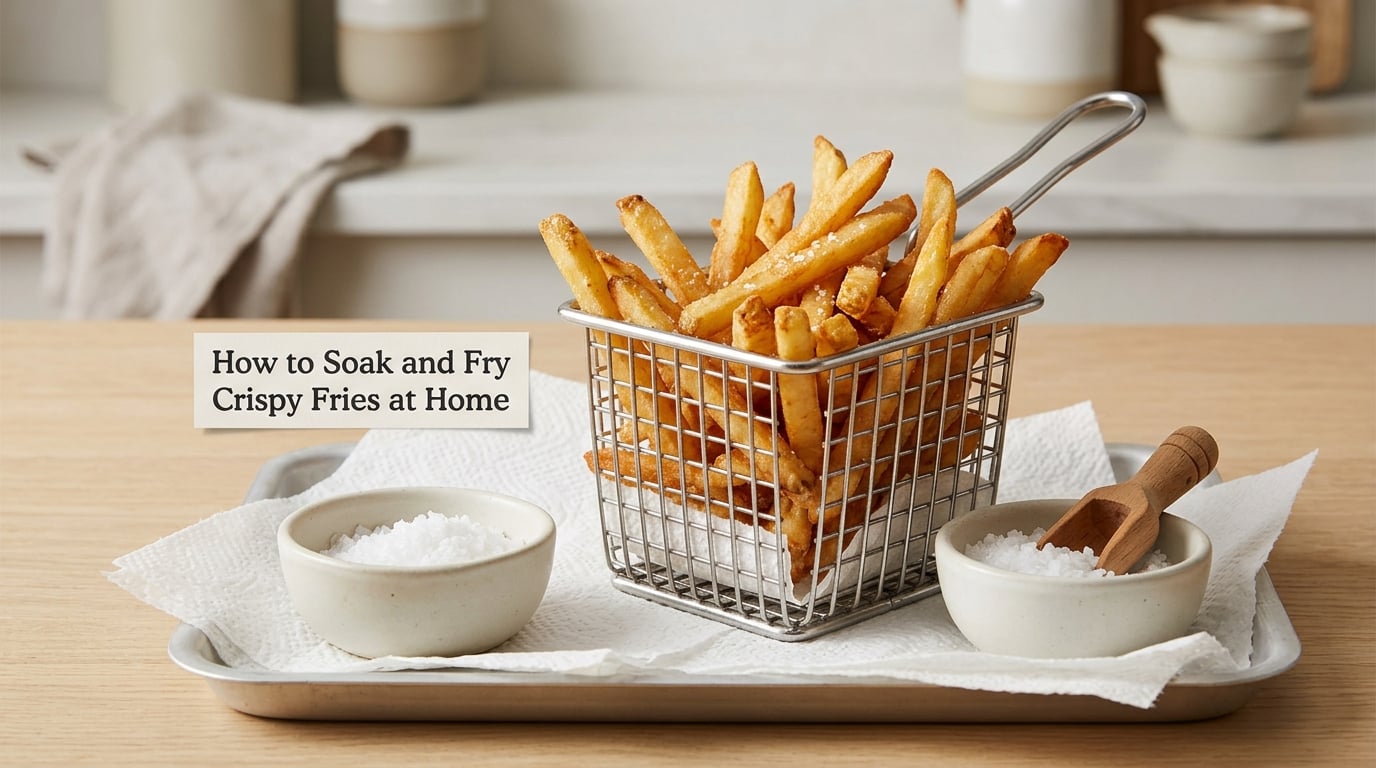
This is the sequence that works, start to finish: a low first fry, a hot second fry, and a hard dry step in between.
- Pick a floury potato. Russets are the classic choice because they release the most surface starch. Yukon Golds are the best compromise, giving good color with a creamier center.
- Cut to a consistent size. A quarter inch is the standard for home fries. Uneven pieces are the reason a batch has both glassy ends and raw middles, and no amount of soaking fixes that.
- Rinse, then soak. Rinse the cut pieces under cold running water until the water runs mostly clear, then submerge them completely in cold water for 30 minutes.
- Refresh the water once. If the water is milky, drain it, rinse the potatoes, and cover them with fresh cold water for the rest of the soak.
- Drain and dry thoroughly. Spread the pieces in a single layer on a towel and let them dry for at least 15 minutes. This step matters as much as the soak itself.
- Heat the oil to 325 F. A thermometer is worth the few dollars here. Too cool and the potatoes soak up oil, too hot and the outsides scorch before the centers cook.
- Fry low and slow, then hot and fast. Cook at 325 F for about 4 minutes to cook the potato through, then raise the oil to 375 F and give them 1 to 2 more minutes to brown and crisp. This is the double fry that gives you a soft center and a hard shell.
- Drain on towels and salt immediately. A towel-lined tray pulls the surface oil off, which is what keeps the crust crisp instead of steamy. Salt while the fries are still wet on the surface.
Salt on the outside, not in the water. Salting the soak water seasons the potato unevenly and does not season the crust, which is the only part that needs it.
The soak is not just a deep-fry technique. Here is how much it helps by method:
| Cooking method | Does the soak help? | What to adjust |
|---|---|---|
| Deep fryer | Biggest effect of any method | Follow the double fry and hold at 325 F then 375 F |
| Shallow fry in a skillet | Strong effect | Fry in a single layer, or the oil temperature drops and the fries soak |
| Pan fried | Moderate effect | Soak 30 minutes, then dry hard before they hit the pan |
| Air fryer | Moderate effect, 20 minutes is usually enough | Do not crowd the basket, or the fries steam instead of browning |
| Oven roasted | Smaller effect | Soak, dry, then rough up the surfaces so oil and heat can reach them |
Does Soaking Potatoes Make Fries Healthier?
Only marginally, and it is not a health technique. Soaking removes a thin layer of surface starch, and that is a very small fraction of the starch in a potato. The bulk of it stays locked inside the cells, which is exactly where you want it to stay.
Because the soak lowers the amount of loose starch on the surface, the fries generally absorb a bit less oil. That is the honest health argument for it, and it is a modest one. It does not meaningfully change the calories in a serving of fried potatoes, and it does not turn a fry into a health food.
If you are genuinely trying to eat more potatoes, boil or roast them. Soaking is worth doing because the fries taste better, and that is a good enough reason on its own.
Common Soaking and Frying Mistakes to Avoid
Frying straight from the water. This is the most common failure and the most damaging. Water on the surface boils inside the oil, the temperature locally collapses, and the fry steams before it fries. Give them 15 minutes in a single layer after draining.
Overcrowding the fryer. Dropping a full basket in makes the oil temperature crater, which is functionally the same as frying at too low a temperature. Batch it.
Frying in oil that is too cool. Below about 300 F, oil soaks into the open, starchy surface instead of the surface sealing. Use a thermometer rather than guessing from a recipe that says medium heat.
Skipping the double fry. One fry at 375 F gives you color fast, but the center is often underdone and the crust is thin. Four minutes at 325 F, then a minute or two at 375 F, is the difference between a crisp fry and a merely browned one.
Salting too early in the process. Salting the soak water or the raw cut potatoes seasons them unevenly and can pull moisture out of the surface, which is the opposite of what you want. Salt after frying.
Leaving cut potatoes in water for hours. The failure mode here is not starch, it is texture. Long immersion pushes water into the potato, and those fries fry into a mushy, flavorless center even though the surface is fine.
Stacking fries on the plate. Steam trapped between layers softens the bottom of the pile. A single layer on a warm plate, or two shallow layers at most, keeps them crisp.
Frequently Asked Questions
How long should I soak potatoes before frying them?
Thirty minutes in cold water is the reliable default for home cooks. It removes most of the loose surface starch without pulling flavor out of the potato. Ten minutes gives you partial benefit and helps with sticking, while two hours is fine occasionally but starts costing you flavor. Overnight soaking is a restaurant technique, not a home one, and the centers come out waterlogged.
Do I need to soak potatoes overnight?
No. Overnight soaking removes a little more starch than 30 minutes, but you are paying for it with a waterlogged, mushy center and a noticeably flatter flavor. Most of the removable surface starch comes off in the first half hour. If you have prepped potatoes that have been sitting in water for hours already, drain and dry them well, and expect a softer result than a 30-minute soak would have given you.
Should the soaking water be cold or warm?
Cold, every time. Cold water slows the swelling of the starch granules on the cut surface, so they stay loose and wash away instead of setting into a paste during the soak. Warm water speeds up that swelling and softens the potato before you fry it. Straight ice water is not necessary and can firm the outsides unevenly. Cold tap water is enough, and if it runs warm, add a few ice cubes and let them sit briefly.
Why do my fries turn soggy even after soaking?
Check the three things a soak cannot fix. First, moisture: if you skipped the drying step, the fries steam instead of frying. Second, oil temperature: below about 300 F, oil soaks into the open surface, and a thermometer matters more than the recipe’s medium-heat instruction. Third, the potato itself, since old or poorly stored potatoes cook up limp no matter what you do to them before they hit the oil.
Do I have to change the soaking water?
Change it if it turns visibly milky, which it usually does within a few minutes. That cloudiness is starch you have already pulled off the potatoes, and sitting in it gives the starch a chance to redeposit on the cut faces. Drain, rinse the pieces under cold running water, and cover them with fresh cold water. A final rinse right before you drain is worth doing even for a 30-minute soak.
Can I fry potatoes straight from the refrigerator after soaking?
You can, but skip the fridge for best results. Chilled potatoes are firmer and take slightly longer to cook, so give them a minute or two more in the oil. The bigger issue is surface moisture: cold condensation on the potatoes is water on the surface, which is the one thing that reliably stops a crust forming. If they have been sitting in the fridge, dry them again before they go in.
What to Do First
If you only change one thing in how you soak potatoes before frying fries, change the drying. Most people soak properly and then rush the pieces into the oil still wet, and surface water stops a crust from forming no matter how much starch you removed.
Cut your potatoes evenly, rinse them, soak them in cold water for 30 minutes, refresh the water if it goes cloudy, then spread them in a single layer and let them dry for 15 minutes. Fry low at 325 F, finish hot at 375 F, drain on towels, and salt right away. That sequence takes about an hour and it is the whole trick.