
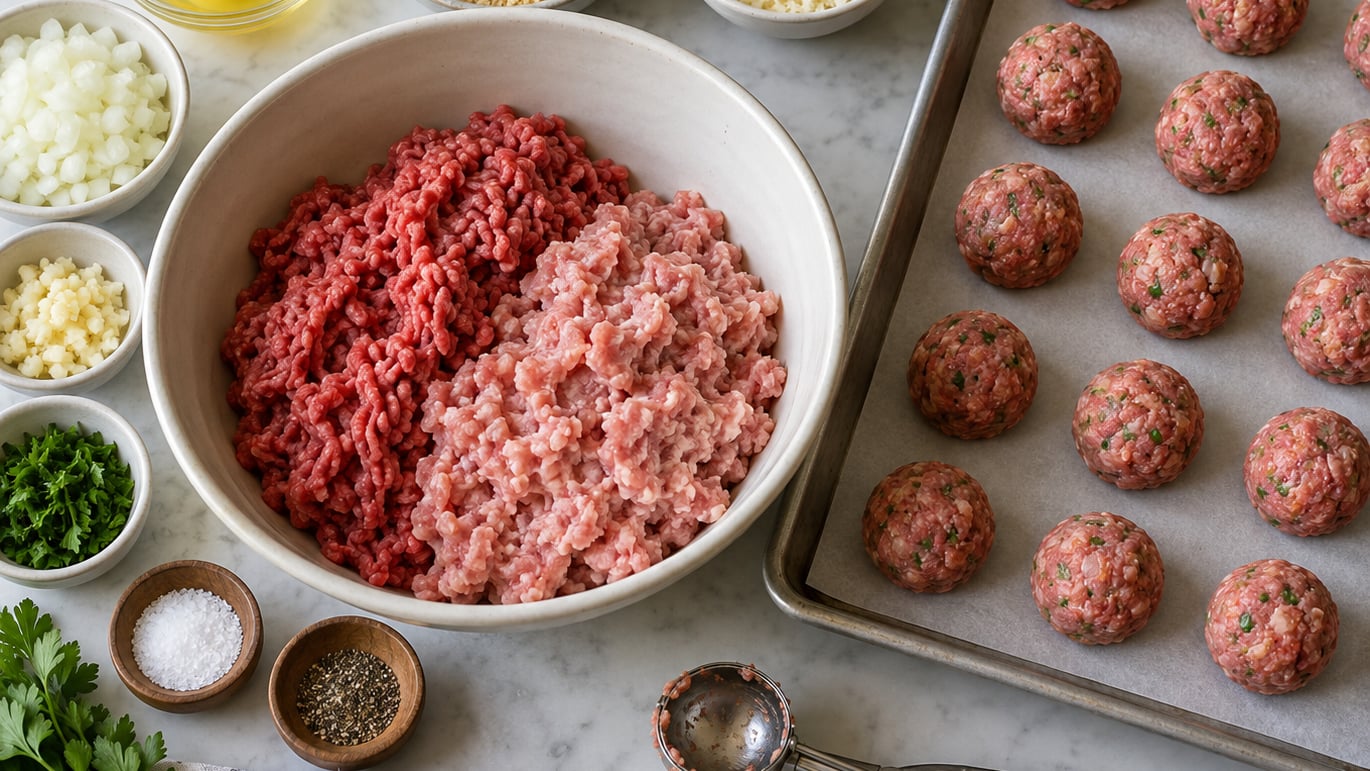
How to make meatballs from scratch is mostly about restraint: combine ground meat with a binder, a little moisture and seasoning, mix it as gently as you can, then bake at 400F until the centers hit 160F. The whole job takes about 40 minutes and makes roughly 24 tender meatballs from two pounds of meat.
Most meatballs go wrong for one of four reasons, and none of them are complicated. Too lean a meat, too much mixing, the wrong amount of binder, or balls of wildly different sizes all lead to the same sad result: dry, rubbery, or crumbly.
Once you know which lever to pull, you can swap the meat, change the cooking method, or feed a crowd without rethinking the recipe. I keep coming back to a baked method because it needs no frying, no standing at the stove, and no batches.
What You Need to Make Meatballs From Scratch
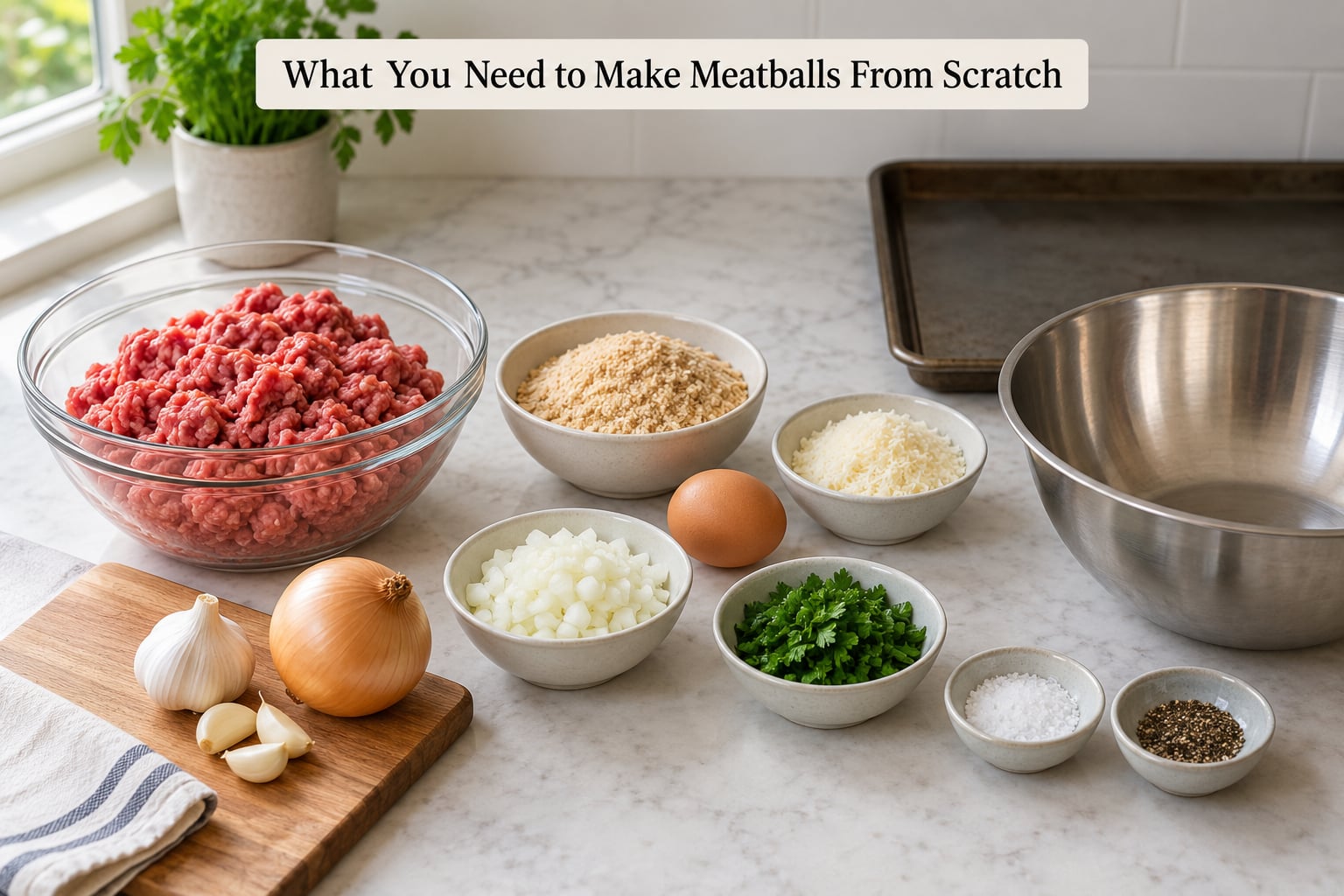
For a two-pound batch, you need 1 pound ground beef (ideally 80/20), 1 pound ground pork, half a cup of breadcrumbs, a quarter cup of whole milk, one egg, half a cup of grated Parmesan, two garlic cloves, half a yellow onion, a quarter cup of chopped fresh parsley, one teaspoon salt, and black pepper.
Every item there is doing a job. The milk and breadcrumbs form a panade, a moist paste that sits between the meat particles and keeps them from squeezing tight. The egg sets as it cooks and acts as the binder. Parmesan adds salt, fat, and a salty depth that reads as umami. The onion and garlic are aromatics, and grating the onion rather than chopping it keeps the ball from cracking later.
The Egg and Breadcrumb Ratio Per Pound of Meat
This is the question that comes up most often, so here it is plainly: one egg and half a cup of breadcrumbs per pound of meat. A quarter cup of milk per pound is the companion number.
| Binder per pound of meat | Result |
|---|---|
| 1 egg + 1/2 cup breadcrumbs + 1/4 cup milk | Standard, holds shape in oven and in sauce |
| 2 eggs + 3/4 cup breadcrumbs | Soft, spongy, sometimes rubbery; mixes better but eats heavy |
| No egg, 1/2 cup breadcrumbs | Fine for beef and pork; lean meats need more binder |
| 1/4 cup breadcrumbs, no liquid | Crumbly, falls apart when you move it |
Double the recipe if you like, but scale the salt with care. Home cooks doubling a batch usually end up with something that tastes like a brine, and the usual suspect is the teaspoon of salt quietly becoming three.
Choosing Your Meat
Beef and pork together is the juiciest, most forgiving option and my default. Pork carries more fat than beef, which is exactly what you want in a meatball. If you use beef alone, stay at 80/20 rather than 90/10; extra lean beef is the number one reason homemade meatballs come out dry.
For poultry, ground chicken and ground turkey both work, but they need roughly 25 percent more binder and an extra splash of milk because they carry so little fat. If you are after something similar with more character, how to make beer brats covers the same idea in sausage form.
A meatball without any meat is easy too. Grated zucchini or cauliflower squeezed dry, plus an egg, breadcrumbs, and a lot of Parmesan, gives you a vegetable meatball that holds together well. Squeeze the moisture out or you will be shaping soup.
Equipment
You need a rimmed baking sheet (the rim stops drippings from scorching), parchment paper or a light coat of cooking spray, a large bowl, and an instant-read thermometer. A cookie scoop sized to one and a half inches is the single best tool for uniform meatballs, and it costs almost nothing.
Step-by-Step
How to Mix the Meatball Mixture
Soak the breadcrumbs in the milk first and let them sit for five minutes. Stir in the egg, Parmesan, onion, garlic, parsley, salt, and pepper, then add the meat on top.
Mix with a fork or your fingertips, just until the meat is coated and the mixture looks loosely combined. Stop while it still looks a little streaky. Overworking ground meat develops the proteins, which squeeze out moisture under heat and turn your meatballs into bouncy rubber balls. That single habit separates tender meatballs from bad ones.
If you have a minute, chill the mixed bowl in the fridge before shaping. Cold meat firms up and rolls cleanly, which is also why chilling helps with lean poultry.
How to Shape Meatballs Without Breaking Apart
Wet your hands, then scoop about one and a half tablespoons of mixture per ball. Roll gently between your palms, loose and quick, without squeezing. Packing the meat tight is another way to make it tough.
Lightly grease the sheet or line it with parchment and space the balls about an inch apart so air can move between them. Crowding steams the bottoms instead of browning them, and it pushes the cooking time out. Do not flip them; they should release on their own when the crust has set.
If the mix sticks to your hands it is too wet, so dust a little more breadcrumb over it. If it crumbles in your palm it needs more binder: a beaten egg or a spoon of milk brings it back together.
For a party, shape the balls hours ahead and refrigerate them on a tray. Fifteen to twenty minutes in the freezer firms poultry and venison meatballs up nicely before they hit the oven.
How to Cook Meatballs So They Stay Juicy
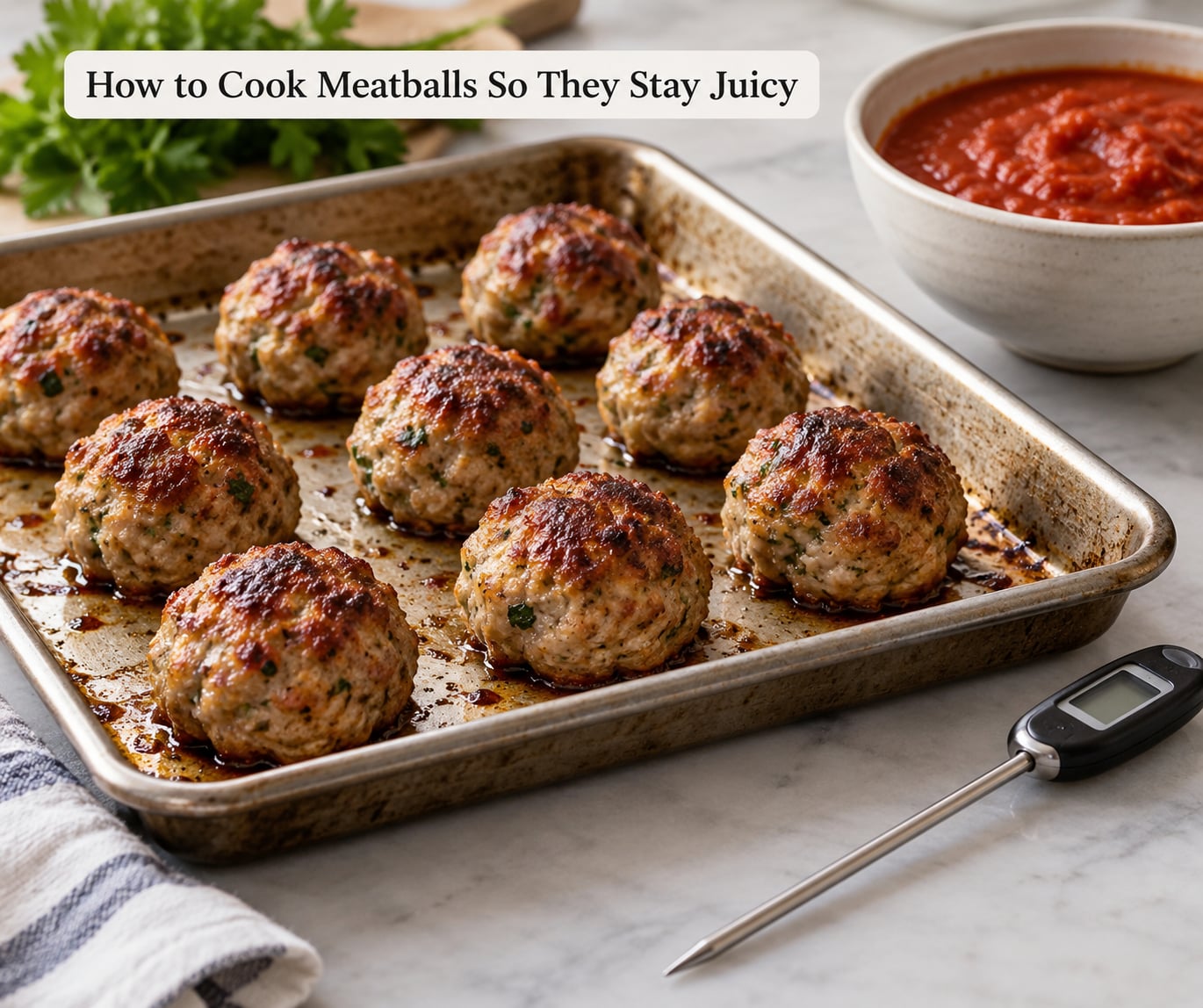
Heat the oven to 400F. Arrange the shaped meatballs on the sheet and bake 18 to 22 minutes, until the outside is browned and an instant-read thermometer reads 160F in the center. That is the safe minimum internal temperature for ground meat, and it is the only doneness test worth trusting. Poultry meatballs need 165F. Pull them the moment they hit the number, because they keep cooking off the heat.
Which Cooking Method Should You Use
| Method | Time and temperature | Result |
|---|---|---|
| Bake | 18-22 min at 400F | Even browning, no batches, easiest cleanup |
| Skillet | 6-8 min over medium-high, turning once | Best crust, but you need two batches for 24 |
| Simmer in sauce | 25-30 min at a bare simmer | Absorbs flavor, never boil or the balls break up |
| Air fryer | 8-10 min at 350F | Fast and crisp, works in small batches |
| Slow cooker | 3-4 hours on low | Easiest hands-off route, loosest texture |
For the simmer method, brown the raw meatballs first if you want the classic restaurant texture, then add them to marinara and barely simmer. A rolling boil is what shreds them.
To serve, put them over spaghetti, tuck them into a sub roll, or float them in soup. If you want a quick dinner that uses the same ground-meat skills, how to make sloppy joes from scratch is a solid next stop. Cocktail meatballs on a platter with a glaze also work, and how to make buffalo wing sauce from scratch gives you the heat to pour over them.
Common Mistakes
Dry meatballs come from lean meat or overmixing. Fix both: use 80/20 and stop mixing early. Rubbery meatballs are almost always the same overmixing problem, sometimes compounded by baking them too long.
Meatballs that fall apart had too few binders, too little liquid, or craggy chopped onion. Grate the onion, add a beaten egg, and let the breadcrumbs sit in the milk so they actually absorb it.
Uneven sizes mean some balls overcook while others stay raw. A cookie scoop fixes this in ten seconds and it is the tool I reach for first.
Soggy texture is crowding. If the meatballs touch, they steam instead of brown. Pull the sheet spacing to a full inch.
Browning too fast means your oven is hot or the pan is close to the element. Move the rack to the center and, if you must, tent with foil for the last five minutes.
Sauce that separates or gets greasy usually means you boiled the sauce hard with the meatballs in it. Lower the heat until the sauce moves once in the pot, no more.
Raw centers happen when the balls are larger than one and a half inches or the pan is packed. Uniform size plus spacing fixes it, and the thermometer confirms it.
Sticking to the sheet is a parchment or cooking spray problem. Grease the pan even if you think the nonstick is fine.
Frequently Asked Questions
How many eggs do I need per pound of meat for meatballs?
Use one egg per pound of ground meat. That is the number that holds a standard batch together without making it spongy. Two eggs per pound also works, but the meatballs come out softer and heavier, and they need more breadcrumbs to match. For beef and pork, one egg and half a cup of breadcrumbs per pound is the ratio most home cooks land on. Lean poultry needs closer to one and a half eggs so the balls hold their shape.
What is the secret ingredient in Italian meatballs?
Milk-soaked breadcrumbs, not the meat itself. Letting breadcrumbs sit in milk or broth creates a paste called a panade, which forms a cushion between the meat particles so they never squeeze tight and dry out. Combined with egg, which sets during cooking, that panade is what holds a meatball together and keeps the inside tender. Grate the onion finely too, since big onion pieces are a common reason meatballs crack.
How do I know when my meatballs are done?
Use an instant-read thermometer and stop at 160F in the center, which is the safe minimum for ground meat. Poultry meatballs need 165F. Time is a poor substitute: 18 to 22 minutes at 400F is a good range for one-and-a-half-inch balls, but oven temperature and size will shift that. Color is not reliable either, because a deeply browned exterior can easily sit on a raw middle.
Why do my meatballs fall apart?
Three causes account for almost every broken meatball. Too few binders, meaning not enough egg and breadcrumbs. Too little liquid, meaning the breadcrumbs never hydrated. And craggy onion pieces that split the ball as it cooks. Fix it by soaking half a cup of breadcrumbs in a quarter cup of milk for five minutes, adding one egg per pound of meat, and grating the onion instead of chopping it. Chill the shaped balls briefly and handle them with wet hands.
Can you make meatballs without breadcrumbs?
Yes, though you trade texture for structure. Skip the breadcrumbs and lean on egg plus a little extra milk, and keep the meat fattier so the ball has its own moisture. For a gluten-free version, use panko, finely ground oats, crushed rice cereal, or crushed pork rinds in place of the breadcrumbs. Breadcrumbs make meatballs softer and more tender, so leaving them out gives you a firmer, more compact ball that holds its shape better in soup.
How do you freeze and reheat meatballs without drying them out?
Freeze cooked meatballs laid on a tray until solid, then move them to a bag or container and keep them for up to three months. You can also freeze them raw, spaced apart on a lined tray, then bag them once firm. Reheat from frozen in a covered pan with a splash of sauce for 15 minutes, or place them in the oven at 350F for 20 minutes. Reheating them in sauce is the better option because it keeps the moisture in.
Conclusion
Learning how to make meatballs from scratch comes down to three habits. Mix the meat gently, so it stays tender. Chill the shaped balls briefly if the mix is sticky or the meat is lean. And cook them only until the centers reach the safe internal temperature, 160F for beef and pork, 165F for poultry.
Everything else, the binder ratio, the panade, the spacing on the sheet, is adjustment. Get those three right and the rest is easy to fix.